Why Did Angola Buy Corvettes from the UAE?



Angola bought three BR71 Mk II corvettes because its navy had nothing larger than a 62 m patrol vessel to guard a 1,600 km coastline, the offshore oil fields that supply about 90 per cent of its exports and a fishing zone under pressure from foreign trawlers. The €1 billion contract with Abu Dhabi Ship Building (ADSB), the naval yard of the UAE’s EDGE Group, was announced at IDEX on 20 February 2023 and also covers inshore craft, six HT-100 shipborne drones and five years of support. The first ship, NRA Ekuikui II, was launched at CMN in Cherbourg on 4 March 2026 and began sea trials on 29 September; EDGE scheduled delivery for October 2026, while Mer et Marine reported on 1 October that handover is now expected in 2027.
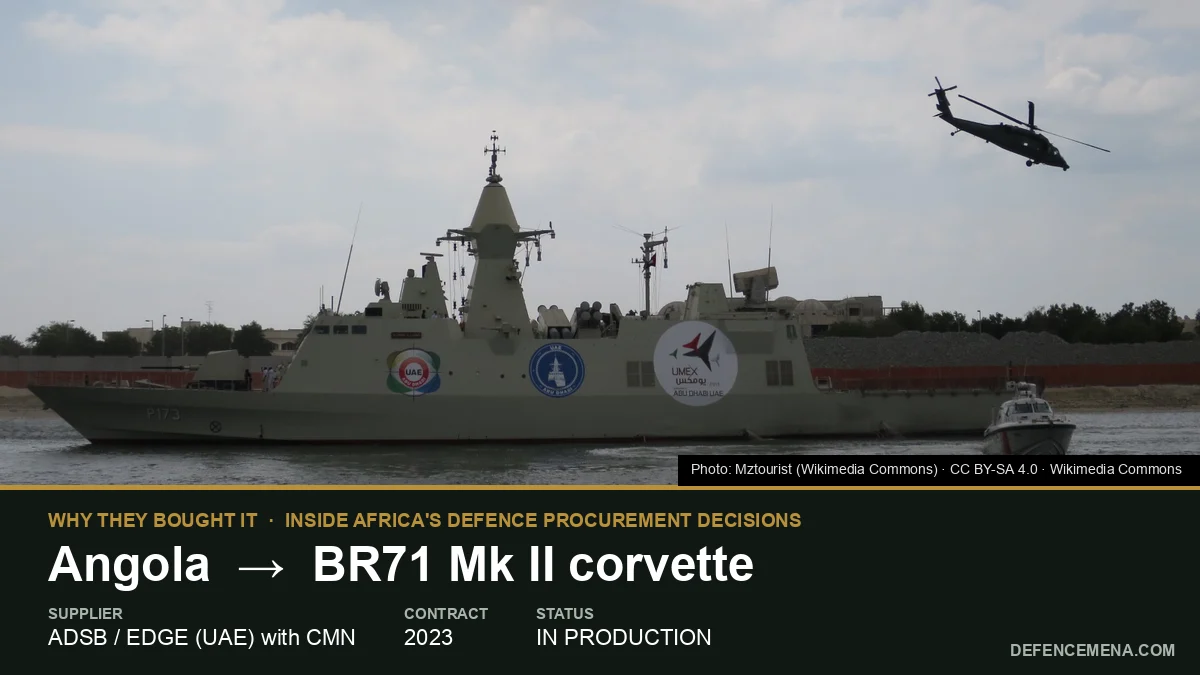
Photo: The UAE Navy's Baynunah-class corvette Al Dhafra (P 173) at NAVDEX, Abu Dhabi, in February 2015. The CMN-designed, ADSB-built Baynunah class is the parent design of the BR71 Mk II corvettes ordered by Angola; no free-licence photo of NRA Ekuikui II is available on Wikimedia Commons. Photo: Mztourist, Wikimedia Commons (CC BY-SA 4.0). Credit: Mztourist (Wikimedia Commons), CC BY-SA 4.0, via Wikimedia Commons.
- Country
- Angola (Marinha de Guerra Angolana)
- System
- BR71 Mk II corvette, 71 m, Exocet and VL MICA armed, with two HT-100 NAVAL drones each
- Supplier
- Abu Dhabi Ship Building / EDGE Group (UAE); two hulls built by CMN Naval, Cherbourg (France)
- Quantity
- 3 corvettes + 6 HT-100 drones + 6 twelve-metre and 5 sixteen-metre craft
- Contract year
- 2023 (announced 20 Feb 2023 at IDEX; some outlets date the wider naval contract to 2021)
- Status
- IN PRODUCTION first ship on sea trials since 29 Sep 2026
- Main requirement
- Multi-mission protection of a 1,600 km coastline, offshore oil infrastructure and fisheries; replacement of a fleet with no major surface combatant
- Training
- HT-100: operator training and integrated logistics support by ANAVIA; corvette crew training not publicly detailed
- Localisation
- None for the corvettes; the ADSB-built hull transfers CMN know-how to the UAE yard, not to Angola; separate CMN–Lobinave interceptor line at Lobito since Jan 2026
- Known alternatives
- No competition documented; the 2016 Privinvest package had foreseen CMN Vigilante-class OPVs instead
What capability did Angola need?
Angola’s maritime problem is one of scale. The coast runs 1,600 km (Angolan officials usually say 1,650 km) from Cabinda to the Cunene river, and most of the national income floats off it. Al Jazeera, reporting Angola’s exit from OPEC in December 2023, noted that oil and gas make up roughly 90 per cent of exports and that output had fallen to about 1.1 million barrels a day from a 2008 peak of two million. Almost all of it comes from offshore blocks served by floating production units and a constant traffic of supply vessels.
The second pressure is fisheries. Africa Defense Forum reported in May 2024 that Angola had only 15 patrol boats for its coastline and quoted fishermen near Benguela on foreign trawlers working close inshore. Navy commander Admiral Valentim António announced in May 2025 that new measures against illegal fishing in oil exploration areas would take effect on 1 June, according to a report carried by Africa Press.
The third is the Gulf of Guinea, whose piracy record has shaped naval buying from Senegal to Nigeria. When President João Lourenço addressed the navy’s 47th anniversary parade at Soyo on 10 July 2023, the presidency framed the fleet’s task around protecting the coast and the Gulf of Guinea sea route, and he said Angola “should invest in the construction of naval shipyards for fleet maintenance and initiate the construction of warships”. The same speech referred to the three corvettes already ordered and to two Airbus C295 maritime patrol aircraft. That is the closest thing to an official Angolan statement of requirement on the record; the ministry of defence has not published a procurement rationale.
What Angola did not have in 2023 was a single ship able to carry a helicopter, fire a missile or stay at sea for weeks. European Security & Defence noted at the time that the navy’s largest units were two 62 m Damen 6210 fisheries-protection vessels delivered in 2012.
What did it already operate?
The Angolan Navy of the early 2020s was a coastal force built in small batches from many suppliers. The Soviet-era OSA-II missile boats and Shershen torpedo craft had been out of service for more than two decades, according to H I Sutton’s 2021 fleet guide, which listed four refurbished Spanish-built Mandume-class (Cormoran type) patrol boats, seven Brazilian-built Macaé-type boats, four Israeli Super Dvora Mk IIIs delivered in 2016, three Dutch-built Damen fisheries vessels and a cluster of French interceptors.
The French element is the key to this story. In September 2016 Angola signed a €495 million contract with Privinvest, the Lebanese-Emirati group that owns the CMN yard in Cherbourg, for three HSI 32 interceptors, a long-range and a short-range Vigilante-type patrol vessel and a shipyard in Angola, as Military Africa and defenceWeb documented in March 2021. The three HSI 32s arrived in 2019. The patrol vessels never did: defenceWeb reported in February 2023 that the programme had been “scaled back under IMF pressure”. What CMN did go on to deliver were three 43 m Ocean Eagle 43 trimarans (the first handed over at Toulon on 19 November 2022) and two 70 m LCT 200-70 landing craft, the first of which, RA 4 de Abril, reached Luanda on 19 July 2023.
Shore infrastructure was rebuilt in parallel. The Soyo naval base, refurbished by Portugal’s Mota-Engil for $297.1 million under a Portuguese government guarantee, was inaugurated on 10 July 2023 with a 330 m quay, defenceWeb reported, and Admiral António said then that larger vessels were coming. Two C295 maritime patrol aircraft arrived in October 2025 and three coastal surveillance centres were built or nearing completion by January 2026. The corvettes are the offshore layer this system lacked.
What system was selected?
The BR71 Mk II, marketed by CMN as the Combattante BR71 Mk II, is a development of the six Baynunah-class corvettes that CMN designed for the UAE Navy and ADSB built in Abu Dhabi up to 2012. Jane’s called the Angolan ship “an updated version of the Baynunah-class corvettes in service with the UAE Navy”. It is the design’s first export.
The specifications given by EDGE, CMN and the trade press are consistent: about 70–71 m long, 11 m beam, roughly 900 tonnes, four MTU diesels driving four waterjets, 30 knots, 2,500 nautical miles at 12 knots, a crew of 50, a flight deck for a 5-tonne-class helicopter and two 6 m RHIBs. The weapons fit reported by Military Africa, defenceWeb and Mer et Marine is a Leonardo 76/62 Super Rapid gun, two Leonardo Lionfish 20 mm remote stations, eight MBDA Exocet MM40 Block 3C anti-ship missiles, an eight-cell VL MICA launcher and two Simbad-RC launchers for Mistral 3, with Lacroix decoys. Italy’s Elettronica signed at IDEX 2023 to supply the electronic-warfare suite, according to Jane’s. The combat management system supplier has not been named in the sources fetched.
Each corvette embarks two ANAVIA HT-100 NAVAL unmanned helicopters: a Swiss-built synchropter with intermeshing rotors, a 15 kW turbine, 120 kg maximum take-off weight, 60 kg of payload and fuel, up to six hours’ endurance with a light sensor and a 200 km data link. EDGE took a 52 per cent stake in ANAVIA in late 2023. The drones feed electro-optical/infrared imagery into the ship’s combat system, which is what lets a 71 m hull see beyond its own radar horizon.
Ekuikui II, pennant F 300, is named after the Bailundo sovereign who reigned from 1876 to 1890, Mer et Marine notes. Names for the other two ships have not been announced.
Which alternatives were considered?
No competition is documented. ADSB “signed” with Angola, represented at IDEX by defence minister João Ernesto dos Santos, and no tender, request for proposals or evaluation of rival designs has been published. The only documented alternative is historical: the 2016 Privinvest package had foreseen CMN Vigilante-type patrol vessels for the same offshore role, and these were dropped. The table lists it alongside same-class designs on the African market, none of which is known to have been offered to Angola.
| Alternative | Class | Status of consideration | Source |
|---|---|---|---|
| CMN Vigilante 400 / 1400 OPVs | Offshore patrol vessel | REPORTED ALTERNATIVE (part of the 2016 Privinvest package, not delivered) | Military Africa, defenceWeb (Mar 2021) |
| Damen Sigma 7513 / OPV 1800 family | Light corvette / OPV | SAME-CLASS MARKET ALTERNATIVE (no offer to Angola documented) | Editorial comparison |
| Naval Group Gowind 1000 corvette | Light corvette | SAME-CLASS MARKET ALTERNATIVE (no offer to Angola documented) | Editorial comparison |
| Fincantieri FCX 20 / Abu Dhabi-class | Light corvette | SAME-CLASS MARKET ALTERNATIVE (no offer to Angola documented) | Editorial comparison |
Why was the BR71 Mk II selected?
Multi-mission coastline protection (officially stated, supplier side). The only on-the-record rationale at signature came from ADSB chief executive David Massey: the BR71 Mk II “is a highly advanced vessel capable of performing multiple missions to secure Angola’s 1600 km coastline”. Lusa, in Observador on 21 February 2023, placed the deal in the context of Angolan statements on piracy and illegal fishing, citing secretary of state Esmeralda Mendonça’s March 2022 remarks. That is thin, but consistent with the presidency’s July 2023 framing.
Continuity with an existing CMN relationship (documented in procurement material). Angola was already a CMN customer, with HSI 32s, Ocean Eagles and landing craft in service or on order when the corvette deal was signed. ADSB subcontracted the design and two of the three hulls to CMN, whose chief executive Serge Quaranta confirmed the delivery schedule at the launch. For the Angolan Navy, the BR71 Mk II meant the same design house, the same French equipment ecosystem (MBDA, MTU, Leonardo, Lacroix) and the same support network it was already learning, now at corvette scale.
A proven parent design (documented). The UAE Navy’s six Baynunah-class corvettes have served since 2012, so Angola bought a decade of operating history rather than a paper design. Jane’s and European Security & Defence both presented the BR71 Mk II as an improved Baynunah.
Emirati capital and the wider UAE–Angola partnership (reported by ISPI; analysts assess). Eleonora Ardemagni of ISPI wrote in October 2025 that Angola turned to the UAE primarily for diversification and infrastructure capital: DP World took over Luanda terminals in 2021, Abu Dhabi Ports followed in 2024, and the two presidents exchanged a Comprehensive Economic Partnership Agreement during Sheikh Mohamed bin Zayed’s state visit in August 2025. Lusa noted that the Abu Dhabi Exports Office signed $122.6 million of financing with Angola in January 2023, a month before the corvette deal. Whether the corvettes are financed by an Emirati credit line has not been disclosed; the link is an inference, not a documented fact.
The price of the earlier failure (analysts assess). The 2016 Privinvest programme promised offshore patrol vessels and a shipyard and delivered interceptors. The 2023 contract reads like a second attempt at the same requirement with a bigger ship, a state-owned Emirati prime and a wider logistics package. That reading is defenceWeb’s and this publication’s; no Angolan official has said it.
Export incentive on the UAE side (officially stated). EDGE president Khalid Al Breiki called the contract “a momentous achievement for EDGE as well as ADSB” and tied it to increasing national exports. ADSB’s Massey told Breaking Defense in 2026 that more than half the yard’s order book would be export work. Angola was the launch customer that made the BR71 Mk II an export product.
Unmanned surveillance (possible but unconfirmed as a decision factor). The HT-100s were in the package from 2023, but the sources do not say whether Angola asked for them or EDGE proposed them. EDGE’s Khaled Al Zaabi described the result in September 2026 as “an integrated solution aligned with Angola’s operational requirements”.
What was included in the contract?
The €1 billion figure covers a package, not three ships. defenceWeb’s October 2024 progress report and later EDGE statements list three BR71 Mk II corvettes; five 16 m “160 Sea Keeper” cargo and transport craft; six 12 m “120 Fast In-shore Platform” interceptors; six HT-100 unmanned systems; and five years of integrated logistics support. The six 12 m craft and the first 16 m craft were delivered on 10 March 2026. The HT-100 package includes a control station on each ship, combat-system integration, logistics support and operator training, according to ANAVIA founder Ishan Sahgal.
Munitions are not itemised in any public source, so it is not known whether the €1 billion includes Exocet and MICA rounds. Mer et Marine, defenceWeb’s launch report and Brazil’s Poder Naval date the overarching Angola–EDGE naval contract to 2021 and treat the Ocean Eagles and landing craft as part of it; EDGE itself announced the corvette contract on 20 February 2023. Both datings are reported here; the framework’s signature date has not been published.
How much did it cost?
The contract value is €1 billion, as announced by EDGE and reported by defenceWeb, Jane’s (which converted it to $1.05 billion), Lusa and Forbes África Lusófona ($1.06 billion). This is a package value covering the corvettes, the smaller craft, the drones and five years of support. No unit price has been published, and the value should not be divided by three. Financing terms, including whether an Emirati export-credit facility is involved, have not been disclosed.
How many were ordered?
Three corvettes. EDGE’s February 2023 statement spoke of “a fleet” without a number; Jane’s confirmed three within days and every later EDGE release repeats it. Two hulls are built by CMN Naval in Cherbourg and one by ADSB in Abu Dhabi. EDGE, Jane’s and Military Africa call the Abu Dhabi hull the second ship; defenceWeb’s launch report and Poder Naval call it the third. Six HT-100 drones were ordered, two per ship.
Training, maintenance and support
Five years of integrated logistics support are written into the package, according to defenceWeb. For the drones, ANAVIA provides the control stations, “integrated logistics support and training”; an Angolan Navy delegation and Simportex, the state defence-import company, attended the factory acceptance trials at Bilten, Switzerland, on 24–28 August 2026. Where corvette crews are trained, how many Angolan sailors are in Cherbourg and whether CMN or ADSB will station support teams in Angola has not been published. Soyo, with its new 330 m quay, is the obvious home port, but no basing decision has been announced.
Local production or technology transfer
None for the corvettes themselves. The decision to build one hull at ADSB was described by Military Africa as a way “to facilitate technology transfer to the UAE shipyard”, which is a transfer from France to Abu Dhabi, not to Angola.
The Angolan industrial strand runs in parallel. On 12 January 2026 General Francisco Furtado, minister of state and head of the president’s military household, inaugurated a naval assembly and maintenance line at the Lobinave yard in Lobito, with CMN responsible for assembling equipment. Jane’s and defenceWeb reported that the line starts with DV15 interceptors and that the yard is rehabilitating its pier and installing a floating dock, with the stated ambition of handling WP18 interceptors, special-forces craft and eventually corvette and frigate maintenance. Furtado said the geopolitical climate “requires each country to create the capacity to defend itself”. This is the shipyard the 2016 contract had promised, arriving a decade late; for the corvettes it matters as a future maintenance base.
Delivery and operational status
Steel for the first ship was cut in December 2023 and the hull laid in March 2024; fitting out had begun by October 2024, defenceWeb reported. Ekuikui II was christened and launched at Cherbourg on 4 March 2026 (EDGE’s press release followed on 10 March, and some outlets carry that date). EDGE restated the plan: first ship October 2026, second April 2027, third October 2027. The corvette began sea trials on 29 September 2026, and in its 1 October report Mer et Marine put delivery in 2027. As of 5 October 2026 no handover has been announced; if the October date holds, this article will be updated. Procurement status is IN PRODUCTION.
- Sep 2016Angola signs a €495 million Privinvest/CMN package including HSI 32 interceptors, Vigilante-type OPVs and a shipyard; the OPVs are later dropped.
- 2019Three CMN HSI 32 interceptors delivered.
- 20 Feb 2023EDGE announces at IDEX a €1 billion ADSB contract for a fleet of BR71 Mk II corvettes; Jane’s and Naval News confirm three ships plus smaller craft.
- 10 Jul 2023President Lourenço refers to the three corvettes at the navy’s 47th anniversary in Soyo; refurbished Soyo base inaugurated.
- Dec 2023 – Mar 2024Steel cut and hull laid for the first corvette at CMN, Cherbourg.
- Oct 2024First hull complete; fitting out begins.
- 22 Oct 2025EDGE signs a letter of intent for an Angolan border-security programme, widening the partnership beyond the navy.
- 12 Jan 2026CMN–Lobinave naval assembly line inaugurated at Lobito.
- 4 Mar 2026NRA Ekuikui II (F 300) launched at Cherbourg; six 12 m and one 16 m interceptors delivered on 10 March.
- 24–28 Aug 2026Factory acceptance of six HT-100 NAVAL drones in Switzerland; delivery announced 10 September.
- 29 Sep 2026Ekuikui II begins sea trials; delivery scheduled for October 2026 by EDGE, reported as 2027 by Mer et Marine.
Has it been used operationally?
No. The first corvette has not been delivered and the class has no operational history. The parent Baynunah class has served with the UAE Navy since 2012, but no public source links that service to Angola’s choice beyond the point that the design was proven. The interceptors and HT-100s delivered in 2026 have no reported operations either.
Did Angola order more?
Not for the corvettes. The EDGE relationship has grown in other directions: on 22 October 2025 EDGE Commercial president Omar Al Zaabi signed a letter of intent with Angola’s Ministry of the Interior for a border-security programme to be delivered by Beacon Red, covering command-and-control systems, surveillance drones and training at land and maritime frontier points. It is a letter of intent, not a contract, and no value has been given. President Lourenço’s 2023 reference to negotiations for additional naval assets has not produced a published order.
What does this tell us about African procurement?
The first lesson is that the Gulf has arrived as a naval supplier to Africa by buying European design houses rather than competing with them. ADSB’s corvette is a French design, built in a French yard for two of three hulls, armed with French missiles and an Italian gun, and sold under an Emirati flag with Emirati state backing. For Luanda the result is a single prime that can bundle ships, drones, interceptors and support, inside a wider relationship covering ports, energy and credit. That bundling appeals to a buyer whose last attempt at the same requirement fell apart when financing tightened. The industrial background is in our analysis of the UAE defence industry’s push for independence.
The second lesson is the gap between what African navies announce and what they can afford to put to sea. Angola’s 2016 package was cut back under IMF pressure; the 2023 package was signed as oil prices recovered and the country prepared to leave OPEC to pump more. Naval procurement on this coast tracks the hydrocarbons cycle, and the commissioning dates of ships two and three will say a lot about Luanda’s finances in 2027. Our survey of frigates and corvettes in African navies shows how few sub-Saharan states have fielded and sustained missile-armed ships of this size.
Third, the HT-100 element is the most forward-looking part of the deal. Shipborne drones give a 71 m corvette a reach that would otherwise require a manned helicopter with its crew, hangar and training. Angola is among the first African navies to buy them as a designed-in component of a new class, a point we examined when the six HT-100s were handed over in September 2026. How a navy with no naval aviation tradition absorbs them will be worth watching.
Fourth, the sequence of Soyo base, C295 aircraft, surveillance centres, interceptors, corvettes and a Lobito assembly line is the outline of a layered maritime-security system, not a one-off purchase. It is the logic Senegal applied with its OPV 58 S programme, covered in our explainer on why Senegal bought the OPV 58 S, and that Gulf of Guinea navies have pursued with smaller craft, as set out in our review of patrol vessels in Gulf of Guinea navies. What is missing in Angola’s case is a published rationale from the buyer. Every stated reason for this €1 billion decision comes from the seller or the press, and that silence is itself a feature of how large African naval contracts are still made. The wider supplier map is in who supplies Africa’s weapons.
Procurement record
| Field | Value |
|---|---|
| Country | Angola |
| Service | Marinha de Guerra Angolana (Angolan Navy) |
| System | BR71 Mk II (Combattante BR71 Mk II) corvette; 2 × ANAVIA HT-100 NAVAL unmanned helicopters per ship |
| Manufacturer | Abu Dhabi Ship Building (EDGE Group), prime; CMN Naval, Cherbourg (design and two hulls); ANAVIA (drones) |
| Origin | United Arab Emirates / France (design and two hulls); Switzerland (drones) |
| Category | Naval; corvette |
| Requirement | Multi-mission protection of a 1,600 km coastline, offshore oil and gas infrastructure and fisheries; first major surface combatants (supplier statement; presidential framing July 2023) |
| Order date | Not published; wider naval contract dated to 2021 by Mer et Marine, defenceWeb and Poder Naval |
| Contract date | Announced 20 February 2023 (IDEX, Abu Dhabi) |
| Quantity | 3 corvettes; 6 HT-100 drones; 6 × 12 m and 5 × 16 m craft |
| Contract value | €1 billion package value (ships, craft, drones, five years’ support); no unit price published |
| Delivery | Ekuikui II launched 4 Mar 2026, sea trials from 29 Sep 2026, delivery scheduled Oct 2026 (EDGE) / expected 2027 (Mer et Marine); ship 2 Apr 2027; ship 3 Oct 2027; interceptors delivered 10 Mar 2026; HT-100s delivered Sep 2026 |
| Operational status | IN PRODUCTION |
| Training | HT-100 operator training by ANAVIA; corvette crew training not published |
| Support | Five years of integrated logistics support in the package (defenceWeb) |
| Localisation | None for the corvettes; separate CMN–Lobinave interceptor assembly line at Lobito (Jan 2026) |
| Tech transfer | CMN to ADSB (one hull built in Abu Dhabi); none to Angola announced |
| Confirmed competitors | None documented |
| Follow-on order | None for corvettes; EDGE border-security letter of intent, 22 Oct 2025 |
| Primary source | EDGE/ADSB statements via defenceWeb (20 Feb 2023, 11 Mar 2026, 14 Sep 2026); Jane’s (24 Feb 2023, 11 Mar 2026) |
| Last verified | 5 October 2026 |
FAQ
Why did Angola buy corvettes from the UAE?
Angola had no ship larger than a 62 m patrol vessel to protect a 1,600 km coastline and the offshore oil fields that provide about 90 per cent of its exports. ADSB, the naval yard of the UAE’s EDGE Group, offered a proven CMN design with drones, interceptors and support in one €1 billion package, at a time when Angola and the UAE were deepening their economic ties. No Angolan procurement rationale has been published.
How much did Angola’s corvettes cost?
The contract announced at IDEX on 20 February 2023 is worth €1 billion, roughly $1.05–1.06 billion at the time. That is a package value covering three corvettes, five 16 m and six 12 m craft, six HT-100 drones and five years of logistics support. No unit price has been released.
Who is building the Angolan Navy’s BR71 Mk II corvettes?
Abu Dhabi Ship Building is the prime contractor. It subcontracted the design and two of the three hulls to CMN Naval in Cherbourg, France, which designed the parent Baynunah class, and is building the third hull itself in Abu Dhabi.
When will Angola receive its first corvette?
NRA Ekuikui II was launched on 4 March 2026 and began sea trials on 29 September 2026. EDGE’s schedule set delivery for October 2026; Mer et Marine reported on 1 October 2026 that delivery is now expected in 2027. The second and third ships are scheduled for April and October 2027.
What weapons will the Angolan corvettes carry?
Reported fit: a Leonardo 76 mm gun, two 20 mm remote weapon stations, eight Exocet MM40 Block 3C anti-ship missiles, an eight-cell VL MICA air-defence launcher, two Simbad-RC Mistral launchers, an Elettronica electronic-warfare suite and two HT-100 unmanned helicopters.
What is the HT-100 naval drone?
A Swiss-built ANAVIA unmanned helicopter with intermeshing rotors, 120 kg maximum take-off weight, up to six hours’ endurance and a 200 km data link. Angola received six in September 2026, two for each corvette, to extend surveillance beyond the ships’ radar horizon.
Did Angola already have ships from CMN?
Yes. Under a 2016 Privinvest contract, CMN delivered three HSI 32 interceptors in 2019, then three Ocean Eagle 43 patrol trimarans from 2022 and two LCT 200-70 landing craft from 2023. The offshore patrol vessels planned in 2016 were never built.
More from Why They Bought It
- Why Did Morocco Buy the AH-64E Apache?
- Why Did Nigeria Buy the VT-4 Tank?
- Why Did Côte d'Ivoire Buy the Wing Loong II?
- Why Did Kenya Buy 118 Katmerciler HIZIR Armoured Vehicles?
- Why Did Nigeria Buy the M-346FA?
- Why Did Egypt Buy (and Build) the K9 Howitzer?
- Why Did Niger Buy the Bayraktar TB2?
- Why Did Senegal Buy the OPV 58 S?
- Why Did Kenya Buy the MD 530F Cayuse Warrior?
- Why Did Uganda Buy the Su-30MK2?
- Why Did Burkina Faso Buy Chinese Armoured Vehicles?
- Why Did Senegal Buy the Ground Master 400 Radar?
- Why Did Kenya Buy the SPYDER Air-Defence System?
- Why Did Chad Buy the Anka and Aksungur Drones?
Sources
- defenceWeb – Angolan Navy to receive corvettes from Abu Dhabi Ship Building under billion euro deal (20 Feb 2023)
- Janes – IDEX 2023: ADSB to build corvettes for Angola (24 Feb 2023)
- European Security & Defence – IDEX 2023: ADSB secures EUR 1 Bn Angolan corvette contract (27 Feb 2023)
- Naval Technology – Edge Group’s naval arm wins contract to build corvettes for Angola (21 Feb 2023)
- Observador / Lusa – Marinha de Guerra Angolana investe mil milhões de euros em corvetas (21 Feb 2023)
- VOA Português – Angola assina acordo de mil milhões de euros para compra de navios de guerra (21 Feb 2023)
- Forbes África Lusófona – Marinha angolana vai receber corvetas BR71 Mk II dos Emirados Árabes Unidos (21 Feb 2023)
- Military Africa – UAE shipbuilder inks deal to build a fleet of corvettes for Angola (21 Feb 2023)
- Primeiro Impacto – “Angola deve iniciar construção de navios de guerra”, President Lourenço at the navy’s 47th anniversary (10 Jul 2023)
- defenceWeb – Angola receives first tank landing craft from CMN; inaugurates refurbished Soyo naval base (3 Aug 2023)
- defenceWeb – CMN proceeding with work on Angolan BR71 Mk II corvettes (17 Oct 2024)
- Janes – Angolan patrol boat production inaugurated (15 Jan 2026)
- defenceWeb – Angola inaugurates naval vessel production line (20 Jan 2026)
- Poder Naval – A primeira corveta La Combattante BR71 Mk II para a Marinha de Angola (10 Jan 2026)
- Janes – CMN and Edge Group launch first BR71 Mk II corvette for Angola (11 Mar 2026)
- defenceWeb – CMN launches and names Angolan corvette (11 Mar 2026)
- The Defense Post – Angola’s First Multi-Mission Corvette Launched in France (11 Mar 2026)
- EDR Magazine – EDGE announces launch of first-of-class corvette for the Angolan Navy (11 Mar 2026)
- Baird Maritime – Angolan Navy’s newest corvette launched in France (11 Mar 2026)
- Military Africa – Angolan Navy BR71 MKII Combattante corvettes launched by CMN and Edge Group (15 Mar 2026)
- Military Africa – Angolan Navy acquires ANAVIA HT-100 NAVAL unmanned aerial systems (15 Mar 2026)
- Breaking Defense – Emirati EDGE Group delivers six unmanned helicopters to Angolan navy (10 Sep 2026)
- defenceWeb – EDGE delivers HT-100 NAVAL UAV to Angola as part of corvette programme (14 Sep 2026)
- Military Africa – EDGE delivers HT-100 Naval UAVs to Angola for corvette programme (20 Sep 2026)
- Mer et Marine – CMN : la première des nouvelles corvettes angolaises a débuté ses essais en mer (1 Oct 2026)
- European Security & Defence – EDGE signs LoI on delivering border security programme for Angola (22 Oct 2025)
- defenceWeb – EDGE Group to provide border security solution to Angola (28 Oct 2025)
- ISPI – Defense Entrepreneurs: The UAE Reinvents Security Assistance from Angola (28 Oct 2025)
- Military Africa – Angolan Navy’s HSI 32 interceptor boat breaks cover (27 Mar 2021)
- defenceWeb – Angola confirmed to be operating HSI 32 interceptors (24 Mar 2021)
- Military Africa – Angolan Navy receives Ocean Eagle trimaran patrol boat from French CMN (29 Nov 2022)
- H I Sutton / Covert Shores – Guide to the Angolan Navy (23 Jun 2021)
- Africa Defense Forum – Chinese vessels decimating Angolan fish stocks, local fishermen say (14 May 2024)
- Africa Press – Angolan Navy reinforces measures to tackle illegal fishing (May 2025)
- Al Jazeera – Angola to leave OPEC over disagreement on oil production quotas (21 Dec 2023)
Last updated: 5 October 2026. This article is updated in place when the procurement status changes.