Gulf of Guinea navies buy patrol vessels in three size bands: 24 to 46 metre boats for creeks, anchorages and inshore waters, 76 to 95 metre offshore patrol vessels for the exclusive economic zone, and second-hand cutters for range. Nigeria has bought in all three from France, China, Türkiye and the United States and builds its own; Ghana has bought Chinese and Singaporean craft. Published evidence on price, delivery and local support is thin for all of them.
Photo: NNS Nguru (P187), a Nigerian Navy patrol vessel of the Ocea FPB 110 Mk II type, August 2022. Credit: Petty Officer 3rd Class Jessica Fontenette, U.S. Coast Guard, public domain, via Wikimedia Commons.
Direct answer
No single vessel covers piracy, illegal fishing and oil theft at once, because the three problems sit in different places. Piracy and kidnapping happen in territorial waters and around ports and anchorages, where a fast 24 to 46 metre boat is enough. Illegal fishing and crude theft happen across the exclusive economic zone and near offshore installations, where endurance, a boat deck and radar coverage matter more than speed. Five families have documented users in the Gulf of Guinea: the Ocea FPB 72 and FPB 110 Mk II (France), the Dearsan OPV-76 (Türkiye), the Chinese P18N offshore patrol vessel and 46 metre patrol boats, the ex-US Coast Guard Hamilton-class cutter, and the Nigerian-built Seaward Defence Boat. Which one fits depends on the sea area, the crew a navy can train and the maintenance base behind it.
| Requirement | Patrol vessels for coastal and offshore work against piracy, illegal fishing and oil theft |
| Classes compared | Ocea FPB 72 / FPB 110 Mk II, Dearsan OPV-76, Chinese P18N and 46 m boats, Hamilton-class cutter, Seaward Defence Boat |
| Also in regional service | Penguin Flex Fighter (Ghana), Sea Eagle class (Nigeria) |
| Largest single contract value found | Dearsan OPV-76: about $160 million for two ships (reported, not confirmed by a primary source) |
| Price data | No comparable unit prices published for any class |
The African requirement
The requirement is set by the navies’ own tasks. Nigeria’s Chief of Naval Staff has credited Chinese-built offshore patrol vessels with reducing piracy, and said Nigeria came off the International Maritime Bureau’s list of piracy-prone countries in 2022 (defenceWeb). That is an official statement, not an independent assessment. Attacks spread from Nigerian waters to Benin, Togo, Ghana and Côte d’Ivoire from about 2015, and the approaches to Cotonou, Lomé and Abidjan remain exposed. Ghana’s president said in 2022 that new Flex Fighter craft would protect offshore oil and gas infrastructure and replace private security vessels (defenceWeb).
A navy therefore needs a mixed fleet: fast interceptors and patrol boats for boarding and response, and a small number of ships that can stay out for weeks, carry a helicopter and act as a command node. For regional coordination, see DefenceMENA’s report on East Africa’s combined anti-piracy task force, which covers the other Atlantic-Indian Ocean piracy model.
Operating environment
- Anchorages and river mouths. Boarding, kidnap and cargo-theft attacks concentrate near ports and creeks, which favours shallow-draught, fast craft with a boarding boat.
- Offshore installations. Oil platforms and floating production units are far from shore. Endurance, sensors and a helicopter deck are the differentiators, not top speed.
- Wide exclusive economic zones. Fisheries enforcement means long patrols with boarding parties. It is a range and crew-endurance problem.
- Maintenance base. Sea-state limits, corrosion and engine wear are real selection issues, but none of the sources reviewed publishes comparable test data for these classes, so this article does not rank them on it.
What capabilities matter?
The same criteria are applied to every class: hull length and displacement, stated speed and range, reported armament, helicopter or boarding-boat provision, documented African users, and evidence of local support, outfitting or construction. Where a source is silent the table says so.
Comparison table
| Class | Origin | Size (reported) | Speed / range (reported) | Armament (reported) | Documented Gulf of Guinea users | Status | Local support / build evidence |
|---|---|---|---|---|---|---|---|
| Ocea FPB 110 Mk II (and FPB 72 Mk II) | France | 35 m (FPB 110); 24 m (FPB 72) | 30 kn; 900 nm, 5 days endurance (FPB 110) | Not stated in sources reviewed | Nigeria | DELIVERED | Not confirmed |
| Dearsan OPV-76 | Türkiye | 76.8 m; 1,100 to 1,200 t | 28 to 30 kn; 2,500 to 3,000 nm (sources differ) | Reports differ; medium helicopter deck, no hangar | Nigeria | CONTRACTED; delivery not confirmed | None confirmed |
| Chinese P18N OPV | China | 95 m; 1,800 t | 20 days at sea; speed and range not stated in sources reviewed | Not stated in sources reviewed | Nigeria (2) | DELIVERED | NNS Unity largely outfitted in Nigeria (reported) |
| Chinese 46 m patrol vessel | China | 46 m | Not stated in sources reviewed | 14.5 mm and 12.7 mm machine guns (Ghana boats) | Ghana, Nigeria | DELIVERED; three more reported under construction for Nigeria | None found |
| Hamilton-class cutter (ex-USCG) | United States | 115 m; 3,250 t | Not stated in sources reviewed | Not stated in sources reviewed | Nigeria (2) | DELIVERED; current status Not confirmed | Nigerian crews trained in Charleston before transfer |
| Seaward Defence Boat | Nigeria | 43 m (later units) | Not stated in sources reviewed | Not stated in sources reviewed | Nigeria | OPERATIONAL (three); two more under construction | Built by Naval Dockyard Ltd, Lagos |
Dearsan figures differ between reports for displacement, range and armament, and the table gives the range across sources rather than choosing one. The lack of stated speed and range for several rows is a gap in the sources reviewed, not evidence about the vessels.
Ocea FPB 72 and FPB 110 Mk II
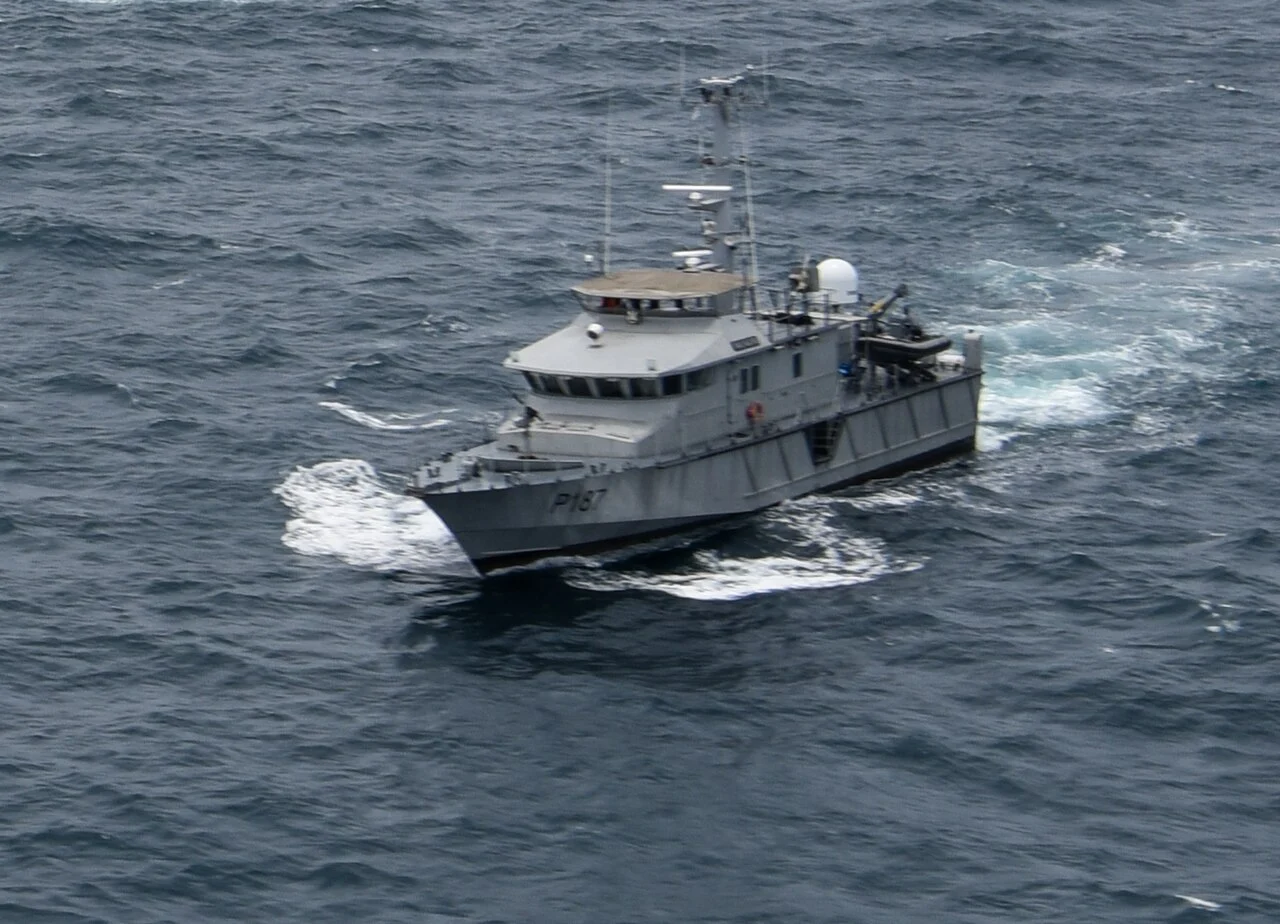
Nigeria is a repeat customer of the French yard Ocea, which reports 18 boats and ships delivered to the Nigerian Navy since 2013, including eight FPB 72 Mk II, four FPB 110-family patrol boats and a survey vessel (defenceWeb). Other sources count seven FPB 72 delivered between 2013 and 2018, so the exact number is not settled. Two FPB 72 Mk II, NNS Shiroro and NNS Ose, were ordered in February 2017, delivered by cargo ship in August 2017 and commissioned at Lagos on 22 September 2017 after acceptance trials in France (Shephard). That gives one documented sequence of about seven months from order to commissioning.
The FPB 110 Mk II is a 35 metre boat with a reported 30 knot speed, 900 nautical mile range and five days of endurance, with a crew of eleven. NNS Nguru and NNS Ekulu arrived in Lagos in April 2018 (Military Africa; Ocea). A further Nigerian contract entered into force at the end of 2022. Reports differ on its contents: one lists three FPB 98 Mk I and river boats, another three 46 metre OPV 190, two FPB 96 and four interceptors (Military Africa). The 2023 Nigerian budget carried N9 billion (about $19 million) for three 32 metre boats, which is a budget line, not a contract price. Status of that order: ORDERED, delivery not confirmed in the sources reviewed.
Turkish option: Dearsan OPV-76
Turkish yards are relevant here because Nigeria has contracted the one Turkish offshore patrol vessel class with a documented Gulf of Guinea buyer. Dearsan signed with the Nigerian Navy in Abuja on 3 November 2021 for two 76 metre ships, with a reported total of about $160 million and an initial payment of $35 million in June 2022 (The Defense Post). Construction began in September 2022, the first ship (P203) was launched on 26 October 2023 and the second (P204) in April 2024, and P204 completed sea trials in March 2025 with delivery scheduled for 2025 (Military Africa). In mid-2025 the Chief of Naval Staff said both ships would arrive before year-end (Military Africa).
The ship is 76.8 metres long with a 43-strong crew, a deck for a medium helicopter and two rigid inflatable boats for interdiction, with Aselsan radar and a Havelsan combat management system reported on the first ship (defenceWeb). Armament reports differ: one lists a 40 mm main gun with an Aselsan 30 mm gun, another a 76 mm gun with a 40 mm gun and Mistral missiles. For background on the shipyard, see Envanter Medya’s profile of Dearsan.
What is verified: a signed contract with Nigeria, the launch dates, sea trials for the second ship, and a helicopter-capable 76 metre design. What is not verified: final delivery and commissioning dates, the unit price, the armament actually fitted, any local outfitting or technology transfer, and any service record in Nigerian hands. No claim about price or delivery speed relative to other suppliers is made here.
Chinese P18N and 46 metre patrol boats
Nigeria ordered two 1,800 tonne P18N offshore patrol vessels from China in April 2012. NNS Centenary was handed over in China in November 2014 and reached Lagos on 6 February 2015, and NNS Unity reached Lagos on 4 November 2016 with most of its outfitting done in Nigeria to build local shipbuilding capacity (defenceWeb). No contract value was published. A 46 metre patrol boat was donated by China and handed over at Lagos on 28 October 2022, and in mid-2025 the Chief of Naval Staff said three more 46 metre fast patrol boats were being built by a Chinese yard.
Ghana signed a $39.86 million contract with Poly Technologies in September 2008 for two 46 metre vessels, Chemle and Ehoo, launched in April 2011 and armed with 14.5 mm and 12.7 mm guns; they were financed through the Ministry of Food and Agriculture for fisheries surveillance (defenceWeb). That figure covers the package, so no unit price can be derived. Ghana also received four donated Chinese patrol boats in 2017.
Ex-US Coast Guard Hamilton-class cutters
Nigeria received the cutter NNS Thunder (ex-USCGC Chase) as an excess defense article and commissioned it in January 2012, then took NNS Okpabana (ex-USCGC Gallatin) on 7 May 2014, arriving in Nigeria in January 2015. The Gallatin is a 115 metre, 3,250 tonne ship with a helicopter deck and retractable hangar, in US service from 1968, and Nigerian personnel trained in Charleston before the transfer (defenceWeb). The transfer terms and refit cost were not stated in the source reviewed. The class offers the largest hull and best endurance of any option here, but at about 45 years of age at transfer it carries a maintenance burden that no source quantifies. Current operational status of both ships is Not confirmed.
Nigerian-built Seaward Defence Boats
Naval Dockyard Limited in Lagos built NNS Andoni, commissioned on 7 June 2012 as Nigeria’s first locally built warship (defenceWeb). Later units followed in 2016 and 2021, and Africa Defense Forum reports two further 43 metre boats, Seaward Defence Boats IV and V, under construction with three earlier units in service (Africa Defense Forum). This is the only class here with documented domestic construction. Speed, range, armament and unit cost are Not stated in sources reviewed, and the build rate of three boats in roughly a decade shows the limit of the route.
Other recent additions in the region fit the smaller band: Ghana commissioned four 40 metre Penguin Flex Fighter craft from Singapore on 25 February 2022, and Nigeria commissioned the Singapore-built Sea Eagle boats NNS Shere and NNS Faro in May 2025, both reported in the sources above.
African operators at a glance
- Nigeria: Ocea FPB 72 and FPB 110 (DELIVERED), further Ocea order (ORDERED), Dearsan OPV-76 (CONTRACTED), Chinese P18N and 46 m boats, two Hamilton-class cutters, Seaward Defence Boats. See DefenceMENA’s Nigeria military strength profile and the Nigeria and South Africa comparison.
- Ghana: Chinese 46 m patrol vessels and donated boats, Flex Fighter craft, US Defender-class boats. A 2022 statement said two offshore patrol vessels would be acquired; no contract was found.
- Benin, Togo, Cameroon, Côte d’Ivoire, Senegal: no patrol vessel purchase matching this requirement was verified in the sources reviewed for this article.
Procurement and price evidence
Two figures exist. The Dearsan contract is reported at about $160 million for two ships, and Ghana’s 2008 Chinese contract at $39.86 million for two 46 metre vessels. Both are package values that can include weapons, spares and training. Dividing them by hull count would mix those items, so this article does not. No price was found for the Ocea boats, the Chinese P18N, the Hamilton transfers or the Seaward Defence Boats. Any claim that one supplier is cheaper is unsupported here.
Delivery speed
Only some sequences are documented and they cannot be ranked. Ocea’s FPB 72 pair went from order in February 2017 to commissioning in September 2017. Dearsan’s OPV-76: contract November 2021, second launch April 2024, delivery scheduled for 2025 and unconfirmed. The P18N: ordered April 2012, first delivered November 2014, second in November 2016. Contract dates for the other classes are missing, so no faster-supplier conclusion can be drawn.
Training, maintenance and local production
The documented local-industry cases are specific. Nigeria outfitted NNS Unity domestically, builds Seaward Defence Boats at Naval Dockyard, and trained crews in the United States before the Hamilton transfers. Ocea’s site records deliveries but the sources reviewed do not describe in-country maintenance for its boats, and no source documents local assembly or support for the Dearsan ships. Ghana’s slipway rehabilitation was reported as a Damen project, which does not amount to patrol vessel support. A buyer should ask each yard specifically about spares stock, crew training and warranty, since none of these terms is public.
Which requirement fits which option?
| If the priority is | Options with documented Gulf of Guinea users | Evidence gap |
|---|---|---|
| Fast boats for anchorages and river mouths | Ocea FPB 72 / FPB 110, Chinese 46 m boats | Armament and range for several classes |
| Offshore endurance and a helicopter deck | Dearsan OPV-76, Chinese P18N, Hamilton-class | Dearsan delivery; Hamilton current status |
| Local build and jobs | Seaward Defence Boat; P18N outfitting | Speed, range, unit cost |
| Lowest entry cost | Hamilton-class (transfer) and donated boats | Transfer terms, refit and upkeep costs |
| Established repeat supplier | Ocea (Nigeria, from 2013) | Contract values; delivery of the 2023 order |
See DefenceMENA’s military equipment database for country files and the report on Türkiye and Senegal maritime surveillance aircraft.
FAQ
Which navies in the Gulf of Guinea have bought offshore patrol vessels?
Nigeria has the clearest record: two Chinese P18N vessels delivered in 2015 and 2016, and two Dearsan OPV-76 ships contracted in 2021. Ghana announced plans for two offshore patrol vessels in 2022 but no contract was found.
Is a Turkish patrol vessel in service in the Gulf of Guinea?
Nigeria contracted two Dearsan OPV-76 ships in November 2021, and the second completed sea trials in March 2025. Delivery and commissioning were not confirmed in the sources reviewed.
How much does a patrol vessel cost for an African navy?
Comparable unit prices are not public. The available figures, about $160 million for two Dearsan ships and $39.86 million for two Chinese 46 metre boats, are package values.
Does any Gulf of Guinea navy build its own patrol vessels?
Nigeria does. Naval Dockyard Limited in Lagos has built three Seaward Defence Boats since 2012, with two more under construction.
Sources
- defenceWeb: Second Dearsan offshore patrol vessel launched for Nigerian Navy
- The Defense Post: Dearsan sea trials for Nigerian Navy OPV
- Military Africa: Second OPV-76 completes sea trials
- Military Africa: Nigerian Navy commissions patrol boats and helicopters
- defenceWeb: Nigeria orders more vessels from Ocea
- Military Africa: Nigerian Navy orders nine boats from Ocea
- Shephard: Nigerian Navy commissions new FPB 72 patrol vessels
- Ocea: FPB 110 Nguru and Ekulu delivered to Nigeria
- Military Africa: Two FPB 110 Mk II delivered to the Nigerian Navy
- defenceWeb: Nigerian Navy receives donated patrol boat from China
- defenceWeb: Nigeria’s first Chinese offshore patrol vessel arrives home
- defenceWeb: Ghana orders two patrol vessels from China
- defenceWeb: Ghana commissions Flex Fighter vessels
- defenceWeb: Nigeria receives ex-US Coast Guard cutter Gallatin
- Africa Defense Forum: Nigerian Navy adds to fleet
Specifications and delivery figures are as reported by the sources named and vary between sources. SIPRI’s Arms Transfers Database and manufacturer data sheets should be checked for any procurement decision.