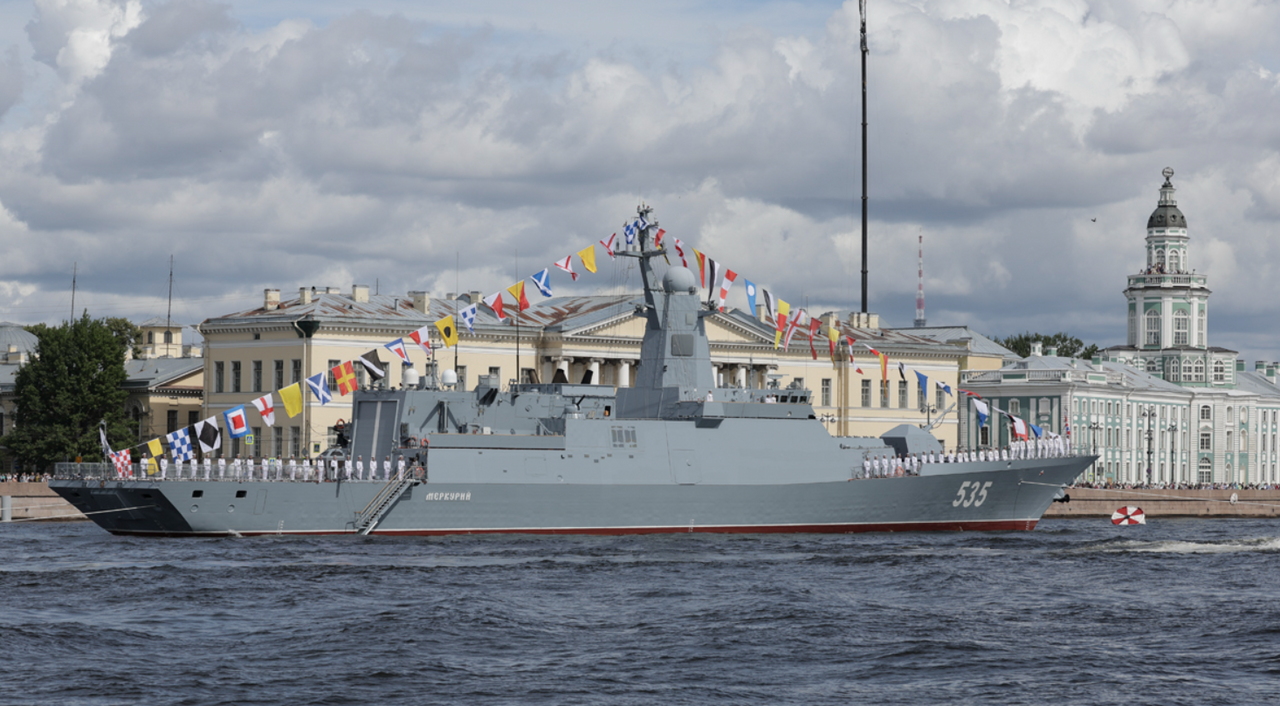
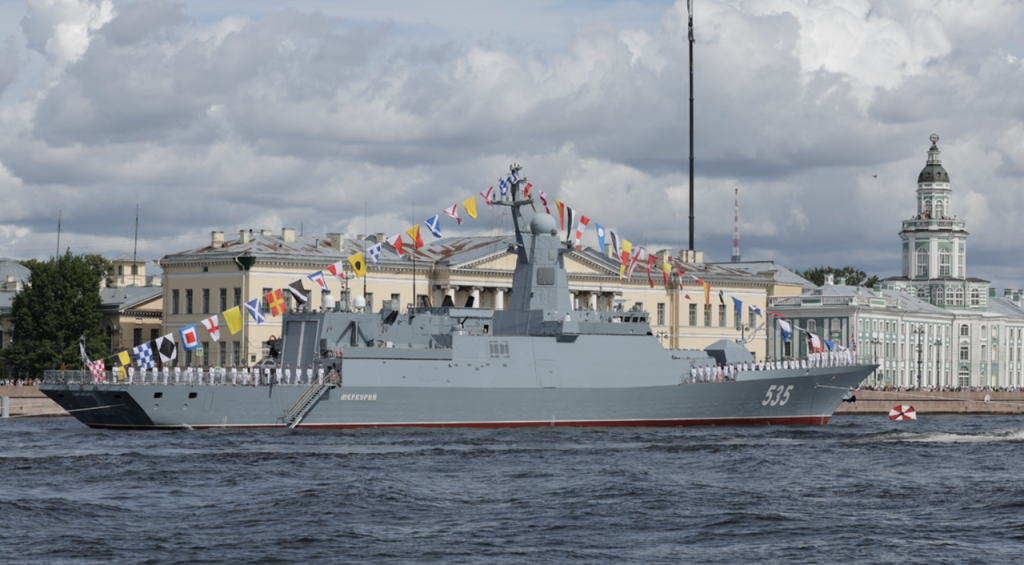
The Russian Navy corvette Merkury capsized and sank at the Benghazi naval base in eastern Libya after a suspected sea drone attack before dawn on 22 November, satellite imagery and Libyan officials indicate. A second vessel was hit by a drone boat off Benghazi the same evening.
No one has claimed responsibility. Two Libyan military officials told the Associated Press (AP) that several Ukrainian sea drones were launched at the corvette from a base run by Ukrainian forces in western Libya. At least four were intercepted and destroyed, and two struck the ship, according to their account of an initial investigation.
What happened at the naval base
Residents heard a powerful explosion from the naval base, after which flames rose for about an hour and a half, the Libyan news site Al Wasat reported, citing eyewitnesses. Benghazi’s civil defence service first described the incident as an explosion at an ammunition depot inside the base and later said the fire was under control.
The eastern-based government, led by Osama Hammad and appointed by the House of Representatives, then said preliminary findings pointed to a drone attack on a Russian ship docked at the base. In its statement, the government said the vessel “was on its way back to Russia” and had stopped in Benghazi to take on fuel and supplies under maritime cooperation agreements between the two countries. It announced a joint investigation with Russian authorities.
Satellite imagery provider Vantor identified the vessel as the Merkury. Images taken late on 22 November and published by AP and The War Zone (TWZ) show the corvette capsized alongside the quay, with only part of the bow above water. Naval analyst H I Sutton of Naval News had earlier assessed that the ship was “almost certainly destroyed”.
Ten Russians and Libyans suffered minor injuries, medical sources told Arab News. Local sources told Al Jazeera that an unknown number of Libyan and Russian nationals were killed and that the ship was carrying weapons, ammunition and drones. Neither claim has been confirmed by Libyan or Russian officials.
The Merkury and its mission
The Merkury is a Project 20380 Steregushchiy-class corvette that joined the Russian Navy in 2023. Ships of the class displace about 2,200 tonnes and typically carry a 100 mm gun, Uran anti-ship missiles and Redut air-defence missiles.
The corvette is nominally part of the Black Sea Fleet but has been operating from Northern Fleet bases because of the war, Naval News reported. It had been in Benghazi for several days while escorting a convoy of Russian government-linked ships used for arms exports, according to the outlet.
Russian ships regularly use Benghazi to supply Russian forces in Africa, and the port has grown in importance to Moscow since it lost its bases in Syria, The Guardian noted. Russia’s Africa Corps operates in Mali, Burkina Faso and Niger; see our reports on the joint raid near Kidal and the Infauna electronic warfare vehicle in Mali.
Second ship hit off Benghazi
In the evening, a drone boat struck a commercial vessel off Benghazi near the Sabri district. Two Libyan military sources told Reuters, as quoted by Al Wasat, that the ship was flying the Maltese flag. The same sources said Libyan naval and air forces intercepted more than 12 drone boats off the coast that evening. Other Libyan military sources put the number at more than 20, Arab News reported.
Open-source accounts identified the ship as the roll-on/roll-off cargo vessel Ascalon. According to Clash Report, the Ascalon is a sanctioned Russian vessel that has carried military cargo for Russia. Ukraine’s Defense Express reported that the ship (IMO 9198226) is owned by M Leasing LLC and is under US sanctions. In October, open-source researchers published satellite images of the Ascalon and two other Russian cargo ships loading military vehicles at Baltiysk in Kaliningrad on 15 and 16 October.
Video released on X shows an uncrewed surface vessel hitting the side of a cargo ship and exploding. Libyan naval units rescued the crew, and some crew members had minor injuries, according to the Libyan health ministry. The identification of the vessel and the extent of damage have not been independently confirmed.
Competing accounts of the launch site
The AP sources’ account that the drones came from western Libya has not been confirmed. A source quoted by Clash Report gave a different version, saying the drones “launched from Albania, not western Libya” and that the eastern Libyan side had detected the launch. The source described the western Libya account as “a diversion by Ukrainian sources”. Defence Mena could not verify either claim, and Albanian authorities had not commented by the time of publication.
A Ukrainian source told TWZ that the Security Service of Ukraine (SBU) launched the drones that struck the Merkury. The SBU has not commented, and Kyiv has made no official statement.
Ukrainian drone units have been reported in north-western Libya since late 2025. In September, CNN quoted a Ukrainian naval drone operator as saying his unit used a military base in Misrata to launch attacks on Russia’s so-called shadow fleet. The Defence Ministry of the Tripoli-based Government of National Unity (GNU) denied at the time that any agreement allowed the Misrata base to be used for operations outside the state’s sovereign duties.
Reactions
The eastern-based government called the attack a “serious assault on national sovereignty” and said Libya was not a party to the Russia-Ukraine war. Hammad later submitted a formal complaint to the UN Secretary-General and the Security Council, calling for an international investigation into both incidents, Al Wasat reported. Al Jazeera reported that he asked for verification of the presence of Ukrainian experts in Libya and for formal explanations from Kyiv.
The GNU, led by Prime Minister Abdul Hamid Dbeibah, said it rejected “turning Libya into a battleground for international conflicts and settling scores between external powers”. Its statement warned that hosting illegal foreign forces opens the door to external conflicts, without naming any country, and called for the armed forces to be unified under state authority. Libya’s rival military structures are explained in our guide Why Does Libya Still Have Two Militaries in 2026?
Russia’s Ambassador to Libya, Aydar Aganin, told RT that the attacks were an attempt by Kyiv to widen the conflict to distant sea areas and described them as terrorist in nature. Moscow would consider possible responses and would not leave the incident unanswered, he said. The Russian Defence Ministry had not commented on the Merkury by the time of publication.
The UN Support Mission in Libya (UNSMIL) called for “an immediate, independent and transparent investigation”. “Libya can not afford, and must not become a battleground for foreign conflicts,” the mission said on X.
Wider campaign at sea
The Benghazi incidents came a day after the Russian cargo ship Sparta II was struck by drones in the Baltic Sea. The Finnish military said that attack was probably carried out by Ukraine. If Ukraine’s role is confirmed, the strike on the Merkury would be one of its most successful naval attacks of the war, The Guardian assessed.
The European Union’s naval mission off Libya, Operation Irini, was extended in early November with a new task covering Russia’s shadow fleet; see EU Extends Operation Irini to 2029. Eastern Libya’s ties with foreign militaries are also covered in our reports on Syria’s Il-76 recovery from Benina and Niger’s protocol with Haftar’s command.
Sources
- Associated Press, “Suspected Ukrainian sea drones hit Russian warship at Benghazi naval base, Libyan officials say”, 22 November 2026: apnews.com
- The Guardian, “Russian warship sinks in Benghazi after suspected Ukrainian drone attack”, 22 November 2026: theguardian.com
- Al Jazeera, “Russian vessel hit by suspected Ukrainian drone at Libya’s Benghazi port”, 22 November 2026: aljazeera.com
- Al Wasat, GNU statement and eyewitness accounts, 22 November 2026: en.alwasat.ly; Hammad complaint to the UN, 23 November 2026: alwasat.ly (Arabic)
- Arab News, “UN urges probe into Benghazi attacks, warns Libya against becoming battleground”, 23 November 2026: arabnews.com
- The War Zone, “Ukraine’s Campaign Against Russian Naval Assets Far Beyond The Black Sea Enters A New Phase”, 22 November 2026: twz.com
- Naval News (H I Sutton), Merkury assessment, 22 November 2026
- Clash Report on X, 22 November 2026: Ascalon video, source on launch site
- Defense Express, “Russian Ro-Ro Ship ASCALON … Hit by Drone Off Libya”, 22 November 2026: en.defence-ua.com
- Vzglyad, Ambassador Aydar Aganin’s remarks to RT, 23 November 2026: vz.ru (Russian)
- The Libya Observer, GNU Defence Ministry denial on Misrata base, September 2026: libyaobserver.ly