Egypt’s Ka-52 Attack Helicopter Fleet Explained



Egypt is the only country outside Russia to fly the Ka-52, and it bought the helicopter for a ship that almost went to someone else. Forty-six Ka-52K Katran attack helicopters, ordered in 2015 to operate from two French-built Mistral-class carriers Russia never received, have been in Egyptian Air Force and Navy service since 2017.
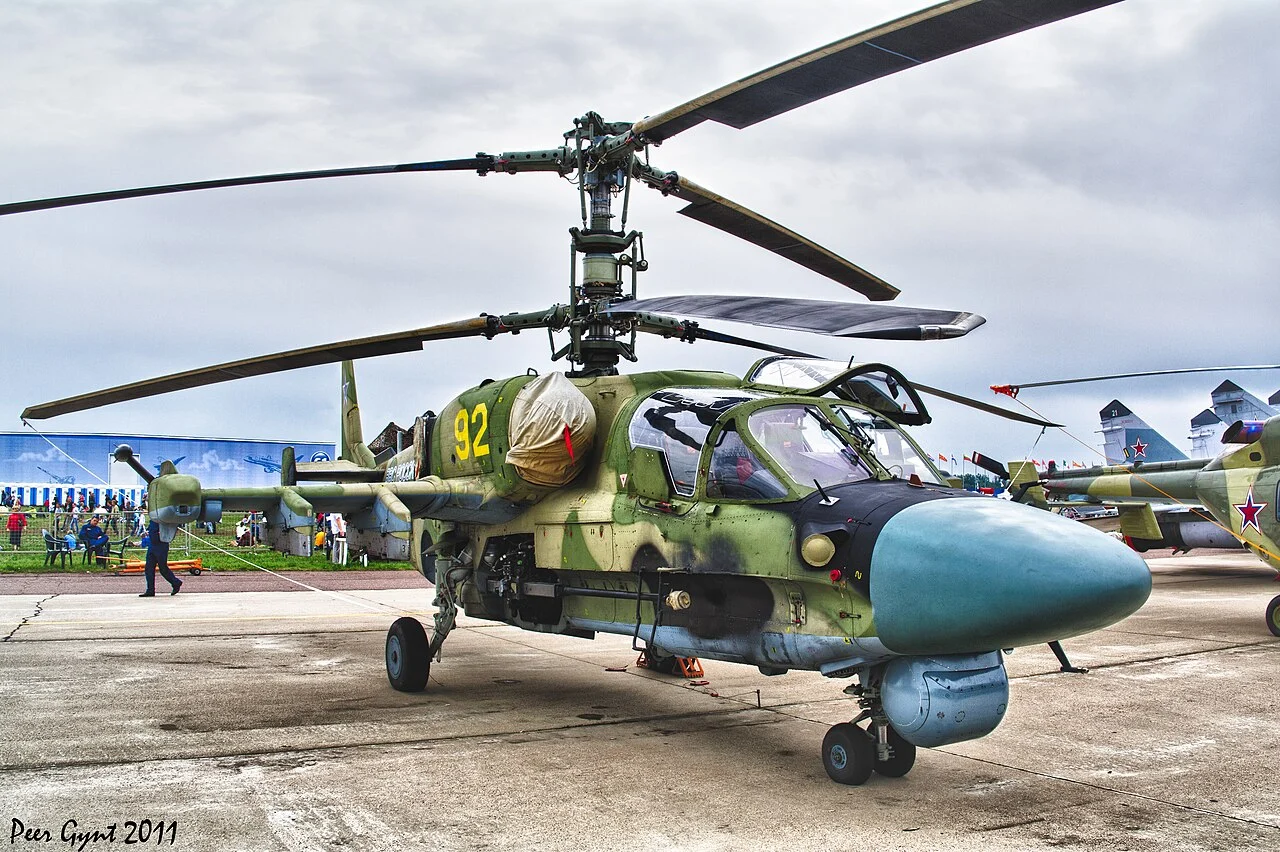
Photo: Kamov Ka-52 Alligator, the base type of Egypt’s Ka-52K Katran fleet, at the MAKS 2011 airshow, Moscow. Credit: Peer.Gynt, CC BY-SA 2.0, via Wikimedia Commons.
Egypt is a confirmed Ka-52 operator, in service and operational since 2017, flying the naval Ka-52K “Katran” variant of the Kamov Ka-52 Alligator attack helicopter. Cairo signed the order in December 2015 for 46 aircraft, Russia’s first and so far only export sale of the type, and deliveries ran from 2017 to 2019. The helicopters exist because of a ship, not the other way round: Egypt had just taken delivery of two Mistral-class amphibious assault ships that France originally built for Russia and could not deliver after the 2014 Crimea sanctions, and it needed a deck-capable attack helicopter to put on them. The Ka-52 sits alongside a larger fleet of American AH-64D/E Apaches in Egyptian service, detailed in DefenceMENA’s Egypt military strength profile.
| Country | Egypt |
| System | Kamov Ka-52K “Katran” |
| Manufacturer | Kamov / Russian Helicopters (Russia) |
| Origin | Russia |
| Variant | Ka-52K navalised export version, with an Egypt-specific avionics and cooling package |
| Quantity | 46 ordered; most consistently reported as fully delivered by 2019 |
| Order year | 2015 (reported September 2015; contract confirmed December 2015) |
| Delivery | First 3 aircraft delivered 2017; deliveries reported complete by 2019 |
| Service status | In service / operational, Egyptian Air Force and Navy |
| Reported contract value | Not publicly disclosed |
What is the Ka-52, and what is the Ka-52K?
The Ka-52 Alligator is a twin-engine, coaxial-rotor attack and reconnaissance helicopter built by Kamov (part of Russian Helicopters). Unlike most Western attack helicopters, its two rotors turn in opposite directions on the same shaft, which removes the need for a tail rotor, gives it unusually tight turning performance and keeps full power available at altitude and in hot conditions. It carries a 30mm cannon, unguided and guided rockets, and the 9A1472 Vikhr-1 and 9M120 Ataka anti-tank guided missiles, directed by a mast-mounted sight and helmet-mounted targeting system. The Ka-52K “Katran” is the navalised export version developed specifically around Egypt’s order: it adds folding rotor blades and wings for shipboard stowage, strengthened corrosion protection for the maritime environment, and, according to Russian industry statements made around the Egypt deal, a modified cooling system and updated avionics for sustained desert and shipboard operation. Egypt’s aircraft are also unusual in seating their two-man crew side by side rather than in the tandem layout used on most other attack helicopters, a Kamov design choice retained on the export version.
Why did Egypt acquire the Ka-52?
The order followed directly from an unrelated French-Russian dispute. Russia had ordered two Mistral-class helicopter carriers from France’s DCNS (now Naval Group) in 2011. After Russia’s 2014 annexation of Crimea, France cancelled the delivery under Western sanctions pressure, leaving two part-built ships without a buyer. Egypt purchased both in 2015, reportedly with Gulf financial backing, taking delivery of the Gamal Abdel Nasser and Anwar El Sadat in June and September 2016. Each ship was designed to operate up to 16 helicopters, but Egypt had no attack helicopter cleared for shipboard use at the scale the carriers needed. Cairo turned to Russia, already a supplier of MiG-29M/M2 fighters and S-300VM-family air defence systems in the same period, and ordered a navalised Ka-52 variant built around the Mistral’s deck and hangar dimensions. The deal also reflected Egypt’s post-2013 push to diversify suppliers beyond the United States, discussed in detail in DefenceMENA’s Egypt Rafale fleet file, which was driven by the same 2013-2015 US arms freeze.
When did Egypt order it, and how long did delivery take?
| Date | Event | Value | Status | Source |
|---|---|---|---|---|
| 2014-2015 | Egypt purchases the two part-built Mistral-class ships from France after Russia’s order is cancelled | Not disclosed | Confirmed | France 24, Naval Group statements |
| Jun-Sep 2016 | Gamal Abdel Nasser and Anwar El Sadat handed over to Egypt | ~€950m-€1bn (ships, reported) | Confirmed | Naval Group, Reuters |
| Sep-Dec 2015 | Egypt and Rosoboronexport agree a Ka-52/Ka-52K order, reported at 46-50 aircraft | Not disclosed | Confirmed (order), quantity varies by source | TASS, AIN Online |
| 2017 | First batch of Ka-52 helicopters (reported as 3) delivered from the Progress plant, Arsenyev | Not disclosed | Confirmed | TASS |
| 2017-2019 | Remaining deliveries, reported as largely complete by 2019 | Not disclosed | Reported; exact completion date not independently confirmed | Military Africa, industry reporting |
| Jan 2024 | Egypt reported to have received a large follow-on batch of Vikhr-1 and Ataka anti-tank missiles for the Ka-52 | Not disclosed | Reported, quantity (reportedly up to ~1,000 of each missile type) not independently confirmed | Military Africa |
How many Ka-52 does Egypt operate?
The most consistently repeated figure across contemporary and later reporting is 46 aircraft, and that is the number used in this file. It is not the only figure that has appeared: early 2015-2016 reporting cited a Rosoboronexport contract for “about 50” Ka-52-family helicopters, and one Russian industry source suggested the order could eventually rise toward 80 including both land-based and naval variants. A 2018 satellite-imagery report counted around 12 Ka-52s at Kattamia air base near Cairo at that point in the delivery schedule, consistent with a multi-year rollout rather than a single batch. By 2024, open-source tracking and Egyptian-focused defence outlets describe the order as fully delivered at 46 airframes, with Egypt remaining the Ka-52’s only export customer worldwide. No DefenceMENA source found a separate, larger naval-specific order on top of the 46; earlier reports describing “32 Ka-52K plus 46 Ka-52” appear to be an unconfirmed restatement of the same single order rather than two distinct batches.
How much did it cost?
Contract value was not publicly disclosed. Egyptian and Russian officials have not released a price for the Ka-52/Ka-52K order, and no primary source — Russian state arms exporter Rosoboronexport, Russian Helicopters, or the Egyptian Ministry of Defence — has published a figure. Secondary reporting sometimes links the helicopter order to a broader roughly $3.5 billion Egypt-Russia arms package reported in September 2014, but that figure predates the Ka-52 contract itself and no source confirms the helicopters were part of it rather than the MiG-29M/M2 fighters, air defence systems or other items discussed in the same period. Readers should treat any specific per-aircraft price for Egypt’s Ka-52 as unverified.
Which variant does Egypt fly?
| Parameter | Value | Source |
|---|---|---|
| Variant | Ka-52K “Katran” (navalised export version) | Russian Helicopters, industry reporting |
| Crew | 2, seated side by side | Manufacturer specification |
| Max speed | ~300 km/h | Manufacturer specification |
| Combat radius | ~460 km (varies with load; manufacturer figure) | Manufacturer specification |
| Service ceiling | ~5,500 m | Manufacturer specification |
| Max take-off weight | ~10,800 kg | Manufacturer specification |
| Armament | 30mm 2A42 cannon; 9A1472 Vikhr-1 and 9M120 Ataka ATGMs; unguided rockets | Manufacturer, Military Africa |
| Export-specific features | Folding rotor blades and wings for shipboard stowage; corrosion protection; reported modified cooling system and avionics | Industry statements around EDEX showings; not independently verified in detail |
Manufacturer figures for speed, range and ceiling are nominal values for the baseline Ka-52 family; DefenceMENA has not found an independently published, Egypt-specific performance figure that differs from the manufacturer’s general specification.
How long has it been in service, and how has it performed?
Official statements: Egypt’s Ministry of Defence and Air Force have confirmed the Ka-52K is in squadron service and have shown the type publicly at events including the EDEX defence exhibition in Cairo. Manufacturer claims: Russian Helicopters has described the export version’s cooling and avionics adaptations as suited to high-temperature operation, without publishing independent test data for the Egyptian climate specifically. Verified combat record: DefenceMENA found no independently verified report of the Egyptian Ka-52 fleet being used in combat. Egypt’s documented airstrikes against Islamic State fighters in Libya, in 2015, were flown by F-16s, not the Ka-52. Media and OSINT reporting: Egyptian state and defence media have shown the Ka-52 in exercises and at air shows, including alongside the Mistral-class ships, but DefenceMENA found no OSINT-sourced claim of an operational strike by the type that would meet this file’s sourcing bar. Readers should treat the aircraft’s regional combat record as unverified rather than assume it mirrors Russia’s own, extensively documented Ka-52 use in Ukraine, which is a separate air force flying a different, non-export configuration.
Is it suited to Egypt’s operating environment?
Egypt operates the Ka-52K across two very different environments: the high-heat, dust-laden conditions of the Sinai Peninsula and Western Desert, where Egyptian forces have conducted a long-running counter-insurgency campaign, and the humid, corrosive maritime environment of shipboard operation from the Mistral-class carriers. Both uses were anticipated in the export design: Russian industry statements made around the EDEX unveiling describe a modified cooling system and strengthened corrosion protection built specifically for Egypt’s order, distinct from the baseline Russian-service Ka-52. DefenceMENA found no independently published trial or qualification report detailing how these adaptations performed once the aircraft entered Egyptian service, so this should be read as a documented design intent rather than a verified operational result. The coaxial-rotor layout that is the Ka-52’s defining feature is also relevant here: Kamov has long marketed it as giving more consistent power margins at altitude and in heat than a conventional single-main-rotor design, though this file found no Egypt-specific data confirming that advantage in practice.
Strengths
- Payload and survivability margin. At roughly 10.8 tonnes maximum take-off weight, the Ka-52 is a genuinely heavy attack helicopter, built around armoured cockpit protection and a documented ejection system (K-37-800) rare among attack helicopters of any origin.
- Shipboard integration already engineered. The Ka-52K’s folding rotor and wing arrangement was purpose-built for the Mistral-class deck and hangar, giving Egypt a helicopter matched to a carrier it already owned rather than a generic export airframe adapted after the fact.
- Diversified supplier relationship. As with the Rafale and the MiG-29M/M2, the Ka-52 order reduced Egypt’s post-2013 reliance on any single arms supplier, a strategic priority documented across DefenceMENA’s Egypt procurement coverage.
Limitations
- Single export customer, thin support ecosystem. Egypt is the Ka-52’s only foreign operator, which means it cannot draw on a wider pool of export-user maintenance experience, spares pooling or shared upgrade programmes the way Apache or Mi-24/35 operators across the region can.
- Sanctions exposure on the supplier side. Russia’s own defence-industrial base has been under sweeping Western sanctions since 2022, which creates a documented risk to spares, component and follow-on-order continuity for any Russian-sourced fleet, Egypt’s Ka-52s included, independent of anything specific to Egypt’s own programme.
- No confirmed combat record to assess. Because no verified Egyptian Ka-52 combat use has been documented, this file cannot evaluate real-world performance against the counter-insurgency and maritime-strike roles it was bought for; that gap should be read as an absence of evidence, not evidence of a problem.
What do neighbouring countries operate?
No other Middle Eastern or African air force currently flies the Ka-52; Egypt remains its sole export customer worldwide. For context, here is what regional air forces fly in the same heavy attack-helicopter class:
| Country | System | Variant | Status | Approx. quantity | Supplier | Order year | Delivery status |
|---|---|---|---|---|---|---|---|
| Egypt | Ka-52K / AH-64D-E | Katran; Apache Longbow | In service | 46 Ka-52K; ~43 AH-64D (being upgraded to E) | Russia; United States | 2015 (Ka-52); 2003 & 2010 (Apache) | Delivered |
| Algeria | Mi-28NE | Night Hunter | In service | ~42 ordered, deliveries from 2019 | Russia | 2014 (initial), expanded 2016 | Delivering / delivered |
| Saudi Arabia | AH-64D/E | Apache | In service | Not disclosed (multiple squadrons) | United States | Multiple contracts since the 1990s | Delivered |
| United Arab Emirates | AH-64D/E | Apache | In service | Not disclosed | United States | Multiple contracts | Delivered |
| Kuwait | AH-64D | Apache | In service | Not disclosed | United States | 1990s | Delivered |
| Nigeria | T129 ATAK | — | In service (partial fleet) | 4 of 6 confirmed delivered | Türkiye | 2018 (initial) | Partially delivered |
Full detail on Nigeria’s programme is in DefenceMENA’s Nigeria T129 ATAK fleet file; Algeria’s Russian-sourced fighter and air-defence holdings from the same period are covered in the Algeria Su-30MKA fleet file. Quantities marked “not disclosed” reflect the absence of an official public inventory figure, not an estimate DefenceMENA chose not to publish.
What are the closest alternatives?
Within the same heavy attack-helicopter class, the closest global comparisons to the Ka-52 are the Boeing AH-64 Apache, which Egypt already operates in far greater numbers (reported ~43 AH-64D being upgraded to AH-64E standard), and the Mil Mi-28, Russia’s other current-generation attack helicopter and Algeria’s choice for the same requirement set. The Apache comparison is the most relevant for Egypt specifically: it is a tandem-seat, single-main-rotor design with a much larger regional user base (Saudi Arabia, the UAE, Kuwait and Egypt’s own larger Apache fleet) and a correspondingly deeper regional parts and training ecosystem, against the Ka-52’s side-by-side seating, coaxial rotor and status as a single-customer export type. DefenceMENA found no public, Egypt-specific cost comparison between sustaining the two fleets in parallel.
Is there a Turkish alternative?
Türkiye’s TAI/AgustaWestland T129 ATAK is the closest Turkish system to an attack-helicopter requirement, and it has a documented African combat-helicopter export record: Nigeria has taken delivery of part of a six-aircraft order (detailed in DefenceMENA’s Nigeria T129 ATAK file), and the Philippine Air Force operates it outside this region. It is not, however, a like-for-like substitute for the Ka-52K specifically: the T129 is built around a roughly 5-tonne airframe with a conventional tandem-seat, single-main-rotor layout, versus the Ka-52’s roughly 10.8-tonne coaxial design, and DefenceMENA found no evidence the T129 has been engineered for shipboard or carrier-deck operation the way Egypt’s Ka-52K was for the Mistral class. A heavier, navy-capable Turkish attack helicopter in the Ka-52K’s weight and role class does not currently exist as an export-ready product. No publicly disclosed T129 contract price allows a direct cost comparison with Egypt’s undisclosed Ka-52 figure.
What could replace or complement it?
DefenceMENA found no public reporting of a planned Egyptian follow-on order for additional Ka-52s, nor of a programme to retire the type. The more active story in Egypt’s rotary-wing fleet is the AH-64D-to-AH-64E Apache upgrade reported at roughly $2.3 billion, which runs in parallel to, rather than in place of, the Ka-52K fleet. The most likely near-term development affecting the Ka-52 specifically is continued missile resupply: Egypt’s reported January 2024 receipt of a large Vikhr-1/Ataka missile batch suggests the fleet is being sustained and armed for continued use rather than phased out.
Frequently asked questions
Does Egypt operate the Ka-52?
Yes. Egypt has operated the Ka-52K “Katran” since 2017 and is the type’s only export customer worldwide, with 46 aircraft ordered in 2015.
How many Ka-52 helicopters does Egypt have?
The most consistently cited figure is 46, ordered in a single 2015 contract and reported as fully delivered by 2019. Earlier reporting cited figures as high as 50 or a possible expansion toward 80, but these are not confirmed in later sourcing.
Why does Egypt have Russian Ka-52 helicopters?
Egypt bought two Mistral-class helicopter carriers from France in 2015 after Russia’s original order for the ships was cancelled under sanctions. The carriers needed a deck-capable attack helicopter, and Egypt ordered a navalised Ka-52K built specifically for that role.
How much did Egypt pay for its Ka-52 helicopters?
The contract value was not publicly disclosed by Egypt or Russia. Reports linking the order to a broader $3.5 billion 2014 arms package are unconfirmed as applying specifically to the helicopters.
Is the Ka-52K the same as the Russian air force’s Ka-52?
No. The Ka-52K “Katran” is a navalised export variant built around Egypt’s order, with folding rotors and wings for shipboard stowage and reported corrosion and cooling adaptations not present on Russia’s own land-based Ka-52.
Has Egypt used the Ka-52 in combat?
No independently verified report confirms Egyptian Ka-52 combat use. Egypt’s 2015 airstrikes against ISIS in Libya were flown by F-16s.
A note on the numbers: reported figures for Egypt’s Ka-52 order have ranged from 46 to roughly 80 across different points in the programme’s history, and this file uses 46 as the figure most consistently repeated in both contemporary 2015-2018 reporting and later retrospective coverage. For more on Egypt’s wider procurement pattern, see the DefenceMENA Egypt tag desk and Egypt’s 10 Biggest Defence Deals, 2011-2026.
Sources
- TASS, “First three Ka-52 Alligator helicopters delivered to Egypt — source”
- TASS, “Source: Egypt buys 50 Russian Alligator helicopters, deck-based version may be supplied”
- TASS, “Egypt may increase order of Russian Ka-52 type helicopters to 80 — source”
- Defense News, “Egyptian Navy to Receive 46 Ka-52K Naval Helicopters From Russia,” 1 Jan 2016
- defenceWeb, “Ka-52 attack helicopters for Egypt,” 31 Aug 2015
- Military Africa, “Satellite photos shows large number of Ka-52 attack helicopters at Egypt’s airbase,” Aug 2018
- Military Africa, “Egypt boosts its Ka-52 attack helicopter fleet with Russian Vikhr anti-tank missiles,” Jan 2024
- Arabian Aerospace, “Egypt snaps up the ‘Nile Crocodile'”
- Defense News, “Algeria Increases Order of Russian-made Mi-28 Helos to 42,” 7 Apr 2016
- Boeing, press statements on Egyptian AH-64D/E Apache fleet upgrade (November 2025)
- Background on the Egyptian Mistral-class carriers (cross-checked against contemporary news reporting)