Why Did Senegal Buy the Ground Master 400 Radar?

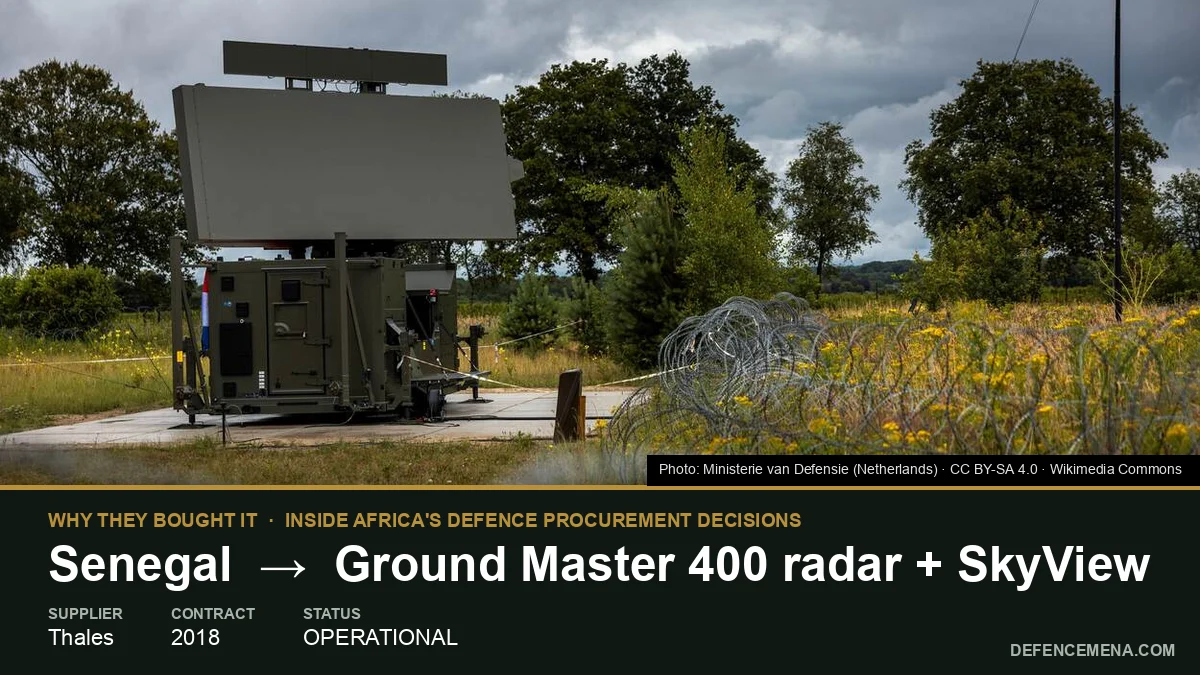


Senegal bought the Thales Ground Master 400 because, until 2018, it had no military long-range radar of its own and could not see what was flying over its territory. Thales announced the order for GM400 long-range radars and a SkyView command and control centre at Ouakam air base, Dakar, on 19 April 2018, with delivery in 2019, calling it the first cooperative project between the Senegalese armed forces and the company. Senegalese press reporting puts the package at two radars and more than 65 billion CFA francs; neither figure is confirmed. The purchase followed the January 2017 ECOWAS intervention in The Gambia, in which the air and naval cover came from Nigeria, and it has since been echoed along the coast: Côte d’Ivoire, already a GM400 operator, was reported in February 2025 to be spending around €50 million on a further GM400 and two GM200s.
Photo: A Thales Ground Master 400 Alpha of the Royal Netherlands Air Force at Nieuw-Milligen, July 2024. Senegal's radars are earlier standard GM400s of the same containerised design; no photograph of the Senegalese sets has been published. Photo: Ministerie van Defensie (CC BY-SA 4.0). Credit: Ministerie van Defensie (Netherlands), CC BY-SA 4.0, via Wikimedia Commons.
- Country
- Senegal (Armée de l’Air sénégalaise)
- System
- Ground Master 400 3D long-range air-surveillance radar + SkyView C2 centre
- Supplier
- Thales (France)
- Quantity
- Not disclosed by Thales; two radars per Senegalese press (Dakaractu)
- Contract year
- 2018 announcement (order reported as 2017 by Dakaractu)
- Status
- OPERATIONAL installed at Ouakam from 2019; no commissioning date published
- Main requirement
- Sovereign surveillance of national airspace and a real-time air picture for the authorities (officially stated by Thales)
- Training
- Not disclosed; Thales SkyView package normally includes initial and refresh training
- Localisation
- None
- Known alternatives
- None documented; same-class radars from Leonardo, Indra, Saab, Lockheed Martin and CETC exist on the market
What capability did Senegal need?
The requirement, as Thales stated it on 19 April 2018, was sovereignty. Governments, the release said, “have a mandate to exercise national sovereignty and protect their countries’ airspace from 21st century threats”, and the Senegalese armed forces were to deploy “a state-of-the-art airspace surveillance and control capability”. The SkyView centre would let operators “establish the air situation autonomously and report to the national authorities in real time”. Strip away the marketing language and the message is simple: Senegal wanted its own recognised air picture, instead of relying on civil air-traffic data or on partners.
The context that gave the requirement urgency was The Gambia. In January 2017, when Yahya Jammeh refused to leave office after losing the December 2016 election, ECOWAS assembled a 7,000-strong force from Senegal, Nigeria, Ghana, Mali and Togo under a Senegalese commander. Senegal provided the ground troops and field artillery; the air and naval component came from Nigeria. The Nigerian Air Force airlifted 200 personnel from Kainji to Dakar aboard C-130s on 18 January, deployed fighters and helicopters and flew reconnaissance over Gambian territory, while the Nigerian Navy blockaded Banjul, according to the Africa Center for Strategic Studies and Vanguard. Military Africa reported in April 2018 that defence analysts linked Senegal’s radar purchase to that operation, in which “the only aerial and naval assets were deployed by the Nigerian military”. That link is reported by Military Africa, not officially stated by Dakar.
What DefenceMENA could not find in any fetched source is a military long-range air-surveillance radar in Senegalese service before 2018. Thales described the order as “the first cooperative project between the Senegalese armed forces and Thales” in air surveillance, and the Air Force chief of staff said in July 2024 that the airspace “has become safer and better protected” thanks to radars that now scan the sky day and night. Both statements describe a capability that did not previously exist; the gap is documented by omission rather than by an explicit official admission.
What did it already operate?
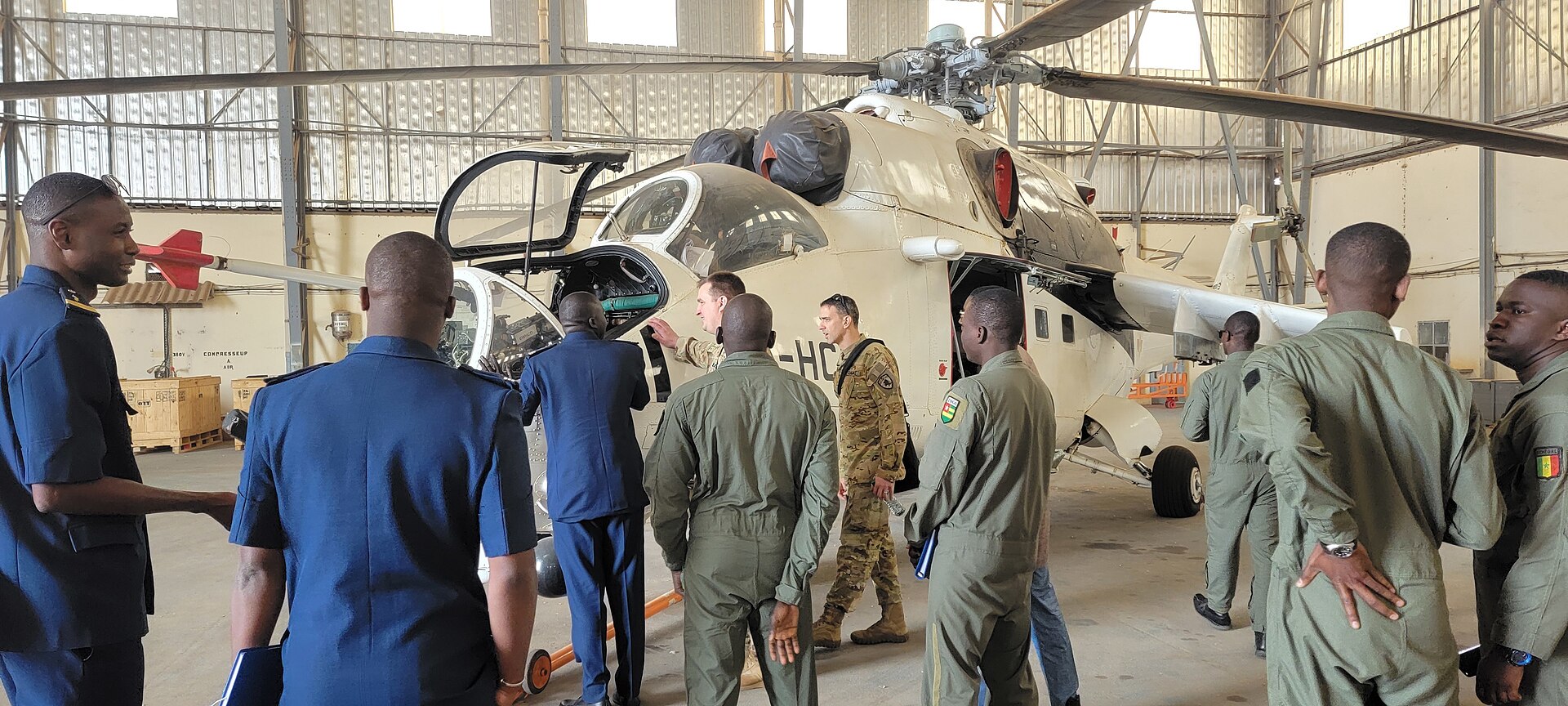
In early 2018 the Armée de l’Air sénégalaise was a small transport and helicopter force headquartered at Ouakam, next to Dakar’s old airport. The French site Avions Légendaires listed its fleet in January 2018: two Mi-35A attack helicopters, two Mi-17V transports, a Mi-2, a UH-1H and two Bell 206s, two CN-235M and one Fokker F27-500 transports, a CASA C-212MP for maritime patrol, a DHC-6 Twin Otter, a King Air, a presidential A319CJ and six TB-30 Epsilon trainers. Four KAI KT-1 trainers were on order and began arriving in April 2020. There were no jets; defenceWeb noted in 2019 that the only ground-attack platforms were the Mi-24/35 and Mi-17 helicopters.
None of this amounted to an air-defence system. A country with no fighters can still police its airspace if it can see it and direct what it has, including patrol aircraft and allied assets, onto a track. The radar came first because the picture comes first. Senegal’s wider modernisation followed the same logic: the Piriou OPV 58 S patrol vessels ordered in 2019 and the later Turkish P72 maritime surveillance aircraft were both about seeing the approaches to a country about to become an oil and gas producer.
What system was selected?
The Ground Master 400 is Thales’s long-range, fully solid-state, three-dimensional S-band surveillance radar, built at Limours south of Paris. defenceWeb gives the figures Thales published at the time: detection from 5 to 470 km, up to 30,500 m, with the whole radar packed into a single 20-foot ISO container that can be fixed on a site or carried on a truck. Military Africa added the digital beam-forming antenna and Thales’s claim of availability above 99.9 per cent. In November 2021 Thales launched the GM400 Alpha, with five times the processing power and a 515 km instrumented range, and said the family was “already supporting 17 nations around the world”. Senegal’s radars are standard GM400s; Thales says fielded units can be upgraded, but no Senegalese upgrade has been announced.
The second half of the purchase is the SkyView command and control centre. Thales’s SkyView datasheet describes an “AirC4I” system that fuses data from Ground Master and legacy radars into a single recognised air picture, automates identification and response, and is built on NATO, US Department of Defense and civil-aviation standards. The company’s standard national formula, a network of GM400s, a communications infrastructure and one SkyView centre, “guarantees air sovereignty including air policing”. That is the package Senegal bought, with the centre at Ouakam. Military Africa described the radars as connecting to an “already existing” SkyView; Thales’s release lists the centre as part of the procurement, and we follow the manufacturer.
Which alternatives were considered?
No tender has been published and no competing bid is documented in any source DefenceMENA fetched. Senegalese reporting attributes its information to the French newsletters La Lettre du Continent and Intelligence Online and places the order alongside French signals-intelligence assistance, which points to a government-to-government choice inside the long-standing Franco-Senegalese defence relationship. The table lists same-class radars on the market in 2017-2018; none is known to have been evaluated by Dakar.
| Alternative | Class | Status of consideration | Source |
|---|---|---|---|
| Leonardo RAT-31DL (Italy) | L-band 3D long-range radar, c. 470 km | SAME-CLASS MARKET ALTERNATIVE; no competition documented | DefenceMENA market survey |
| Indra Lanza 3D LRR (Spain) | L-band 3D long-range radar | SAME-CLASS MARKET ALTERNATIVE; no competition documented | DefenceMENA market survey |
| Lockheed Martin TPS-77 (USA) | L-band 3D long-range radar, transportable | SAME-CLASS MARKET ALTERNATIVE; no competition documented | DefenceMENA market survey |
| Saab Giraffe 4A (Sweden) | S-band AESA medium/long-range radar | SAME-CLASS MARKET ALTERNATIVE; no competition documented | DefenceMENA market survey |
| CETC JY-27A (China) | VHF 3D long-range radar | SAME-CLASS MARKET ALTERNATIVE; no competition documented | DefenceMENA market survey |
Why was the Ground Master 400 selected?
Air sovereignty and a real-time national air picture (officially stated). This is the only motive Thales and, through the APS agency, Senegalese media have put on the record. The release ties the radars and SkyView to the state’s “mandate to exercise national sovereignty”, and Thomas Got, Thales’s vice-president for air operations and weapon systems, said the package would give the armed forces “a state-of-the-art detection, surveillance and control capability, improving airspace security and helping to keep Senegal’s citizens safer”. For an air force with no radar network, the first purchase had to be the sensor and the centre that turns it into a decision.
The lesson of The Gambia, January 2017 (reported by Military Africa). Senegal commanded the ECOWAS force and supplied most of its ground troops, but the aircraft overhead and the ships offshore were Nigerian. Military Africa reported that analysts attributed the modernisation to Senegal’s lack of “proper aerial protection” during that operation, and Dakaractu later reported the radars were ordered in 2017, the year of the intervention. The sequence fits; the official causal link does not exist in writing.
A long-term French partnership (officially stated by Thales; wider assistance reported by Dakaractu). Thales called the order “the beginning of a promising long-term partnership in the air surveillance field”. Dakaractu, citing La Lettre du Continent and Intelligence Online, placed the radars within a wider French security-assistance effort that included DGSE help in building radio-interception capability and training specialists for counter-terrorism work in the Sahel. A French radar and a French command system kept the supply chain inside one relationship.
A proven, containerised design (documented in manufacturer material). The GM400 fits in one container, can be fixed or mobile, and is sold with operational availability above 99.9 per cent and a command centre Thales calls “fully automated” and “intuitive”. For an air force with no radar tradition that was a practical fit. The type was also mature: defenceWeb recalled that by 2013 a dozen countries had selected it and 36 radars had been sold since 2008; by 2021 Thales counted 17 user nations.
Regional standardisation (analysts assess). Morocco signed for GM400s in 2013 and 2019 and Côte d’Ivoire operates two; interoperability with neighbours is a plausible benefit, not a stated reason.
The sources do not support any claim about price, offsets or political pressure. There is no evidence of a Chinese, Turkish or American offer, and no Senegalese official has explained the choice beyond the goal of protecting the airspace.
What was included in the contract?
Thales’s release names two elements: Ground Master 400 long-range radars, in the plural, and a SkyView command and control centre at Ouakam. Communications links between radar sites and the centre are implied but not described. Dakaractu reported in November 2019 that the two radars were being installed on air force bases still under construction, which suggests civil works were part of the programme, though who paid for them is not public. No training, spares or support element has been disclosed, and no weapons were part of the deal. The GM400 is a surveillance radar; it was not sold with a surface-to-air missile system.
How much did it cost?
The contract value has not been disclosed by Thales or the Senegalese Ministry of the Armed Forces. The only figure in circulation is from Dakaractu, which reported on 15 November 2019 that “the two radars cost the Senegalese state more than 65 billion CFA francs”, attributing it to French sources (La Lettre du Continent and Intelligence Online). At the CFA franc’s fixed parity that is roughly €99 million, but the figure is unofficial and its scope unknown: it may or may not include the SkyView centre, sites, training and support. DefenceMENA does not treat it as a contract value and derives no unit price from it.
For scale, Military Africa put Côte d’Ivoire’s 2025 package of one GM400 and two GM200s at around €50 million, also a press figure. The two numbers are not comparable: different years, different radar mixes, neither confirmed.
How many were ordered?
Thales said “radars” and gave no number. Dakaractu reported two Ground Master 400s. Two long-range radars is a coherent architecture for a country of Senegal’s shape: a 470 km instrumented range from the Dakar peninsula covers the whole coastline and most of the territory, and a second site inland closes the gap towards Mali and The Gambia. The second site has not been published and DefenceMENA has not inferred it.
Training, maintenance and support
Nothing has been disclosed for Senegal. Thales’s SkyView literature describes the standard support offer as initial and refresh training, in-operations support and security sustainment, with “rent and support” as an option. Operator and maintainer training was presumably delivered with the system, but its duration, location and cost are not public. The air force has separately acquired a Thales helicopter mission trainer for its Mi-17 and Mi-24 crews, installed at the air force academy, which points to a training relationship with the company beyond the radar deal.
Local production or technology transfer
None. The radars and the command centre were built in France and installed in Senegal. No assembly, maintenance facility or technology transfer has been announced, and Senegal has no defence-electronics industry that could absorb one. For a first radar purchase by a small air force the realistic form of localisation is Senegalese operators running the system without a permanent foreign presence, which Thales’s “autonomous” language implies but no source confirms.
Delivery and operational status
Thales said the armed forces would receive the system in 2019. Dakaractu confirmed in November 2019 that installation was under way but that the host bases were still being built, so the system would not be operational immediately. No commissioning ceremony has been found. The clearest statement of status is indirect: on 3 July 2024 the Air Force chief of staff, Colonel El Hadj Niang, said that high-performance radars now “scan the sky day and night to detect and track all aircraft movements”, and that the air-defence set-up would be completed by the acquisition of jet fighters. He did not name the Ground Master 400, but no other military long-range radar programme in Senegal is on record. DefenceMENA records the status as OPERATIONAL, with the caveat that the commissioning date is not public.
- 19 Jan 2017ECOWAS force led by Senegal enters The Gambia; Nigerian Air Force and Navy provide the air and naval component
- 2017Radars ordered, according to Dakaractu citing La Lettre du Continent and Intelligence Online (not confirmed by Thales)
- 19 Apr 2018Thales announces the GM400 and SkyView order for Senegal; delivery scheduled for 2019
- 25 Apr 2018APS relays the announcement in Senegalese media (Seneweb, KoldaNews)
- 2019First radar set delivered and integrated with SkyView at Ouakam (Thales schedule; Military Africa)
- 15 Nov 2019Dakaractu reports two radars being installed, cost “more than 65 billion CFA francs”, host bases still under construction
- Jul 2021Thales delivers its 100th Ground Master, a GM400 for Morocco; Senegal cited among African GM operators
- 3 Jul 2024Air Force chief of staff says radars now watch the national airspace day and night
- 15 Feb 2025Military Africa reports Côte d’Ivoire’s c. €50m order for one GM400 and two GM200s, the regional follow-on
Has it been used operationally?
Air-surveillance radars are used every day by definition, and Senegal’s have presumably been producing the national air picture since commissioning. No specific incident, intercept or detection involving the Ground Master 400 has been published. The air force’s own framing in July 2024 was that the radars had made the airspace “safer and better protected” and that the missing piece was an interceptor; no fighter purchase has been announced as of October 2026. For how African air forces pair surveillance aircraft with ground radars, see DefenceMENA’s survey of ISR aircraft in African air forces.
Did Senegal order more?
No further Senegalese radar order has been announced, and no medium-range gap-filler or point-defence layer has been reported. The regional follow-on happened next door. Military Africa reported on 15 February 2025 that Côte d’Ivoire, which already operated two GM400s, would buy one more GM400 and two GM200 medium-range radars for around €50 million, with the first GM200 due by March 2025 and more units planned during the year, to protect the northern border with Mali and counter drones and missiles. The acquisition date of Abidjan’s original two GM400s is not given in fetched sources, no Ivorian government communiqué was located, and the €50 million is a press figure.
What does this tell us about African procurement?
The first lesson is that sensors precede shooters. Senegal did not respond to the exposure of January 2017 by buying fighters; it bought a radar and a command centre, and only seven years later did its air force chief describe jets as the next step. That is the reverse of the pattern in several larger African air forces, where combat aircraft arrived before the surveillance network needed to employ them. It reflects both Senegal’s budget and a clear view of what sovereignty requires: knowing what is in your airspace before deciding what to do about it.
The second is the strength of the incumbent relationship. There was no competition, no public tender and, as far as the record shows, no alternative supplier approached. The deal came through the French channel and sat alongside French intelligence assistance. That is not unusual for Francophone West Africa and not a criticism; a first-time radar operator has good reasons to buy a type with a long service record from a supplier it already trains with. But the price was never tested against the market, and the one public figure, more than 65 billion CFA francs for two radars, cannot be benchmarked. Compare the France-Morocco arms relationship, where the same GM400 was sold under 2013 and 2019 contracts, and our overview of who supplies Africa’s weapons.
The third is that the Ground Master family has become a regional standard along the Gulf of Guinea, much as the Bayraktar TB2 has for armed drones. Morocco, Senegal, Côte d’Ivoire and Egypt all operate it, and Thales doubled production in 2024, from around ten radars a year to more than twenty, on global demand after the war in Ukraine. Standardisation has a practical benefit for coastal states that share airspace: SkyView centres built on the same standards can, in principle, exchange tracks. It also concentrates a dependency on one supplier for the most basic layer of air defence, a choice each government has made with its eyes open.
The fourth is about what the radar cannot do. Côte d’Ivoire’s 2025 order was explicitly about drones and the Malian border, a threat that long-range radars optimised for aircraft at altitude handle less well than medium-range or dedicated counter-UAS sensors. Senegal has the same geography and no reported low-altitude layer. The next decade of West African air-defence buying is likely to be about that gap; DefenceMENA’s surveys of counter-drone systems in African armies and border surveillance systems bought by African armies show how neighbours are approaching it.
Procurement record
| Field | Value |
|---|---|
| Country | Senegal |
| Service | Armée de l’Air sénégalaise (Senegalese Air Force), Ouakam air base, Dakar |
| System | Thales Ground Master 400 3D long-range S-band air-surveillance radar with SkyView command and control centre |
| Manufacturer | Thales (Limours, France) |
| Origin | France |
| Category | Air surveillance radar; air command and control |
| Requirement | Sovereign airspace surveillance and control; real-time air picture for national authorities (officially stated by Thales) |
| Order date | 2017 (Dakaractu, citing La Lettre du Continent and Intelligence Online); not confirmed by Thales |
| Contract date | Announced by Thales on 19 April 2018; signature date not published |
| Quantity | Not disclosed by Thales (“radars”); two per Dakaractu |
| Contract value | Not disclosed. Press figure: “more than 65 billion CFA francs” for two radars (Dakaractu, Nov 2019, unofficial, scope unknown) |
| Delivery | Scheduled 2019 (Thales); installation under way November 2019 (Dakaractu) |
| Operational status | OPERATIONAL (commissioning date not public; Air Force chief of staff, July 2024) |
| Training | Not disclosed |
| Support | Not disclosed |
| Localisation | None |
| Tech transfer | None announced |
| Confirmed competitors | None documented |
| Follow-on order | None for Senegal as of Oct 2026; regional follow-on: Côte d’Ivoire GM400 + 2 GM200, c. €50m (Military Africa, Feb 2025) |
| Primary source | Thales press release, 19 April 2018 (via ASDNews/Shephard/DPI); APS via Seneweb |
| Last verified | 5 October 2026 |
FAQ
Why did Senegal buy the Ground Master 400 radar?
The officially stated reason is sovereign surveillance of national airspace and a real-time air picture for the authorities. Senegal had no military long-range radar before 2018, and the purchase followed the January 2017 Gambia intervention in which Nigeria supplied all the air and naval cover, a link reported by Military Africa but not stated by the Senegalese government.
What is the Thales Ground Master 400?
A French fully solid-state, three-dimensional S-band long-range air-surveillance radar. Thales’s published figures at the time of the Senegal order were a detection range of 5 to 470 km and an altitude ceiling of 30,500 m, with the whole radar packed into one 20-foot container. The GM400 Alpha, launched in 2021, extends the range to 515 km.
How much did Senegal pay for the Ground Master 400?
Neither Thales nor the Senegalese government has disclosed the value. Dakaractu reported in November 2019, citing French newsletters, that the two radars cost the state more than 65 billion CFA francs. The figure is unofficial and its scope is unknown.
How many Ground Master 400 radars does Senegal have?
Thales referred to “radars” without a number. Senegalese press reporting says two. No official quantity has been published.
Where is Senegal’s SkyView command centre?
At Ouakam air base in Dakar, the headquarters of the Senegalese Air Force, according to Thales’s April 2018 announcement.
Which African countries use Thales Ground Master radars?
Morocco (GM400, contracts in 2013 and 2019, 100th Ground Master delivered in 2021), Senegal (GM400 with SkyView), Côte d’Ivoire (two GM400s, with a further GM400 and two GM200s reported in 2025) and Egypt (GM400 delivered in May 2021).
Is Côte d’Ivoire buying Thales radars?
Military Africa reported in February 2025 that Côte d’Ivoire would spend around €50 million on one GM400 and two GM200 radars, with the first GM200 due by March 2025, to watch the northern border with Mali and counter drones. No Ivorian government communiqué confirming the figure has been located.
More from Why They Bought It
- Why Did Morocco Buy the AH-64E Apache?
- Why Did Nigeria Buy the VT-4 Tank?
- Why Did Côte d'Ivoire Buy the Wing Loong II?
- Why Did Kenya Buy 118 Katmerciler HIZIR Armoured Vehicles?
- Why Did Nigeria Buy the M-346FA?
- Why Did Egypt Buy (and Build) the K9 Howitzer?
- Why Did Niger Buy the Bayraktar TB2?
- Why Did Senegal Buy the OPV 58 S?
- Why Did Kenya Buy the MD 530F Cayuse Warrior?
- Why Did Uganda Buy the Su-30MK2?
- Why Did Burkina Faso Buy Chinese Armoured Vehicles?
Sources
- Thales – Senegalese airspace secured by Thales (19 April 2018)
- ASDNews – Senegalese Airspace Secured by Thales, full text of the Thales release (24 April 2018)
- Seneweb / APS – Le Sénégal bénéficiera de radars longue portée Ground Master 400 en 2019 (25 April 2018)
- KoldaNews / APS – Défense aérienne : Thalès va équiper l’armée sénégalaise du Ground Master 400 (25 April 2018)
- Dakaractu – Pour 65 milliards FCFA : le groupe français Thales protège l’espace aérien sénégalais (15 November 2019)
- SenePlus – « Notre espace est devenu plus sûr et bien protégé », Air Force chief of staff Colonel El Hadj Niang (4 July 2024)
- defenceWeb – Senegal orders Ground Master radars (April 2018)
- Shephard Media – Senegal orders Thales radars (24 April 2018)
- Defence Procurement International – Senegal buys Ground Master radar from Thales (20 April 2018)
- Military Africa – Senegal purchases Thales Ground Master 400 long-range surveillance radars (19 April 2018)
- Military Africa – Ivory Coast to acquire Thales Ground Master radars in €50 million deal (15 February 2025)
- Military Africa – Morocco receives Thales Ground Master 400 radar in milestone deal (10 November 2021)
- Thales – Ground Master 400 Alpha, taking long-range air surveillance to the next level, press release (15 November 2021)
- Airforce Technology – Thales launches GM400 Alpha long-range 3D surveillance radar (22 November 2021)
- Thales – SkyView AirC4I datasheet (June 2019)
- The Defense Post – Thales ramps up GM radar production amid global demand (8 April 2024)
- Africa Center for Strategic Studies – Lessons from Gambia on effective regional security cooperation (27 March 2017)
- Vanguard – Gambia: Air Force airlifts 200 personnel to force Jammeh out (18 January 2017)
- Avions Légendaires – Le parc aérien de l’Armée de l’Air du Sénégal en 2018 (19 January 2018)
- defenceWeb – No firm date for Senegal’s L-39NG deliveries (9 June 2020)
Last updated: 5 October 2026. This article is updated in place when the procurement status changes.