Why Did Kenya Buy the SPYDER Air-Defence System?

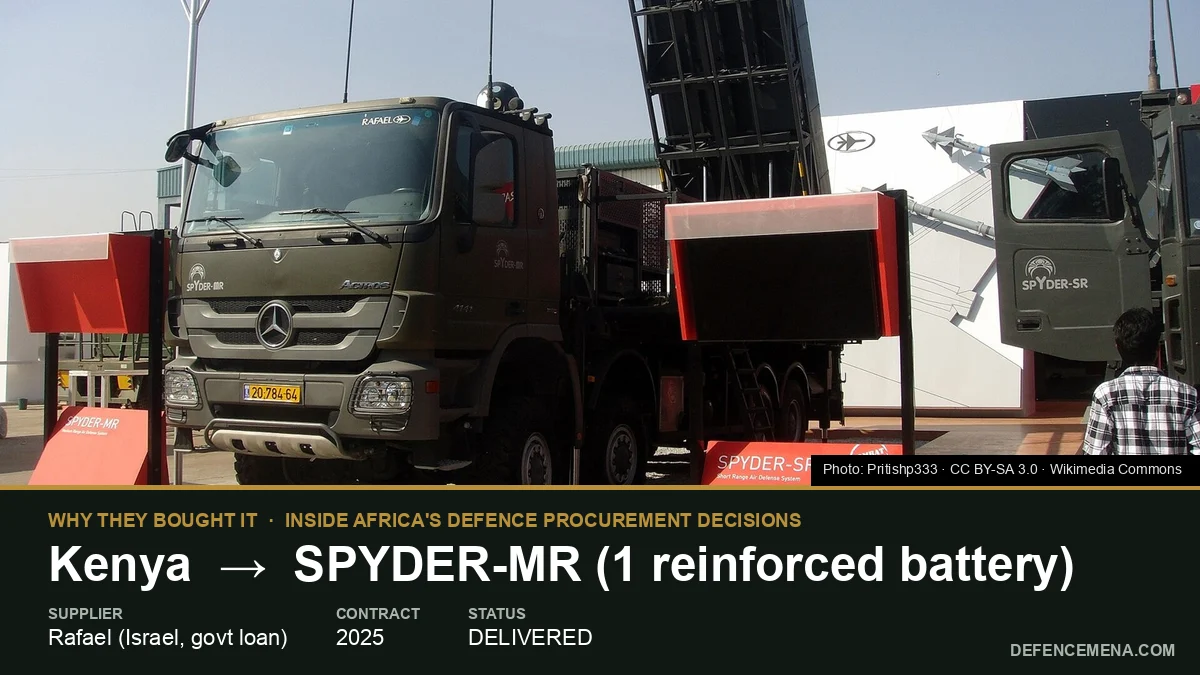


Kenya is buying Rafael’s SPYDER because, until 2024, the Kenya Defence Forces had no guided surface-to-air missile system at all, and its intelligence chief was telling Parliament that al-Shabaab and Islamic State-linked cells were gaining access to drones and other weapons through the Houthis. The Treasury’s budget books describe the purchase as “one reinforced battery of medium range surface to air missile system” from Rafael Advanced Defense Systems, financed by Israeli government loans: Sh1 billion pencilled in for 2024/25, Sh3.4 billion (about $26 million) in 2025/26 and Sh6.1 billion planned for 2026/27. A delivery flight on an Israeli Ministry of Defence-chartered freighter was reported in mid-December 2025. No Kenyan commissioning ceremony has been announced, and the contract value has never been disclosed.
Photo: A Rafael SPYDER-MR launcher vehicle on static display at Aero India 2013. Kenya's budget documents specify one reinforced battery of the medium-range variant; no photograph of the Kenyan battery has been published. Photo: Pritishp333, CC BY-SA 3.0, via Wikimedia Commons. Credit: Pritishp333, CC BY-SA 3.0, via Wikimedia Commons.
- Country
- Kenya
- System
- SPYDER medium-range surface-to-air missile system (Python-5 and Derby interceptors, Elta radar)
- Supplier
- Rafael Advanced Defense Systems (Israel), with IAI/Elta radar
- Quantity
- One reinforced battery (Treasury budget documents)
- Contract year
- Not publicly disclosed; first loan line in the 2024/25 budget, main financing in 2025/26
- Status
- DELIVERED
- Main requirement
- First guided air-defence layer against aircraft, helicopters, drones and precision-guided munitions; al-Shabaab and Houthi-linked drone threat cited in budget reporting
- Training
- Not publicly disclosed
- Localisation
- None disclosed
- Known alternatives
- No competition documented; same-class market alternatives include Barak MX, HİSAR-A+/O+ and Pantsir-S1
What capability did Kenya need?
Kenya went into the 2020s with an air force built around a fighter bought in the 1970s and an army whose air-defence branch fired cannon shells, not missiles. The order of battle maintained by defenceWeb, last updated in May 2026, lists Kenya’s ground-based air defence as roughly 70 TCM-20 twin 20 mm mounts, 11 Oerlikon guns and 13 Bofors L/70 40 mm guns. Under “air defence missiles” it records a single entry: SPYDER, one battery, on order. There was no guided surface-to-air missile in the inventory before this programme.
That gap began to matter once small drones reached the Horn of Africa. In July 2023 defenceWeb reported that Kenyan security forces had brought down a drone al-Shabaab fighters were using to gather intelligence ahead of an attack on the Sirari outpost, the first confirmed case of the group using unmanned aircraft against the Kenya Defence Forces. At that point al-Shabaab’s commercial drones were too small to carry a payload, and the outlet noted that the group had not yet armed them as Boko Haram had done in Nigeria.
The threat assessment then shifted north-east. When Business Daily first reported the Israeli loan in May 2024, the newspaper placed it against “Iranian-backed Houthi rebels” attacking Red Sea shipping with drones and missiles and against al-Shabaab, including the group’s January 2020 assault on US forces at Manda Bay. Africa Defense Forum, citing UN Monitoring Group reporting from February 2025, described a Houthi–al-Shabaab relationship that now involves weapons transfers through Somali ports, weaponised drones, surface-to-air missiles and drone-warfare training. The quote that Kenyan papers attached to the SPYDER loan came from the Director-General of the National Intelligence Service, Noordin Haji, who told legislators that “ISIS and Al-Shabaab have been collaborating with the Houthis, gaining access to advanced weaponry”, as reported by The Eastleigh Voice and Business Daily in July 2025.
The documented requirement, then, was not a shield against a state air force but a first guided layer against the threat Kenya’s own intelligence service was briefing. The Treasury’s May 2024 budget documents, as quoted by Military Africa, framed the item as the “procurement of quantity one (1) Reinforced Battery of Medium Range Surface to Air Missile System”.
What did it already operate?
The Kenya Air Force’s only interceptor remains the Northrop F-5E/F Tiger II, in service since 1978. defenceWeb counts 22 airframes; Military Africa, in a November 2024 assessment of Kenya’s need for a modern air-superiority fighter, put the active fleet at 17 F-5EM and four F-5FM in Number Two Squadron, including ex-Jordanian aircraft upgraded to F-5EM standard before delivery. No replacement fighter has been announced, and a fleet approaching half a century in service is no answer to small drones.
The Kenya Defence Forces had spent the previous decade buying for the war in Somalia instead: MD 530F Cayuse Warrior scout helicopters from the United States, Hızır mine-protected vehicles from Türkiye, and the rest of the inventory profiled in our Kenya Army weapons guide. Air defence had been the one domain left untouched by that modernisation.
There is a regional precedent that Kenyan reporting leaned on. Military Africa’s May 2024 story suggested that Kenya’s purchase “may not be unrelated” to Ethiopia’s procurement of the same system, and its September 2023 analysis of the air defences around the Grand Ethiopian Renaissance Dam reported SPYDER-MR installed near the dam in July 2019 alongside Russian Pantsir and a Ukrainian ST-68UM radar. That Ethiopian SPYDER has never been confirmed by Addis Ababa or by Rafael, so it should be read as a reported deployment rather than a documented sale. Ethiopia’s own experience of drone warfare is part of the backdrop against which every East African government now thinks about airspace.
What system was selected?
SPYDER stands for Surface-to-air Python and Derby: a family of mobile, quick-reaction air-defence systems built by Rafael with Israel Aerospace Industries (IAI) supplying the radar. Janes, reporting a January 2024 test of the newest All-in-One configuration, lists the variants as SR, MR, LR, ER and AiO, all firing ground-launched versions of the Python-5 imaging-infrared missile, the I-Derby active-radar missile and the longer-legged I-Derby ER. The MR and LR variants use a booster on the missiles for extra range; the AiO, which puts radar, command post and launcher on a single truck, gives up the booster and reaches a maximum of 40 km with the I-Derby ER.
Kenya’s budget documents specify a medium-range battery, which in Rafael’s catalogue means the SPYDER-MR: a separate command-and-control vehicle, an Elta radar and truck-mounted launchers carrying canisterised missiles. Military Africa’s December 2025 report said the battery delivered to Kenya includes an Elta radar suite and identified it as the EL/M-2106 ATAR, a three-dimensional solid-state radar; Army Recognition noted the same radar and described a launcher on an 8×8 chassis with up to eight canisterised missiles. Neither Rafael nor Kenya has published a configuration, so radar, launcher count and missile load remain unconfirmed; Army Recognition even hedged that the financing scale could point to a smaller SR or AiO set. We take the Treasury’s wording, “medium range”, as controlling.
What “reinforced battery” means has not been explained publicly; extra launchers or missiles is the plausible reading, but it is our reading, not a sourced fact.
Which alternatives were considered?
No competition has been documented: no public tender, no evaluation report and no Kenyan statement comparing SPYDER with anything else. The public knows about SPYDER only because the loan appears in Treasury estimates tabled in Parliament. The table lists same-class systems other African buyers have chosen, strictly as market context.
| Alternative | Class | Status of consideration | Source |
|---|---|---|---|
| IAI Barak MX (Israel) | Modular short/medium/long-range SAM | SAME-CLASS MARKET ALTERNATIVE; bought by Morocco, never linked to Kenya | DefenceMENA – Why Morocco bought Barak MX |
| Rafael SPYDER All-in-One (Israel) | Single-vehicle short/medium-range SAM, same family | SAME-CLASS MARKET ALTERNATIVE; a configuration choice within the same supplier, not a competitor | Janes, 11 Jan 2024 |
| ASELSAN/Roketsan HİSAR-A+ and HİSAR-O+ (Türkiye) | Low/medium-altitude SAM with counter-UAS layer | SAME-CLASS MARKET ALTERNATIVE; no Kenyan interest documented | DefenceMENA – ASELSAN air-defence and counter-UAS systems |
| KBP Pantsir-S1/S2 (Russia) | Gun-missile short-range air defence | SAME-CLASS MARKET ALTERNATIVE; reported in Ethiopian service, never linked to Kenya | Military Africa, Sep 2023 (Ethiopia GERD) |
Why was SPYDER selected?
No minister has explained the decision, so it has to be reconstructed from budget documents and official threat language. Four factors are visible, each with a different level of certainty.
The drone and missile threat from the Houthi–al-Shabaab axis: officially stated (threat picture) and documented in procurement material (purpose). The NIS Director-General’s statement that al-Shabaab and Islamic State-linked groups were obtaining advanced weaponry through the Houthis is the nearest thing to an official rationale, and it is the sentence every Kenyan report on the loan reproduces. The Treasury’s description of the system as “capable of intercepting aircraft, drones, helicopters, and guided weapons”, quoted by The Eastleigh Voice from the 2025/26 budget documents, matches that threat exactly. No specific drone incident inside Kenya is documented as the trigger; the 2023 Sirari reconnaissance drone is the only confirmed case we found.
Financing on the supplier’s terms: documented in procurement material. This is the clearest factor in the record. The Treasury’s 2025/26 Estimates of Development Expenditure list the Government of Israel as a bilateral lender providing Sh3,400,000,000 to Vote 1041, the Ministry of Defence, as appropriations-in-aid. The same table shows the Ministry’s entire gross development estimate for the year at Sh4,934,000,000, of which Sh3,934,000,000 is appropriations-in-aid and only Sh1,000,000,000 is net Exchequer funding. Business Daily did the arithmetic on 1 July 2025: the Israeli loan equalled 69.38 per cent of the Ministry’s development budget. That Israel offered such a credit line is documented; that Kenya chose SPYDER because of it is an inference, and we label it “analysts assess”.
The political channel between Nairobi and Jerusalem: reported by Army Recognition and Kenyans.co.ke. President William Ruto paid a state visit to Israel in May 2023 and met Prime Minister Benjamin Netanyahu; Army Recognition traced the SPYDER deal to a security cooperation framework dating from 2011 and to those Jerusalem meetings. Kenyans.co.ke reported that the Sh3.4 billion loan was “negotiated by President William Ruto in July 2025”. None of this has been confirmed by State House, and outlets that called the delivery a “gift” are contradicted by the Treasury’s books, which record a loan.
A regional precedent in Ethiopia: reported by Military Africa. The outlet that broke the loan story linked it to Ethiopia’s reported SPYDER-MR deployment around the GERD. Kenya and Ethiopia are not adversaries; this is a demonstration effect, not an arms race.
What is absent is as telling. There is no stated requirement to protect a named site, no reference to Nairobi’s airspace or the Manda Bay base, and no threat assessment involving a state air force. Anyone writing that Kenya bought SPYDER to defend a specific installation is guessing.
What was included in the contract?
Not publicly disclosed. The only itemisation in the public domain is the Treasury’s one-line description: one reinforced battery of a medium-range surface-to-air missile system from Rafael Advanced Defense Systems Ltd. Whether the loan covers missiles, spares, training, simulators or infrastructure has not been stated. Military Africa’s December 2025 description of Python-5 and Derby interceptors with an Elta radar is consistent with any SPYDER-MR package but is not an official manifest.
How much did it cost?
The figures that circulate are loan amounts, not a contract price, and the distinction matters.
| Financial year | Amount | Document | Reported by |
|---|---|---|---|
| 2024/25 | Sh1 billion | Treasury budget estimates tabled in Parliament, May 2024 | Business Daily, 3 May 2024; Military Africa, 9 May 2024 |
| 2025/26 | Sh3.4 billion (about $26 million) | Estimates of Development Expenditure 2025/26, Table I and II (Government of Israel, Vote 1041) | National Treasury; Business Daily, 1 July 2025 |
| 2026/27 (planned) | Sh6.1 billion (about $46.9 million) | Treasury budget report for the year starting July 2026 | Business Daily, 4 May 2026; Anadolu Agency, 5 May 2026 |
Sh3.4 billion is the loan the Treasury booked against the Ministry of Defence in 2025/26, converted by The Defense Post at $26.4 million. It is not the system price: Military Africa reported in 2024 that the system was acquired “for undisclosed cost through the loan”, and nothing since has changed that. Business Daily reported in May 2026 that a further Sh6.1 billion Israeli-backed loan, a 79.4 per cent increase, is planned for 2026/27 for the same system, within a defence development budget rising to Sh10.3 billion. If all three lines are drawn, Israeli financing would exceed Sh10 billion over three years, which implies either that the battery costs well over $26 million or that follow-on elements are being funded; neither is confirmed. Business Daily’s reading of the 2025/26 estimates, Sh48.17 million of interest and Sh811.38 million of external redemptions against the Ministry, is the only glimpse of repayment terms on record.
How many were ordered?
One reinforced battery, according to the Treasury’s budget documents as quoted by Military Africa and Business Daily. defenceWeb’s May 2026 order of battle likewise lists one battery. No launcher count, missile count or radar count has been published. Whether the Sh6.1 billion planned for 2026/27 buys a second battery or completes the first is not stated.
Training, maintenance and support
Not publicly disclosed. No Kenyan or Israeli statement describes operator training, where it takes place or who provides it. Operator and maintainer training is a standard element of Rafael’s export packages, and a first-of-type guided missile system would require it; whether Kenya’s loan covers it is unknown. Kenya’s existing air-defence artillery units are the obvious home for the battery, but the service that will operate it, Army or Air Force, has not been announced.
Local production or technology transfer
None disclosed. Nothing in the budget documents or in reporting from either country mentions local assembly, offsets or industrial participation. For a single-battery buy financed by the supplier’s government, none would be expected.
Delivery and operational status
Delivery is reported, not confirmed. On 13 December 2025 the analyst Rashid Abdi posted images of military cargo arriving in Kenya aboard a Boeing 767 freighter operated for Israel’s Ministry of Defence, and Military Africa, The Defense Post and The Jerusalem Post reported over the following days that Kenya had received its SPYDER battery. No Kenyan Ministry of Defence statement, KDF ceremony or Rafael announcement has followed, and defenceWeb’s Kenya profile, updated 28 May 2026, still listed the battery as on order. We have found no report of commissioning, test-firing or deployment as of 5 October 2026, and record the status as DELIVERED on the strength of the freighter reporting alone.
- 9 May 2023President Ruto meets Prime Minister Netanyahu in Jerusalem on a state visit; security cooperation is among the topics reported.
- Jul 2023Kenyan forces down an al-Shabaab reconnaissance drone before the Sirari outpost attack, the first confirmed al-Shabaab drone use against the KDF (defenceWeb).
- 3 May 2024Business Daily reports a Sh1 billion Israeli loan in the 2024/25 estimates for a SPYDER air-defence system from Rafael.
- 9 May 2024Military Africa quotes the Treasury line: “one (1) Reinforced Battery of Medium Range Surface to Air Missile System”.
- Jun 2025Treasury’s 2025/26 Estimates of Development Expenditure record a Sh3.4 billion Government of Israel loan to Vote 1041, Ministry of Defence.
- 1 Jul 2025Business Daily calculates the loan at 69.38 per cent of the Ministry’s Sh4.93 billion development budget.
- 13–17 Dec 2025Freighter arrival imagery posted; Military Africa, The Defense Post and The Jerusalem Post report delivery of the battery.
- 4 May 2026Business Daily reports a planned Sh6.1 billion Israeli loan for air defence in the 2026/27 budget.
- 28 May 2026defenceWeb’s Kenya order of battle still lists one SPYDER battery as on order.
- 5 Oct 2026No commissioning, live firing or deployment reported.
Has it been used operationally?
No. There is no report of the Kenyan battery being deployed, let alone engaging a target. Rafael’s late-2023 UAV interception trials of the All-in-One configuration, reported by Janes, do not involve Kenya and we do not extrapolate from them.
Did Kenya order more?
Not as a documented second order. What is documented is money: Business Daily describes the Sh6.1 billion 2026/27 loan line as being for the same missile defence system, within a development budget the Treasury projects at Sh16.63 billion in 2027/28 and Sh21.63 billion in 2028/29. Whether that buys launchers, missiles or a second battery is not public.
What does this tell us about African procurement?
The first lesson is transparency by accident. Kenya has never announced the purchase; everything public comes from the Treasury’s duty to table loan financing in Parliament, where a line reading “Government of Israel, Vote 1041, Ministry of Defence, 3,400,000,000” became a national story. For analysts of African procurement, the budget book is often a better primary source than the ministry of defence.
The second concerns financing. The striking number is not Sh3.4 billion but 69 per cent: the share of Kenya’s entire defence development budget that one supplier’s government credit covered in 2025/26. Governments under fiscal pressure buy what can be financed, and suppliers whose governments extend credit shape the outcome before any technical evaluation begins. Our survey of counter-drone systems in African armies shows the same pattern: the equipment that arrives is the equipment somebody was willing to finance.
Third, the threat is new and shared. Kenya is not buying a missile system to deter Ethiopia or Somalia but because non-state actors in the Horn and the Red Sea have acquired drones and, through the Houthis, a supply chain for more. A medium-range missile battery is a heavier answer than a jammer, and it implies the planners expect something larger than a quadcopter.
Fourth, the Israeli channel is politically costly and Kenya has paid the cost quietly. The first loan line appeared in the budget in May 2024, three months after the African Union had called on members to review trade links with Israel over the war in Gaza, as The Eastleigh Voice noted at the time. Nairobi proceeded anyway. Morocco made the same calculation with Barak MX and, by Rafael’s 2023 account, with SPYDER; in both cases the buyer declined to hold a ceremony.
Finally, “received” and “operational” are different things. Nearly ten months after cargo photographs circulated, no Kenyan unit has been shown with the system. For a force that has never operated a guided SAM, the gap between delivery and a trained battery on alert may be long, and nobody in Nairobi is obliged to say when it closes.
Procurement record
| Field | Value |
|---|---|
| Country | Kenya |
| Service | Kenya Defence Forces (operating service not announced) |
| System | SPYDER medium-range surface-to-air missile system (SPYDER-MR), Python-5 and Derby interceptors, Elta radar |
| Manufacturer | Rafael Advanced Defense Systems Ltd (radar: IAI Elta) |
| Origin | Israel |
| Category | Air defence / counter-drone |
| Requirement | First guided air-defence layer against aircraft, helicopters, drones and guided weapons; Houthi-linked drone and missile proliferation to al-Shabaab and Islamic State-linked groups cited by the NIS Director-General |
| Order date | Not publicly disclosed; first appears in 2024/25 budget estimates (May 2024) |
| Contract date | Not publicly disclosed |
| Quantity | One reinforced battery |
| Contract value | Not publicly disclosed. Israeli government loans: Sh1bn (2024/25), Sh3.4bn / about $26m (2025/26), Sh6.1bn / about $46.9m planned (2026/27) |
| Delivery | Reported mid-December 2025 by Israeli MoD-operated Boeing 767 freighter; not confirmed by Kenya |
| Operational status | DELIVERED (reported); no commissioning or deployment reported as of 5 Oct 2026 |
| Training | Not publicly disclosed |
| Support | Not publicly disclosed |
| Localisation | None disclosed |
| Tech transfer | None disclosed |
| Confirmed competitors | None documented |
| Follow-on order | Sh6.1bn Israeli loan planned for 2026/27 for the same system; no order details |
| Primary source | National Treasury, Estimates of Development Expenditure 2025/26, Vol. II, Tables I–II (Government of Israel, Vote 1041) |
| Last verified | 5 October 2026 |
FAQ
Does Kenya have an air defence system?
Until this purchase Kenya’s air defence consisted of 20 mm and 40 mm guns and F-5E/F fighters. The SPYDER battery, reported delivered in December 2025, is its first guided surface-to-air missile system; no commissioning has been announced.
How much did Kenya pay for the SPYDER system?
The contract value has not been disclosed. The Treasury booked a Sh3.4 billion (about $26 million) Israeli government loan for the system in 2025/26, after a Sh1 billion line in 2024/25, and plans a further Sh6.1 billion in 2026/27. These are loan amounts, not a system price.
Has Kenya received the SPYDER air defence system?
Delivery by an Israeli Ministry of Defence-operated freighter was reported in mid-December 2025 by Military Africa, The Defense Post and The Jerusalem Post. Kenya has not confirmed it; defenceWeb still listed the battery as on order in May 2026.
What is the SPYDER air defence system?
SPYDER is a Rafael family of mobile surface-to-air missile systems that fire ground-launched Python-5 and Derby missiles, with an IAI Elta radar. Kenya’s budget documents specify the medium-range variant, which uses boosted missiles and separate radar, command and launcher vehicles.
Why does Kenya need an air defence system?
Kenyan reporting on the loan cites the intelligence service’s warning that al-Shabaab and Islamic State-linked groups are obtaining advanced weapons, including drones, through Yemen’s Houthis. Al-Shabaab first used a drone against a Kenyan outpost in 2023.
Which African countries operate SPYDER?
Ethiopia is reported to have installed SPYDER-MR near the Grand Ethiopian Renaissance Dam in 2019, and Rafael said in 2023 that Morocco was buying the system. Neither has been officially confirmed by the buyer. Kenya is the third reported African customer.
More from Why They Bought It
- Why Did Morocco Buy the AH-64E Apache?
- Why Did Nigeria Buy the VT-4 Tank?
- Why Did Côte d'Ivoire Buy the Wing Loong II?
- Why Did Kenya Buy 118 Katmerciler HIZIR Armoured Vehicles?
- Why Did Nigeria Buy the M-346FA?
- Why Did Egypt Buy (and Build) the K9 Howitzer?
- Why Did Niger Buy the Bayraktar TB2?
- Why Did Senegal Buy the OPV 58 S?
- Why Did Kenya Buy the MD 530F Cayuse Warrior?
- Why Did Uganda Buy the Su-30MK2?
- Why Did Burkina Faso Buy Chinese Armoured Vehicles?
- Why Did Senegal Buy the Ground Master 400 Radar?
Sources
- The National Treasury (Kenya) – Estimates of Development Expenditure 2025/2026, Vol. II, Tables I–II: Government of Israel loan to Vote 1041 Ministry of Defence (June 2025)
- defenceWeb – Kenya: order of battle and equipment (updated 28 May 2026)
- defenceWeb – Attack on Kenya Defence Forces outpost confirms al-Shabaab drone use (28 July 2023)
- Business Daily – Kenya taps Israeli loan for upgrade of air defence (3 May 2024)
- Business Daily – Israeli loan to fund 69pc of Defence development budget (1 July 2025)
- Business Daily – KDF gets Sh6bn Israel loan for air defence amid Iran war (4 May 2026)
- The Eastleigh Voice – Kenya moves to acquire Israeli Sh1 billion air defence system (3 May 2024)
- The Eastleigh Voice – Israel to fund part of Kenya’s military modernisation with Sh3.4 billion loan (2 July 2025)
- Military Africa – Kenya acquiring Spyder air defence system from Rafael (9 May 2024)
- Military Africa – Kenya receives Israeli SPYDER air defence system (December 2025)
- The Defense Post – Kenya Boosts Air Defense With Israeli SPYDER System (17 December 2025)
- The Jerusalem Post – Kenya receives SPYDER air defense systems from Israel (24 December 2025)
- Army Recognition – Kenya Receives Israeli SPYDER Air Defense to Counter Growing Drone and Air Threats (15 December 2025)
- Kenyans.co.ke – Kenya Acquires Israeli SPYDER Air Defence System for Ksh3.4 Billion (15 December 2025)
- Anadolu Agency via Yeni Şafak – Kenya secures $46.9 million Israeli financing for new air defense system (5 May 2026)
- Janes – Rafael tests SPYDER All in One air-defence system with Israeli MoD (11 January 2024)
- Military Africa – Ethiopia defends GERD dam with Russian-made Pantsir-S2 and Ukrainian ST-68UM radar (21 September 2023)
- Military Africa – Kenya in need of capable air superiority aircraft (15 November 2024)
- Africa Defense Forum – Al-Shabaab Alliance With Houthis Continues to Grow (24 June 2025)
- Defence Industry Europe – Morocco to buy Spyder air defence system from Rafael (20 March 2023)
Last updated: 5 October 2026. This article is updated in place when the procurement status changes.