Why Did Kenya Buy the MD 530F Cayuse Warrior?

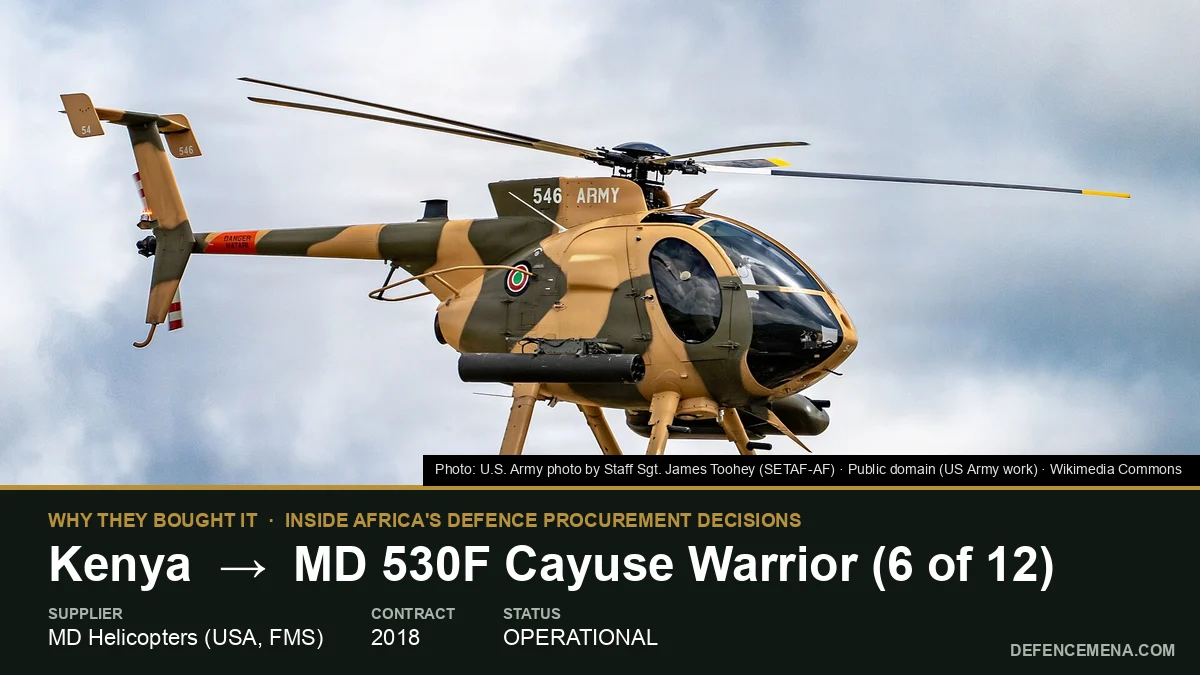


Kenya bought the MD 530F Cayuse Warrior because its army needed an armed scout helicopter for troops in Somalia and along the Somali border, and because the type is the modern descendant of the Hughes/MD 500 Defenders its 50 Air Cavalry Battalion had flown for decades. The United States approved up to 12 aircraft in May 2017 at an estimated $253 million including weapons and support; Kenya took six under a US Army delivery order of September 2018 and commissioned them at Embakasi on 23 January 2020. The second six have never been publicly contracted.
Photo: A Kenya Army MD 530F Cayuse Warrior flies close air support during the Justified Accord 2026 live-fire exercise at Laresoro, Kenya, 8 March 2026. Photo: US Army / Staff Sgt. James Toohey, public domain, via Wikimedia Commons. Credit: U.S. Army photo by Staff Sgt. James Toohey (SETAF-AF), Public domain (US Army work), via Wikimedia Commons.
- Country
- Kenya
- System
- MD 530F Cayuse Warrior armed scout / light attack helicopter
- Supplier
- MD Helicopters, Mesa, Arizona (USA), via US Army Foreign Military Sales
- Quantity
- 12 approved; 6 ordered and delivered
- Contract year
- 2018 (delivery order, 27 September)
- Status
- OPERATIONAL
- Main requirement
- Scout and attack rotary-wing operations for the AMISOM mission in Somalia; replacement of the ageing MD 500 reconnaissance fleet
- Training
- Transition training at Mesa, Arizona; armament and gunnery training at Laikipia Air Base (five-year support contract, 2019)
- Localisation
- None disclosed
- Known alternatives
- No documented competition (FMS sole-source); parallel AT-802L Longsword case approved in 2017 but never signed
What capability did Kenya need?
When Kenya’s helicopter request reached Congress in May 2017, the Kenya Defence Forces had been inside Somalia for five and a half years, holding the Jubaland sector north of Kismayo along roads that al-Shabaab had learned to mine. What the ground force lacked was an armed helicopter that could scout ahead of a convoy, orbit over a forward operating base at night and put fire on a position within minutes.
The US notification said so in plain terms. The sale, the Defense Security Cooperation Agency wrote, would “advance Kenya’s efforts to conduct scout and attack rotary wing aircraft operations in support of their AMISOM mission” and would improve “the security of a strong regional partner who is a regional security leader, undertaking critical operations against al-Shabaab.” The same document described the MD 500 reconnaissance fleet as ageing. That is the officially stated requirement: a mission in Somalia, and a predecessor that needed replacing.
The Kenyan side framed it as counter-terrorism. President Uhuru Kenyatta, quoted by Business Daily in September 2019, said the acquisitions provided “our nation with safety and security from terror groups and other asymmetrical threats.” At the commissioning in January 2020 the Kenya Army commander, Lieutenant General Walter Koipaton, said the helicopters had “come at a time when we most need them in our operations both within our borders and beyond.” The border half of that sentence matters: al-Shabaab’s raids into Kenya’s north-eastern counties were as much a driver as Jubaland.
Between December 2015 and September 2017 Kenya also pursued a fixed-wing close air support aircraft, the AT-802L Longsword, through a separate FMS case that was approved, protested in Congress and then allowed to lapse unsigned. The helicopter case went ahead.
What did it already operate?
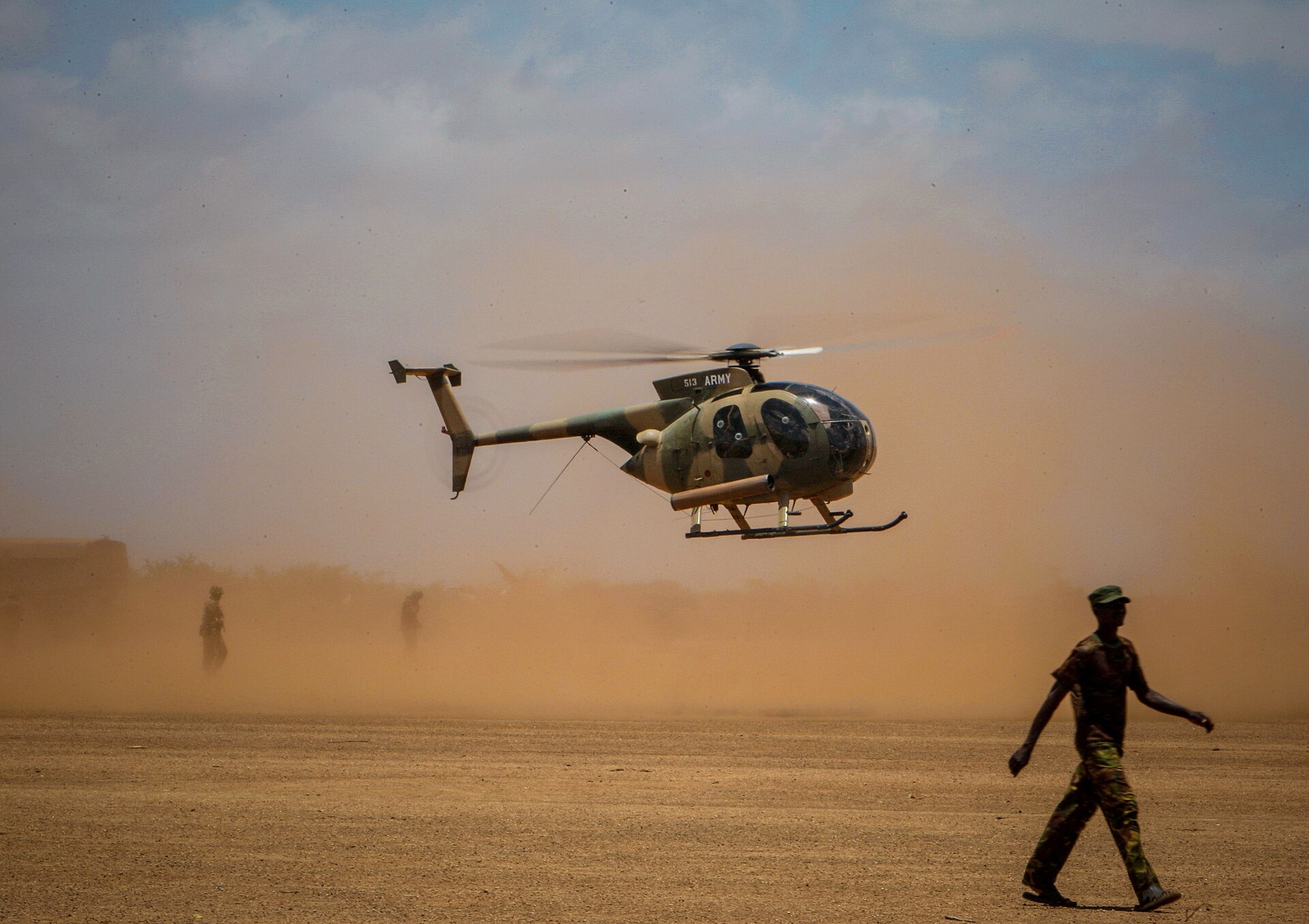
Kenya’s army aviation has been built around the Hughes/MD 500 family for decades. The 50 Air Cavalry Battalion, identified by defenceWeb, Military Africa and Business Daily as the unit whose MD 500s the new aircraft would replace, flies from Embakasi in Nairobi and deployed its Defenders to Somalia after October 2011. A Kenya Army 500-series aircraft is the subject of the AMISOM photograph from Kismayo in October 2012 that accompanies this article.
Military Africa, reporting the South Korean donation of six retired 500MD airframes in January 2024, put the fleet at 40 MD 500E plus the six MD 530F: a large, old, single-type fleet the army knew how to fly and maintain. The same outlet listed eight AS350 Fennecs in Kenyan service. For lift, the KDF relies on Kenya Air Force Mi-17s and Pumas and on US-supplied UH-1H Huey IIs, a flow that continued in July 2024 with eight more Hueys and eight MD 500s. Our Kenya Army inventory guide covers the ground fleet and this survey of African Mi-17 operators the transport helicopters.
What Kenya did not operate was a dedicated attack helicopter. The MD 530F filled that gap while fitting into a unit and a maintenance culture that already existed.
What system was selected?
The MD 530F Cayuse Warrior is the armed military version of the MD 530F, the hot-and-high member of the MD 500 line with a 650 shp Rolls-Royce 250-C30 turbine. The Kenyan configuration, as described by MD Helicopters in September 2018 and repeated by defenceWeb and Military Africa, includes the FN Herstal weapons management system, the Dillon Aero armament system and fixed-forward sight, 62 mm ballistic armour, a crashworthy fuel system, a glass cockpit and Harris and Rockwell Collins radios. The weapons are FN Herstal HMP 400 .50-calibre gun pods and M260 seven-shot 70 mm rocket launchers.
The DSCA package of May 2017 covered 12 aircraft, 24 HMP 400 pods, 24 M260 launchers, 4,032 M151 high-explosive rockets, 1,536 M274 practice rockets, 400,000 rounds of .50-calibre ammunition, communications equipment, contractor logistics support, training, spares and airlift delivery, with MD Helicopters as prime contractor. The type was already in Afghan Air Force service, the “proven performer in combat operations” that chief executive Lynn Tilton cited when the Kenyan order was placed.
Two features deserve attention. Kenya took the F model rather than the newer MD 530G that Lebanon ordered days later; the F is closer to the aircraft Kenya already flew. And the sale ran through the US Army’s five-year, $1.4 billion indefinite-delivery, indefinite-quantity contract with MD Helicopters, signed in September 2017 for up to 150 armed MD 530F/G for US and partner forces. Kenya’s six were the second delivery order on that vehicle: a fixed price, a US Army airworthiness release, no bespoke production line.
Which alternatives were considered?
No competition is documented for the MD 530F. As the GAO explained in its 2017 review of the Longsword case, an FMS customer may name the firm it wants and “need not provide a rationale” for a sole-source request. What the record holds is the fixed-wing case that ran alongside, and the market Kenya could in principle have chosen from.
| Alternative | Class | Status of consideration | Source |
|---|---|---|---|
| Air Tractor / L3 AT-802L Longsword (12 + 2 AT-504) | Fixed-wing light attack / ISR | REPORTED ALTERNATIVE: separate FMS case, requested Dec 2015, approved Jan 2017 ($418m est.), never signed | Federal Register; GAO-17-713R; defenceWeb |
| IOMAX Archangel | Fixed-wing light attack | REPORTED ALTERNATIVE: raised by IOMAX in the Congressional protest over the Longsword case, not against the MD 530F | GAO-17-713R; defenceWeb |
| MD 530G | Armed scout helicopter (same family) | SAME-CLASS MARKET ALTERNATIVE: on the same US Army contract; chosen by Lebanon in Oct 2018; no Kenyan evaluation documented | The Defense Post |
| Airbus H125M / AS550 Fennec (armed) | Light armed helicopter | SAME-CLASS MARKET ALTERNATIVE: Kenya operates AS350 Fennecs; no competition documented | Military Africa |
| Bell 407GT / 407GXi armed | Light armed helicopter | SAME-CLASS MARKET ALTERNATIVE: no competition documented | Market reference only |
The Longsword story is often misreported as a purchase. According to the GAO, Kenya first requested six AT-802L in December 2015, with an option the US Air Force turned into an offer for up to 12. The January 2017 notification, published in the Federal Register on 10 February, priced the package at $418 million with Paveway II kits, 714 APKWS guidance sections and L3 as prime. Representative Ted Budd and IOMAX objected that the armed AT-802L was unproven and that IOMAX’s Archangel had been overlooked; the GAO reported on 5 September 2017 that the Air Force found Kenya “made a reasonable choice” and that Nairobi valued the aircraft’s “simplicity of use, ease of maintenance, and long loiter time”. The offer, extended to 16 September because Kenya did not want to sign before its August election, lapsed. No AT-802L was ever contracted or delivered.
Why was the MD 530F selected?
The record supports four factors, with different levels of certainty.
A stated mission requirement in Somalia (officially stated). Both governments said the aircraft were for scout and attack operations in support of AMISOM and for counter-terrorism: the DSCA text, Kenyatta’s and Koipaton’s remarks, and Ambassador Kyle McCarter’s description of the helicopters as “tangible examples of our joint commitment to the fight against terrorism.” Major Kamicha Gachoki, the KDF’s programme officer, told the US Army Security Assistance Command in April 2019 that this was “just about the most important program for KDF because of the capability we will acquire with delivery of these aircraft that can impact operations both by day and by night.” Night capability is the detail the old Defenders lacked.
Fleet continuity with the MD 500 (documented in procurement material). The DSCA notification described the sale as replacing an ageing MD 500 reconnaissance fleet. The MD 530F shares its lineage, handling and support philosophy with the aircraft the battalion already flew, so conversion would take months rather than years. No Kenyan statement spells this out.
The FMS route and the US Army contract vehicle (documented). Buying through the US Army gave Kenya a fixed-price lot on an existing contract, an airworthiness release and a sustainment contract signed before the aircraft arrived. The GAO’s account of why governments use FMS lists a mature acquisition process, a reliable product and interoperability, while conceding that FMS “is generally not the quickest or least expensive option”. DVIDS said the Kenyan “journey began in 2016”, so the two cases ran in parallel.
The lapse of the Longsword case (analysts assess). Kenya walked away from a $418 million fixed-wing package in September 2017 and a year later placed a six-helicopter order. It is reasonable to read that as a choice to fund the rotary-wing capability first, but no Kenyan official has publicly linked the two decisions. The sequence is a fact; the causal link is an assessment. A budget constraint is possible but unconfirmed: no breakdown of the 2018 allocation of Sh114.2 billion noted by Business Daily has been published.
What was included in the contract?
The 27 September 2018 delivery order from US Army Contracting Command, Redstone Arsenal, was a firm fixed-price award for six armed MD 530F Cayuse Warriors in the configuration above, with initial logistics support for the aircraft, their systems and ground support equipment. The US Army said in April 2019 that the case also covered weapons, ammunition, training and ground equipment, with a full airworthiness release for every aircraft. A second award on 13 September 2019, effective 1 September, added five years of logistics support and training: transition training at Mesa, then field service, armament and gunnery training at Laikipia Air Base. DVIDS called this a “multi-year sustainment package”. Its value has not been published.
How much did it cost?
The only published figure is the DSCA estimate of $253 million, and it must be handled with care. It is the ceiling for the whole notified package of 12 aircraft, weapons, ammunition, training, spares and contractor support. It is not a contract value and does not describe what Kenya bought, which was six aircraft and a support contract. The value of the 2018 delivery order and the 2019 support award has not been disclosed by the US Army, MD Helicopters or the Kenyan Ministry of Defence. Dividing $253 million by 12 produces a number that corresponds to nothing in the record; unit price, system price and package value are all not publicly disclosed. defenceWeb reported that the purchase was funded under the Ministry of Defence’s modernisation programme.
How many were ordered?
Twelve were approved and notified to Congress on 1 May 2017. Six were ordered on 27 September 2018 and six delivered. At the January 2020 handover the US military said a second batch of six was “scheduled”; none has been ordered or delivered since. In February 2022 a US Army spokesman told Janes, as reported by defenceWeb and Military Africa, that the service was “working towards resuming production for Kenya as part of their next aircraft procurement”, with two airframes built for Afghanistan sitting under a stop-work order. That is the last public word. The second six should be treated as APPROVED but unconfirmed.
Training, maintenance and support
Training has two documented layers: transition training at Mesa, Arizona, and armament, gunnery and field service support at Laikipia Air Base, both under the September 2019 award. A programme management review in Huntsville in April 2019 was attended by the Kenya Army deputy commander, Major General Thomas Chepkuto, and Major Gachoki. Sustainment is covered by the five-year contract that began on 1 September 2019; whether a follow-on has been signed is not publicly known. That an MD 530F was flying at Laresoro in March 2026 shows the fleet is being kept airworthy, though not by whom.
Local production or technology transfer
None disclosed. The Federal Register notice for the parallel Longsword case stated there were no known offset agreements, and none has been reported for the helicopter case. The aircraft were built at Mesa and delivered by airlift, as the DSCA package specified.
Delivery and operational status
MD Helicopters planned deliveries from April to August 2019; they slipped to December, as Business Daily forecast and defenceWeb and Military Africa confirmed. The handover took place at the Joint Helicopter Command, Embakasi, on 23 January 2020, before General Samson Mwathethe, Ambassador McCarter and Major General Michael Turello of CJTF-HOA. Mwathethe said the type’s integration “will go a long way in enhancing our capacity to operate in the contemporary security environment.”
- Dec 2015Kenya submits its first letter of request for six AT-802L Longsword fixed-wing attack aircraft, a separate FMS case (GAO).
- Jan–Feb 2017DSCA notifies Congress of the Longsword package, up to 12 aircraft, $418 million estimate; IOMAX and Rep. Ted Budd protest.
- 1–2 May 2017DSCA notifies Congress of 12 MD 530F Cayuse Warriors with weapons and support, $253 million estimate.
- 5–16 Sep 2017GAO finds Kenya “made a reasonable choice” on the Longsword; the extended Longsword offer lapses unsigned.
- Sep 2017US Army awards MD Helicopters a five-year, $1.4 billion IDIQ contract for up to 150 armed MD 530F/G for US and partner forces.
- 27 Sep 2018Delivery order for six MD 530F for Kenya; deliveries planned April–August 2019.
- 8–9 Apr 2019Programme management review in Huntsville with the KDF delegation; first delivery planned for May.
- 13 Sep 2019Five-year logistics support and training award (Mesa transition training; Laikipia gunnery and field service).
- Dec 2019All six aircraft delivered to Kenya.
- 23 Jan 2020Handover and commissioning at Joint Helicopter Command, Embakasi; second six described as “scheduled”.
- Feb 2022US Army tells Janes it is working to resume production “for Kenya as part of their next aircraft procurement”; no order follows publicly.
- 8–10 Mar 2026Kenya Army MD 530F flies close air support in the Justified Accord 2026 live-fire at Laresoro.
Has it been used operationally?
The aircraft were bought for Somalia, and the KDF’s own ATMIS magazine for 2023–24 places the army’s “MD 500” helicopters in Jubaland, escorting Hueys, flying surveillance and conducting what it calls precision airstrikes during Operation Thunderstrike IV in July 2023. The magazine does not distinguish the MD 500E from the MD 530F, and the KDF has not named the Cayuse Warrior in a specific operation, so we cannot say with certainty that the six have flown combat sorties, although it would be surprising if they had not. The documented use is on exercise: in Justified Accord 2026, a Kenya Army MD 530F provided close air support for KDF rangers at Laresoro on 8 March, with US and Kenyan joint terminal attack controllers coordinating the fires, and again on 10 March. Kenya’s wider cooperation with the United States is covered in our report on the Manda Bay exercise.
What has operational use shown?
At public level, three things. The aircraft have been integrated into combined-arms training with forward observers and JTACs, the mission the DSCA notification described. They have been kept flying for six years, the practical test of a sustainment package. And the fleet is small: six helicopters cannot cover both a Somali sector and a long border, so the MD 500Es and the Hueys still carry most of the load. For how other African armies have used heavier gunships, see our Battlefield Proven study of the Mi-24 and Mi-35 in Africa.
Did Kenya order more?
Not as far as the record shows. The second six remain unordered; the February 2022 Janes report is the last mention. MD Helicopters went through Chapter 11 in 2022 and emerged that September under new ownership, as AIN reported, though no source connects that to the Kenyan case. Kenya’s later rotary-wing additions have come as donations: six retired 500MD Defenders from South Korea announced in December 2023 for UN peacekeeping use, and eight UH-1 Huey IIs plus eight MD 500s from the United States announced in July 2024 during President William Ruto’s state visit. Kenya’s armoured vehicle purchases in the same period went to Türkiye, as the HIZIR decision in this series shows.
What does this tell us about African procurement?
The first lesson is that the fleet you already have shapes the fleet you buy. Kenya had flown the Hughes/MD 500 family for decades, had a battalion organised around it and a generation of technicians who knew it. When the time came to add firepower and night capability, the path of least resistance was the armed version of the same airframe. A small air arm that converts to a new type pays in years of reduced availability, and the KDF, fighting across the border, could not afford that.
The second is that approvals are not purchases. The $253 million and 12 aircraft of the DSCA notification have been repeated for nine years as if they described a deal. They describe a ceiling. Kenya bought half the aircraft at an undisclosed price, and the other half has sat in the “scheduled” column since January 2020. The Longsword case is the sharper version: a $418 million package, a Congressional fight, a GAO review, and then nothing, because the customer chose not to sign. Every DSCA figure is the start of a story, not the end of one.
The third concerns the FMS system itself, which Kenya has used since 1976. The MD 530F case shows its strengths: an existing contract vehicle, an airworthiness release, a sustainment package negotiated before delivery. It also shows the cost the GAO was candid about: the request began in 2016 and the aircraft landed at the end of 2019. Kenya’s parallel turn to Türkiye for vehicles, and to donations for transport helicopters, suggests Nairobi understands that trade-off. Our analysis of who supplies Africa’s weapons places this in the continental picture.
Finally, the decision illustrates a purchase that is easy to overlook: the small, cheap, armed helicopter. It does not make headlines the way Nigeria’s AH-1Z Vipers do, and that decision answered a different threat with a larger budget. But for a counter-insurgency fought along supply routes and around forward operating bases, a light helicopter with a gun pod and seven rockets, flown by a crew who grew up on the type, may be the more useful instrument. Kenya bought six. Whether it ever buys the other six is the open question.
Procurement record
| Field | Value |
|---|---|
| Country | Kenya |
| Service | Kenya Defence Forces (Kenya Army, 50 Air Cavalry Battalion / Joint Helicopter Command, Embakasi) |
| System | MD 530F Cayuse Warrior armed scout / light attack helicopter |
| Manufacturer | MD Helicopters, Mesa, Arizona |
| Origin | United States |
| Category | Light attack / scout helicopter |
| Requirement | Scout and attack rotary-wing operations in support of the AMISOM mission; replacement of ageing MD 500 reconnaissance fleet (DSCA, May 2017) |
| Order date | DSCA notification 1 May 2017 (12 aircraft); Kenyan request reported to have begun in 2016 |
| Contract date | 27 September 2018 (US Army delivery order, six aircraft); 13 September 2019 (five-year support and training award) |
| Quantity | 12 approved; 6 ordered and delivered |
| Contract value | Not publicly disclosed. DSCA ceiling estimate $253 million for 12 aircraft plus weapons, ammunition and support; delivery order placed under a $1.4 billion US Army IDIQ for up to 150 aircraft |
| Delivery | Six aircraft delivered December 2019; handed over and commissioned 23 January 2020 |
| Operational status | OPERATIONAL (six); second batch of six APPROVED, not contracted |
| Training | Transition training at Mesa, Arizona; armament and gunnery training at Laikipia Air Base; US Army programme management review April 2019 |
| Support | Initial logistics support in delivery order; five-year logistics support contract from 1 September 2019 (“multi-year sustainment package”); value undisclosed |
| Localisation | None disclosed |
| Tech transfer | None disclosed |
| Confirmed competitors | None (FMS sole-source request) |
| Follow-on order | None announced; US Army said in February 2022 it was working to resume production “for Kenya as part of their next aircraft procurement” |
| Primary source | DSCA notification of 1–2 May 2017 (via Forecast International reprint); DVIDS handover report, 23 January 2020 |
| Last verified | 5 October 2026 |
FAQ
Why did Kenya buy the MD 530F?
For scout and attack helicopter operations supporting its AMISOM mission in Somalia and counter-terrorism at home, and to replace the ageing MD 500 Defenders of the 50 Air Cavalry Battalion, as stated in the US notification of May 2017.
How many MD 530F helicopters does Kenya have?
Six. The United States approved up to 12 in May 2017; Kenya ordered six in September 2018 and received them in December 2019. The second six have not been contracted as far as the public record shows.
How much did Kenya’s MD 530F helicopters cost?
The contract value has not been published. The $253 million figure often quoted is the DSCA ceiling estimate for 12 aircraft with weapons, ammunition, training and support, not the price Kenya paid for six.
Did Kenya buy the AT-802L Longsword?
No. The US approved a $418 million package of 12 AT-802L and two AT-504 aircraft in January 2017; Kenya let the offer lapse in September 2017 without signing. None were delivered.
Which Kenya Air Force helicopters and army helicopters fly alongside the MD 530F?
The Kenya Army also flies MD 500E Defenders and UH-1H Huey IIs, with more Hueys and MD 500s donated by the United States in 2024 and six 500MDs by South Korea. The Kenya Air Force operates Mi-17, Puma and Fennec helicopters.
Has the MD 530F been used in combat by Kenya?
The KDF has not named the MD 530F in a specific operation; its ATMIS reports describe “MD 500” helicopters flying escort, surveillance and strikes in Somalia in 2023–24 without specifying the model. Documented use is on exercise, most recently Justified Accord 2026.
More from Why They Bought It
- Why Did Morocco Buy the AH-64E Apache?
- Why Did Nigeria Buy the VT-4 Tank?
- Why Did Côte d'Ivoire Buy the Wing Loong II?
- Why Did Kenya Buy 118 Katmerciler HIZIR Armoured Vehicles?
- Why Did Nigeria Buy the M-346FA?
- Why Did Egypt Buy (and Build) the K9 Howitzer?
- Why Did Niger Buy the Bayraktar TB2?
- Why Did Senegal Buy the OPV 58 S?
Sources
- Forecast International (reprinting DSCA) – United States approves MD530F sale to Kenya (3 May 2017)
- US Army / USASAC – International helicopter pact (25 April 2019)
- DVIDS / CJTF-HOA – United States delivers MD-530F helicopters to Kenya Defense Force (January 2020)
- DVIDS / SETAF-AF – US, Kenya air to ground forces integrate fires during Justified Accord 2026 (8 March 2026)
- US Government Accountability Office – Foreign Military Sales: Kenyan Request for Armed Aircraft, GAO-17-713R (5 September 2017)
- Federal Register – Arms Sales Notification, Transmittal 16-79, Kenya AT-802L (10 February 2017)
- ATMIS / Kenya Defence Forces – KDF ATMIS contingent magazine, February 2023 – February 2024
- MD Helicopters – Kenya Defence Force orders six armed MD 530F attack helicopters (27 September 2018)
- defenceWeb – Kenya seeking sale of 12 armed MD 530F helicopters (May 2017)
- defenceWeb – MD Helicopters receives order for six Kenyan MD530Fs (October 2018)
- defenceWeb – Kenyan MD 530Fs delivered (January 2020)
- defenceWeb – Kenya commissions MD 530F helicopters (January 2020)
- defenceWeb – Kenya interested in acquiring more MD 530 helicopters (February 2022)
- defenceWeb – Kenya fails to commit to acquisition of 12 Air Tractors from US (2018)
- defenceWeb – US approves possible Air Tractor weapons sale to Kenya (January 2017)
- Military Africa – Kenya Defence Forces induct MD 530F helicopters (January 2020)
- Military Africa – Kenya push for additional MD 530F helicopters from the US (February 2022)
- Military Africa – South Korea donates MD500 Defender helicopters to Kenya for UN peacekeeping (January 2024)
- Business Daily Africa – Kenya military to receive six US-made helicopters in December (16 September 2019)
- The Star – Kenya receives first batch of military choppers from US (15 July 2024)
- The Defense Post – Lebanon and Kenya each order 6 MD 530 light attack helicopters (2 October 2018)
- The Defense Post – Kenya commissions 6 MD 530F Cayuse Warrior helicopters (24 January 2020)
- AIN – MD Helicopters emerges from bankruptcy (7 September 2022)
Last updated: 5 October 2026. This article is updated in place when the procurement status changes.