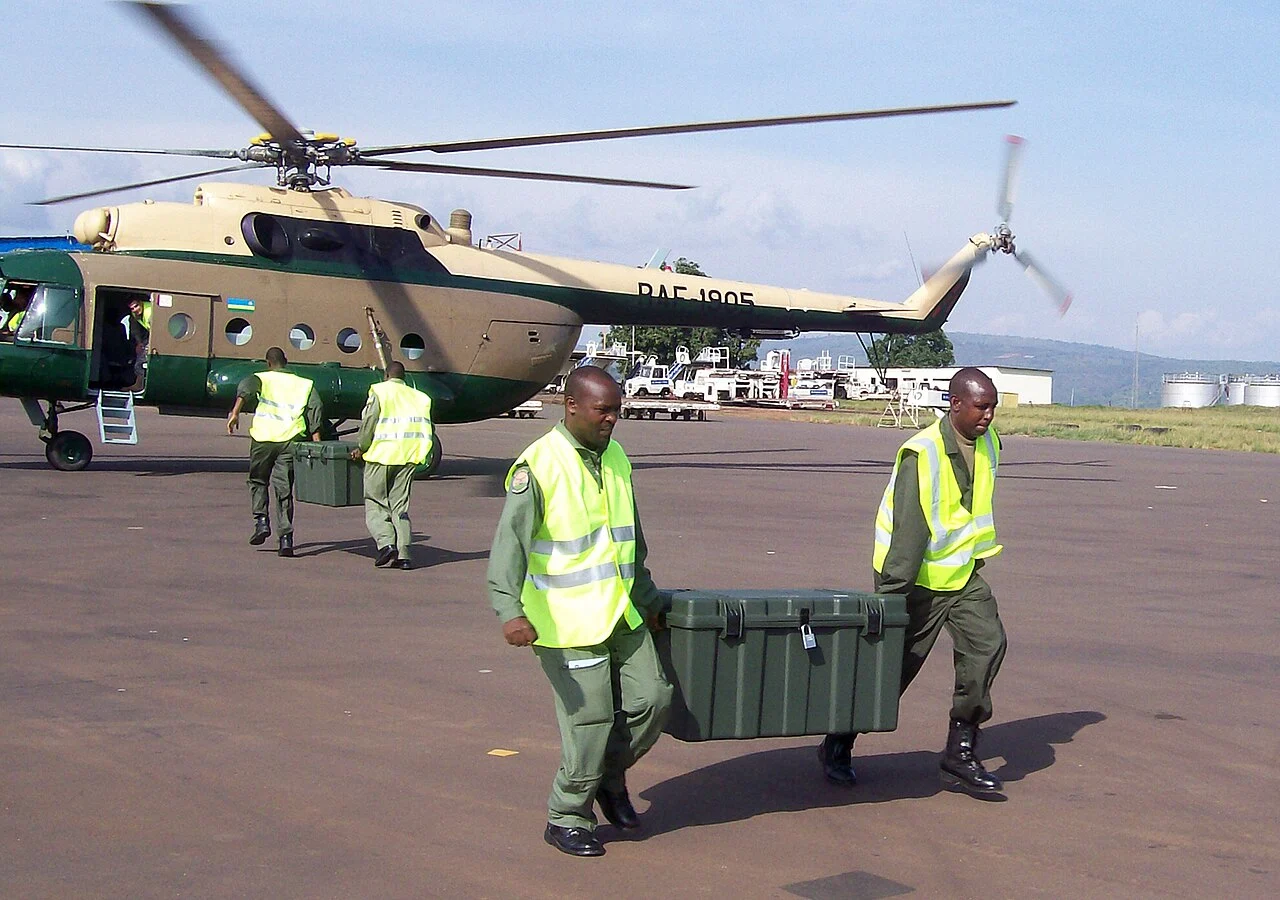
Twelve African air forces have documented use of the Mi-17/Mi-171 family, the Russian-built medium transport helicopter that has become the continent’s most widely used rotary workhorse: Nigeria, Niger, Mali, Ghana, Uganda, Ethiopia, Sudan, DR Congo, Rwanda, Cameroon, Kenya and, with a single confirmed airframe, Ivory Coast. Roughly eighteen further African states are listed as Mi-8/17 family operators in general references but could not be independently verified this cycle.
Photo: A Rwanda Air Force Mi-17 helicopter in Kigali. Credit: US Army Africa, CC BY 2.0, via Wikimedia Commons.
Direct answer
Operational, with documented in-service use, commissioning or deployment: Nigeria, Niger, Mali, Ghana, Uganda, Ethiopia, Sudan, DR Congo, Rwanda, Cameroon and Kenya. Delivered, with a confirmed airframe but no documented in-service statement: Ivory Coast. A further set of countries appear in general references (chiefly a Wikipedia operator list) as historical or current Mi-8/17-family users, but this run found no independent confirmation for them; they are listed separately below and kept off the “confirmed” map colour.
Status count by country entry, 27 Sep 2026
- Operational (documented in-service use): 11 (Nigeria, Niger, Mali, Ghana, Uganda, Ethiopia, Sudan, DR Congo, Rwanda, Cameroon, Kenya)
- Delivered, status unclear: 1 (Ivory Coast)
- Ordered / under contract: 0 (none found this cycle)
- Reported, unconfirmed this cycle: 18 (Algeria, Angola, Chad, Djibouti, Egypt, Equatorial Guinea, Eritrea, Libya, Mozambique, Namibia, Republic of the Congo, Senegal, Sierra Leone, South Sudan, Togo, Zambia, Zimbabwe, Guinea)
Ordered is not delivered. Delivered is not operational. Reported is not confirmed.
Quick operator table
| Country | Variant | Quantity | Status | Order year | Delivery year | Contract value | Source | Last verified |
|---|---|---|---|---|---|---|---|---|
| Nigeria | Mi-171Sh (armed transport); Mi-171E | 6 Mi-171Sh (2015); 2 Mi-171E (2020) | Operational | UNKNOWN | 2015; 2020 (Feb and Dec) | UNKNOWN | DefenceWeb; DefenceWeb; Janes | 27 Sep 2026 |
| Niger | Mi-171Sh | 2 | Operational | 2017-2019 | 2020 (24 Feb) | US$47m (reported) | DefenceWeb; Military Africa | 27 Sep 2026 |
| Mali | Mi-171Sh | 4 | Operational | 2020 (Dec, contract) | 2021 (30 Sep arrival; 26 Nov handover) | 36bn CFA francs, about US$61m (reported) | DefenceWeb; DefenceWeb; Key.Aero | 27 Sep 2026 |
| Ghana | Mi-171Sh | 4 | Operational | UNKNOWN | 2012 (Dec) | UNKNOWN | Ghana Air Force (official); Air Force Technology | 27 Sep 2026 |
| Uganda | Mi-17/Mi-171 Hip family; one Mi-171E VIP | UNKNOWN (single non-official source cites 12 Mi-17 Hip-H) | Operational | UNKNOWN | UNKNOWN (in-service fleet, plus a VIP Mi-171E) | UNKNOWN | DefenceWeb; DefenceWeb | 27 Sep 2026 |
| Ethiopia | Mi-17V-5; Mi-171Sh | UNKNOWN | Operational | UNKNOWN | UNKNOWN | UNKNOWN | The Defense Post; Scramble.nl orbat (20 Squadron, Dire Dawa air base) | 27 Sep 2026 |
| Sudan | Mi-17 | At least 3 confirmed by tail number; a dated (about 2013) force total gives about 20 Mi-8/17 – see Quantity conflicts | Operational | UNKNOWN | UNKNOWN | UNKNOWN | UN Security Council Panel of Experts on Sudan report (tail numbers 525, 540, 543); GlobalSecurity.org | 27 Sep 2026 |
| DR Congo | Mi-8/Mi-17 (mixed designation in sources) | 4 (reported, 2022) | Operational | UNKNOWN | UNKNOWN (in fleet by 2010; 4 confirmed 2022) | UNKNOWN | Military Africa | 27 Sep 2026 |
| Rwanda | Mi-17 | 12-24 depending on source – see Quantity conflicts | Operational | UNKNOWN | UNKNOWN (in service by 2009) | UNKNOWN | US Army Africa documentation of Rwandan Mi-17 use in Darfur peacekeeping airlift and MEDEVAC training (2009, 2011) | 27 Sep 2026 |
| Cameroon | Mi-17 | About 6 (reported, single tracker source) | Operational | 2013 | UNKNOWN | UNKNOWN | GlobalSecurity.org (Sputnik-sourced); SP’s MAI defence magazine, Sep 2013 | 27 Sep 2026 |
| Kenya | Mi-171E; Mi-17 | At least 1 lost (2021 crash); total UNKNOWN | Operational | UNKNOWN | UNKNOWN | UNKNOWN | Military Africa; Helis.com (53 Tactical Helicopter Squadron, FOB Nyeri) | 27 Sep 2026 |
| Ivory Coast | Mi-171 | At least 1 (registration TU-VHQ) | Delivered, status unclear | UNKNOWN | UNKNOWN | UNKNOWN | Helis.com aircraft-registration database (visual confirmation) | 27 Sep 2026 |
Manufacturer: Russian Helicopters JSC (Kazan Helicopters and Ulan-Ude Aviation Plant, part of Rostec), marketed by Rosoboronexport. Origin: Russia. UNKNOWN means no source reviewed gives the figure; nothing has been estimated to fill a cell.
Map: status by country
Each country is coloured by its highest verified status for this system; hatched countries are reported only and excluded from the confirmed count.
Confirmed operators
- Nigeria. The Nigerian Air Force reactivated Mi-171Sh armed transports around 2015 and later added two new-build Mi-171E helicopters, inducted on 6 February and 24 December 2020 respectively, the first ceremony attended by then-President Muhammadu Buhari.
- Niger. Two Mi-171Sh combat-transport helicopters ordered 2017-2019 arrived in Niamey on 24 February 2020 after Nigerien crews trained in Russia; Military Africa reported the type as in active Nigerien service the same year.
- Mali. Four Mi-171Sh arrived from Russia on 30 September 2021 under a December 2020 contract reported at roughly US$61 million, and were formally commissioned into Malian Armed Forces service in November 2021.
- Ghana. The Ghana Air Force’s own aircraft listing carries the Mi-171Sh as a current type; four were inducted in December 2012 as both transport and armed-gunship configured airframes.
- Uganda. The Uganda People’s Defence Force Air Wing operates Mi-17/Mi-171-family Hips from Entebbe, supported by a domestic MRO facility (with Pro-Heli) commissioned for Mi-17 and Mi-24 overhaul; a VIP-configured Mi-171E was separately delivered to the Ugandan government.
- Ethiopia. The Ethiopian Air Force’s 20 Squadron flies Mi-17V-5 and Mi-171Sh from Dire Dawa air base; The Defense Post has described Ethiopia as fielding “a number of Mi-17 utility helicopters” in the transport role.
- Sudan. A UN Security Council Panel of Experts report identifies at least three Sudanese Mi-17s by tail number, documenting continuing use; older, dated force estimates put the fleet far higher (see Quantity conflicts).
- DR Congo. The Congolese Air Force is reported flying four Mi-8/17-family helicopters alongside Mi-24 gunships and a single Mi-26, used for logistics in support of operations against the M23 insurgency in North Kivu.
- Rwanda. US Army Africa documented Rwandan Mi-17s used for the Darfur peacekeeping airlift (January 2009) and MEDEVAC training with Rwandan and US personnel (January 2011); more recent secondary reporting cites a larger fleet (see Quantity conflicts).
- Cameroon. Cameroon’s Ministry of Defence signed a Rosoboronexport contract for Mi-17 helicopters in September 2013; open trackers describe roughly six as currently active, though this figure has no official confirmation.
- Kenya. The Kenya Air Force’s 53 Tactical Helicopter Squadron, based at FOB Nyeri, flies the Mi-171E; the type’s in-service status was confirmed painfully by a 2021 crash that killed two crew.
Ordered or awaiting delivery
No open African Mi-17/Mi-171 order was found in the sources reviewed this cycle.
Reported but unconfirmed users
A Wikipedia operator-list compilation names Algeria, Angola, Chad, Djibouti, Egypt, Equatorial Guinea, Eritrea, Libya, Mozambique, Namibia, the Republic of the Congo, Senegal, Sierra Leone, South Sudan, Togo, Zambia, Zimbabwe and Guinea as current or former Mi-8/17-family operators. Consistent with this database’s sourcing rules, that list was treated as discovery only: each of these eighteen countries was checked against the source-priority list (official statements, manufacturer/delivery announcements, FlightGlobal, SIPRI, UN Register, IISS/Janes, credible defence press, Oryx) and none turned up independent confirmation within this cycle’s research window. They are not shown as confirmed operators and are excluded from the “operational” map colour; several (Egypt’s historical Mi-8 use during Exercise Bright Star, and Chad’s 1990s-2000s Mi-17 purchases) have some documentary trail and are priority follow-ups for a future update.
Quantity conflicts
- Rwanda: a 2024-era secondary report cites 24 Mi-17s in Rwandan service, while an older, lower figure of 12 appears in general aircraft-inventory compilations. Neither is an official Rwandan figure; this page keeps both numbers visible rather than picking one.
- Sudan: a UN Panel of Experts report confirms at least three Mi-17s by specific tail number. A separate, dated (roughly 2013) force estimate puts Sudan’s Mi-8/17 fleet at about 20. The two figures describe different points in time and cannot be reconciled from the sources reviewed.
- Cameroon: the reported total of about six Mi-17s comes from a single open-source aircraft tracker, not from an official Cameroonian or Russian announcement; treat the figure as indicative only.
- Nigeria: the 6 Mi-171Sh figure describes a 2015 reactivation/refurbishment program rather than a new-build delivery, and DefenceWeb’s reporting does not fully separate reactivated airframes from new deliveries across Nigeria’s wider Mi-17-family fleet.
Procurement history
Mi-8/Mi-17-family helicopters entered African service in waves going back to the Cold War, when Soviet-aligned air forces in Ethiopia, Sudan, Angola and elsewhere received the type alongside MiG and Sukhoi fast jets. A second wave followed in the 2000s and 2010s as air arms such as Ghana (2012), Cameroon (2013) and Kenya modernised ageing rotary fleets with Kazan- and Ulan-Ude-built export variants. A third, more visible wave has run since 2020, coinciding with the Sahel’s pivot toward Russian-sourced hardware: Niger (February 2020), Nigeria’s new-build Mi-171Es (2020) and Mali (September 2021) all took delivery of armed Mi-171Sh or Mi-171E helicopters as counter-insurgency logistics and strike-support assets, in several cases alongside separate Mi-35 and Mi-24 attack-helicopter purchases from the same supplier.
Variants
The baseline Soviet-era Mi-8 (NATO reporting name Hip) remains in limited African use, but most current African fleets fly later export variants: the Mi-17, built originally at Kazan Helicopters; the modernised Mi-171 and armed Mi-171Sh, built at Ulan-Ude Aviation Plant with uprated engines, a rear ramp and, on the Sh, stub-wing pylons for rockets and guided anti-armour missiles; and the further-export Mi-171E sold to Nigeria, Kenya and Uganda. All are marketed internationally through Rosoboronexport and produced under the state holding Russian Helicopters JSC, part of Rostec; for background on the manufacturer’s global helicopter deliveries, sister publication Envanter Medya has a roundup of the world’s largest military helicopter producers.
African operational context
Across Africa the Mi-17/Mi-171 family functions as the continent’s default medium-lift helicopter: troop and cargo transport, MEDEVAC, VIP airlift and UN/AU peacekeeping logistics in Sudan, Rwanda and DR Congo, alongside armed Mi-171Sh variants used for Sahel counter-insurgency resupply and limited close support in Niger, Mali and Nigeria. It sits in a different tier from dedicated Western or Turkish rotary systems profiled elsewhere on this site, such as Nigeria’s AH-1Z Viper attack helicopters or the Turkish systems tracked in Turkish systems in African service; operators frequently run Russian transport helicopters and Western or Turkish attack helicopters side by side rather than choosing one supplier exclusively, a pattern also visible in African drone fleets (see military drones used across Africa).
Related alternatives
The closest rotary-wing cousins in African service are the Mi-24/Mi-35 attack helicopter, operated by several of the same air forces (Nigeria, Mali, Rwanda) as a dedicated gunship alongside the Mi-17/Mi-171 transport, and Western types such as the Bell AH-1Z Viper now entering Nigerian service. For Nigeria’s wider rotary and fixed-wing inventory see Nigerian Air Force aircraft inventory and Nigeria’s military strength in 2026; sister publication Envanter Medya tracks Ghana’s wider order of battle in Gana Ordusunun Askeri Gücü (Turkish-language).
FAQ
Which African countries operate the Mi-17 or Mi-171 helicopter?
Eleven have documented in-service use: Nigeria, Niger, Mali, Ghana, Uganda, Ethiopia, Sudan, DR Congo, Rwanda, Cameroon and Kenya. Ivory Coast has a confirmed airframe but no documented in-service statement.
Is the Mi-17 the same as the Mi-171?
They belong to the same Mi-8-derived family. Mi-17 generally refers to Kazan-built export variants; Mi-171 and the armed Mi-171Sh are later, more heavily modernised versions built at Ulan-Ude, with the Mi-171E a further export sub-variant.
Which African country has the most Mi-17/Mi-171 helicopters?
No official continent-wide count exists. Secondary reporting suggests Rwanda’s fleet may be the largest (12 to 24 depending on source), but neither figure is confirmed by an official Rwandan statement, so this page does not rank countries by quantity.
Are Niger’s and Mali’s Mi-171Sh helicopters armed?
Yes. The Sh variant carries stub-wing pylons for rockets and guided munitions such as the 9M120 Ataka and 9M114 Shturm anti-tank missiles, in addition to its transport role.
Does Egypt operate the Mi-17?
Not confirmed this cycle. Egypt has historically operated the earlier Mi-8 (documented at Exercise Bright Star in 2001), and general references list Egypt among Mi-8/17-family operators, but no independent Mi-17/Mi-171-specific confirmation was found in this run.
Sources
- DefenceWeb – Nigerian Air Force adds AW109, Mi-171 helicopters to its fleet
- DefenceWeb – Second Nigerian Air Force Mi-171E inducted
- Janes – Nigerian Air Force inducts Mi-171E helicopter
- DefenceWeb – Niger receives Mi-171Sh helicopters
- Military Africa – Nigerien military now flying Mi-171Sh helicopter
- DefenceWeb – Mali receives four Mi-17 helicopters and weapons from Russia
- DefenceWeb – Mali officially takes delivery of Mi-171 helicopters
- Key.Aero – Mali commissions new aircraft into Air Force service
- Ghana Air Force (official) – MI-171SH aircraft listing
- Air Force Technology – Ghana Air Force inducts four Mi-171Sh helicopters
- DefenceWeb – Uganda takes delivery of Mi-171 VIP helicopter
- DefenceWeb – Uganda commissions helicopter MRO facility
- The Defense Post – Ethiopia military helicopter crash kills 18
- GlobalSecurity.org – Sudan Air Force
- Military Africa – DRC buys Russian helicopters to quell M23 rebellion
- GlobalSecurity.org – Russia-Cameroon Mi-17 helicopter delivery
- Military Africa – Kenyan Air Force lose Mi-171E helicopter, 2 dead
- Wikipedia – List of Mil Mi-8/17 operators (discovery reference only, not used for figures)
Method: every confirmed row required either an official government source or two independent secondary sources; countries appearing only in the Wikipedia discovery list without further confirmation are shown separately as reported, not confirmed.
Last updated: 27 September 2026