The Nigerian Air Force is in the middle of the most sweeping re-equipment programme in its history — Italian light-attack jets, Bell AH-1Z Vipers, a Turkish drone fleet dozens strong and a helicopter order book years long — layered on top of a fighter fleet so small and, in the JF-17’s case, so troubled that Nigeria still leans on 1980s Alpha Jets and Cold War-era Mi-35 gunships to do the bulk of its counter-insurgency flying. This is the full 2026 aircraft inventory: what the NAF actually flies today, what is only on order, and who built each type.
In short: no single country dominates the Nigerian Air Force the way China dominates the Army’s tank park. Italy (Leonardo) now supplies the widest spread of types — the M-346FA light fighter, AW109 Trekker helicopters, MB-339 trainers and VIP AgustaWestland rotorcraft — while France, the United States, China and Türkiye each hold a distinct niche: French Alpha Jets and transport aircraft, American C-130H airlift and AH-1Z Vipers now in production, Chinese JF-17s and reconnaissance drones, and Turkish T129 ATAK gunships and Bayraktar TB2s that have become the counter-insurgency campaign’s most publicised weapon. Nigeria does not publish an official aircraft return; the counts below are drawn from delivery reporting, factory-acceptance announcements and open-source trackers, with every figure carrying a status label.
| Origin | Main systems | Share of listed inventory | Era |
|---|---|---|---|
| Italy | M-346FA light fighter, AW109 Trekker, AW139/AW189 VIP helicopters, MB-339 trainers | Widest spread of active types, fast-growing since 2022 | 2022–present, deliveries accelerating through 2026 |
| France | Alpha Jet E/A, Do 228, ATR 42, H215M/H135 helicopters, A330/Falcon 7X VIP | Largest transport and utility-helicopter share by aircraft count | 1970s–present, with a fresh 12-aircraft Alpha Jet batch acquired December 2024 |
| China | JF-17 Thunder, F-7Ni/FT-7Ni, Wing Loong II, CH-3A/CH-4B | Fighters and the largest single ISR/strike-drone type count | 2000s–present; JF-17 fleet reported partly grounded |
| Türkiye | Bayraktar TB2 (43 on order/pipeline), TAI T129 ATAK (4 of 6 delivered) | Dominant supplier of combat drones and modern attack helicopters | 2023–present |
| United States | C-130H Hercules, AH-1Z Viper (12 in production), Beechcraft King Air, Bell 412 | Core airlift plus the incoming attack-helicopter fleet | 1975–85 airlift buy; AH-1Z production began September 2026 |
| Russia | Mi-35 (Mi-24V), Mi-171/Mi-17 | Legacy attack and transport helicopter backbone | 2015–19 contract, reported only partially fulfilled |
Nigeria’s fighter jets
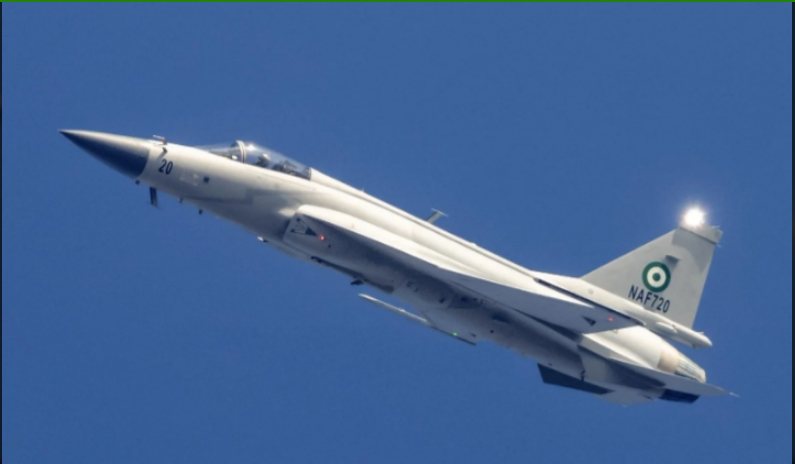
For the full procurement history behind the three-jet order – the 2016 MoU, the $184.3 million contract and the reliability questions since – see our dedicated explainer, Why Nigeria bought the JF-17 Thunder.
Asked plainly, Nigeria’s fighter fleet is small. Strictly multirole jets number under ten airframes, and a meaningful share of even that handful has been reported grounded at various points since 2021. The air force compensates with light-attack and combat-trainer types — Alpha Jet, A-29 Super Tucano and now the Italian M-346FA — that fly most of the actual counter-insurgency and close-air-support missions over the northeast.
| System | Origin (country + manufacturer) | Quantity | Status | Source |
|---|---|---|---|---|
| JF-17 Thunder (Block II) | China/Pakistan, Chengdu Aircraft Corporation/Pakistan Aeronautical Complex | 3, ordered 2016, entered service 2021 | Operational, but widely reported partly grounded over structural and engine issues | DefenceWeb; Eurasian Times |
| F-7Ni / FT-7Ni | China, Chengdu Aircraft Corporation | Estimated 5–6 remaining after attrition (crashes reported August 2024 and October 2025) | Operational, ageing conversion-trainer/fighter fleet | DefenceWeb (F7 crash reporting) |
| Alpha Jet E/A | France, Dassault/Dornier | Roughly 8 of the original 1980s fleet still airworthy, plus 12 ex-French Alpha Jet E acquired December 2024 (6 to be made operational, 6 for spares) | Operational / refurbishment and deliveries ongoing through 2026 | DefenceWeb; Military Africa; Key.aero |
| A-29 Super Tucano | Brazil, Embraer | 12 | Operational, the mainstay counter-insurgency strike aircraft since 2021 | Military Africa; Army Recognition |
| M-346FA | Italy, Leonardo | 24 on order in four batches of six; first batch of 3 completed factory acceptance testing June–July 2026 | On contract, deliveries pending as of September 2026 | Army Recognition; DefenceWeb; Africa Defense Forum |
Trainers
Behind the combat fleet sits a trainer pipeline that has quietly become one of Nigeria’s most interesting defence-industrial stories: a Hungarian light-aircraft line now partly assembled inside the country.
| System | Origin (country + manufacturer) | Quantity | Status | Source |
|---|---|---|---|---|
| PAC MFI-17 Mushshak (MFI-395) | Pakistan, Pakistan Aeronautical Complex | Estimated 8–10 | Operational, basic/primary trainer | Aggregated open-source trackers, not independently verified |
| Aermacchi MB-339AN | Italy, Leonardo | Estimated ~6 | Operational, jet trainer | Aggregated open-source trackers, not independently verified |
| Aero L-39ZA Albatros | Czech Republic, Aero Vodochody | Estimated 10–11 | Operational, jet trainer also flown in light-attack sorties | Aggregated open-source trackers, not independently verified |
| Magnus Fusion 212 / Sentinel | Hungary, Magnus Aircraft, with local assembly at NCAT Zaria | 20 on order; first ISR-configured aircraft arrived December 2022 | On contract, partial delivery, domestic assembly under way | Military Africa; DefenceWeb; Businessday NG |
| Robinson R66 | United States, Robinson Helicopter | Estimated ~4 | Operational, rotary-wing basic trainer | Aggregated open-source trackers, not independently verified |
Transport and ISR aircraft
Nigeria’s fixed-wing transport fleet is old, French- and American-built at its core, and increasingly supplemented by small ISR-configured turboprops bought for the counter-insurgency and Gulf of Guinea missions rather than strategic airlift.
| System | Origin (country + manufacturer) | Quantity | Status | Source |
|---|---|---|---|---|
| Lockheed C-130H / C-130H-30 Hercules | United States, Lockheed | 8 originally delivered 1975–85 (NAF910–918); serviceable count not disclosed, aircraft cycle through depot maintenance individually | Operational, partial fleet, ongoing programmed depot maintenance | Military Africa; USAFE Air Forces Africa |
| Dornier Do 228 | Germany, Dornier | Estimated ~6 | Operational, light transport/utility | Aggregated open-source trackers, not independently verified |
| Airbus (EADS CASA) C-295 | Spain, Airbus Defence and Space | 3 on order | Reported (on contract) | Aggregated open-source trackers, not independently verified |
| Diamond DA42/DA62 MPP | Austria, Diamond Aircraft | Estimated ~5 (1 DA42, 4 DA62) | Operational, light ISR/surveillance | Aggregated open-source trackers, not independently verified |
| Beechcraft King Air 350ER | United States, Textron | Estimated 2–4 | Operational, ISR | Aggregated open-source trackers, not independently verified |
| Cessna Citation CJ3 | United States, Textron | Estimated 1–2 | Operational, ISR/maritime patrol configuration | Aggregated open-source trackers, not independently verified |
| ATR 42 MPA | France/Italy, ATR | Estimated 1–2 | Operational, maritime patrol | Aggregated open-source trackers, not independently verified |
| Airbus A330 / Dassault Falcon 7X / Gulfstream G550 | France / United States | 1 / 2 / 1 | Operational, presidential and VIP transport fleet | Aggregated open-source trackers, not independently verified |
Helicopters
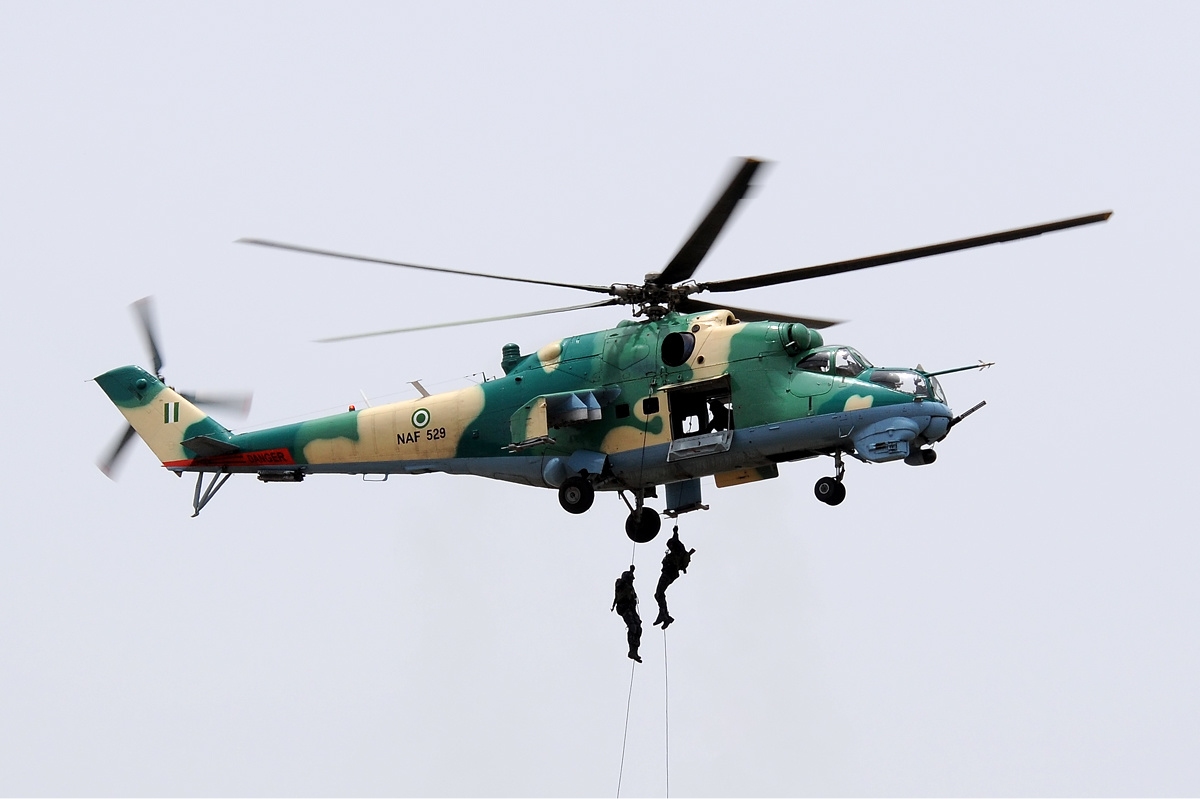
Rotary-wing is where the modernisation programme is most visible: a Cold War-era Russian gunship fleet is being supplemented, not replaced, by Turkish attack helicopters already in service and American AH-1Z Vipers now in production.
| System | Origin (country + manufacturer) | Quantity | Status | Source |
|---|---|---|---|---|
| Mil Mi-35 (Mi-24V) | Russia, Rosoboronexport | 12 ordered under a 2015 contract; IISS Military Balance 2023 recorded 10 on inventory; Russian officials have since called the contract only “partially fulfilled” | Operational, attack | DefenceWeb; Defence Express |
| Mil Mi-171 / Mi-17 | Russia, Russian Helicopters | Estimated ~6 (one lost in a crash, August 2023) | Operational, transport | Aggregated open-source trackers, not independently verified |
| TAI T129 ATAK | Türkiye, Turkish Aerospace Industries | 4 of 6 ordered delivered (first batch November 2023, second batch September 2024) | Delivered (4/6); balance on contract | Military Africa; DefenceWeb; Army Recognition |
| Bell AH-1Z Viper | United States, Bell/Textron | 12 on a $997m Foreign Military Sale notified 2022; production formally began at Bell’s Amarillo plant, September 2026 | On contract, production under way, deliveries projected to complete early 2029 | DefenceWeb; Army Recognition; Zona Militar; Textron |
| AgustaWestland AW109 Trekker | Italy, Leonardo | 2 inducted May 2025; 10 more ordered October 2024, 6 of the 10 had completed factory acceptance testing by July 2026 | Operational (2) / on contract, deliveries in progress (10) | Military Africa; HeliHub; AirMed&Rescue |
| AgustaWestland AW139 | Italy, Leonardo | Estimated 1–3 | Operational, VIP/utility | Aggregated open-source trackers, not independently verified |
| AgustaWestland AW189 | Italy, Leonardo | 2 | Operational, presidential VIP transport | Aggregated open-source trackers, not independently verified |
| Bell 412EP | United States, Bell | 2 | Operational, utility | Aggregated open-source trackers, not independently verified |
| Airbus H215M (AS332 Super Puma) | France, Airbus Helicopters | Estimated ~5 | Operational, utility/transport | Aggregated open-source trackers, not independently verified |
| Airbus H135 (EC135) | France/Germany, Airbus Helicopters | Estimated ~3 | Operational, utility/training | Aggregated open-source trackers, not independently verified |
Unmanned aerial vehicles
Drones now do more of the Nigerian Air Force’s daily strike and surveillance work than any single manned type, and the fleet is dominated by Türkiye and China. Nigeria fields at least four verified UAV types, enough that DefenceMENA covers the drone fleet in full in a separate, dedicated piece; the summary below covers what the air force operates today.
| System | Origin (country + manufacturer) | Quantity | Status | Source |
|---|---|---|---|---|
| Bayraktar TB2 | Türkiye, Baykar | 43 ordered/in the delivery pipeline under “Project Guardian” (announced December 2024); an initial batch was delivered in 2023 | Delivered (initial batch); balance on order | Army Recognition; Military Africa |
| CAIG Wing Loong II | China, Chengdu Aircraft Industry Group | Estimated ~5 | Operational | DefenseMirror; Army Recognition |
| CASC CH-3A / CH-4B | China, China Aerospace Science and Technology Corporation | Estimated ~3 CH-3A plus ~4 CH-4B | Operational | DefenseMirror |
| Yabhon Flash-20 | United Arab Emirates, ADCOM Systems | Estimated ~2 | Operational, ISR | Aggregated open-source trackers, not independently verified |
| Gulma / Tsaigumi / UNIKAM (indigenous programmes) | Nigeria, DICON and Air Force Research and Development Centre | Prototype/low-rate stage | Under development, not yet fielded at scale | DefenceWeb; Military Africa |
How the arsenal was built
The Nigerian Air Force’s fleet was built in four overlapping waves rather than one coherent programme. The oldest layer is Cold War-era airlift and trainers: the C-130H Hercules fleet delivered by Lockheed between 1975 and 1985, the original 1980s Alpha Jet batch from France, and Czechoslovak L-39 and Italian MB-339 jet trainers. A second, smaller wave in the 2000s brought Chinese Chengdu F-7Ni fighters into service as a stopgap after Nigeria’s earlier Jaguar and MiG fleets were retired, giving China its first real foothold in the NAF’s combat inventory.
The third wave, from around 2015, mixed a Russian rotary-wing buy — the still only partially delivered 12-aircraft Mi-35 contract — with China’s first drone sales, the Wing Loong II and CH-3A/CH-4B, bought as Nigeria’s counter-insurgency campaign against Boko Haram and ISWAP intensified and the air force needed persistent strike-ISR capability faster than manned fighters could provide it.
The fourth and by far the largest wave began around 2022 and is still landing: Türkiye’s TAI T129 ATAK gunships and the 43-strong Bayraktar TB2 order under Project Guardian; the United States’ $997 million AH-1Z Viper Foreign Military Sale, now in production at Bell’s Amarillo plant; Italy’s twin-track Leonardo package of 24 M-346FA light fighters and a growing AW109 Trekker helicopter fleet; a fresh batch of 12 second-hand Alpha Jets bought from the French Air and Space Force in December 2024; and Hungary’s Magnus Sentinel ISR aircraft, notable because Nigeria is assembling part of that fleet domestically at the Nigerian College of Aviation Technology in Zaria — one of the few points in this inventory where “who built it” is starting to include Nigeria itself.
| Date | Event | Value | Status |
|---|---|---|---|
| September 2026 | Bell formally commences AH-1Z Viper production for Nigeria at its Amarillo, Texas plant | Part of $997m FMS programme | On contract, production started |
| June–July 2026 | First batch of 3 Leonardo M-346FA jets completes factory acceptance testing | Part of a €1.2bn/$1.4bn, 24-aircraft programme | On contract, deliveries pending |
| June–July 2026 | 3 additional AW109 Trekker Type B helicopters complete factory acceptance testing, bringing the fleet to 6 of 10 ready for handover | Part of an October 2024 order for 10 more Trekkers | On contract, deliveries in progress |
| May 2025 | President Tinubu formally inducts the first 2 AW109 Trekker helicopters into NAF service | Not disclosed | Operational |
| April 2025 | Nigerian Air Force operationalises additional refurbished Alpha Jets from the December 2024 ex-French batch | Part of a 12-aircraft acquisition | Operational |
| October 2025 | Nigerian Air Force F-7Ni conversion-trainer lost in a crash | Not applicable | Attrition loss |
Turkish systems in the Nigerian Air Force
Türkiye is now the Nigerian Air Force’s most consequential single supplier by operational impact, even though it does not lead by raw aircraft count. The TAI T129 ATAK has become the air force’s newest dedicated attack helicopter, with four of six ordered delivered in successive batches through 2023 and 2024, and the Bayraktar TB2 — ordered in bulk as part of the 43-aircraft “Project Guardian” announced in December 2024 — has become the single most publicly cited weapon in Nigeria’s counter-insurgency campaign, alongside the CH-4B and Wing Loong II Chinese types it flies with. DefenceMENA covers the wider China–Nigeria and Türkiye–Nigeria supply relationships in dedicated supplier-anatomy pieces.
How many aircraft does Nigeria have?
How many fighter jets does Nigeria have?
Counting only true multirole fighters, Nigeria has fewer than ten: 3 JF-17 Thunders from China and an estimated 5–6 F-7Ni/FT-7Ni, also Chinese, with a share of the JF-17 fleet reported grounded over structural and engine problems. Widen the count to include the light-attack and combat-trainer jets the air force actually flies in a fighter role — Alpha Jet, A-29 Super Tucano and the Italian M-346FA now arriving — and the combat-capable fixed-wing fleet is closer to 30–40 aircraft.
How many attack helicopters does the Nigerian Air Force have?
Roughly 16 are confirmed operational today: about 10 Mi-35s from a partially fulfilled Russian order and 4 of 6 delivered TAI T129 ATAKs. That total is set to rise toward 28 once the remaining T129s and the 12 Bell AH-1Z Vipers now in production arrive, a process expected to run into 2029.
Does Nigeria have a stealth fighter?
No. Nigeria’s most advanced fighter, the JF-17 Thunder, and its newest combat jet, the Italian M-346FA, are both conventional, non-stealth aircraft. No stealth or fifth-generation type is on order.
How many drones does the Nigerian Air Force have?
A large and fast-growing fleet: 43 Bayraktar TB2s on order or in the delivery pipeline from Türkiye (with an initial batch already delivered), an estimated 5 Wing Loong IIs and roughly 7 CH-3A/CH-4Bs from China, plus a small number of Emirati Yabhon Flash-20s and early-stage domestic prototypes.
What is the newest aircraft type Nigeria has acquired?
By first-flight date, the Leonardo M-346FA, which completed factory acceptance testing in mid-2026 ahead of its first deliveries; by units already in Nigerian hands, the AW109 Trekker helicopter, inducted from May 2025.
How Nigeria compares
DefenceMENA’s Nigeria vs South Africa military comparison sets this air power inventory against South Africa’s smaller but more technically advanced Gripen and Hawk fleet. The Nigerian Army’s land-systems inventory, including its own China-supplied modernisation, is covered separately in DefenceMENA’s Nigerian Army weapons and equipment list, and a full four-service profile is published as the Nigeria military strength profile.
A note on the numbers
Nigeria does not publish an official, itemised aircraft return, so most quantities above are aggregated from manufacturer and government delivery announcements, reporting by DefenceWeb, Military Africa, Army Recognition and Africa Defense Forum, and open-source equipment trackers that are not independently audited. Figures for the M-346FA, AH-1Z Viper, T129 ATAK, AW109 Trekker, Alpha Jet and Mi-35 fleets have reasonably direct sourcing to specific delivery or production events. Figures for the older trainer, transport and utility-helicopter fleets rest on tertiary aggregators and are marked Estimated; DefenceMENA has not found a primary source confirming them and will update this page as the Nigerian Air Force or IISS’s Military Balance publishes more precise counts. Global Firepower’s index is not used as a source for any specific quantity in this piece. This page was published on 24 September 2026 and will be updated as further deliveries are confirmed.
Sources
- DefenceWeb, Bell begins Nigerian AH-1Z production
- Army Recognition, Nigeria’s M-346FA light attack jet performs first flight ahead of official delivery
- DefenceWeb, Nigerian Air Force completes factory acceptance testing for first M-346FA jets
- Military Africa, Nigeria takes delivery of second batch of T-129 ATAK
- Zona Militar, The United States moves forward with the delivery of 12 AH-1Z Viper attack helicopters to the Nigerian Air Force
- DefenceWeb, Nigerian Air Force receives additional Mi-35Ms
- Military Africa, Nigerian Air Force certifies more AW109 Trekker helicopters for delivery
- HeliHub, Nigeria orders ten AW109S Trekkers
- DefenceWeb, Another Nigerian F-7Ni lost in a crash
- DefenceWeb, Nigerian Air Force acquires ex-French Alpha Jets
- Military Africa, Nigeria begins Magnus aircraft production
- SIPRI, Trends in International Arms Transfers 2025 (March 2026)
- Global Firepower, Nigeria 2026 (unofficial index, cited for ranking only)