Can Tunisia Build Its Way Out of Dependence on US Military Aid?



Tunisia fields one of the smallest defence budgets in North Africa, and almost everything in its inventory arrived as a grant, a discount or a donation rather than a commercial purchase. That makes its dependency story less about any single fighter or missile deal and more about who signs the aid package.
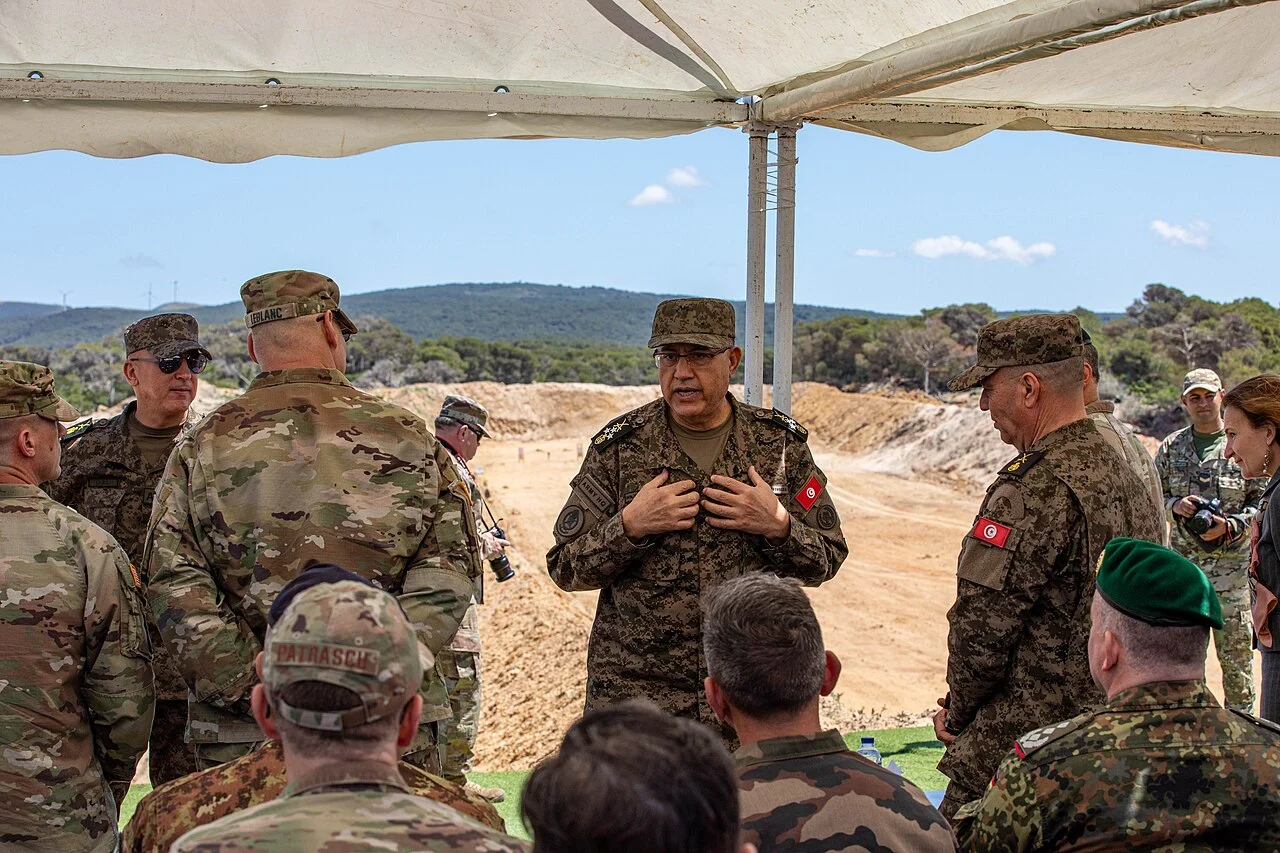
Photo: Maj. Gen. Mohamed El Ghoul, chief of staff of the Tunisian Land Forces, addresses visitors at Camp Rimel, Bizerte, during exercise African Lion 2025, April 29, 2025. Credit: U.S. Army Reserve photo by 1st Sgt. Randall Townsend, Public domain, via Wikimedia Commons.
- Tunisia’s top-tier equipment, from F-5 fighters to T-6C trainers and a pending Javelin order, has been bought almost entirely through US Foreign Military Financing grants rather than Tunisian defence-budget cash.
- That FMF line fell from $85 million in FY2021 to $45 million by FY2023-24 after Washington linked aid to concerns about President Kais Saied’s 2021 power concentration, showing the political string attached to the relationship.
- France and Italy supply mostly donated vehicles and patrol boats rather than contracted systems, softening the headline figures without reducing Tunisia’s reliance on foreign goodwill.
- A four-aircraft AT-6E/C Wolverine light-attack order approved in 2020 has still not been delivered, a case study in how a stalled FMS case can leave a capability gap for years.
- Tunisia’s own industrial base, built around the locally designed Istiklal-class patrol boats and the Barb MRAP, is real but narrow, and the defence ministry only formalised a public-private strategy to expand it in September 2026.
- With no significant Russian or Chinese platforms in service, Tunisia carries almost no CAATSA exposure — its vulnerability runs through Washington’s own aid politics instead.
A military financed more than it is bought
Tunisia’s armed forces are not large by regional standards — they sit well outside the continent’s strongest military rankings — and the state spends little on them in absolute terms: roughly $1.4 billion a year, about 2.6% of GDP, according to the open-source budget tracker Militaryspend.org. What stands out is not the size of the force but how it was assembled. Since Washington named Tunisia a major non-NATO ally in 2015, the United States has supplied the bulk of its frontline hardware through Foreign Military Financing (FMF) grants that pay for Foreign Military Sales cases — meaning Tunis rarely writes the check itself.
The clearest illustration is the US Air Force training fleet now in service. A 2019 FMS case worth roughly $234 million covered up to 12 Beechcraft T-6C Texan IIs; Tunisia drew down eight of them, the last delivered to No. 13 Squadron at Sfax air base in August 2023, according to European Security & Defence. A follow-on sale of four AT-6C Wolverine light-attack variants, worth about $325.8 million, was approved by the State Department in February 2020 — but as of this writing it has not been delivered, reportedly for lack of a funding line, per The Defense Post. The T-6Cs and the still-pending AT-6s share about 85% structural and avionics commonality, so Tunisia already owns half of an armed light-attack capability it cannot yet field.
The same grant-driven pattern runs through the rest of the inventory. Tunisia’s dozen-strong F-5E/F fighter fleet, its only fast jets, received a $32.5 million Northrop Grumman avionics upgrade rather than a replacement, and Tunis has separately asked Washington about further F-5 avionics work, according to DefenceTalk. Its C-130H transport fleet has grown mainly through the US Excess Defense Articles (EDA) programme — donated, not sold, airframes — with a fourth aircraft reported transferred in early 2026. Twelve Subaru Bell 412EPX utility helicopters ordered at the June 2025 Paris Air Show are one of the few recent orders placed as a direct commercial purchase rather than an FMS grant case.
On land, Tunisia is set to become North Africa’s first Javelin anti-tank missile operator under a $900.5 million US Army contract extension announced in September 2025 that also brought in Brazil as a first-time buyer, according to The Defense Post; deliveries were still described as pending in mid-2026. In parallel, a $95 million State Department-approved border-security package notified via Federal Register transmittal 26-16 in mid-2026 brings in L3Harris communications and surveillance equipment and Toyota-built Border Reaction Unit vehicles for the long, porous frontiers with Libya and Algeria — a programme aimed squarely at the counter-terrorism mission that has anchored the US-Tunisia relationship since the 2015 Bardo and Sousse attacks and the 2014-15 Chaambi mountains campaign against Ansar al-Sharia and AQIM-linked militants.
France and Italy fill in around the edges, mostly through donation rather than sale. The French army handed over 20 of a planned 100 MASSTECH all-terrain vehicles worth roughly €5 million in total, with deliveries running through 2027, French diplomatic sources told Tunisie Numérique. Italy has twice donated small coastal fleets: twelve patrol vessels built by Cantiere Navale Vittoria in the early 2010s, split between the navy and the National Guard, and a further six National Guard boats worth €4.8 million delivered from 2024 under a 2023 interior-ministry memorandum, per Baird Maritime. These gifts help Tunisia patrol its coastline and borders cheaply, but they add still more foreign maintenance and spares chains to manage rather than reducing dependence on any one capital.
Dependency map
| Capability | Main supplier | Dependency level | Main risk | Alternative |
|---|---|---|---|---|
| Fighter aircraft (F-5E/F) | United States | High | No funded replacement; avionics support tied to US contractor | None funded; L-39NG or used F-16s discussed, not ordered |
| Trainers / light attack (T-6C, pending AT-6) | United States | High | AT-6 case stalled since 2020 on funding, not politics | None; capability gap persists until FMF is applied to it |
| Transport aircraft (C-130H) | United States | Medium-High | Donated (EDA) airframes, ageing, spares via Lockheed Martin | Limited; used C-27J or C295 would still be a foreign purchase |
| Armour / anti-tank (M60, Javelin pending, TOW, MILAN) | United States / France-Germany | Medium | Javelin delivery timeline unclear; mixed legacy stocks | Barb MRAP covers protected mobility locally, not firepower |
| Helicopters (OH-58D, Bell 412EPX) | United States | Medium | OH-58D fleet is EDA-donated and ageing | 412EPX purchase shows a working commercial-buy alternative |
| Naval / coastal patrol | Italy (donated) / domestic (SCIN) | Low-Medium | Donated hulls still need foreign engines and electronics | Istiklal-class programme already substitutes for imports |
| Border surveillance / sensors | United States (L3Harris) | Medium-High | Software, radar and thermal-imaging support tied to US vendor | European or Turkish ISR vendors exist but unproven locally |
Dependency levels are DefenceMENA’s editorial assessment based on the sources listed below, not an official rating.
Dependence by category, not by country
Treating Tunisia as simply “pro-American” misses where the real leverage sits. On platforms, the United States dominates the fast-jet, trainer and transport fleets outright; France and Italy’s contributions are vehicles and boats, not aircraft. On engines, Tunisia has no domestic capacity at all — even its home-built Istiklal-class patrol boats run on imported Rolls-Royce diesels. On weapons and munitions, the picture is thinner still: TOW and MILAN anti-tank missiles, soon joined by Javelin, all come from US or European production lines, and Tunisia’s own ammunition output is limited to small-arms calibres.
On sensors, the new border-security package puts L3Harris radars and thermal cameras at the centre of Tunisia’s frontier-security posture, alongside Northrop Grumman-supplied F-5 avionics. On software and mission systems, there is effectively no domestic layer; everything from the T-6C’s avionics suite to the border-surveillance command software is foreign-sourced and foreign-supported. On maintenance, the picture is mixed: the Istiklal-class boats are serviced by their Sfax builder, SCIN, but the air force’s F-5 and C-130 fleets depend on US contractor support chains that move only as fast as FMF funding allows.
The political dimension is where Tunisia’s case differs most from a Gulf state’s. There is no CAATSA or ITAR drama over a single big-ticket deal, because Tunisia has no major Russian or Chinese platforms to trigger one. Instead, the leverage runs through the FMF spigot itself: because nearly every major asset was financed by a US grant rather than Tunisian money, a change in the US Congress’s mood about Tunisian politics — as happened after 2021 — can slow deliveries and compress future options even without a single sanction being imposed. On the industrial axis, Tunisia has shown it can design and build a corvette-sized patrol boat and an armoured MRAP hull, but has not yet translated that into serial production of anything beyond a handful of vessels.
Sanctions and export-control exposure
Tunisia carries negligible CAATSA risk. Its Soviet-era holdings amount to AKM rifles in units operating in the Sahara, not platforms that could trigger the sanctions law, and a 2015-16 flirtation with buying Russian helicopters and training was criticised domestically and never produced a contract, per Kapitalis. There is no ITAR third-country re-export question either, since Tunisia neither re-exports US kit nor integrates it with non-US systems in ways that would trigger a licensing dispute.
The real export-control story is Foreign Military Financing conditionality. After President Saied suspended parliament and began ruling by decree in July 2021, the Senate’s FY2022 foreign-operations bill stripped Tunisia’s funding earmark and required State Department reporting on the military’s role in “democratic backsliding,” while the administration separately proposed cutting both military and economic aid by roughly half, according to Brookings. FMF fell from $85 million in FY2021 to $60 million in FY2022 and then to $45 million in both FY2023 and FY2024, per a Middle East Policy Council assistance fact sheet (PDF). Reporting from North Africa Post confirmed Washington explicitly tied continued aid to a “transparent, inclusive” reform process. No formal embargo followed, and the wider defence relationship — Javelin, border security, T-6C/AT-6 — has continued regardless, but the FMF trend line shows the mechanism is political discretion in Washington, not a signed treaty, and it can move again in either direction depending on how the relationship between the two capitals develops.
Local industry and what it can take over
Tunisia’s clearest industrial success is the Istiklal-class patrol boat programme, a public-private partnership between the defence ministry and the Sfax shipbuilder SCIN that began in 2012. The lead vessel, built entirely by Tunisian engineers and launched in 2015, carries a 20mm cannon and a thermal-imaging system on a hull that reportedly cost about 40% less than an equivalent foreign purchase, according to Africa Defense Forum. SCIN went on to deliver further hulls — Utique, Kerkouane and El Jem among them — with up to seven planned and an ambition to export the design regionally. It is a genuine capability, but it covers small coastal patrol craft, not frigates, and still depends on imported Rolls-Royce engines and sensors.
On land, the army’s Barb MRAP has passed ballistic and blast-protection trials and is positioned for mass production, giving Tunisia its first indigenously designed protected vehicle. Beyond these two programmes, the industrial base is thin: AD Industrie, which operates precision-parts sites in France, Morocco and Tunisia, is the closest thing to a tier-two component supplier, and most small-arms and basic-munitions work remains at a workshop scale. Tunisian officials have themselves been candid about the gap. In September 2026, Defence Minister Khaled Shili publicly backed a new public-private-partnership strategy explicitly aimed at “cutting total dependence on imported military equipment,” according to AllAfrica — language that only makes sense if the ministry itself regards the current level of import dependence as a problem rather than a settled policy choice.
Alternatives
For the fighter and light-attack gap, Tunisia’s options are narrow given its budget. Used F-16s or Gripens have been discussed informally for years without an order; the more realistic near-term path is simply funding the AT-6C case it already holds, since switching suppliers now would mean starting a new foreign-military-sales process and a new set of spares and training dependencies from zero. For anti-tank and border-sensor needs, European (Thales, Saab) or Turkish (Aselsan, Roketsan) vendors offer technically credible alternatives to the US Javelin and L3Harris packages, and Turkish firms have supplied uniforms and light equipment to Tunisia’s forces already, per North Africa Post, though that case also shows the political friction such substitutions can cause with domestic manufacturers. Tunisia’s forces also train each year in African Lion, the US-led exercise series through which much of this equipment is tested alongside other African militaries. For coastal patrol, Tunisia has effectively already built its own alternative in the Istiklal class, the strongest evidence in this profile that diversification away from a single supplier is achievable when the capability requirement is modest enough.
Switching cost
Because so much of Tunisia’s inventory was financed rather than purchased, the switching-cost conversation is less about contract penalties than about forfeiting a funding stream. Moving the fighter or trainer fleets to a non-US supplier would mean giving up FMF-backed pricing on the F-5, T-6C and AT-6C lines and starting from zero on pilot conversion, simulator access, munitions compatibility and a maintenance ecosystem that, however US-dependent, Tunisian technicians already know. The Javelin and border-security packages are new enough that switching now, before full fielding, would be comparatively cheap — but doing so would also mean walking away from financing Tunisia did not have to find itself. The one area where switching has already happened at low cost is coastal patrol, precisely because the capability (a small, lightly armed patrol hull) was simple enough for SCIN to absorb the technology quickly; the same is far harder to imagine for fast jets or guided munitions, where the engineering and certification burden is an order of magnitude higher.
Diversification: what it solved and what it complicated
Tunisia’s pattern of accepting donations from multiple capitals — Washington’s FMF, Paris’s vehicle gifts, Rome’s patrol boats — has kept the overall defence budget low and given the armed forces a wider circle of partners than a single-supplier state would have. That has solved an immediate fiscal problem: Tunisia simply could not afford to buy most of this equipment outright. What it has not solved is political dependence, because grants come with conditions that purchases do not, and the FMF cuts of 2021-2024 show those conditions are enforced in practice, not just on paper. It has also multiplied logistics lines rather than consolidating them: French MASSTECH trucks, Italian-donated hulls, US airframes and a growing Turkish uniform-and-kit presence each carry their own spares and training tail, even though none of them individually represents a large capital outlay. Tunisia is, in effect, diversified in donor count but concentrated in donor leverage, since the United States alone still accounts for the large majority of high-end capability and nearly all of the counter-terrorism-linked equipment that matters most for its actual security tasks.
DefenceMENA Autonomy Index
| Criterion | Weight | Score | Justification |
|---|---|---|---|
| Domestic manufacturing | 20 | 5 | Istiklal-class boats and Barb MRAP are real but limited to small patrol/protected-mobility classes |
| Local maintenance | 15 | 4 | Boat fleet serviced by SCIN at Sfax; air fleets depend on US contractor support tied to FMF funding |
| Local ammunition | 15 | 3 | Small-arms calibres only; all guided munitions and major-calibre rounds imported |
| Supplier diversification | 15 | 4 | Multiple donors (US, France, Italy) but high-end capability concentrated in one capital |
| Critical components | 15 | 2 | No domestic engines, radars, avionics or seeker production, including for home-built hulls |
| Technology transfer | 10 | 3 | SCIN absorbed hull-design know-how; no transfer on engines, avionics or guided weapons |
| Export-control exposure | 10 | 3 | Low legal (CAATSA/ITAR) risk but high practical exposure to FMF political conditionality |
| Total | 100 | 24 |
DefenceMENA editorial analytical index, not an official ranking.
Why it matters for the MENA region
Tunisia is a useful counterpoint to the Gulf states and Egypt that usually dominate MENA defence coverage, because its dependency problem has almost nothing to do with sanctions law or export-licence disputes over a flagship platform. Instead it shows how a small, aid-reliant military can be reshaped by shifts in a donor’s domestic politics — in this case Washington’s response to Tunisia’s own democratic trajectory — without a single arms-control statute ever being invoked. For neighbours such as Jordan, which this series has shown runs on a similar US-financing model at a larger scale, and for other North African states weighing how much of their modernisation to finance through grants rather than national budgets, Tunisia’s experience since 2021 is a live example of what happens when the money, not the hardware, becomes the point of leverage. Its parallel push to build patrol boats and armoured vehicles at home, while still modest, also tests whether a small state can carve out defensible niches of self-reliance even while remaining financially dependent on a single partner for its most capable systems.
Sources
- European Security & Defence: Tunisia receives eighth and final T-6C (2023)
- The Defense Post: US approves AT-6 Wolverine sale to Tunisia (2020)
- DefenceTalk: Tunisia requests F-5 avionics upgrade
- The Defense Post: US, Brazil, Tunisia Javelin order (2025)
- Federal Register: Transmittal 26-16, Tunisia border-security FMS case (2026)
- Tunisie Numérique: French army MASSTECH vehicle donation (2026)
- Baird Maritime: New patrol boats for Tunisian coast guard
- Africa Defense Forum: Tunisia marks new era with locally built vessel (2016)
- Middle East Policy Council: Tunisia Assistance Fact Sheet (2023)
- North Africa Post: US subjects military aid to Tunisia to return to democratic path
- Brookings: Tunisia is sliding back into authoritarianism (2022)
- Kapitalis: Expert warns against Tunisia acquiring Russian military equipment (2015)
- North Africa Post: Chinese, Turkish textile firms to supply Tunisian armed forces
- AllAfrica: Tunisia defence ministry backs public-private partnership for military industry (2026)