Italy’s top military officer travelled to Tripoli this month to expand defence ties with Libya’s UN-recognised government, agreeing to widen training, cyber-defence and special-forces cooperation as Rome looks to shore up a partner it considers central to counter-terrorism, migration control and energy security across the central Mediterranean.
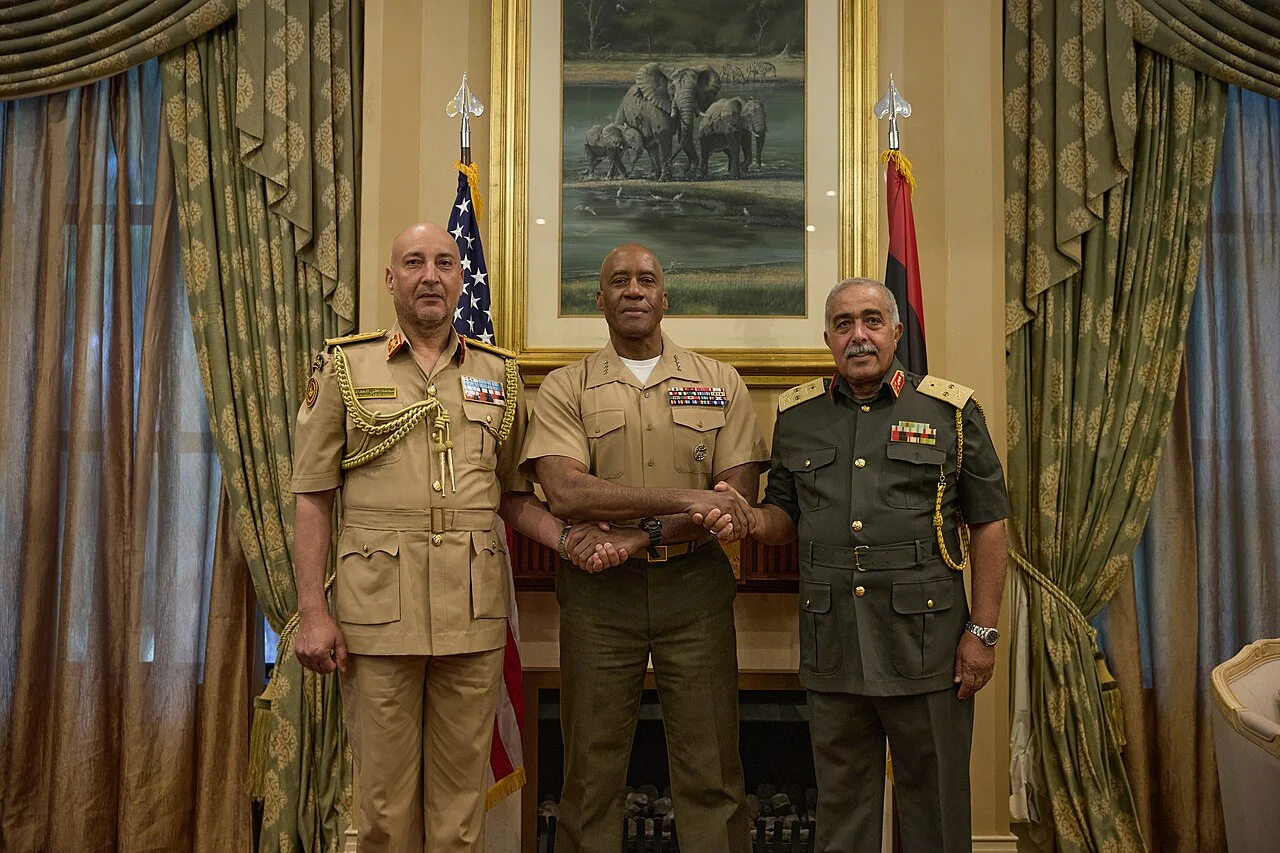
Photo: Libyan Gen. Mohammed al-Haddad (left) and Gen. Abd al-Razzaq al-Nadhuri (right) meet AFRICOM Commander Gen. Michael E. Langley at a Chiefs of Defense conference (file photo, illustrative of Libyan military diplomacy, not the Italy meeting). Credit: Cpl. Addysyn Tobar, U.S. Marine Corps, Public domain, via Wikimedia Commons
General Luciano Portolano, Italy’s chief of defence staff, met his Libyan counterpart General Salah al-Din al-Namroush at the General Staff headquarters of the Government of National Unity in Tripoli on 10 September, according to a statement from Italy’s Rivista Italiana Difesa and confirmed independently by the Libya Observer. The two chiefs of staff agreed to progressively expand cooperation between their armed forces and said they wanted to extend the relationship into the technical-industrial sector, bringing major Italian defence companies into future programmes.
What Was Agreed in Tripoli
According to the official readout, the talks focused on cyber-defence training for Libyan personnel, Italian-language instruction in Tripoli to prepare Libyan officers for courses in Italy, and expanded professional development for Libya’s special forces. Portolano also confirmed Italy’s willingness to take more Libyan cadets at its military academies. Libyan officials involved included Deputy Defence Minister Major General Abdulsalam al-Zoubi, while the two air force chiefs, General Luca Goretti and Brigadier General Emhamed Goujil, held separate talks on pilot training.
The visit built on a July meeting in Rome, where al-Namroush met Portolano and Vice Admiral Paolo Pezzutti at Italy’s Joint Special Forces Command, and on a March 2025 technical agreement that already allows Libyan air force pilots to train in Italy.
A Relationship With a Troubled History
Italy and the Tripoli-based government have cooperated on defence and security since a foundation agreement signed in December 2020, covering training, maintenance, border security and disaster response, and Italy has previously transferred patrol vessels to Libyan forces, including Corrubia-class boats delivered in 2018. Rome currently keeps roughly 100 personnel in Libya under its Miasit mission, which supports reform of Libyan defence institutions.
That cooperation has drawn scrutiny. A United Nations panel of experts has disputed whether some Italian-run training complies with the exemptions built into the UN arms embargo on Libya; Italy’s foreign ministry has rejected the finding. The dispute reflects a wider problem for outside partners in Libya: the country remains split between the Tripoli-based Government of National Unity and eastern authorities aligned with Khalifa Haftar’s forces, and any foreign military assistance to one side carries diplomatic and legal risk.
The Russia Factor
Rome’s renewed push comes as Italian officials publicly track a build-up of Russian naval activity linked to Libya. Euronews reported on 16 September that Russian vessels have been operating within a few hundred kilometres of Italian shores as Moscow reinforces its position in Libya, prompting increased monitoring by the Italian government. Russian private military contractors have held a foothold in eastern Libya for years, and a deeper Russian naval presence on Europe’s southern doorstep is precisely the scenario Italy’s defence establishment has been trying to pre-empt by keeping Tripoli close.
Why It Matters for Africa
Libya sits at the hinge between North Africa, the central Mediterranean and the wider Sahel, and whoever has military influence in Tripoli has leverage over migration routes, energy infrastructure and the flow of weapons into neighbouring states. A more capable, better-trained Libyan military under GNU control is, in Rome’s calculation, the best available check on both further Russian entrenchment and the kind of institutional collapse that let militias and traffickers flourish after 2011. For African states further south, the outcome of the contest for influence in Libya has direct consequences: it shapes how much irregular military hardware and personnel move across the Sahara into the Sahel, an axis DefenceMENA has tracked through open flight and logistics data.
Sources
- Rivista Italiana Difesa: Incontro bilaterale tra il Capo di SMD Portolano e il Generale al-Namroush
- The Libya Observer: Libya, Italy discuss military cooperation and training
- Military Africa: Libya and Italy to deepen military ties
- Euronews: Navi russe a poche centinaia di km dall’Italia, Mosca si rafforza in Libia