Five African countries have operated the Dassault Mirage F1: Morocco, Libya, South Africa, Gabon and the Republic of Congo. Morocco is the only large operator left. About 25 Royal Moroccan Air Force F1s, upgraded to the MF2000 standard with a new radar and weapons, are listed in open sources. Gabon and Congo-Brazzaville flew small batches of ex-South African F1AZs, but their present serviceability is not publicly documented. South Africa retired its F1s and sold them, and Libya’s fleet was largely lost or grounded after 2011.
Quick answer
Active: Morocco (~25 listed, MF2000 upgrade, about 27 aircraft upgraded). Listed, status unclear: Gabon (6 ex-SAAF F1AZ), Republic of Congo (2–4 ex-SAAF F1AZ). Historical: South Africa (48 assembled from kits in 1975–1977; fleet sold in 2006), Libya (38 delivered 1978–1981). Largest African order: Morocco, 50 delivered 1978–1982.
Last updated: 8 November 2026. Delivery figures from SIPRI (data to 2025); current Moroccan fleet size is an open-source listing, not an official figure. Gabon and Congo serviceability is unconfirmed.
What is the Mirage F1?
The Mirage F1 is a single-engine, supersonic French fighter that entered service in the 1970s. Unlike the delta-winged Mirage III and 5 before it, the F1 has a swept wing and tailplane, giving it better low-speed handling and more internal fuel. Export customers bought interceptor (F1C), multirole (F1E) and simplified ground-attack (F1A) versions. In Africa it was a prestige fighter of the late Cold War, bought by Morocco, Libya and apartheid-era South Africa.
African Mirage F1 operators
| Country | Versions | Delivered | Years | Status, November 2026 |
|---|---|---|---|---|
| Morocco | F1CH, F1EH, F1EH-200, F1BH trainers | 50 (25 + 5 + 20) | 1978–1982 | Active; MF2000 upgrade; ~25 listed |
| Libya | F1AD, F1ED, F1BD | 38 (16 + 22) | 1978–1981 | Largely lost or grounded since 2011; no verified active fleet |
| South Africa | F1AZ, F1CZ | 48 (32 + 16), assembled from kits | 1975–1977 | Retired; surplus fleet sold to Paramount in 2006 |
| Gabon | F1AZ (ex-SAAF, refurbished) | 6 | 2006–2010 | Listed; serviceability unconfirmed |
| Republic of Congo | F1AZ (ex-SAAF, refurbished) | 4 per SIPRI; 2 per Paramount (2011) | 2010–2012 | Listed; serviceability unconfirmed |
Source: SIPRI Arms Transfers Database (data to 2025); defenceWeb (2010, 2011); Gabonreview (October 2026). Delivered totals are not current inventories.
Morocco: the MF2000 upgrade keeps the F1 relevant
Morocco ordered 25 Mirage F1CHs in 1975, a FFR1.25 billion ($308 million) deal according to SIPRI, then five more F1CHs and 20 F1EHs in 1977. Six of the F1EH-200s were fitted for air-to-air refuelling. In 2005 the Royal Moroccan Air Force launched the MF2000 upgrade, developed by the Sagem–Thales ASTRAC consortium. Aviation Week reported that the prototype first flew on 19 October 2009. The package replaced the Cyrano IV radar with a Thales RC400 multimode radar, added a modern cockpit and self-protection systems, and cleared the aircraft for MICA air-to-air missiles, the AASM Hammer guided bomb, laser designation pods and AM39 Exocet anti-ship missiles.
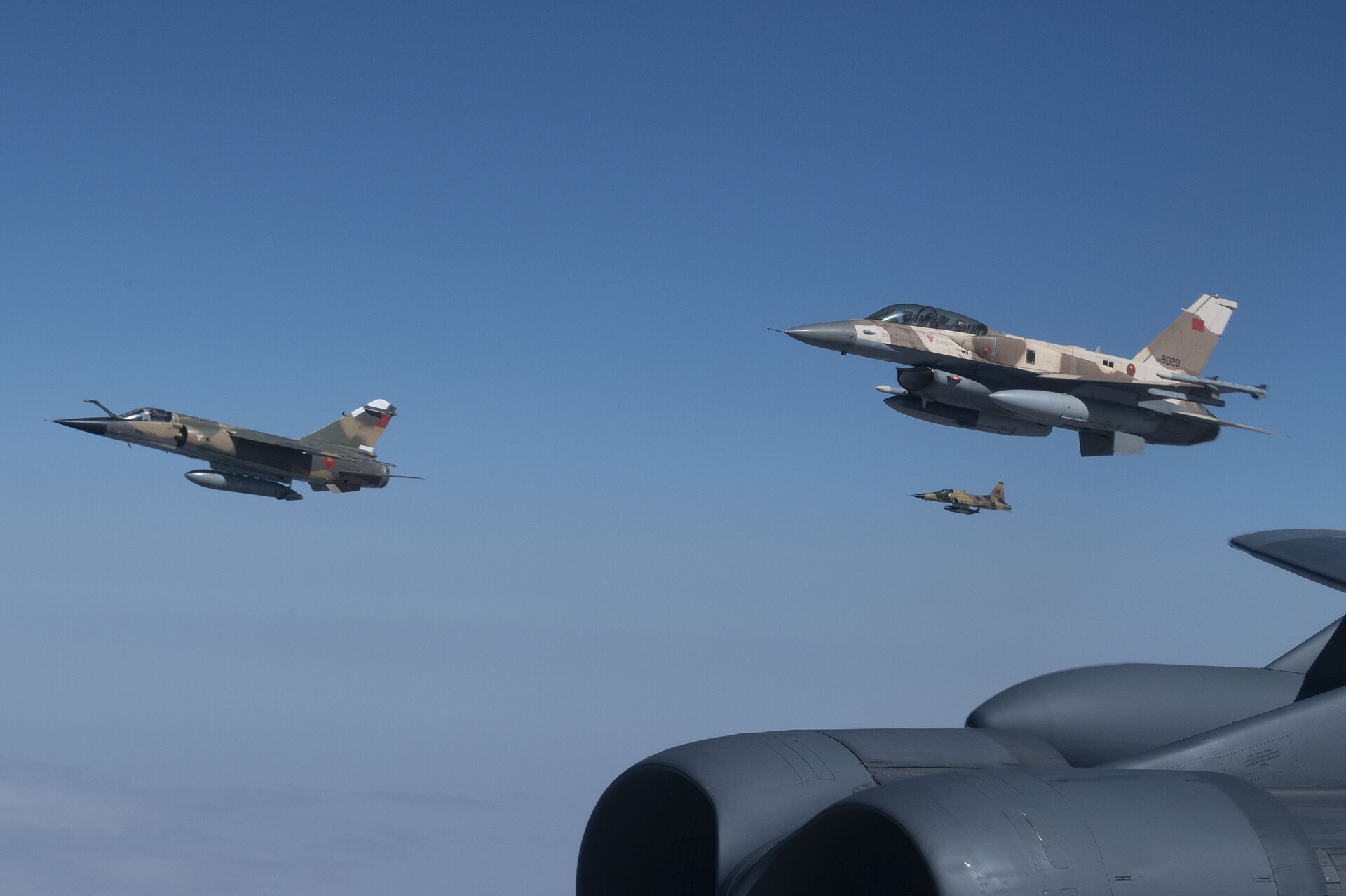
About 27 aircraft were planned for the upgrade, and open-source fleet listings currently show about 25 Moroccan F1s. That keeps the F1 as one of Morocco’s three fighter types, alongside the F-16 and F-5. Our Morocco military strength profile places that fleet in the wider force structure. US Air Force imagery from exercise African Lion in May 2024 shows a Moroccan F1 flying alongside an F-16D and an F-5, confirming that the type was still flying that year.
Libya: from large fleet to fragments
Libya received 16 F1ADs and 22 F1EDs, including six two-seat F1BDs, between 1978 and 1981. The fleet’s decline was accelerated by sanctions and then by the 2011 conflict. On 21 February 2011, two Libyan Air Force colonels flew their Mirage F1s to Malta after refusing orders to attack protesters, Reuters reported; the Malta Independent reported that the aircraft were formally returned to Libya in January 2012. Since then, Libya’s divided air arms have flown a mix of rebuilt and second-hand aircraft, and no reliable source documents a current, serviceable F1 fleet. See our Libya military strength overview for the wider picture.
South Africa, Gabon and Congo: one fleet, three owners
South Africa assembled 48 F1s from French kits in 1975–1977. SIPRI records them as 32 F1A and 16 F1C, the versions South Africa designated F1AZ and F1CZ. After retirement, the South African Air Force put 21 F1s up for disposal in 2003, and the Paramount Group bought the whole package, with spares and support equipment, in 2006, defenceWeb reported. Paramount and Aerosud then refurbished F1AZs for export. Gabon received two in August 2006 and two in November 2007, with the remainder of a six-aircraft order following; five took part in a flypast for Gabon’s 50th independence anniversary on 17 August 2010. Paramount said in 2011 that two had gone to Congo-Brazzaville, while SIPRI records four Congolese deliveries between 2010 and 2012.
Whether these jets still fly is the open question. A Gabonreview analysis published on 13 October 2026 noted that international directories still attribute six F1s to Gabon, but that no recent public data shows how many are operational. DefenceMENA therefore lists Gabon and Congo as operators with unconfirmed status.
What replaces the Mirage F1 in Africa?
For Morocco, the F-16 is the long-term frontline fighter; see our comparison of Morocco’s old and new F-5 and F-16 fleets. Elsewhere, the F1’s natural successors have been second-hand fourth-generation jets or none at all. Many smaller air forces have shifted spending to armed trainers, helicopters and drones. Our guide to fighter aircraft flown by African air forces compares the alternatives.
Frequently asked questions
Which African country flies the Mirage F1?
Morocco is the main active operator, with about 25 aircraft listed after the MF2000 upgrade. Gabon and the Republic of Congo still list ex-South African F1AZs, but their serviceability is unconfirmed.
What is the Moroccan Mirage F1 MF2000?
It is a mid-life upgrade by the Sagem–Thales ASTRAC consortium. It adds a Thales RC400 radar, a modern cockpit, self-protection systems and compatibility with MICA missiles and precision-guided weapons. The prototype flew in October 2009.
Does South Africa still fly the Mirage F1?
No. The South African Air Force retired its F1s. Surplus airframes and spares were sold to the Paramount Group in 2006, which refurbished some for Gabon and Congo.
Did Libyan Mirage F1 pilots defect to Malta?
Yes. On 21 February 2011 two Libyan Air Force colonels landed their Mirage F1s in Malta after refusing orders to attack protesters. The jets were formally returned to Libya in January 2012.
How many Mirage F1s did Morocco buy?
SIPRI records 50 delivered between 1978 and 1982: 25 F1CHs (including two F1BH trainers), five more F1CHs and 20 F1EH/EH-200s.
Sources
- Stockholm International Peace Research Institute (SIPRI), “SIPRI Arms Transfers Database, trade registers for African recipients (data to 2025)”, March 2026 release. https://armstransfers.sipri.org/ (accessed 6 November 2026 (local extract re-checked 8 November 2026)).
- Aviation Week, “Mirage upgrade augments new fighter force”, c. 2010. https://aviationweek.com/defense/mirage-upgrade-augments-new-fighter-force (accessed 8 November 2026).
- defenceWeb, “Paramount confirms Mirage F1AZs delivered to Congo-Brazzaville, eyes future customers”, 21 April 2011. https://defenceweb.co.za/aerospace/aerospace-aerospace/paramount-confirms-mirage-f1azs-delivered-to-congo-brazzaville-eyes-future-customers/ (accessed 8 November 2026).
- defenceWeb, “Gabon celebrates 50 years of independence with 5-ship Mirage F1 flypast”, 8 September 2010. https://defenceweb.co.za/aerospace/aerospace-aerospace/gabon-celebrates-50-years-of-independence-with-5-ship-mirage-f1-flypast/ (accessed 8 November 2026).
- Gabonreview, “Les six Mirage du Gabon volent-ils encore ? La grande inconnue de l’armée de l’air”, 13 October 2026. https://www.gabonreview.com/les-six-mirage-du-gabon-volent-ils-encore-la-grande-inconnue-de-larmee-de-lair/ (accessed 8 November 2026).
- Reuters, “Two Libyan fighter pilots defect, fly to Malta”, 21 February 2011. https://www.reuters.com/article/world/two-libyan-fighter-pilots-defect-fly-to-malta-idUSTRE71K52R/ (accessed 8 November 2026).
- The Malta Independent, “Libyan Mirages: Libyan Army heads thank Malta as jets formally returned”, 24 January 2012. https://www.independent.com.mt/articles/2012-01-24/local-news/Libyan-Mirages:-Libyan-Army-heads-thank-Malta-as-jets-formally-returned-304834 (accessed 8 November 2026).
- US Air Force via DVIDS/Wikimedia Commons, “BTF 24-3 supports African Lion 2024 (image 8445859)”, 31 May 2024. https://commons.wikimedia.org/wiki/File:BTF_24-3_supports_African_Lion_2024_(8445859).jpg (accessed 8 November 2026).
Method: counts from SIPRI are deliveries recorded by SIPRI, not current inventories. Status labels distinguish delivered, reported in service, ordered and retired; where open sources disagree, the range is shown rather than a single figure.