Morocco has become Africa’s second-largest defence spender and, per SIPRI, the continent’s largest arms importer, but its front-line air force is still flying 2011-vintage F-16s while a larger, contracted Block 72 fleet sits years behind schedule. This profile sets out what the Royal Armed Forces actually operate in 2026, what is on order, and where the open-source numbers should be read with care.
The short answer: Morocco fields a mid-sized, increasingly well-funded force built around a single strategic driver, the Western Sahara dispute, rather than the multi-front planning that shapes Algeria’s much larger military. Personnel estimates vary by tracker, the newest F-16s and Patriot air defence are not yet in service, and the country has no submarines. But the direction of travel is consistent: a $500 million Israeli Barak MX air-defence system (why Morocco bought it) reached full operational status in early 2026, Apache attack helicopters and Bayraktar Akinci drones are arriving, and SIPRI’s own arms-transfer data shows Morocco overtaking Algeria as Africa’s top importer for the first time. The sections below go service by service. Every line carries a status label: Operational, Delivered, On contract, Ordered, Under modernization, Estimated or Reported (unconfirmed). An order is not a delivery, and a delivery is not an operational unit.
| Indicator | Figure | Year / source |
|---|---|---|
| Active personnel | About 200,000 (IISS-style estimate), plus about 50,000 in the Gendarmerie Royale and Auxiliary Forces; Global Firepower’s 2026 index gives a much higher 400,000, a figure trackers disagree on | Estimated, 2024–25 |
| Reserves | 250,000 (unverified figure, treat with caution) | Global Firepower 2026 |
| Conscription | Reinstated February 2019; one year, ages 19–25, compulsory for men, optional for women and dual nationals | Moroccan law, 2019 |
| Military expenditure | US$6.3 billion in 2025, up 6.6% real terms – Africa’s second-largest after Algeria | SIPRI Milex, April 2026 |
| Official 2026 budget | MAD 157.2 billion commitment appropriations (~US$15.7bn), up 17.8% on 2025; MAD 55.3bn (~US$5.6bn) in payment credits actually disbursed in-year | 2026 finance law, Hespress / Barlaman Today |
| Arms imports rank | 28th in the world in 2021–25, 1.0% of global imports, up 12% on 2016–20; Africa’s largest importer, overtaking Algeria | SIPRI, March 2026 |
| Main suppliers 2021–25 | United States 60%, Israel 24%, France 10% | SIPRI |
| Combat aircraft | 84 (F-16C/D, Mirage F1, F-5E Tiger II) | Estimated, 2026 |
| Main battle tanks | About 1,346 (M1A1 SA / M1A2 SEPv3 Abrams, legacy T-72B and M60) | Estimated, 2026 |
| Submarines / major ships | 0 submarines; 6 frigates, 1 corvette | 2026 |
Current military overview
The Royal Armed Forces (Forces Armées Royales, FAR) are organised as a single unified command under King Mohammed VI as Supreme Commander, encompassing the Royal Moroccan Army, Royal Moroccan Air Force, Royal Moroccan Navy, Royal Gendarmerie and Royal Guard. Doctrine and procurement are shaped overwhelmingly by one problem: the decades-long Western Sahara dispute, reinforced since 2020 by a partially built defensive berm system and by the deployment of the new Barak MX air-defence layer near Rabat. Morocco’s land border with Algeria has been closed since 1994, and the two countries have had no diplomatic relations since August 2021, adding a second, colder front to Moroccan planning even though open Moroccan doctrine does not address specific contingencies against Algiers.
Morocco’s international alignment has shifted markedly over the past five years. The 2020 restoration of diplomatic ties with Israel opened a new supply channel that now accounts for roughly a quarter of Moroccan arms imports, while a US-Morocco military roadmap for 2026–2036, signed in Washington in April 2026, deepens an already close American relationship built on annual African Lion exercises. The North Africa desk tracks how this compares with Algeria’s much larger, more Russian-dependent build-up.
Defence budget: what the numbers do and do not show
Morocco’s 2026 finance law, adopted in the Chamber of Representatives in late 2025, allocates MAD 157.2 billion (roughly US$15.7 billion) in commitment appropriations to national defence, a 17.8% increase on 2025 according to Hespress and Barlaman Today. That headline number is not what is actually spent in a given year: the “crédits de paiement” (payment credits) disbursed in 2026 are far smaller, at MAD 55.3 billion (about US$5.6 billion), covering salaries, running costs and instalments on contracts signed in earlier years. SIPRI’s independent Military Expenditure Database estimate for calendar-year 2025 is US$6.3 billion, up 6.6% in real terms, which made Morocco Africa’s second-largest defence spender after Algeria and comfortably ahead of Egypt and Nigeria. SIPRI’s figure and Morocco’s own budget appropriation are different measures using different methodologies and should not be treated as interchangeable.
Secondary trackers put Morocco’s defence spending at around 4.2% of GDP, ranking 45th in the world by that share – a figure DefenceMENA has not been able to verify against SIPRI’s own published country tables and reports here only as a secondary estimate.
Active personnel
Morocco’s personnel figures are unusually contested among open-source trackers. Global Firepower’s 2026 index credits the Royal Armed Forces with 400,000 active personnel, a number that appears to blend full-time military strength with reserve call-up capacity and territorial elements rather than a strict active-duty count. Estimates built on IISS Military Balance-style categorisation put the FAR’s genuine full-time active strength closer to 200,000, with a further roughly 50,000 personnel in the Gendarmerie Royale and Auxiliary Forces counted separately as paramilitary rather than military. Global Firepower separately lists 250,000 in reserve, a figure DefenceMENA treats with caution given the disagreement over the active baseline it would be drawn from.
Morocco reinstated compulsory military service on 7 February 2019 after a twelve-year hiatus, requiring one year of service for men aged 19 to 25; service is optional for women and for dual nationals. The programme was budgeted at MAD 500 million a year at launch, with an initial intake of 10,000 conscripts rising toward 15,000 in subsequent years, according to Moroccan and international reporting at the time.
Army
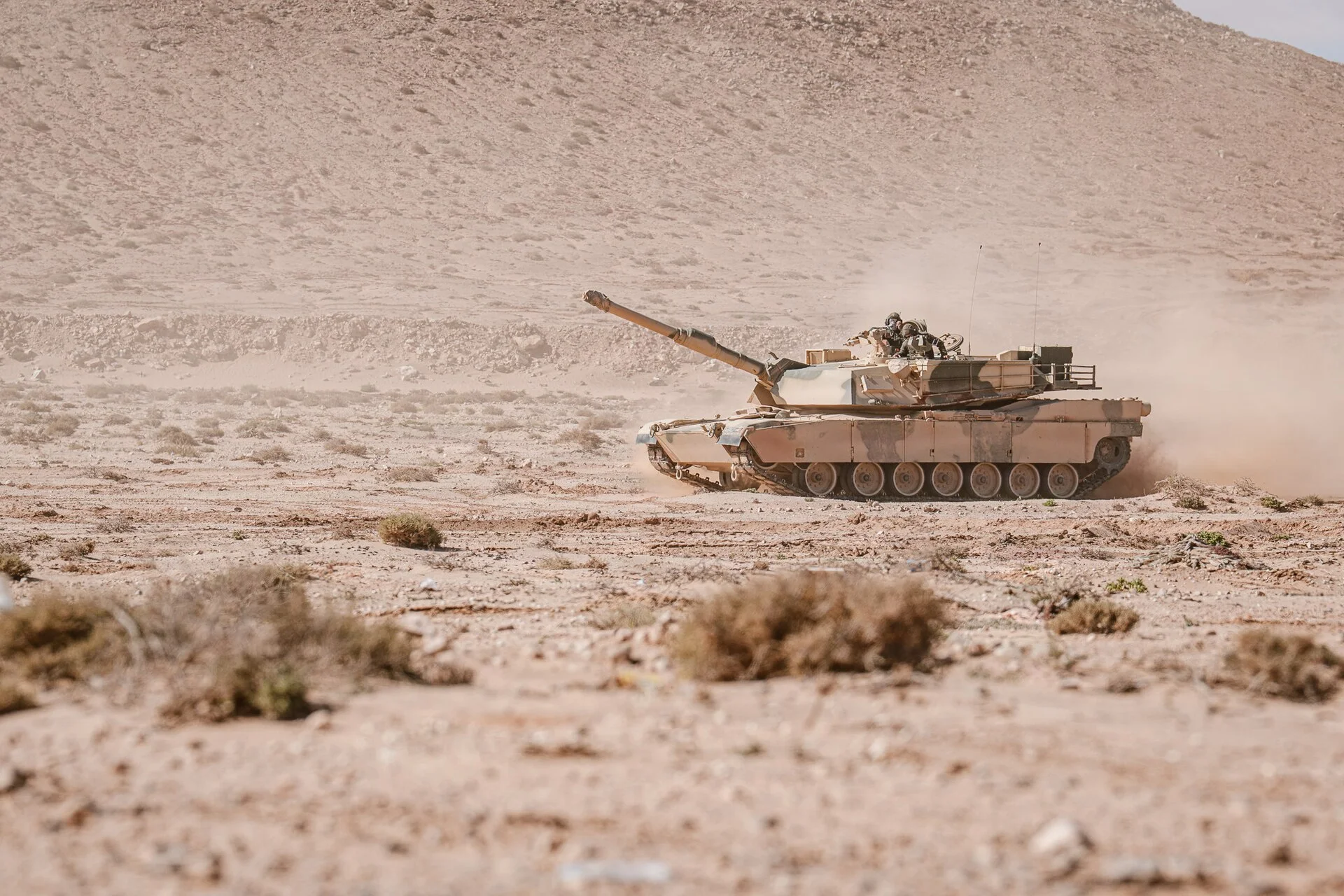
The Royal Moroccan Army’s roughly 1,346 main battle tanks mix US-supplied M1A1 SA and newer M1A2 SEPv3 Abrams – deliveries of the SEPv3 standard began in December 2023 – with older Soviet-era T-72B and American M60 tanks that make up a declining share of the fleet. Infantry mobility rests on a mixed wheeled and tracked fleet: American M113 and AIFV tracked carriers, French VAB wheeled APCs, South African Ratel 20/90 and Turkish Otokar Cobra II vehicles, the last a rare case of Ankara supplying Rabat directly with a combat vehicle rather than only aerial systems.
| System | Origin | Quantity | Status | Source |
|---|---|---|---|---|
| M1A2 SEPv3 Abrams | United States | Undisclosed, deliveries began December 2023 | Delivered / Operational | US Army, Shephard |
| M1A1 SA Abrams | United States | Part of 1,346 total tank fleet | Operational | Estimated |
| T-72B | Soviet-era / Eastern Europe | Legacy stock | Operational, ageing | Estimated |
| M60 | United States | Legacy stock, being phased down | Operational, ageing | Estimated |
| M113 / AIFV | United States | Undisclosed | Operational | Open-source, RMA equipment lists |
| VAB | France | Undisclosed | Operational | Open-source |
| Ratel 20/90 | South Africa | Undisclosed | Operational | Open-source |
| Otokar Cobra II | Türkiye | Undisclosed | Operational | Open-source |
| CAESAR 155mm (truck-mounted) | France | Undisclosed | Operational | Open-source |
| ATMOS 2000 155mm (truck-mounted) | Israel | Undisclosed | Operational | Open-source |
| HIMARS | United States | Undisclosed | Operational | Open-source |
| PULS | Israel | Undisclosed | Operational | Open-source |
| L118, M101, M114 (towed) | UK / United States | Legacy stock | Operational, legacy | Open-source |
| MO-120-RT mortars | France | Undisclosed | Operational | Open-source |
Morocco’s rocket-artillery mix is unusual for the region: HIMARS from the United States sits alongside Israel’s PULS system, a combination that gives Rabat two independent precision-strike suppliers rather than relying on a single source, mirroring the diversification pattern visible across the rest of its procurement.
Air Force
The Royal Moroccan Air Force is mid-overhaul rather than newly re-equipped. Its front line still rests on 23 F-16C/D Block 52+ jets in active service (of 24 originally delivered in 2011–12; one was lost during Saudi-led coalition operations over Yemen in 2015), backed by older Mirage F1, F-5E Tiger II and Alpha Jet squadrons. The next generation is contracted but not yet operational: in March 2019 the US State Department approved a further sale of 25 new-build F-16C/D Block 72 aircraft plus an upgrade of the 23 surviving Block 52s to F-16V standard, together notified at up to roughly $4.8 billion. As of September 2026, seven years after approval, not one Block 72 airframe had reached Morocco, though Lockheed Martin has pointed to deliveries “within weeks” and flight testing beginning late 2026, with the underlying contract schedule running to 2027.
| System | Origin | Quantity | Status | Source |
|---|---|---|---|---|
| F-16C/D Block 52+ | United States (Lockheed Martin) | 23 in service (of 24 delivered 2011–12) | Operational | F-16.net, DefenceMENA |
| F-16C/D Block 72 / F-16V upgrade | United States (Lockheed Martin) | 25 new-build plus upgrade of 23 Block 52+; approved 2019, ~$4.8bn notified ceiling | On contract, not yet delivered | DSCA, Lockheed Martin, The Defense Post |
| Mirage F1 | France | 25 | Operational, ageing | Open-source, WAF-style |
| F-5E Tiger II | United States | 22 | Operational, ageing | Open-source |
| Alpha Jet | France / Germany | 22 | Operational (light attack / trainer) | Open-source |
| AH-64E Apache | United States | 12, in service by April 2026 | Delivered / Operational | US Army |
| H225M Caracal | France (Airbus Helicopters) | 10 ordered, November 2025, replacing Puma fleet | Ordered | Open-source, 2025 |
| C-130H / KC-130H Hercules | United States (Lockheed Martin / L3Harris overhaul) | 14 C-130H plus 2 KC-130H tankers, under multi-year L3Harris overhaul signed July 2025, running to 2029 | Operational / Under modernization | Military Africa, Morocco World News, defenceWeb |
Sustainment, not new airframes, has been the more concrete 2025–26 story. Morocco’s Administration of National Defense signed a multi-year overhaul agreement with L3Harris in July 2025 covering the RMAF’s 14 C-130H aircraft and 2 KC-130H tankers, some flying for more than four decades. The first airframe returned from L3Harris’s Waco, Texas facility with a new digital engine display and standby instrument after a full depot-level inspection and repair cycle; a second arrived in Texas in late August 2026, and a third was scheduled to enter before L3Harris’s presentation at the Marrakech Air Show in October 2026. Rather than replace the fleet outright, Rabat is extending Hercules service life while it weighs longer-term transport decisions, a pattern common among African air forces flying legacy C-130s.
Navy
The Royal Moroccan Navy has no submarines and has said only that it is “exploring options” for an underwater capability, a gap that stands out against Algeria’s six-boat Kilo-class fleet. Its surface combatants are centred on the French-built FREMM frigate Mohammed VI, delivered in 2014 and optimised for anti-submarine warfare, backed by three Dutch-designed Sigma-class corvettes/frigates (Tarik Ben Ziyad, Sultan Moulay Ismail and Allal Ben Abdellah) and two older Floreal-class frigates. A large coastal and patrol fleet, 84 vessels by Global Firepower’s count, covers Morocco’s roughly 1,835km Atlantic and Mediterranean coastline but performs a different mission from blue-water combatants and is not counted as strength on its own. A dedicated breakdown of fleet composition, the new Avante 1800 patrol vessel delivered in September 2026, and the unresolved submarine search is in DefenceMENA’s Morocco navy ships and submarines explainer.
| Class | Origin | Quantity | Status | Source |
|---|---|---|---|---|
| Mohammed VI (FREMM frigate) | France (Naval Group) | 1, delivered 2014 | Operational | seaforces.org, Army Recognition |
| Sigma-class corvettes/frigates (Tarik Ben Ziyad, Sultan Moulay Ismail, Allal Ben Abdellah) | Netherlands (Damen) | 3 | Operational | seaforces.org |
| Floreal-class frigates | France | 2 | Operational | Open-source |
| Patrol and coastal craft (various classes) | Mixed | 84 (Global Firepower count) | Operational (Estimated, composite figure) | Global Firepower 2026 |
| Submarines | — | 0 | None in service; “exploring options” | Army Recognition, open-source |
UAV and drone fleet
Morocco operates one of the largest and most combat-tested military drone fleets in Africa. Hespress reported the Royal Armed Forces held roughly 223 drones as of 2023, a total placing Morocco second on the continent behind only Egypt, built initially around Israeli-made WanderB and ThunderB systems from BlueBird Aero Systems. Turkish and Chinese types have since expanded the fleet’s strike capability: an estimated 19–25 Bayraktar TB2s have been in service since 2021, and deliveries of the larger Bayraktar Akinci strike drone began under a 2023 contract, though the delivered quantity is undisclosed. Chinese Wing Loong II and TB-001 airframes have been observed flying missions from Laâyoune, and Israeli Heron/Harfang medium-altitude platforms were delivered from 2021 under a roughly $48 million deal, alongside Israeli Harop loitering munitions.
| System | Origin | Quantity | Status | Source |
|---|---|---|---|---|
| Bayraktar TB2 | Türkiye (Baykar) | ~19–25 | Operational, in service since 2021 | Open-source, military.africa |
| Bayraktar Akinci | Türkiye (Baykar) | Undisclosed | Delivered / Operational, under 2023 contract | Military Africa |
| Wing Loong II | China | Undisclosed | Reported, observed at Laâyoune | Open-source |
| TB-001 | China | Undisclosed | Reported, observed at Laâyoune | Open-source |
| Heron / Harfang | Israel (IAI) | Undisclosed, ~$48m deal | Delivered, 2021 | Open-source |
| WanderB / ThunderB | Israel (BlueBird Aero Systems) | Bulk of the ~223-drone fleet reported 2023 | Operational | Hespress, 2023 |
| Harop loitering munition | Israel (IAI) | Undisclosed | Operational | Open-source |
| BDS GPS-free prototype | Morocco (Ballistic Defense System, private) | Prototype | Reported (unconfirmed); company claim, not independently verified or confirmed by the Moroccan government | Assahifa, Yabiladi, September 2026 |
A domestic entrant surfaced in September 2026: Rabat-based startup Ballistic Defense System (BDS) said it had flight-tested a prototype attack drone able to navigate roughly 2,000km without GPS, GLONASS or BeiDou satellite positioning, using terrain-recognition software to identify and close on targets autonomously. Founder Fahd Laamoumi told Yabiladi the software, not the airframe, consumed about 90% of development effort, and that the main constraint on a domestic strike-drone industry is a shortage of engineers skilled in computer-vision and flight-control robotics rather than funding. The claim comes from the company alone and has not been verified by independent testing or a government statement, and it is listed here as reported rather than confirmed.
Air defence
Morocco’s ground-based air-defence layer is thinner than Algeria’s but newer at the top end. A $500 million Israeli Barak MX system, contracted in 2022, began delivery in 2023 and reached full operational status at a new air-defence base near Sidi Yahya El Gharb by early 2026, integrating IAI’s ELM-2084 radar with interceptors covering three engagement ranges out to 150km. Morocco has separately sought US approval for the Patriot system, cleared for possible sale by the Defense Security Cooperation Agency in early 2023 but not yet confirmed as acquired; if finalised it would give Rabat a second, US-sourced long-range layer alongside Barak MX, a deliberate redundancy across suppliers that Moroccan officials have cited as a goal. The legacy medium-range layer remains the older MIM-23 I-HAWK system.
| System | Tier | Origin | Quantity / value | Status | Source |
|---|---|---|---|---|---|
| MIM-104 Patriot | Long range | United States | DSCA clearance early 2023 | Under evaluation, not confirmed acquired | Army Recognition |
| Barak MX | Medium–long range (layered, to 150km) | Israel (IAI) | $500 million contract, 2022 | Delivered / Full operational status, early 2026 | military.africa, Jerusalem Post, Army Recognition |
| MIM-23 I-HAWK (upgraded) | Medium range | United States | Undisclosed | Operational, legacy | Open-source |
Missiles and artillery
Morocco’s precision fires rest more on rocket artillery than on ballistic or cruise missiles: no land-attack cruise missile or ballistic-missile programme is confirmed in Moroccan service. Instead, the Army pairs Western and Israeli truck-mounted 155mm self-propelled guns, CAESAR and ATMOS 2000, with US HIMARS and Israeli PULS multiple rocket launchers, an artillery-plus-rocket combination that gives Rabat mobile precision fires from two independent supplier chains. Legacy towed 105mm and 155mm guns (L118, M101, M114) round out the count without representing current-generation firepower.
Defence industry
Morocco’s defence-industrial base is small and built almost entirely on foreign joint ventures rather than indigenous weapons design. Eaton-Souriau has run electrical-connector manufacturing at Tangiers for around two decades supporting the F-16 and C-130H fleets, and a 2022 Maintenance Aero Maroc joint venture handles airframe MRO for the same types. On the drone side, Israel’s BlueBird Aero Systems opened a production plant in Morocco in 2024, and Turkish manufacturer Baykar announced plans in 2025 for a Moroccan production and maintenance facility, though it was not yet operational as of September 2026. Morocco World News reported in mid-2025 that Rabat is actively pursuing greater defence-industrial autonomy as a stated policy direction, but as of this profile’s publication that remains a direction of travel rather than an established manufacturing base comparable to Algeria’s armoured-vehicle production lines.
Main defence suppliers
SIPRI’s Trends in International Arms Transfers fact sheet for 2021–25 shows Morocco has overtaken Algeria as Africa’s largest arms importer by volume, a reversal of the historical pattern, while also shifting away from its traditional reliance on France toward the United States and Israel.
| Metric | Figure |
|---|---|
| Global import rank | 28th of all states |
| Share of global arms imports | 1.0% |
| Change vs 2016–20 | +12% |
| United States | 60% of Moroccan imports |
| Israel | 24% |
| France | 10% |
Pending orders from Spain and the United States remain to be delivered, which is likely to extend the diversification trend rather than reverse it.
For the full programme-by-programme breakdown of Israel’s rise from zero to roughly a quarter of Moroccan arms deliveries — Barak MX, PULS, SPYDER, the Ofek-13 satellites and the MMI turret-production deal — see our dedicated Israel–Morocco supplier anatomy.
Recent procurement, 2025–2026
| Date | Event | Value | Status |
|---|---|---|---|
| July 2025 | Administration of National Defense signs multi-year C-130H/KC-130H overhaul with L3Harris (through 2029) | Undisclosed | On contract |
| November 2025 | 10 Airbus H225M Caracal helicopters ordered to replace Puma fleet | Undisclosed | Ordered |
| By early 2026 | Barak MX air-defence system reaches full operational status near Sidi Yahya El Gharb | $500 million (2022 contract) | Delivered / Operational |
| April 2026 | Morocco–US military roadmap for 2026–2036 signed in Washington | n/a | Signed |
| April–May 2026 | Exercise African Lion 26 held across Ghana, Morocco, Senegal and Tunisia, more than 5,600 personnel from 40+ nations, culminating at Cap Draa, Tan-Tan | n/a | Exercise |
| Late August 2026 | Second RMAF C-130H arrives at L3Harris Waco facility for overhaul | Part of 2025 contract | Under modernization |
| September 2026 | F-16 Block 72 deliveries described by Lockheed Martin as due “within weeks”; flight testing expected late 2026 | Part of ~$4.8bn 2019 notification | On contract, awaiting delivery |
| September 2026 | Rabat-based BDS unveils GPS-free drone prototype claim | Undisclosed (privately funded) | Reported (unconfirmed) |
Turkish systems in Morocco
Turkish equipment in Moroccan service is limited but mature where it exists: Morocco’s Bayraktar TB2s have been operational for several years, longer than most other Turkish drone exports to Africa, and its Akinci order is already being delivered rather than merely contracted. Where Turkish systems are actually fielded, the practical advantage is less about the airframe than the ecosystem around it – MAM-series munitions are markedly cheaper per shot than Western-integrated missiles, Baykar’s delivery timelines have generally run faster than Western MALE competitors, and Ankara has shown more willingness to offer local assembly, evidenced by Baykar’s 2025 plan for a Moroccan production and maintenance plant, still not operational as of September 2026. That is a logistics and technology-transfer argument, not a claim that Turkish airframes are inherently superior to the Israeli, American or Chinese systems Morocco also operates side by side.
| System | Manufacturer | Quantity | Status | Role |
|---|---|---|---|---|
| Bayraktar TB2 | Baykar | ~19–25 | In service since 2021 | MALE ISR/strike |
| Bayraktar Akinci | Baykar | Undisclosed | Deliveries under way since 2023 contract | Heavy strike/ISR |
| Otokar Cobra II | Otokar | Undisclosed | In service | Wheeled APC |
Set against Morocco’s other recent suppliers, the comparison is instructive. Israel’s Barak MX and Apache/Heron deals, and the United States’ F-16 and HIMARS programmes, come with far larger price tags, longer approval processes through DSCA, and (in the Barak MX case) genuine layered air-defence capability Turkish systems do not currently offer Morocco. China’s Wing Loong II and TB-001, observed flying from Laâyoune, sit in the same MALE-drone category as the TB2 at a lower unit cost but with less combat history in Moroccan service and no confirmed local production plan comparable to Baykar’s announced plant. DefenceMENA’s analysis of Turkish-Chinese drone dual-sourcing in Africa, published by Envanter Medya, sets out that pattern across the continent in more detail.
What is changing?
Five shifts stand out from the past twelve months. Air defence has moved from a single legacy I-HAWK layer to a genuinely modern one, with Barak MX now fully operational and Patriot still under evaluation as a second layer. Sustainment, not new airframes, has been the concrete 2025–26 air force story, with the L3Harris C-130H overhaul progressing on schedule while the higher-profile F-16 Block 72 order remains years late. The supplier base keeps diversifying: SIPRI now ranks Morocco ahead of Algeria as Africa’s top arms importer, drawing roughly equally on the United States and Israel rather than depending on France as in past decades. The drone fleet has grown a domestic dimension for the first time, with BDS’s unverified GPS-free prototype adding a small private-sector entrant to a fleet still dominated by Israeli, Turkish and Chinese imports. And the US-Morocco relationship has been formalised further, with an April 2026 ten-year military roadmap layered on top of the annual African Lion exercise series.
How Morocco compares in Africa
Morocco is Africa’s second-largest defence spender by SIPRI’s measure, behind Algeria and ahead of Egypt and Nigeria, but its conventional force is narrower than Algeria’s: Algeria fields roughly 153 combat aircraft to Morocco’s 84, six submarines to Morocco’s none, and a multi-layered S-400-anchored air-defence network against Morocco’s single Barak MX system. DefenceMENA’s Morocco vs Algeria comparison sets out the two forces side by side in full. Morocco’s build-up is newer in places than Algeria’s largely Russian-sourced inventory – its Apache and Akinci deliveries, and its FREMM frigate and Sigma-class corvettes, are more recent than most of Algeria’s equipment – and its drone fleet is more combat-proven, with Bayraktar TB2s in service since 2021 against Algeria’s still-unconfirmed Turkish drone orders. Against Egypt, Africa’s largest force by most measures, Morocco is a smaller and less heavily armed military but a better-resourced one relative to its size, and its Global Firepower rank of 56th of 145 (an auxiliary, composite index, not an inventory count) puts it well behind both North African neighbours. Envanter Media’s Africa’s strongest militaries 2026 ranking and DefenceMENA’s own continental ranking reach broadly similar conclusions.
A note on the numbers
Morocco publishes no official inventory, and the quantities in this profile come from open-source trackers, SIPRI transfer and expenditure data, Global Firepower’s 2026 index (used only for its composite ranking and disputed personnel figures, never as an inventory source), F-16.net, Atalayar, Army Recognition, Military Africa, defenceWeb and Moroccan outlets including Hespress, Barlaman Today, Morocco World News and Yabiladi. Where sources disagree materially, as with Morocco’s active-personnel total and the BDS drone claim, a range or an explicit disagreement note is given rather than a single imposed number. This profile was published on 29 September 2026 and will be updated as F-16 Block 72 deliveries, the Patriot decision and further Baykar plant news are confirmed; the Morocco desk carries the running news.
Sources
- SIPRI, Trends in International Arms Transfers 2025 (March 2026)
- SIPRI Military Expenditure Database, 2025 data (April 2026)
- Hespress, Moroccan military coverage
- Morocco World News, Morocco increases defense budget to $15.7 billion for 2026
- Global Firepower, Morocco 2026
- F-16.net, Morocco F-16 users database
- DefenceMENA, Morocco’s F-16 Fleet Explained
- DefenceMENA, L3Harris Begins Multi-Year Overhaul of Morocco’s C-130H Fleet
- DefenceMENA, Morocco’s BDS Says It Built a GPS-Free Drone With a 2,000km Range
- DefenceMENA, How Morocco and Algeria Compare Militarily in 2026
- Medias24, A new Morocco-US roadmap for 2026-2036
- Army Recognition, Morocco defence coverage
- Military Africa, Morocco defence coverage
- defenceWeb, Morocco defence coverage
- Yabiladi, BDS GPS-free drone interview