Medium-Range Air Defence Systems for African Air Forces



Morocco runs French VL MICA batteries alongside a reported $500 million Israeli Barak MX deal, Egypt has fielded seven German IRIS-T SLM batteries since 2021, and Kenya took delivery of its first-ever guided surface-to-air missile system, an Israeli SPYDER battery, in December 2025. Each of these is a truck-mounted, radar-guided system built to defend a base, a capital region or a border sector against aircraft, helicopters, drones and precision-guided munitions — a tier above man-portable MANPADS and below the layered strategic networks that only a handful of African states operate.
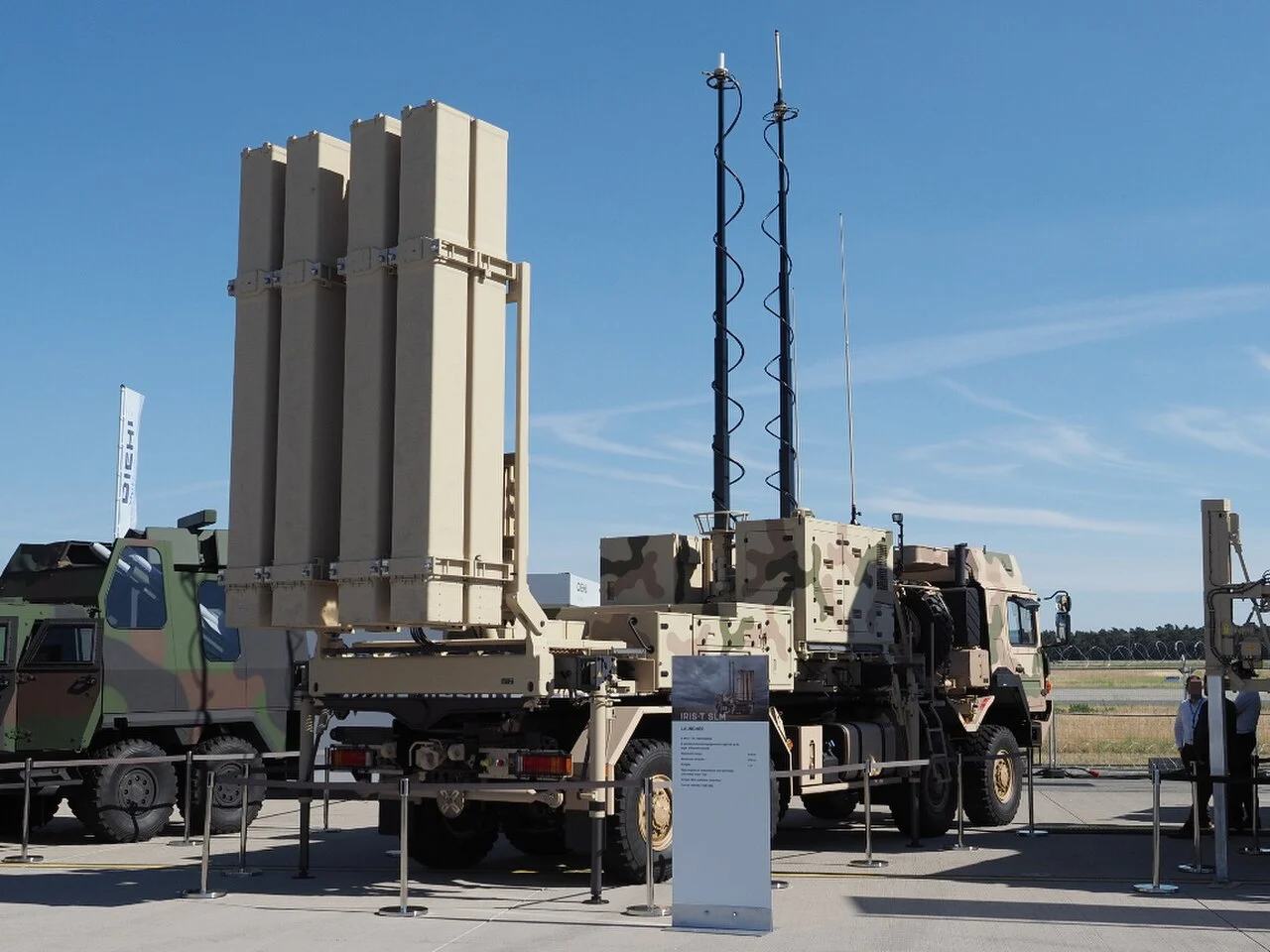
Photo: A Diehl IRIS-T SLM launcher in desert camouflage paint, the configuration associated with Egypt’s order, on static display at the ILA Berlin Air Show, June 2022. Credit: Boevaya mashina, CC BY-SA 3.0, via Wikimedia Commons.
Direct answer
Four systems have documented or credibly reported African buyers in the medium-range, point-defence class: France’s VL MICA (Morocco), Israel’s Barak MX (Morocco), Germany’s IRIS-T SLM (Egypt) and Israel’s SPYDER-MR (Kenya). No single system wins on every criterion. VL MICA has the longest confirmed delivery record in Africa, Egypt’s IRIS-T SLM fleet is the largest by battery count, Barak MX gives Morocco the longest reported engagement range of the four, and Kenya’s SPYDER is the newest and the only case where the buyer had no prior guided air-defence capability at all. No Turkish system in this class, such as Roketsan/Aselsan’s HİSAR-O+, has a confirmed African contract yet.
| Requirement | Truck-mounted, radar-guided medium-range air defence for an air base, capital region or border sector |
| Systems compared | VL MICA (France), Barak MX (Israel), IRIS-T SLM (Germany), SPYDER-MR (Israel) |
| Confirmed African operators | Morocco (VL MICA, Barak MX), Egypt (IRIS-T SLM), Kenya (SPYDER-MR) |
| Newest delivery | Kenya’s SPYDER-MR, delivered mid-December 2025 |
| Price data | No comparable unit prices published; only package or loan figures, some unconfirmed |
The African requirement
Most African air forces do not operate a layered national air-defence network. What a growing number need instead is a single mobile battery that can protect one air base, one capital region or one contested border sector against aircraft, attack helicopters, armed drones and, increasingly, precision-guided munitions — threats that sit above the reach of man-portable systems and short-range guns but do not require a strategic, multi-tier network. That is a distinct requirement from the one covered in DefenceMENA’s Short-Range Air Defence and MANPADS for African Armies, and a narrower one than the Russian-built S-300, Buk and Pantsir networks covered in Which African Countries Operate Advanced Air Defence Systems.
Operating environment
- Morocco: a contested desert frontier. Polisario Front forces have used small drones and loitering munitions against Moroccan positions in Western Sahara since the 2020 ceasefire collapse, and Rabat’s wider regional tension with Algeria has pushed it to diversify across several suppliers rather than rely on one system.
- Kenya: starting from zero. The Kenya Defence Forces had no guided surface-to-air missile system of any kind before SPYDER arrived. Parliament has heard from the country’s intelligence chief that al-Shabaab and Islamic State-linked cells were gaining access to drones and other weapons through Houthi networks, which is the threat cited in Kenya’s own budget documentation for the purchase.
- Egypt: a layer below an existing strategic shield. Egypt already fields Russian-sourced S-300VM, Buk-M2E and Tor-M2 systems (see DefenceMENA’s advanced air defence piece). IRIS-T SLM sits underneath that network, defending specific bases rather than replacing it, in a Sinai, Libyan-border and Suez Canal Zone security environment.
- Common gap across all three. None of the sources reviewed for this article publish independent, comparable test data on performance in African heat, dust or humidity for any of the four systems. That gap is stated here rather than filled.
What capabilities matter?
The same criteria are applied to all four systems: supplier and missile family, publicly stated engagement range, radar or sensor fit, mobility, the African operator and procurement status, publicly reported value, and any documented local support or technology transfer. Where a source does not state a figure, the table says so, and where governments have not officially confirmed a reported figure, that is flagged rather than presented as fact.
Comparison table
| System | Origin / supplier | Missile & stated range | Radar / sensor | Mobility | African operator | Status |
|---|---|---|---|---|---|---|
| VL MICA | France (MBDA) | MICA IR/RF, ~20 km | Sigma 30 fire-control radar | Truck-mounted vertical launch | Morocco (2 batteries) | Delivered (June 2022) |
| Barak MX | Israel (IAI) | MRAD ~35 km / LRAD ~70 km / ER ~150 km (tiered) | ELTA EL/M-2084 multi-mission radar | Truck-mounted vertical launch | Morocco | Contracted / reportedly deployed (not officially confirmed) |
| IRIS-T SLM | Germany (Diehl Defence) | IRIS-T, ~40 km, imaging infrared seeker | Dedicated acquisition/fire-control radar | Truck-mounted launcher | Egypt (7 batteries, SIPRI-sourced) | Delivered (from 2021) |
| SPYDER-MR | Israel (Rafael, with IAI/Elta radar) | Python-5 / I-Derby, ~35–50 km | Elta radar | Truck-mounted launcher | Kenya (1 reinforced battery) | Delivered (reported; not officially confirmed by Kenya) |
Engagement ranges are manufacturer or market figures, not independently verified. Barak MX’s three interceptor tiers mean it can also reach into the long-range band covered in DefenceMENA’s advanced air defence piece; the figure most comparable to the other three systems here is the MRAD tier.
VL MICA
Morocco’s government gazette recorded a roughly €192.1 million ($210.6 million) French loan in May 2020 financing a contract between MBDA’s French subsidiary and the Moroccan defence ministry, with media reporting at the time identifying VL MICA as the system and describing an option on up to four further batteries beyond the first two. Morocco received the first two batteries in June 2022, according to Morocco World News and The Defense Post. The system uses the MICA missile, shared with Morocco’s Mirage F1 and F-16 fleets in its air-to-air form, fired vertically from a truck-mounted launcher and guided by a Sigma 30 radar, with a stated range of about 20 km. Status: delivered.
Barak MX
Israeli media reported on 13 February 2022 that IAI would supply Morocco’s army with the Barak MX air and missile defence system in a deal valued at more than $500 million, a figure attributed to unnamed sources rather than an official statement; Hespress and Morocco World News carried the same figure days later. The talks followed Israeli defence minister Benny Gantz’s November 2021 visit to Rabat. Barak MX is a tiered family: its MRAD interceptor is reported at roughly 35 km, LRAD at roughly 70 km and ER at roughly 150 km, cued by IAI/ELTA’s EL/M-2084 multi-mission radar. Reporting on delivery timing is inconsistent — one account describes component shipments beginning around 2023, and a later Globes report cites satellite imagery showing a deployed system near Sidi Yahya el Gharb. Neither the Israeli nor the Moroccan government has officially confirmed the contract value or the delivery schedule. Status: contracted; deployment reported but not officially confirmed.
IRIS-T SLM
Germany’s SIPRI-tracked exports to Egypt include seven IRIS-T SLM batteries and 400 surface-to-air missiles, part of a defence relationship that peaked at €4.34 billion in 2021 arms exports and then fell sharply, as DefenceMENA covers in How Germany Built Egypt’s Submarines, Then Pulled Back. The air-defence purchase traces to a 2019 German export-credit guarantee of up to €2.3 billion that also covered Egypt’s MEKO A200 frigates, with Germany’s government separately approving the sale of 16 IRIS-T SL systems in December 2021. Sources disagree on sequencing: some reporting places the first SLM battery’s arrival in 2021, before that December approval, which may reflect an earlier tranche or inconsistent reporting; neither is resolved in the sources reviewed. A further complication is that in 2022 Germany diverted at least one IRIS-T consignment originally intended for Egypt to Ukraine after the Russian invasion. IRIS-T SLM uses an imaging-infrared-seeker missile with a stated range of about 40 km. Status: delivered, seven batteries per SIPRI-sourced figures.
SPYDER-MR
Kenya had no guided surface-to-air missile system until Rafael’s SPYDER arrived. DefenceMENA covers the purchase in detail in Why Did Kenya Buy the SPYDER Air-Defence System?: Kenya’s Treasury budget documents describe “one reinforced battery of medium range surface to air missile system” from Rafael, financed through Israeli government loans phased across three budget years — Sh1 billion in 2024/25, Sh3.4 billion (about $26 million) in 2025/26 and Sh6.1 billion planned for 2026/27. An Israeli Ministry of Defence-chartered freighter delivered the system in mid-December 2025, with photos of the unloading surfacing on social media on 13 December. The battery uses Python-5 and I-Derby/Derby missiles against aircraft, helicopters, drones and precision-guided munitions, cued by an Elta radar, with a stated range in the 35–50 km band. No Kenyan commissioning ceremony has been announced and the full contract value has never been disclosed. Status: delivered (reported; not officially confirmed by Kenya).
The Turkish option
Roketsan and Aselsan’s HİSAR family (HİSAR-A for low altitude, HİSAR-O for medium altitude) is the Turkish equivalent in this class, in service with the Turkish Armed Forces since 2022. DefenceMENA’s own reporting on Kenya’s SPYDER purchase lists HİSAR-A+/O+ among the “known alternatives” in the market that Kenya did not select, and no source reviewed for this article documents a confirmed African contract, evaluation or delivery for HİSAR anywhere on the continent. It is not included as a full option here for that reason, consistent with this site’s standard of only presenting Turkish systems where African use is documented.
African operators at a glance
- Morocco: VL MICA (2 batteries, delivered 2022), Barak MX (contracted 2022, deployment reported). Morocco also operates a longer-range Chinese FD-2000B battery and is a long-standing buyer of French and US air defence hardware; see DefenceMENA’s Morocco military strength profile and advanced air defence systems piece for that longer-range tier.
- Egypt: IRIS-T SLM (7 batteries, delivered from 2021), layered beneath Egypt’s Russian-sourced S-300VM, Buk-M2E and Tor-M2 holdings. See DefenceMENA’s Egypt military strength profile.
- Kenya: SPYDER-MR (1 reinforced battery, delivered December 2025), its first guided air-defence system of any kind. See DefenceMENA’s Kenya military strength profile.
Procurement and price evidence
No comparable unit price exists for any of the four systems, and this article does not derive one. VL MICA’s package figure, $210.6 million for two batteries, is loan financing, not a battery price, and the option on further batteries was never priced in the sources reviewed. Barak MX’s $500 million figure comes from unnamed sources cited by Israeli and Moroccan media, not an official disclosure. IRIS-T SLM’s air-defence component was bundled into a broader €2.3 billion German export-credit guarantee that also covered Egyptian frigates, so no standalone system price is public. SPYDER-MR’s only disclosed figures are the loan tranches in Kenya’s own budget books, which total roughly $82 million in loan financing phased across three fiscal years for one reinforced battery; the underlying contract value with Rafael has never been published, and the loan tranches include financing costs, not just hardware. Dividing any of these totals by battery count would mix missiles, radars, training and financing, so this article does not attempt it.
Delivery speed
The four cases are not on a common timeline and cannot be ranked cleanly. VL MICA took about two years from loan financing (May 2020) to delivery (June 2022). Barak MX’s contract was reported in February 2022, and its deployment was only confirmed later, through satellite imagery, with no official delivery date ever published. IRIS-T SLM’s first batteries reportedly arrived in 2021, with further approvals and at least one diversion to Ukraine complicating the sequence through 2022. SPYDER-MR was the fastest in reported terms — a loan negotiated in July 2025 and a delivery flight in mid-December 2025 — but that compares a single reinforced battery against multi-battery European and French packages, so it is not a fair volume-for-volume comparison.
Training, maintenance and local production
No source reviewed for this article documents local assembly, licensed production or a dedicated in-country maintenance facility for VL MICA, Barak MX, IRIS-T SLM or SPYDER-MR in Morocco, Egypt or Kenya. All four operators appear to depend on supplier-provided training and sustainment, none of which is detailed in public reporting. Anyone evaluating one of these systems should ask specifically about spares stocks, in-country technical support and warranty terms, since none of that is public for any of the four.
Which requirement fits which option?
| If the priority is | Option with documented or reported fit | Evidence gap |
|---|---|---|
| Building a first guided air-defence capability from nothing, loan-financed, single battery | SPYDER-MR (Kenya precedent) | Contract value, commissioning status |
| Diversifying across multiple suppliers and range tiers around one or more air bases | VL MICA and Barak MX together (Morocco precedent) | Barak MX delivery date and contract value |
| Adding a mobile layer beneath an existing strategic, Russian-sourced network | IRIS-T SLM (Egypt precedent) | Exact delivery sequence versus the 2021 and 2022 reporting |
| Longest confirmed, undisputed delivery record in Africa | VL MICA | Status of the further-battery option |
| Largest confirmed battery count in African service | IRIS-T SLM | Standalone system price |
See DefenceMENA’s military equipment database for country-by-country files, and Israeli-Built Weapons Systems in African Military Service for the wider pattern behind Morocco’s and Kenya’s purchases.
FAQ
What is a medium-range air defence system and how does it differ from MANPADS?
A medium-range system like VL MICA, Barak MX, IRIS-T SLM or SPYDER-MR is a radar-guided, truck-mounted battery engaging targets at roughly 20 to 70 km, built to defend a fixed site such as an air base or capital region. MANPADS are shoulder-fired, much shorter-ranged weapons for point protection of troops or small sites; DefenceMENA covers that tier separately in Short-Range Air Defence and MANPADS for African Armies.
Which African countries operate medium-range air defence systems like these?
Morocco operates VL MICA (delivered 2022) and has contracted Barak MX (2022, deployment reported). Egypt operates seven IRIS-T SLM batteries delivered from 2021. Kenya took delivery of one SPYDER-MR battery in December 2025, its first guided surface-to-air missile system.
Does any African country operate a Turkish medium-range air defence system?
Not according to the sources reviewed. Roketsan and Aselsan’s HİSAR-A+/O+ family is in Turkish service, and Kenya’s own procurement documentation lists it among the alternatives considered, but no African contract, evaluation or delivery for HİSAR is documented.
How much do these systems cost?
No comparable unit price is public for any of the four. Available figures are loan or package values — $210.6 million for Morocco’s two VL MICA batteries, a reported but unconfirmed $500 million for Barak MX, an undisclosed share of a €2.3 billion German export-credit package for Egypt’s IRIS-T SLM, and roughly $82 million in phased Kenyan loan financing for one SPYDER-MR battery — and none of them isolate a single battery’s price.
Sources
- Janes: Morocco VL MICA financing, May 2020
- Morocco World News: Morocco receives VL MICA missiles, June 2022
- Globes: IAI agrees $500m missile defense deal with Morocco
- Globes: Morocco completes deployment of IAI air defense system
- Hespress: Morocco enters $500 million deal with Israel for air defense system
- Army Recognition: New German-made IRIS-T SLM of Egypt’s armed forces
- Army Recognition: Germany approves sale of 16 IRIS-T SL systems to Egypt
- The Defense Post: Kenya boosts air defense with Israeli SPYDER system
- Army Recognition: Kenya receives Israeli SPYDER air defense
- DefenceMENA: Why Did Kenya Buy the SPYDER Air-Defence System?
Specifications, dates and figures are as reported by the sources named and vary between sources. Several contract values in this article, as flagged in the text, have not been officially confirmed by the governments involved. SIPRI’s Arms Transfers Database and manufacturer data sheets should be checked for any procurement decision.
Related: DefenceMENA compares the man-portable and short-range systems that sit below this tier in Short-Range Air Defence and MANPADS for African Armies.
Related: for the longer-range, strategic SAM networks that Morocco and Egypt field alongside the systems covered here, see Which African Countries Operate Advanced Air Defence Systems.