Egypt runs the largest armed forces in Africa and one of the most mixed arsenals anywhere: American F-16s and Abrams tanks, French Rafales and frigates, German submarines, Russian air defence, South Korean howitzers and, since 2025, Turkish and Chinese combat drones. This profile sets out what is actually in service in 2026, what is on order, and where the open-source numbers should be handled with care.
The short answer to the question in the headline: by personnel, combat aircraft and major warships, Egypt is the strongest military on the continent, and Global Firepower’s 2026 index again places it first in Africa and inside the world’s top 20. The longer answer is about money and mix. Cairo has cut its arms imports by half over the past five years, its budget is squeezed by an IMF programme, and it now sustains equipment from at least seven supplier countries. The sections below go service by service. Every line carries a status label: Operational, Delivered, On contract, Ordered, Under modernization, Estimated or Retired. An order is not a delivery, and a delivery is not an operational unit.
| Indicator | Figure | Year / source |
|---|---|---|
| Active personnel | 438,500 (Army about 310,000; Navy 18,500; Air Force 30,000; Air Defence Forces 80,000) | IISS Military Balance figure reproduced by Global Firepower and other trackers |
| Reserves / paramilitary | 479,000 reserves; about 397,000 paramilitary (Central Security Forces, National Guard, Border Guard) | IISS-derived, open source |
| Conscription | One to three years depending on education level | Egyptian law |
| Military expenditure | US$2.5 billion in 2025, up about 4% on 2024 (excludes off-budget military income) | SIPRI estimate |
| US military aid | US$1.3 billion a year in Foreign Military Financing | US State Department, September 2024 |
| Arms imports rank | 12th in the world in 2021–25 (2.6% of global imports, down 51% on 2016–20) | SIPRI, March 2026 |
| Main suppliers 2021–25 | France 39%, Germany 30%, Italy 18% | SIPRI |
| Combat aircraft | About 330 (F-16, Rafale, MiG-29M/M2, Mirage 2000) | Open-source directories, 2026 (Estimated) |
| Main battle tanks | 1,100–1,360 M1A1 Abrams plus a legacy M60 fleet | Estimated |
| Submarines | 4 Type 209/1400mod plus 4 ageing Romeo-class boats | Operational |
| Modern frigates | 7 (1 FREMM ex-French, 2 FREMM Bergamini, 4 MEKO A-200EN, one of them pending delivery confirmation) | Delivered / Operational |
Current military overview
The Egyptian Armed Forces are organised in four services: the Army, the Navy, the Air Force and the Air Defence Forces, which have been a separate service since 1968. Their planning is shaped by three standing problems. The first is the western and southern borders, where the war in Sudan and instability in Libya have pushed Cairo to garrison remote airstrips and, since 2025, to fly combat drones from the East Oweinat area. The second is Sinai, where a decade of counter-insurgency was followed by a build-up along the Gaza frontier during the 2023–2025 war. The third is deterrence in the eastern Mediterranean and the Red Sea, which drove the naval expansion of 2014–2023 and the layered air-defence purchases that followed.
Egypt has also kept a deliberately wide supplier base. Since the 2013 change of government it has bought from France, Germany, Italy, Russia, China, South Korea and, most recently, Türkiye, while continuing to receive US$1.3 billion a year in US Foreign Military Financing. The result is a force with real depth but also four incompatible supply chains for combat aircraft alone. The North Africa desk tracks how that compares with Algeria and Morocco.
Defence budget: what the numbers do and do not show
Egypt does not publish a line-item defence budget. The state budget for fiscal year 2025/26, approved by parliament in June 2025, totals EGP 4.6 trillion (about US$91 billion) and lists defence and national security as a single aggregate; the cabinet approved a EGP 5.1 trillion budget for 2026/27 in March 2026. SIPRI’s estimate of military expenditure, the figure most analysts use, comes to about US$2.5 billion for 2025, up roughly 4% on the US$2.4 billion recorded in 2024. The dollar values fell sharply after the pound’s 2023–24 devaluations, so the trend in local currency is steeper than the dollar series suggests.
Three things sit outside those figures. First, the military’s commercial enterprises generate income that is not reported in the budget. Second, US Foreign Military Financing: in September 2024 Washington released the full US$1.3 billion for the first time since 2020, waiving the human-rights conditions attached to US$320 million of it. Third, the large European purchases are financed by export credits rather than cash. The 2021 Rafale contract, worth about €3.75 billion for 30 aircraft, is spread over ten years and covered by a French state guarantee of up to 85%. Any single “Egypt defence budget” number is therefore partial.
Active personnel
The IISS Military Balance figure of 438,500 active personnel remains the reference number and is reproduced by Global Firepower and most other trackers. It breaks down into roughly 310,000 in the Army, 18,500 in the Navy, 30,000 in the Air Force and 80,000 in the Air Defence Forces. Reserves stand at about 479,000, and the paramilitary Central Security Forces, National Guard and Border Guard add close to 397,000. Conscripts serve one year with a university degree, two years with a secondary-school certificate and three years without either. Egypt itself publishes no personnel totals, and the IISS figures have changed little in recent editions, so they should be read as an order of magnitude rather than a headcount.
Army
The Army is built around a large armoured and mechanised core equipped from the United States, with Soviet-era systems in second-line and reserve roles and a growing set of locally built vehicles. Two programmes define its current direction: the M1A1 Abrams co-production line at Military Factory 200, which has assembled tanks since 1992, and the K9A1 EGY howitzer deal with South Korea, which moved into local production in 2025–26. Open-source tank counts vary widely, and Egypt has never published its own, so the table uses ranges.
| System | Origin | Quantity | Status | Source |
|---|---|---|---|---|
| M1A1 Abrams main battle tank | USA, co-produced at Factory 200 | About 1,360 assembled since 1992; open-source estimates of the active fleet run from 1,100 to 1,360 | Operational (Estimated) | Egypt–US co-production programme, open-source trackers |
| M60A1 / M60A3 | USA | Up to about 1,700 delivered historically; several hundred active, remainder stored | Operational / Reserve (Estimated) | Open-source trackers |
| Ramses II, T-62, T-55 | Egypt upgrade / USSR | About 260 Ramses II conversions; T-62 and T-55 mostly stored | Reserve / Retired (Estimated) | Open-source trackers |
| K9A1 EGY 155 mm self-propelled howitzer | South Korea (Hanwha) / Egypt | 216 on contract (February 2022, about US$1.66 billion) plus 39 K10 resupply and 51 K11 command vehicles; first batch delivered 2024–25, first battalion due early 2026, remainder from Factory 200 | Delivered / On contract | Army Recognition, SIS, defenceWeb |
| M109A2 / M109A5 155 mm | USA | About 400–500 | Operational (Estimated) | Open-source trackers |
| Towed artillery (D-30 122 mm, M-46 130 mm, others) | USSR / China | Several hundred | Operational (Estimated) | Open-source trackers |
| Rocket artillery (BM-21 and Sakr 122 mm, Sakr-45, RM-70, M270 MLRS) | USSR / Egypt / Czechoslovakia / USA | 300+ Grad-type launchers; 26 M270 | Operational (Estimated) | Open-source trackers |
| Armoured infantry vehicles (M113 family, YPR-765, BMP-1, Fahd, Temsah MRAP family, ST-100 / ST-500) | USA / Netherlands / USSR / Egypt | M113 about 2,500; YPR-765 about 600; Fahd 1,000+; Temsah and ST series undisclosed | Operational (Estimated) | Open-source trackers, EDEX displays |
| Anti-tank guided missiles (TOW-2A/B with local assembly, MILAN, Kornet-E) | USA / France / Russia | Thousands of TOW rounds; Kornet-E reported but not officially confirmed | Operational / Reported | Open-source trackers |
| Tactical ballistic missiles (Scud-B, Project T, Sakr-80 rockets) | USSR / Egypt | Small legacy stock | Estimated | Open-source trackers |
The K9 programme is the one to watch. Hanwha delivered the first battery from South Korea, Hanwha Systems and Arab International Optronics supply Egyptian-made fire-control electronics, and officials at EDEX 2025 projected a localisation rate rising toward 67%. On the vehicle side, the Kader Factory’s Temsah mine-resistant family and the private IMUT company’s ST-100 and ST-500 have replaced imports for most new protected-mobility buys, and Egypt announced its first production of 30 mm armoured steel plate in December 2025.
Air Force
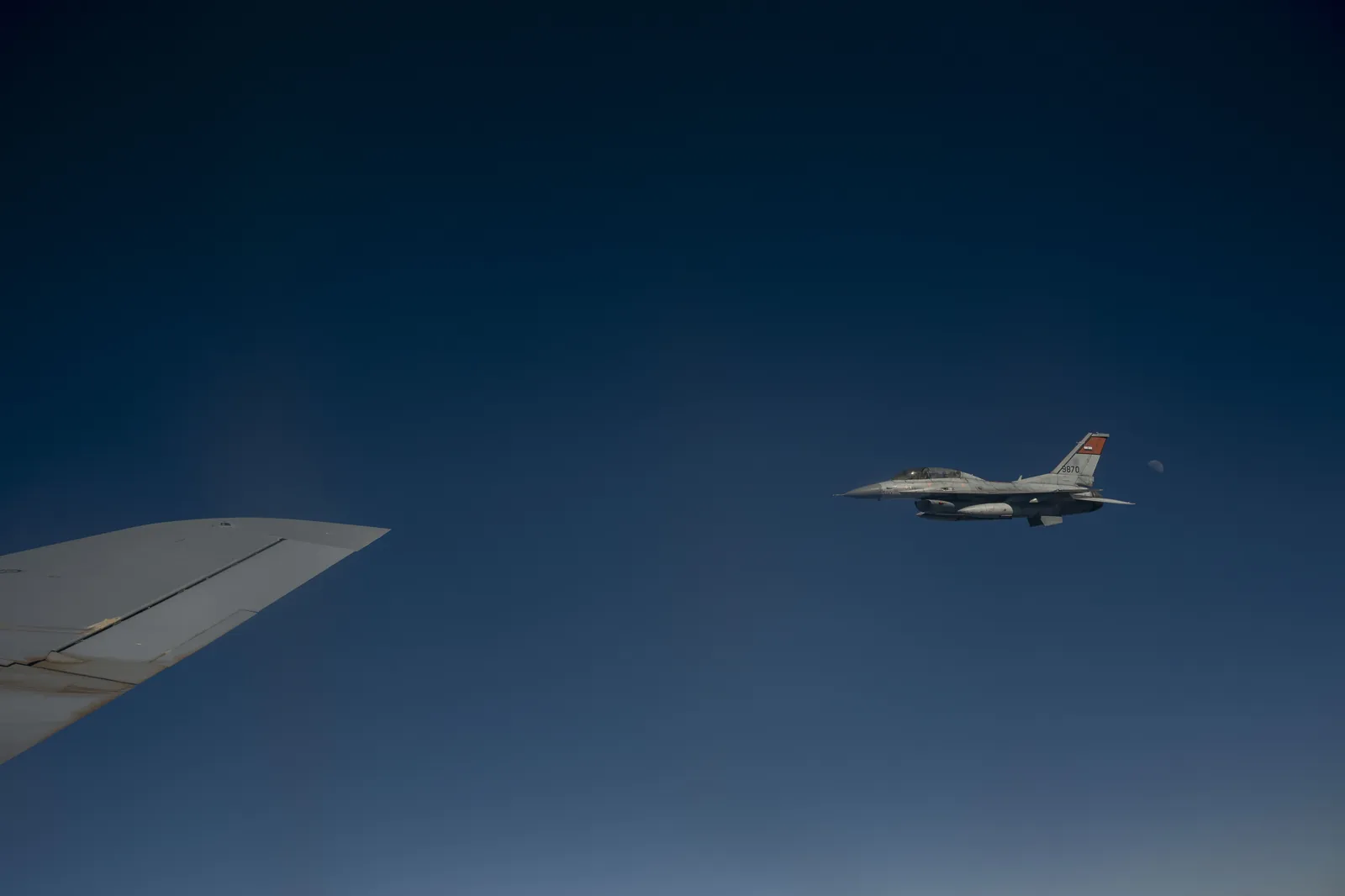
The Egyptian Air Force is the largest in Africa and the Arab world by combat aircraft, and the only one flying US, French and Russian fighters side by side. Its spine is still the F-16, of which about 218 remain listed across the A, B, C and D models, but the oldest Block 15 aircraft are now more than 40 years old and the fleet’s future is the subject of the Rafale request sent to Paris in September 2026.
For a full breakdown of every fighter type, quantity and status, see DefenceMENA’s dedicated file on Egypt’s fighter jets.
| System | Origin | Quantity | Status | Source |
|---|---|---|---|---|
| F-16A/B/C/D (Block 15, 32, 40, 52) | USA | About 218 listed (32 A, 8 B, 136 C, 42 D); 42 Block 15 delivered 1982–85 | Operational, part stored (Estimated) | Open-source directories, Army Recognition |
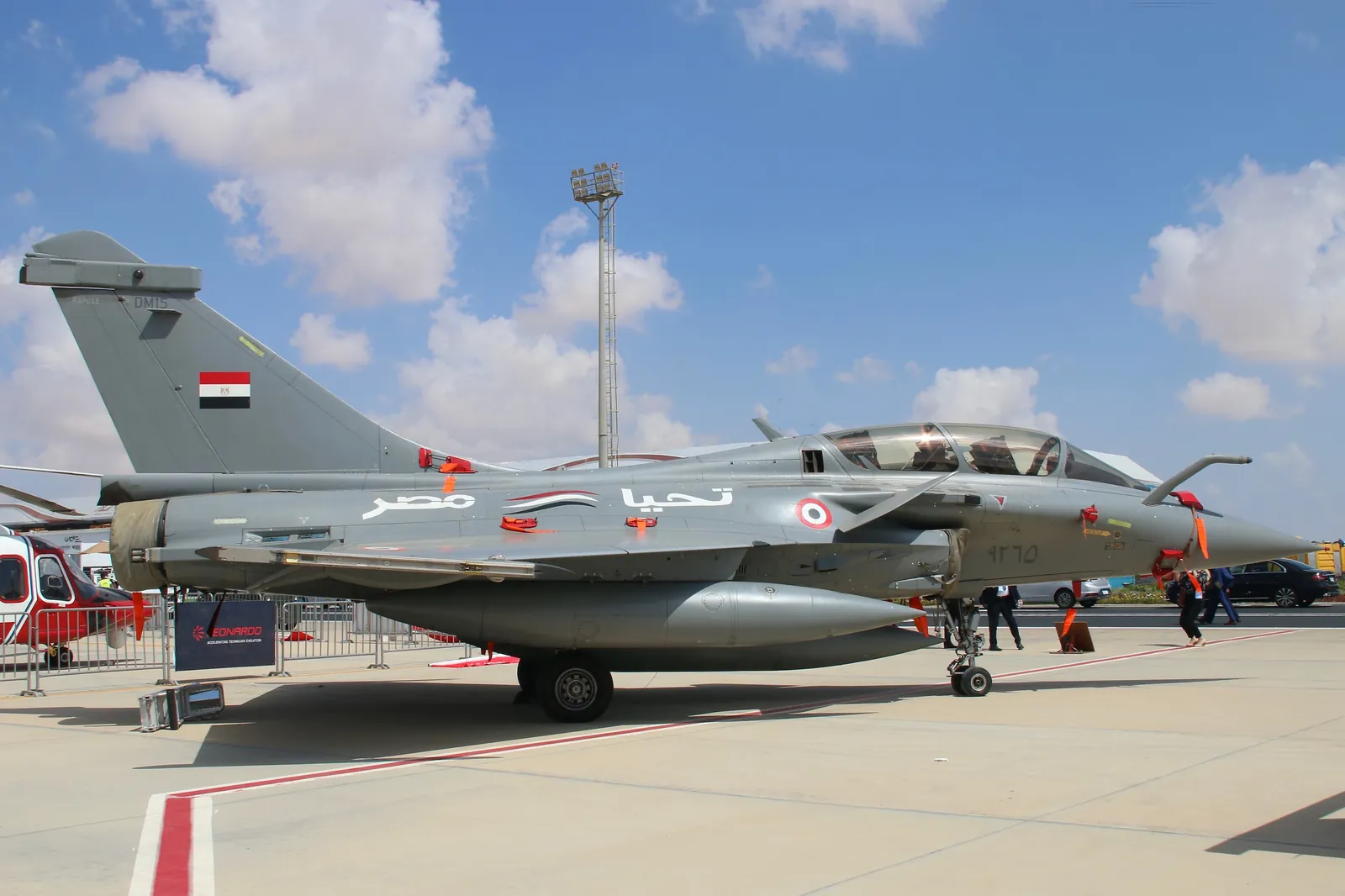
| Rafale DM/EM (F3R standard) | France (Dassault) | 24 delivered 2015–19; 30 ordered May 2021, deliveries since late 2024 (about 46 in service by mid-2026, balance due by end-2026); request for 24 more sent 1 September 2026 | Operational / Delivered / Requested | Army Recognition, The Aviationist, Military Africa |
| MiG-29M / M2 | Russia | 46 ordered 2015, delivered 2017–20; 44–46 after attrition | Operational (Estimated) | Open-source directories |
| Mirage 2000EM/BM | France | About 18 | Operational (Estimated) | Open-source directories |
| Mirage 5 (various) | France | Residual airframes | Retiring (Estimated) | Open-source directories |
| Su-35 | Russia | Ordered 2018; the deal was not completed under US sanctions pressure | Not in service | Open-source reporting |
| E-2C Hawkeye | USA | 7–8 | Operational (Estimated) | Open-source directories |
| C-130H / C-130J-30 Hercules | USA | About 20 C-130H; 2 C-130J-30 ordered September 2024, with up to 10 more expected in a staggered order | Operational / Ordered | Lockheed Martin |
| C-295 | Spain (Airbus) | 24 | Operational | Open-source directories |
| Il-76MF; An-74 | Russia; Ukraine | 2; 3+ | Operational (Estimated) | Open-source directories |
| AH-64D / AH-64E Apache | USA (Boeing) | 46 AH-64D; 43 being remanufactured to AH-64E under a US$2.3 billion package; 10 new-build AH-64E approved 2018; US$630 million Hellfire package approved January 2025 | Under modernization / On contract | FlightGlobal, Military Africa |
| Ka-52 | Russia | 46 delivered 2017–19 | Operational | Open-source directories |
| CH-47C/D/F Chinook | USA (Boeing) | 19 C/D; 12 CH-47F ordered 2023 (about US$426 million), first 5 handed over at El Alamein, September 2026 | Operational / Delivered / On contract | Military Africa |
| Mi-8/Mi-17, UH-60, Commando (Sea King), SA342 Gazelle | Russia / USA / UK / France | About 40 Mi-8/17; about 20 UH-60; about 20 Commando; 80+ Gazelle | Operational (Estimated) | Open-source directories |
| K-8E Karakorum, Alpha Jet (trainers) | China, assembled by AOI; France–Germany | Up to 120 K-8E assembled locally; about 44 Alpha Jet | Operational (Estimated) | Open-source directories |
The Rafale story runs in three chapters. The 2015 contract for 24 aircraft came inside a roughly US$5.9 billion package that also bought the FREMM frigate Tahya Misr and missiles. The May 2021 follow-on for 30 aircraft at about €125 million each began arriving in late 2024, with single-seat EM12, EM13 and EM14 photographed at Mérignac in November 2025. Then on 1 September 2026, according to La Tribune as relayed by Army Recognition, Cairo sent Dassault a request for proposals for 24 more, which would lift the fleet to 78. The weapons picture is less clear: open sources conflict on whether the Meteor air-to-air missile has been cleared for Egypt, and neither MBDA nor the Egyptian Ministry of Defence has confirmed a delivery, so this profile does not list it.
A full breakdown of the order, delivery and service history, cost and possible fourth batch is in DefenceMENA’s dedicated Rafale equipment file.
China’s role is growing but has not produced a fighter order. The second Eagles of Civilization exercise, held from 22 August to 7 September 2026, brought Chinese J-16 fighters, a KJ-500 airborne early-warning aircraft, Y-20 transports and a YY-20A tanker to Egypt to train against Rafales and MiG-29M2s. Reports of a J-10C or J-35 purchase have circulated for two years without confirmation. The one gap the exercise exposed is Egypt’s own: it has no dedicated tanker aircraft.
Navy
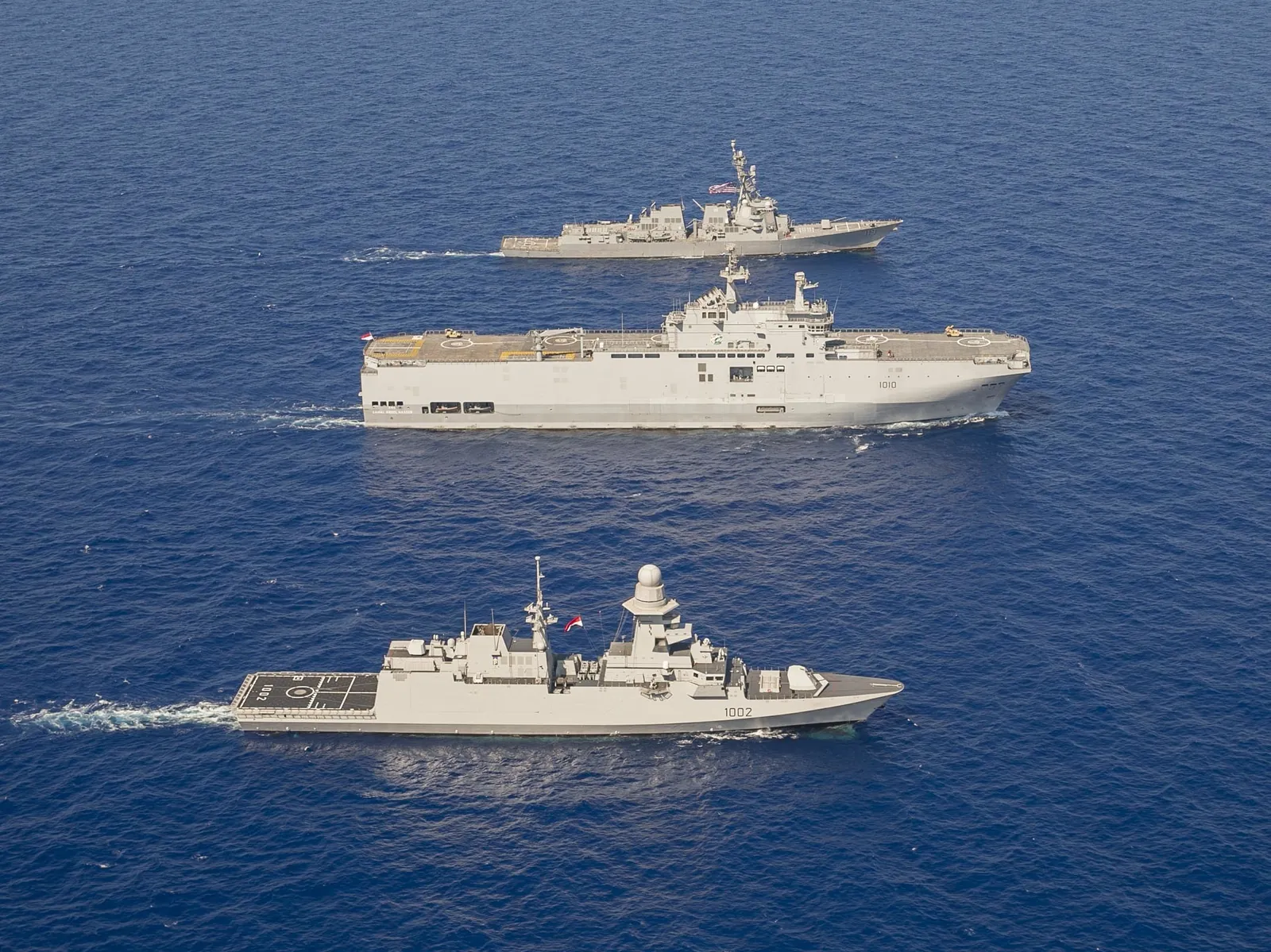
Between 2014 and 2023 Egypt built the most capable navy in Africa, with two fleets (Mediterranean and Red Sea), two helicopter carriers, seven modern frigates, four Gowind corvettes and four new German submarines. The 2026 naval roadmap shifts the emphasis from large surface combatants to submarines, unmanned vessels and local construction at Alexandria Shipyard.
| Class | Origin | Quantity | Status | Source |
|---|---|---|---|---|
| Type 209/1400mod submarines | Germany (TKMS) | 4 (S41–S44), delivered 2016–21 | Operational | Military Africa |
| Romeo-class (Type 033) submarines | China, upgraded with Harpoon | 4, delivered 1980s | Operational, limited (Estimated) | Open-source trackers |
| FREMM Tahya Misr (ex-Normandie) | France (Naval Group) | 1, delivered 2015 | Operational | Naval News |
| FREMM Bergamini (Al-Galala, Bernees) | Italy (Fincantieri) | 2, delivered 2020–21 | Operational | Open-source trackers |
| MEKO A-200EN frigates (Al-Aziz, Al-Qahhar, Al-Qadeer, Al-Jabbar) | Germany (TKMS) / Egypt | 4 ordered 2018 (about US$2.7 billion); three delivered 2022–23; Al-Jabbar built at Alexandria, launched December 2023, delivery scheduled for October 2025 | Operational (3) / Delivery pending confirmation (1) | Naval News, Janes |
| Oliver Hazard Perry-class frigates | USA (ex-US Navy) | 4 | Operational, limited (Estimated) | Open-source trackers |
| Knox-class frigates; Descubierta-class corvettes | USA; Spain | 2; 2 | Retired or reserve (Estimated) | Open-source trackers |
| Gowind 2500 corvettes (El Fateh, Port Said, Al Moez, Ismailia ex-Luxor) | France (Naval Group) / Egypt | 4, three built at Alexandria Shipyard | Operational | Naval Group, Baird Maritime |
| Mistral-class helicopter carriers (Gamal Abdel Nasser, Anwar El Sadat) | France | 2, delivered 2016 | Operational | Open-source trackers |
| Ambassador Mk III missile craft (S. Ezzat class) | USA (VT Halter) | 4, delivered 2013–15 | Operational | Open-source trackers |
| Fast attack craft (Molniya, Tiger, Ramadan, Osa) | Russia / Germany / UK / USSR | 1 / 5 / 6 / small numbers | Operational / Retiring (Estimated) | Open-source trackers |
| PV43-M patrol vessels | Germany (NVL) / Egypt | 10, construction started at Alexandria in September 2025 under a 2023 contract | Under construction | The Defense Post |
| Swiftships patrol boats, Osprey-class minehunters, replenishment ship Luxor (ex-RFA Fort Rosalie), Polnocny landing ships | USA / UK / Poland | About 30 Swiftships-built boats; 3 Osprey; 1 replenishment ship; 3 landing ships | Operational (Estimated) | Open-source trackers |
Two decisions from the past year set the direction. In December 2025 the Navy signed a five-year in-service support contract with Naval Group covering seven vessels, the FREMM, the four Gowinds and the two Mistrals, with work centred on Alexandria. In January 2026 open sources described a submarine plan built around two options: Spain’s S-80 Plus, assessed after the Spanish submarine Isaac Peral visited Alexandria in November 2025, and a Barracuda-derived conventional design from France, where talks are reported to have slowed over Egypt’s demand for production rights and local manufacturing scope. Either would replace the four Romeo boats. One caution on the table above: Al-Jabbar’s delivery was scheduled for October 2025, and as of September 2026 DefenceMENA has not found an official commissioning announcement, so the frigate is listed as pending rather than operational.
UAV and drone fleet
Egypt’s drone force was built on Chinese airframes and is now being dual-sourced from Türkiye, with a parallel push to assemble locally. Its most consequential deployment is on the Sudanese border. Reuters reported on 2 February 2026 that satellite images from Vantor and Planet Labs showed a Bayraktar Akıncı on the apron at East Oweinat, about 60 km from Sudan, on 29 September, 28 December and 9 January, with two aircraft visible on one date. A Turkish defence ministry source told the agency the two countries had agreed the sale in 2024 but gave no numbers; Baykar and the Egyptian government did not respond. The New York Times, cited by Reuters, reported the aircraft were being used for strikes inside Sudan. Cairo has not commented.
| System | Origin | Quantity | Status | Source |
|---|---|---|---|---|
| Wing Loong I / Wing Loong II | China (AVIC) | Undisclosed; in service since about 2018; open-source estimates 30+ | Operational (Estimated) | Military Africa |
| WJ-700 | China (CASIC) | 10, contract of about US$400 million reported June 2025 | Ordered (reported) | Military Africa |
| Bayraktar Akıncı | Türkiye (Baykar) | Sale agreed 2024; airframes observed in Egypt from September 2025; quantity undisclosed, at least two seen | Delivered (number unconfirmed) | Reuters |
| Bayraktar TB2 | Türkiye (Baykar) | Reported in 2024 alongside the Akıncı; no evidence of delivery | Reported, unconfirmed | Open-source reporting |
| Yabhon United 40 / Flash-20 | UAE (ADCOM) | Reported 2015 | Estimated | Open-source trackers |
| 30 June, Nut and Thebes UAVs | Egypt (AOI) | Development and limited service | Estimated | EDEX displays |
| Hamza-1 VTOL UAV | Türkiye (Havelsan) / Egypt | Co-production memorandum signed December 2025 | On contract (MoU) | Military Africa, The Defense Post |
| Hamza-2 (ASN-209-derived) | China (Norinco) / Egypt (AOI) | Co-production memorandum signed December 2025 | MoU | Military Africa, Ahram Online |
The WJ-700 purchase, reported by Military Africa in December 2025, adds a turbojet-powered, higher-altitude platform to the turboprop Wing Loong fleet, and it was signed in the same year the Akıncı arrived. Egypt is therefore one of the clearest cases of an African buyer running Turkish and Chinese combat drones together, a pattern Envanter Media examined in its piece on why some African air forces buy both.
Air defence
The Air Defence Forces field the most varied ground-based air-defence inventory in Africa, and since 2024 the layering has become denser at every altitude: German IRIS-T SLM batteries were shown operational at the October 2024 parade, a Chinese HQ-9B long-range system was acknowledged in July 2025, a US$4.67 billion NASAMS package was approved by Washington the same month, and a Turkish short-range system was contracted in February 2026. Integrating Russian, Chinese, German, American and Turkish fire-control networks is the unspoken engineering problem behind the list.
| System | Tier | Origin | Quantity | Status | Source |
|---|---|---|---|---|---|
| S-300VM (Antey-2500) | Long range / anti-ballistic | Russia | Estimated 4 battalions, delivered 2015–17 | Operational (Estimated) | Open-source trackers |
| HQ-9B | Long range | China | Estimated 2–4 batteries; acknowledged by retired Major General Samir Farag on Sada El-Balad TV in July 2025; deployment in Sinai reported from September 2025 | Delivered (reported; no Ministry of Defence statement) | Military Africa, Army Recognition |
| Buk-M2E (with older Buk-M1) | Medium range | Russia | Estimated 10 batteries | Operational (Estimated) | Open-source trackers |
| IRIS-T SLM | Medium range | Germany (Diehl Defence) | 7 batteries; paraded October 2024 | Delivered / Operational | Military Africa, Army Recognition |
| IRIS-T SLX | Long range | Germany (Diehl Defence) | 10 on contract (2018 approval); deliveries not confirmed | On contract | Army Recognition |
| IRIS-T SLS | Short range | Germany (Diehl Defence) | 6 on contract | On contract (delivery unconfirmed) | Army Recognition |
| NASAMS | Medium range | USA / Norway (RTX, Kongsberg) | Foreign Military Sale approved 24 July 2025, ceiling US$4.67 billion: 4 Sentinel radars, 100 AMRAAM-ER, 100 AIM-120C-8, 600 AIM-9X Block II | Approved (no contract announced) | Army Recognition, DSCA |
| MIM-23 Improved HAWK | Medium range | USA | About 18 batteries; life-extension ordered 2014 | Operational / Under modernization (Estimated) | Open-source trackers |
| S-125 Pechora-2M | Medium range | Russia (upgrade) | About 70 upgraded launchers | Operational (Estimated) | Open-source trackers |
| Tor-M2E | Short range | Russia | Estimated 16 firing units | Operational (Estimated) | Open-source trackers |
| Pantsir-S1 | Short range | Russia | Reported | Reported, unconfirmed | Open-source reporting |
| Tolga | Short range / counter-drone | Türkiye (MKE) | US$130 million export contract, February 2026 | On contract | The Defense Post |
| Crotale NG, Avenger, Chaparral, Skyguard/Amoun, Sinai-23, ZSU-23-4 | Short range / point defence | France / USA / Switzerland / Egypt / USSR | Legacy, hundreds of fire units | Operational (Estimated) | Open-source trackers |
| MANPADS (Igla-S, Stinger, Ayn al-Saqr) | Point defence | Russia / USA / Egypt | Undisclosed | Operational | Open-source trackers |
Two caveats. The HQ-9B has never been confirmed by the Egyptian Ministry of Defence; the public evidence is a retired general’s television remark, Il-76 flights between China and Egypt in July 2025 and subsequent imagery reports, which is why it is listed as reported rather than operational. And the NASAMS value is a DSCA ceiling based on initial requirements; the Defense Security Cooperation Agency itself notes the final figure could be lower, and no contract has been announced.
Missiles and artillery
Egypt’s strike capability is short-legged by regional standards. Its anti-ship inventory is modern: Exocet MM40 Block 3 on the Gowinds and Tahya Misr, Harpoon on the Perry frigates, Ambassador craft and Romeo submarines, and Otomat on the Italian FREMMs. On land it relies on rocket artillery and a small stock of Scud-B and Project T ballistic missiles from the 1980s, and no land-attack cruise missile is confirmed in service. The heavy investment is going into tube artillery instead: the K9A1 EGY line at Factory 200, the M109 fleet and a new 155 mm ammunition plant to be built with Türkiye’s MKE.
Defence industry
Egypt has the oldest and largest defence-industrial base in Africa, organised in two state groups. The Arab Organization for Industrialization (AOI), founded in 1975, runs the Aircraft Factory (K-8E assembly and, since December 2025, certified Rafale components for Dassault), the Engine Factory, the Kader vehicle plant, the Sakr rocket and air-defence works and the Arab International Optronics joint venture. The Ministry of Military Production’s numbered factories include Factory 200 (M1A1 assembly and now the K9A1 EGY line), Factory 99 at Helwan (ammunition) and Factory 81 at Heliopolis (explosives). Alexandria Shipyard has built three Gowind corvettes, a MEKO frigate and is now building ten PV43-M patrol vessels. A private sector is emerging around IMUT’s ST-series vehicles.
EDEX 2025, held in Cairo from 1 to 4 December, was built around localisation: 260 locally produced items were shown, AOI alone presented 57 systems including 18 shown for the first time and an integrated counter-drone platform, and Egypt announced 30 mm armoured steel production, the Sina 806 recovery vehicle and the Sakr 105 thermobaric launcher. The agreements signed there map the industrial strategy: Rafale parts with Dassault, co-production and technology transfer with China’s Norinco, the Hamza-1 drone with Havelsan, aircraft-engine maintenance with France’s Sofema, and a Cairo office for ASELSAN. Egypt is not yet an exporter of complete systems; it does not appear among SIPRI’s 25 largest suppliers, and its sales abroad are concentrated in ammunition, light vehicles and rockets.
Main defence suppliers
The 2010s made Egypt one of the world’s largest arms buyers, third in SIPRI’s 2015–19 ranking. That wave has receded: SIPRI’s March 2026 fact sheet places Egypt 12th in 2021–25 with 2.6% of global imports, down 51% from the previous five-year period, and it attributes the collapse of Russian exports partly to the fall in deliveries to Egypt. Within the smaller total, Europe dominates.
| Supplier | Share of Egypt’s imports 2021–25 | Main items | Trend |
|---|---|---|---|
| France | 39% | Rafale, FREMM, Gowind, Mistral, missiles, in-service support | Egypt is 11% of French arms exports, France’s second client after India |
| Germany | 30% | MEKO A-200EN, Type 209/1400mod, IRIS-T | Egypt is 14% of German arms exports, Germany’s second client after Ukraine |
| Italy | 18% | FREMM Bergamini frigates | Follow-on Italian package under discussion since 2020 |
| United States | Below 10% by SIPRI volume | F-16 sustainment, Apache, Chinook, C-130J, Hellfire, NASAMS approval; US$1.3 billion FMF a year | Steady, grant-financed |
| Russia | Sharply down | MiG-29M, Ka-52, S-300VM, Buk, Tor | No major deliveries since 2020; Su-35 not completed |
| China | Rising | Wing Loong, WJ-700, HQ-9B, K-8E, Norinco co-production | Drones and air defence, plus joint exercises |
| South Korea | Single programme | K9A1 EGY howitzers with local production | Delivering |
| Türkiye | New since 2024 | Akıncı, Tolga, ammunition joint venture, Hamza-1 | Growing from a low base |
| Spain | Small | C-295; S-80 Plus submarine talks | Potential growth |
DefenceMENA has separate supplier-by-supplier breakdowns of two of these relationships: how France became a major defence supplier to Egypt and how Germany built Egypt’s submarines and frigates, then pulled back, with programme-by-programme contract and delivery tables for each.
Recent procurement, 2025–2026
| Date | Event | Value | Status |
|---|---|---|---|
| January 2025 | US approves Hellfire missiles for the Apache fleet | US$630 million | Approved |
| June 2025 | Contract for 10 Chinese WJ-700 combat drones reported | About US$400 million | Ordered (reported) |
| July 2025 | Retired general acknowledges HQ-9B; Il-76 flights from China | Undisclosed | Delivered (reported) |
| 24 July 2025 | US State Department approves NASAMS and missiles | Up to US$4.67 billion | Approved |
| September 2025 | Akıncı first imaged at East Oweinat; PV43-M construction starts at Alexandria; Friendship Sea naval exercise with Türkiye | Undisclosed | Delivered / Under construction |
| November 2025 | Rafale EM12–EM14 handed over at Mérignac | Part of €3.75 billion 2021 contract | Delivered |
| 1–4 December 2025 | EDEX 2025: Dassault–AOI Rafale parts, Norinco MoU, Havelsan Hamza-1, ASELSAN Egypt office, Naval Group five-year support for seven ships, K9A1 EGY shown in service | Various | Signed / In service |
| January 2026 | Submarine plan surfaces: S-80 Plus assessment and Barracuda-derived talks | Reported €4.5–6 billion for four boats | Under consideration |
| February 2026 | Türkiye–Egypt package: MKE Tolga export and joint ammunition plant | US$350 million (130 + 220) | On contract |
| March 2026 | SIPRI ranks Egypt 12th importer for 2021–25 | n/a | Published |
| 22 August–7 September 2026 | Eagles of Civilization 2026 with Chinese J-16, KJ-500, YY-20A | n/a | Exercise |
| 1 September 2026 | Request for proposals to Dassault for 24 more Rafales | Undisclosed | Requested |
| 8–10 September 2026 | First five CH-47F Chinooks handed over at El Alamein | Part of US$426 million 2023 sale | Delivered |
Turkish systems in Egypt
Relations between Cairo and Ankara were frozen for a decade after 2013 and were restored at head-of-state level in 2024. Defence followed quickly: some 80 Turkish companies exhibited at EDEX 2025, the two navies held the Friendship Sea exercise in September 2025, and in February 2026, during a visit by President Erdoğan to Cairo, the two governments announced a US$350 million package. According to The Defense Post it has two parts: a US$130 million export of MKE’s Tolga short-range air-defence system, and a US$220 million joint venture to build a 155 mm artillery ammunition plant in Egypt together with 7.62 mm and 12.7 mm lines. A further memorandum between MKE and Military Factories 81 and 99, covering explosives, was reported in September 2026 by The Middle East Observer, which also noted that neither side has disclosed investment values, volumes or timetables.
| System | Company | Scope | Status | Source |
|---|---|---|---|---|
| Bayraktar Akıncı heavy combat drone | Baykar | Sale agreed 2024; airframes deployed at East Oweinat from September 2025; quantity undisclosed | Delivered | Reuters |
| Tolga short-range air-defence system | MKE | Export contract, February 2026 | On contract (US$130 million) | The Defense Post |
| 155 mm, 7.62 mm and 12.7 mm ammunition production | MKE with the Egyptian Ministry of Defence | Joint-venture factory in Egypt | On contract (US$220 million) | The Defense Post |
| Explosives and energetics co-production | MKE with Factories 81 and 99 | Memorandum signed at the Balkan Shield exhibition | MoU | The Middle East Observer |
| Hamza-1 VTOL drone | Havelsan with Egyptian partners | Co-production memorandum, December 2025 | MoU | Military Africa |
| Aqrab unmanned ground vehicle | Turkish–Egyptian joint development | Exhibited at EDEX 2025 | Prototype | The Defense Post |
| ASELSAN Egypt | ASELSAN | Representative office in Cairo and preliminary co-production agreements | Established December 2025 | Anadolu Agency |
| Bayraktar TB2 | Baykar | Reported in 2024 | Unconfirmed | Open-source reporting |
What does Türkiye actually offer Cairo that others do not? The evidence supports three points and one limit. Availability: the Akıncı went from agreement to deployment in roughly a year, in a segment where Washington has not offered Egypt armed MQ-9s. Local production: the ammunition joint venture and the Hamza-1 memorandum fit the localisation policy that dominated EDEX 2025 better than a finished-goods sale would. Political fit: after the 2024 rapprochement, Turkish equipment carries none of the sanctions exposure that stopped the Su-35, and Egypt has shown it will use Turkish drones operationally. The limit is scale: Turkish deliveries are still a small fraction of Egypt’s imports next to France, Germany and Italy, Türkiye supplies no Egyptian fighter, frigate or tank, and Cairo bought Chinese WJ-700s in the same year it took the Akıncı. Egypt is hedging, not switching. The Turkish delegation’s scale at this year’s AAD show in Pretoria suggests the same pattern is being pursued across the continent; the Turkish Defence in Africa desk follows it.
| Factor | Türkiye | China | Russia |
|---|---|---|---|
| Delivered to Egypt 2024–26 | Akıncı drones; Tolga and ammunition plant on contract | HQ-9B (reported); WJ-700 ordered; Wing Loong sustainment | Nothing major since the Ka-52 and MiG-29M deliveries ended in 2020 |
| Local production | Ammunition JV, Hamza-1, explosives MoU | Norinco MoU, Hamza-2, K-8E assembly since 1999 | None current |
| Political exposure | Low since 2024 normalisation | US pressure on major buys; no fighter order confirmed | CAATSA risk; Su-35 not completed |
| Price and financing | Not disclosed for Egypt | WJ-700 about US$40 million per aircraft as reported | Not applicable currently |
| Munitions | Turkish guided munitions with the Akıncı; 155 mm plant planned | Chinese weapons for the Wing Loong and WJ-700 | Legacy stocks |
What is changing?
Six shifts stand out from the past twelve months. The Rafale is becoming the fleet’s centre of gravity, with the F-16 force ageing and a request for 24 more French aircraft on the table. Air defence is being layered from four supplier blocs at once, which raises the integration cost even as it closes altitude gaps. The Navy is turning from a decade of frigate purchases toward submarines, unmanned vessels and construction in Alexandria. The Army is moving from buying to co-producing, with the K9 line, armoured steel and the ammunition joint venture. Drones have become an instrument of policy on the Sudanese border, and Cairo is buying them from Ankara and Beijing at the same time. And the money is tighter: imports are down by half, the budget is under IMF supervision, and export credits and US grants are doing more of the work.
How Egypt compares in Africa
No other African state fields two helicopter carriers, eight submarines or more than 300 modern combat aircraft. Algeria is the closest peer in air defence and submarines, with six Kilo-class boats and a large Russian-sourced network, and it has overtaken Egypt in defence spending per SIPRI’s estimates. A side-by-side reading of the two is in DefenceMENA’s Egypt vs Algeria comparison. Morocco is modernising a smaller F-16 fleet to Block 72 standard. Nigeria and South Africa are not in the same weight class in conventional terms, whatever their regional roles. Envanter Media’s ranking of Africa’s strongest militaries in 2026 reaches the same conclusion by a different route. DefenceMENA’s own continental ranking of Africa’s strongest militaries in 2026 sets out the full top 10 and the budget data behind it.
A note on the numbers
Egypt publishes no inventory, and the quantities in this profile come from IISS-derived open sources, SIPRI transfer and expenditure data, manufacturer and government statements, Egyptian outlets including the State Information Service, Ahram Online and Sada El-Balad, and specialist reporting by defenceWeb, Military Africa, Naval News, Army Recognition, Janes, The Aviationist and The Defense Post. Global Firepower is used only for its composite ranking, never as an inventory source. Where sources disagree, the table gives a range and the label Estimated. This profile was published on 22 September 2026 and will be updated as deliveries are confirmed; the Egypt desk carries the running news.
Sources
- SIPRI, Trends in International Arms Transfers 2025 (March 2026)
- SIPRI, Recent trends in arms transfers in the Middle East and North Africa
- Trading Economics, Egypt military expenditure (SIPRI data)
- Middle East Briefing, Egypt approves FY2025/26 budget
- The Washington Post, US releases $1.3 billion in military aid to Egypt
- Global Firepower, Egypt 2026
- Army Recognition, Egypt sends Dassault a request for 24 more Rafales (September 2026)
- The Aviationist, Egypt receives more Rafales (November 2025)
- Military Africa, Egypt advances Rafale fleet with new F3R deliveries
- The Aviationist, Chinese J-16s train against Egyptian Rafales
- State Information Service, Egypt and China launch Eagles of Civilization 2026
- Military Africa, Egypt receives first CH-47F Chinooks (September 2026)
- FlightGlobal, US approves $2.3bn Apache refurbishment package for Egypt
- Military Africa, US authorises $630m Hellfire package
- Lockheed Martin, Egypt joins the C-130J fleet
- Army Recognition, K9A1 EGY moves into service (EDEX 2025)
- State Information Service, local K9A1 EGY manufacturing
- defenceWeb, Egypt receives first K9 howitzers
- Naval News, Egypt launches fourth MEKO A-200 frigate Al-Jabbar
- Janes, TKMS hands over third MEKO frigate
- Naval News, Naval Group five-year support for seven Egyptian vessels
- The Defense Post, Egypt and NVL begin building PV43-M patrol fleet
- Army Recognition, Egypt’s 2026 submarine and naval drone plan
- Military Africa, Egypt considers new submarines
- Reuters via US News, Egypt’s drone deployment to the Sudan border (February 2026)
- Military Africa, Egypt acquiring Chinese WJ-700 combat drones
- Military Africa, Egypt acknowledges HQ-9B
- Army Recognition, US approves NASAMS sale to Egypt (July 2025)
- Military Africa, Egypt operationalises IRIS-T
- Army Recognition, IRIS-T SLM in Egyptian service
- The Defense Post, Türkiye and Egypt sign $350 million defence package (February 2026)
- The Middle East Observer, Egypt–Türkiye defence reset shifts to joint production
- Anadolu Agency, ASELSAN opens representative office in Egypt
- Military Africa, EDEX 2025 opens with focus on localisation
- Ahram Online, AOI unveils new systems at EDEX 2025
- Army Recognition, Egypt begins certified Rafale component production
- Open-source compilation of Egyptian air-defence systems (Wikipedia, with references)