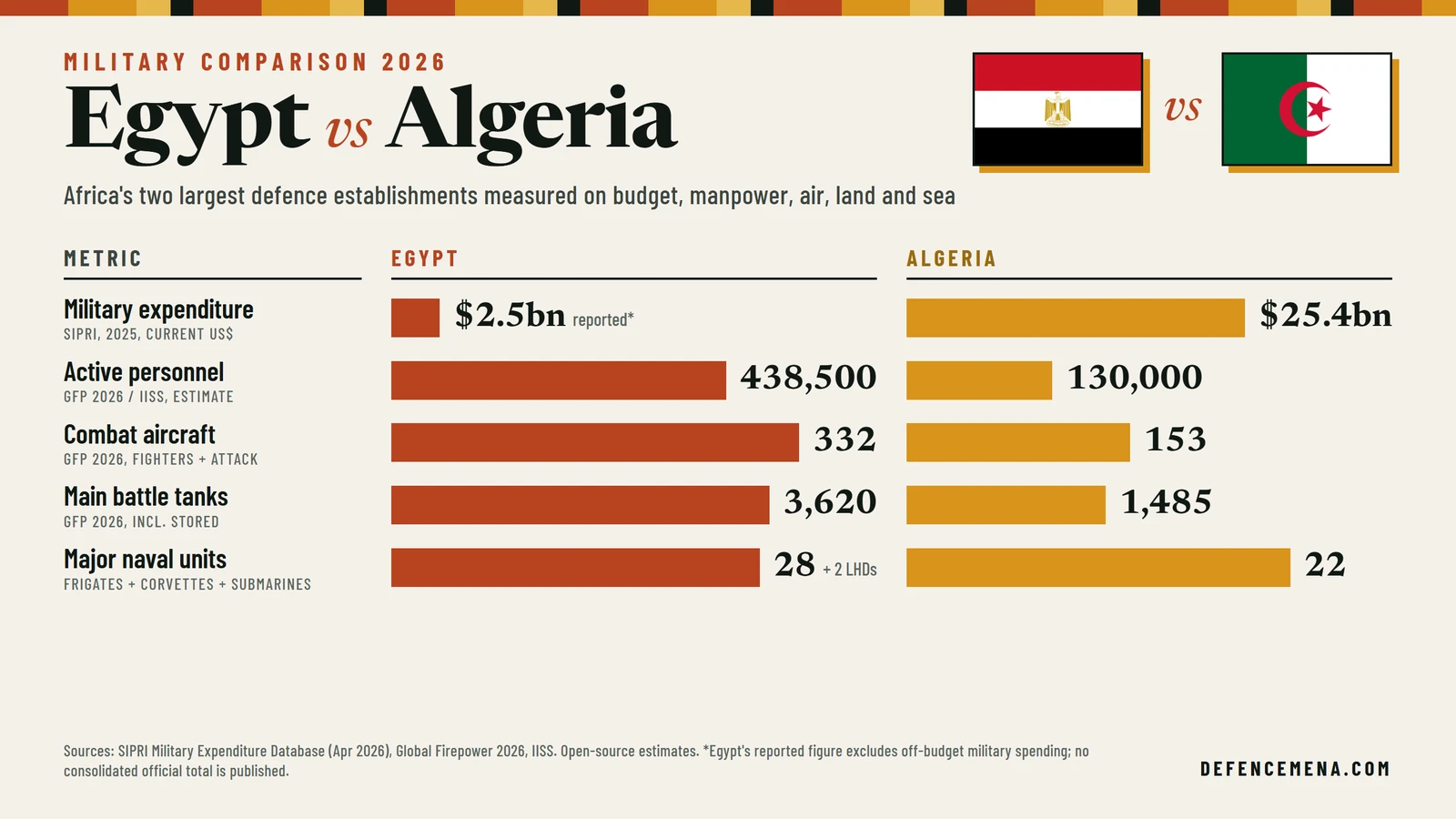
Algeria now spends roughly ten times what Egypt reports on defence, yet Egypt fields more than three times the active manpower, twice the combat aircraft and the only helicopter carriers in Africa. This DefenceMENA comparison puts the continent’s two largest militaries side by side on 2025-2026 open-source data, category by category, and explains where the numbers come from rather than declaring a winner.
Egypt and Algeria sit first and second in every African military ranking and are compared constantly online, usually through a handful of Global Firepower figures with no explanation of what they measure. This file lines up budgets, personnel, air, land and naval inventories, air defence, drones, defence industry, suppliers and modernisation programmes, keeps both countries to the same year wherever possible and marks every figure that is an estimate. The two forces are built for different problems, as the geography section explains, which is why the numbers below point in different directions. Country desks for both are at Egypt and Algeria, regional coverage sits under North Africa, and DefenceMENA’s full Egypt military profile covers the Egyptian side in more depth.
Egypt vs Algeria at a glance
| Metric | Egypt | Algeria | Source / year |
|---|---|---|---|
| Military expenditure, 2025 | $2.5 billion reported (understated, see below) | $25.4 billion | SIPRI Military Expenditure Database, April 2026 |
| Official defence budget, 2026 | No consolidated line in the FY2026/27 state budget | DZD 3,208 billion (about $25 billion) | Egyptian budget law; Algerian 2026 Finance Law |
| Active personnel | 438,500 (estimated) | 130,000 (estimated) | Global Firepower 2026, drawing on IISS |
| Reserve / paramilitary | 479,000 / 300,000 (estimated) | 150,000 / 150,000 (estimated) | GFP 2026; definitions differ |
| Main battle tanks | 3,620 including stored; about 2,000 in active units | 1,485 | GFP 2026 / IISS 2025 |
| Combat aircraft (fighters and attack) | 332 | 153 | GFP 2026; open-source fleet estimates differ |
| Attack helicopters | About 100 (AH-64D, Ka-52) | About 74 (Mi-28NE, Mi-24 Super Hind) | GFP 2026 |
| UAV / UCAV capability | Wing Loong, CH-4B, Bayraktar Akinci, domestic EJune-30 and Nut, loitering munitions | Wing Loong II, CH-3/CH-4, WJ-700, El Djazair 54; Aksungur and Anka-S on order | Open sources, 2025-2026 |
| Major naval vessels (frigates, corvettes, submarines) | 28, plus two Mistral-class LHDs | 22 | GFP 2026; class detail in the naval section |
| Submarines | 8 (four Type 209/1400, four elderly Romeo-class) | 6 Kilo-class | GFP 2026 / open sources |
| Air defence | S-300VM, HQ-9B, IRIS-T SLM, Buk-M2, Hawk, Tor, Pantsir, Avenger | S-400, S-300PMU-2, Buk-M2E, Tor-M2E, Pantsir-S1/SM | Open sources, 2025-2026 |
| Defence industry | Ministry of Military Production and AOI; tanks, howitzers, frigates, corvettes, UAVs | Ministry of National Defence industries; Fuchs 2 and Nimr vehicles, ammunition, OPVs, UAV assembly | Open sources |
| Global Firepower 2026 rank | 19th of 145 (PwrIndx 0.3651) | 27th of 145 (PwrIndx 0.4849) | GFP 2026, auxiliary indicator only |
Two notes on reading the table. GFP tank and aircraft counts include stored and low-readiness equipment, so they run higher than the IISS Military Balance figures for active units. The personnel rows keep active, reserve and paramilitary forces apart, because Egypt’s Central Security Forces and Algeria’s rural self-defence groups both inflate any “total security personnel” figure.
Defence budgets: two numbers that do not measure the same thing
Algeria’s spending is transparent by regional standards. The 2026 Finance Law, approved in October 2025, allocates DZD 3,208 billion to national defence out of DZD 17,636 billion in total state expenditure, about a fifth of the budget and roughly $25 billion at the exchange rate of the time, the largest defence allocation in the country’s history according to The New Arab. SIPRI’s April 2026 fact sheet puts Algerian military expenditure at $25.4 billion in 2025, up 11 per cent in real terms, equal to 8.8 per cent of GDP and 25 per cent of government spending, the second-highest military burden in the world after Ukraine and most of the $35 billion North Africa spent on defence that year.
Egypt’s figure is a different kind of number. SIPRI records $2.5 billion for 2025, up 4.3 per cent in real terms, based on the defence line of the state budget. SIPRI’s own 2020 background paper on Egyptian military expenditure explains why that line is a floor: it excludes paramilitary forces, the armed forces’ economic activities and other off-budget spending. The FY2026/27 state budget approved in June 2026 totals EGP 8.176 trillion in uses but publishes no consolidated defence line. Global Firepower’s 2026 index uses its own estimate of $5.2 billion, and US Foreign Military Financing adds about $1.3 billion a year that never appears in Egyptian domestic figures.
A SIPRI-to-SIPRI comparison is the only same-year, same-method option, and it shows a gap of roughly ten to one in Algeria’s favour. Even if Egypt’s real outlay is two or three times the reported figure, Algeria still outspends it several times over. What the budget line hides is Egypt’s much larger stock of platforms bought in the 2014-2021 procurement wave, when SIPRI ranked it the world’s third-largest arms importer.
Personnel: conscript mass against a professional core
Egypt’s armed forces number about 438,500 active personnel, with roughly 479,000 reservists and an estimated 300,000 in paramilitary formations, on Global Firepower’s 2026 figures, which follow IISS data; the army alone exceeds 300,000, the Air Defence Forces are a separate branch and conscription is universal for men. Algeria’s People’s National Army has about 130,000 active personnel, roughly 150,000 reservists and a paramilitary component of 150,000 or more, depending on whether the gendarmerie, the Republican Guard and the rural self-defence groups are all counted, and is organised around six military regions, an autonomous Territorial Air Defence Command and heavy mechanised divisions rather than infantry mass. Manpower is the metric where the gap is largest and least meaningful on its own: Egypt’s numbers reflect a population above 110 million and internal-security duties, Algeria’s a doctrine that prefers capital-intensive formations, and neither says anything about training quality, which open sources cannot measure.
Air power
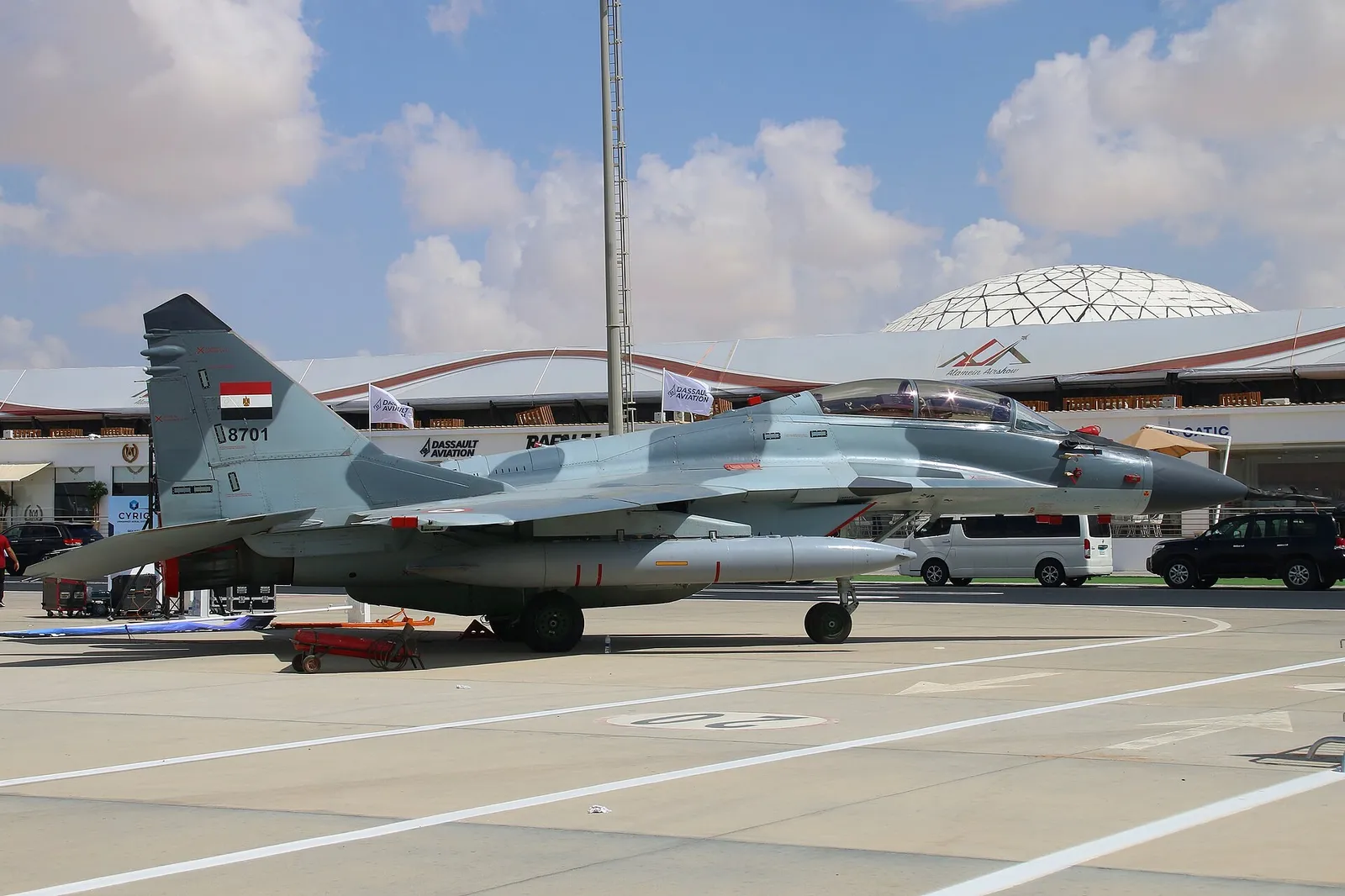
Egypt operates the larger combat fleet by a wide margin; Algeria operates the more modern one at the top end. On Global Firepower’s 2026 count Egypt has 242 fighters and 90 attack aircraft against Algeria’s 111 and 42. FlightGlobal’s World Air Forces directory and other trackers use different categories, so open-source fleet estimates differ, but every published count puts Egypt at roughly twice Algeria’s combat strength.
The Egyptian Air Force rests on three fighter families. Around 200 F-16s delivered between 1982 and 2013 remain the backbone, many of them old and, as The Defense Post noted in September 2026, limited in the weapons Washington has been willing to integrate. The Rafale is the modern core: 24 ordered in 2015 and 30 in 2021, with all 54 due in service by the end of 2026 and, according to La Tribune, a request sent to Dassault on 2 September 2026 for 24 more that would take the fleet to 78. Around 45 MiG-29M/M2s delivered from 2017 form the third pillar. Reports that Egypt became the first export operator of China’s J-10CE in 2025 have not been confirmed by either government. Support assets include seven E-2C Hawkeyes, about 20 C-130Hs, 24 C-295s, some 45 AH-64D Apaches, 46 Ka-52s and 19 CH-47 Chinooks; Egypt has no tanker aircraft.
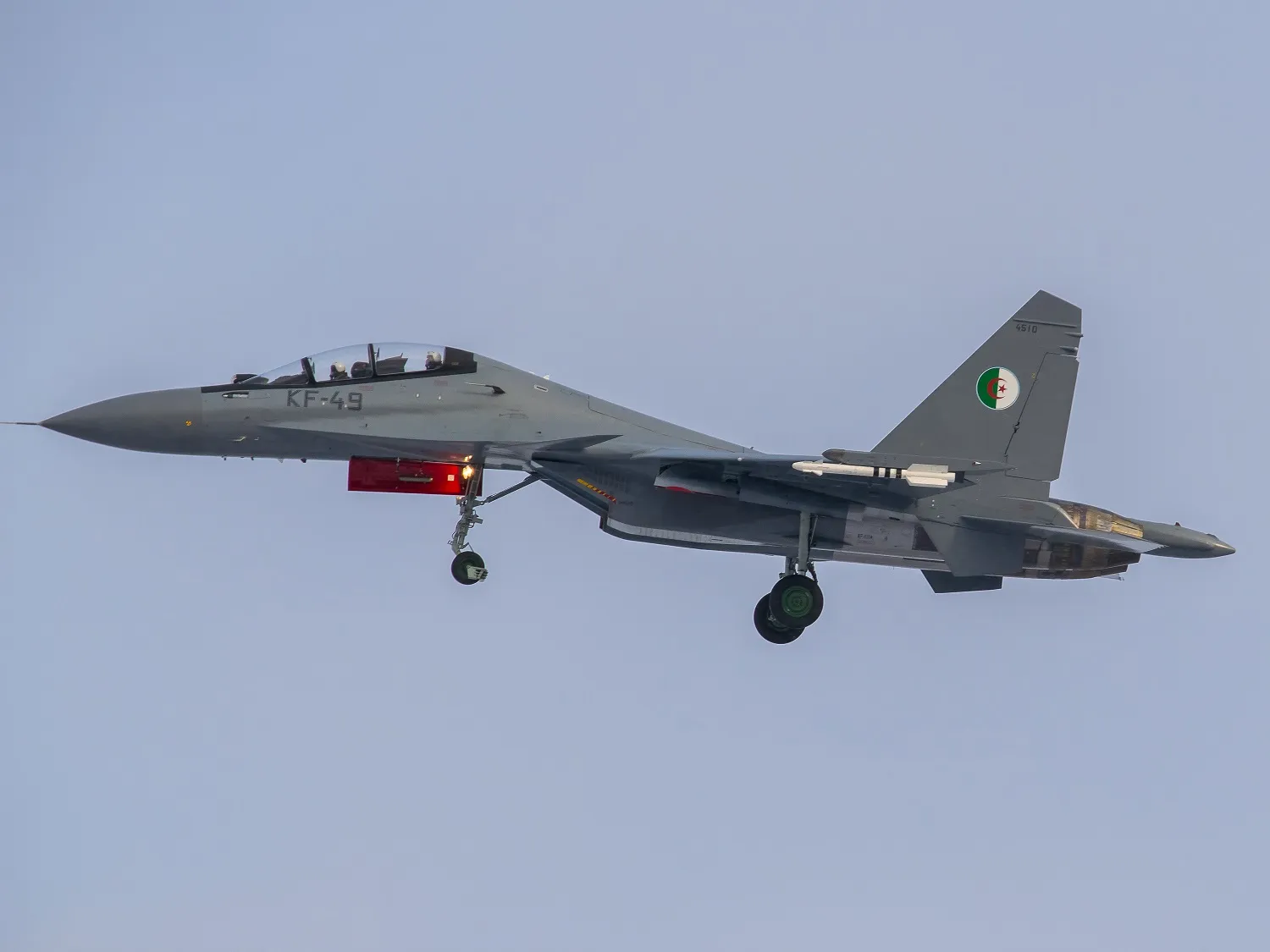
Algeria’s air force is smaller, almost entirely Russian and in the middle of the most ambitious re-equipment programme on the continent. The Su-30MKA fleet stands at 63 to 72 aircraft depending on the source, alongside 35 to 46 MiG-29s and 33 to 42 Su-24 strike aircraft. Three new types are arriving at once. Su-35 deliveries began in January 2025, with nine in service on open-source counts. Su-34ME bombers have been arriving against a reported order of 14, and Military Africa reported in September 2026 that at least four more reached Algeria this year. The first two Su-57E fifth-generation fighters, confirmed delivered by United Aircraft Corporation in November 2025, were filmed over Algeria in February 2026, according to The Aviationist, against a widely reported but unpublished order of 14. Support assets include 11 Il-76 transports, four to six Il-78 tankers, around 15 C-130s, 42 Mi-28NE and 32 Mi-24 Super Hind attack helicopters and a large Mi-8/17/171 fleet. Algeria has no airborne early warning aircraft; reports of a KJ-500 order remain unconfirmed.
Training fleets are not added to either combat total. Egypt’s 344 trainers on the GFP count include K-8Es, Alpha Jets and L-39s; Algeria’s 90 include 16 to 18 Yak-130s and around 50 L-39s.
Land forces
Egypt’s army is the largest in Africa by any measure. IISS figures put around 1,300 M1A1 Abrams tanks in service, assembled at the Factory 200 tank plant under a co-production programme that began in 1992, with several hundred M60A3s in active units and older M60A1, T-62 and Ramses II vehicles in storage. Mechanised infantry rides in about 390 YPR-765 and 300 BMP-1 infantry fighting vehicles and more than 2,000 M113-family carriers. Artillery is numerous but ageing: around 500 self-propelled guns, mostly M109A5s, some 560 towed pieces and about 360 rocket launchers including 26 M270 MLRS. The modernisation lever is the K9A1EGY programme, a contract of about $1.6 billion signed with Hanwha in February 2022 for K9 howitzers with K10 resupply and K11 fire-control vehicles, with later batches built in Egypt at a localisation rate expected to exceed 60 per cent; Janes reported the first complete battery at EDEX in December 2025, where AOI also unveiled its Rad’a 300 launcher.
Algeria’s land force is smaller but heavier and newer at the front. IISS 2025 lists around 600 T-90SA main battle tanks, with 325 upgraded T-72M1s and older T-62 and T-55AMV vehicles for a total of about 1,485, and Algeria is the only export operator of the BMPT-72 Terminator fire-support vehicle, with 26 or more delivered since 2018. The infantry fleet is dominated by roughly 760 BMP-2Ms and more than 1,000 Fuchs 2 carriers assembled at the Rheinmetall Algérie plant near Constantine, plus Nimr vehicles built locally under a 3,000-unit contract. Artillery is smaller in numbers but includes systems Egypt lacks: about 50 TOS-1A thermobaric launchers, 18 BM-30 Smerch and 70 Chinese SR-5 launchers alongside PLZ-45 guns, and the Iskander-E ballistic missile system in undisclosed numbers. The army’s own air-defence layer, around 100 Pantsir-S1/SM systems and more than 200 modernised Shilka-M guns, is denser than anything in Egyptian ground formations.
Naval power
Counting hulls flatters Algeria; counting tonnage and capability favours Egypt. Global Firepower lists 149 Egyptian naval assets against 111 Algerian, but the difference that matters is at the top of each fleet.
Egypt operates two Mistral-class landing helicopter docks, Gamal Abdel Nasser and Anwar El Sadat, the only ships of their kind in Africa. Its frigate force combines the French-built FREMM Tahya Misr, the Italian-built FREMMs Al-Galala and Bernees, four MEKO A-200EN frigates from ThyssenKrupp Marine Systems, three delivered from Germany between October 2022 and December 2023 and the fourth, Al-Jabbar, launched at Alexandria Shipyard in December 2023 as the first frigate built in Egypt, plus two elderly ex-US Perry-class ships. Four Gowind 2500 corvettes, three of them built at Alexandria under Naval Group’s technology-transfer deal, complete the surface core, and four Type 209/1400mod submarines were delivered from Germany between 2016 and 2021. The fleet is split between the Mediterranean and the Red Sea, where the Berenice base opened in 2020, so Egypt must keep two fleets in being.
Algeria’s navy is a Mediterranean force with 998 kilometres of coast and a clear emphasis on submarines. Six Kilo-class boats, two Project 877EKM from the late 1980s and four Project 636 delivered in 2010 and 2019, give it the largest modern submarine force in Africa. The surface fleet has two MEKO A-200AN frigates, Erradii and El Moudamir, three Chinese C28A frigates of the Adhafer class, three modernised Koni-class frigates, the Chinese Type 056 corvette El Moutassadi delivered in 2023, three Djebel Chenoua corvettes and modernised Nanuchka missile corvettes, with the Italian-built landing platform dock Kalaat Béni Abbès for amphibious work.
On GFP’s count Egypt has 13 frigates, seven corvettes and eight submarines against Algeria’s eight, eight and six. Egypt’s edge is blue-water and amphibious capability; Algeria’s is a coherent modern submarine force and a navy that only has to be in one place.
Air defence
This is the category where Algeria’s spending shows most clearly, and where Egypt’s diversity is both a strength and a burden.
Algeria’s Territorial Air Defence Forces field a layered, almost entirely Russian architecture. The S-300PMU-2 was ordered in 2006 and delivered between 2008 and 2011; open sources put the force at anywhere from three to eight fire units. The S-400 was shown publicly for the first time during the Al-Sumoud 2025 live-fire exercise on 30 May 2025, according to Army Recognition, after years of satellite-imagery reports; the number of regiments has never been disclosed. Below them sit Buk-M2E, Tor-M2E and Pantsir-S1/SM batteries and a large MANPADS stock, tied together by Russian radars and command systems. A single-origin network integrates well; it also makes every radar, missile and spare part dependent on a supplier under sanctions and at war.
Egypt runs a separate Air Defence Forces branch and has bought from every major supplier. Four S-300VM (Antey-2500) battalions arrived from Russia by 2017. Egypt confirmed the Chinese HQ-9B in July 2025, when retired Major General Samir Farag discussed its deployment on Egyptian television, as Military Africa and Army Recognition reported. Germany’s IRIS-T family provides the modern medium layer: SIPRI’s transfers database records seven IRIS-T SLM batteries and 400 missiles delivered, and ten IRIS-T SLX long-range and six SLS short-range batteries are reported under contract. Buk-M2, upgraded I-Hawk, Tor, Pantsir-S1, Crotale, Skyguard/Amoun, Avenger and Chaparral units fill the lower layers. The breadth reduces single-supplier risk, but Russian, Chinese, German and American systems share no common command system, and integration is the branch’s central engineering problem.
Drones and loitering munitions
Both countries built their first armed-drone fleets on Chinese platforms and have since diversified. Egypt operates Wing Loong and CH-4B medium-altitude long-endurance UAVs and domestically produced systems, including the EJune-30 and Nut MALE designs and the Thebes and Taba tactical families, and has shifted its emphasis to loitering munitions and counter-drone systems: AOI showed the Hamza-3 loitering munition and the Haris-2 jammer at the World Defense Show in February 2026, according to Breaking Defense, and interceptor drones at El Alamein in September 2026.
Algeria’s fleet is larger on paper. FlightGlobal’s 2026 directory lists 24 Wing Loong IIs, ten CH-3/CH-4s, four WJ-700 Falcons received in 2024 and ten Denel Seekers, alongside the locally assembled El Djazair 54, a derivative of the Emirati Yabhon United 40 in service since 2018; six CH-5s were confirmed on order in 2022. Neither country publishes the number of armed drones actually in service.
Turkish systems in the two inventories
Turkish equipment is a small but growing element in both inventories, and the status of each programme differs.
| Country | System | Manufacturer | Quantity | Status (2026) | Role |
|---|---|---|---|---|---|
| Egypt | Bayraktar Akinci | Baykar | At least two observed; total undisclosed | Operating from East Oweinat air base near the Sudanese border since August 2025 (Janes) | Long-endurance ISR and strike |
| Egypt | Bayraktar TB2 | Baykar | Undisclosed | Purchase agreed during the 2024 normalisation; deliveries not publicly confirmed | Tactical armed ISR |
| Egypt | Hamza-1 UAV | Havelsan with AOI | Not disclosed | Joint development converted into a sales agreement at the Egypt International Airshow, September 2026 (Military Africa) | Tactical UAV, local production |
| Algeria | Aksungur | Turkish Aerospace | 6 ordered | Ordered October 2022 as launch export customer (Shephard); World Air Forces 2026 still lists none delivered | Twin-engine MALE ISR and strike |
| Algeria | Anka-S | Turkish Aerospace | 10 reported | Reported order; deliveries not confirmed in open sources | MALE ISR and strike |
The Turkish platforms do not change the balance between the two countries; their value lies in what they offer against the Chinese and Russian alternatives each air force already flies: faster delivery than Russian industry can currently manage, prices below Western MALE systems, a mature munitions ecosystem in the MAM-L, MAM-T and Roketsan families and, in Egypt’s Havelsan-AOI case, local production that neither the Wing Loong nor the CH-4 purchase included. For Algeria the Aksungur would be the first non-Chinese, non-domestic MALE type, which complicates logistics but reduces single-supplier exposure. None of this makes the Turkish systems better by origin; it makes them a different trade-off between cost, delivery time and integration.
Defence industry
Five hundred tanks and a strong domestic industry are not the same thing, and this is where the two countries differ most in kind.
Egypt has the larger and older base, organised around the Ministry of Military Production, with around 20 factories including the Factory 200 tank plant and the Helwan and Abu Zaabal complexes, and the Arab Organization for Industrialization, whose companies build the Fahd, Temsah and ST-100 vehicle families, Sakr rockets, electronics and aircraft components. Its record is in licensed production of complex systems: M1A1 assembly since the 1990s, three Gowind 2500 corvettes and the frigate Al-Jabbar at Alexandria Shipyard, and the K9A1EGY line with Hanwha. AOI has signed an agreement with Dassault to expand Egypt’s role in Rafale manufacturing and support, and exports are beginning.
Algeria’s industry is younger, state-run under the Ministry of National Defence and built largely on joint ventures: Rheinmetall Algérie assembles the Fuchs 2 at Aïn Smara, SAFAV-MB builds Mercedes-Benz military trucks, and Nimr Algérie produces armoured vehicles at Khenchela. The ECRN yard at Mers el-Kébir has built Kebir-class patrol vessels and landing craft and is the intended site for Type 056 corvette construction, and ammunition comes from ERIS and ONEX. What Algeria lacks is licensed production of a major combat platform: every tank, fighter and long-range air-defence system arrives complete, and the industry has no export market.
Main suppliers
SIPRI’s March 2026 fact sheet on arms transfers gives the clearest picture of dependency, and it shows two countries moving in opposite directions.
| SIPRI, 2021-2025 | Egypt | Algeria |
|---|---|---|
| World rank as importer | 12th (2.6% of global imports) | 33rd (0.9%) |
| Change from 2016-2020 | -51% | -78% |
| Main suppliers | France 39%, Germany 30%, Italy 18% | Russia 39%, China 27%, Germany 18% |
| Previous window, 2020-2024 | 8th largest importer; major warships from Italy, Germany and France | Russia 48%, China 19%, Germany 14% |
Egypt’s 2021-2025 imports were dominated by French Rafales and FREMMs, German frigates and submarines and Italian FREMMs, with the United States still important through Foreign Military Financing and Russia and China as secondary sources; buying from six major suppliers gives Cairo leverage and protection from any single embargo, at the cost of training, spares and integration complexity. Algeria’s imports fell by 78 per cent between the two periods, largely because Russian deliveries stalled, and SIPRI now ranks Morocco ahead of it as Africa’s largest importer while cautioning that Algeria’s secrecy means its estimate may be low. The 2025-2026 fighter deliveries will lift the Russian share again.
Modernisation and orders not yet in service
None of the following appears in the inventory tables above, because ordered is not the same as delivered.
Egypt: up to 24 additional Rafales requested in September 2026 and the balance of the 54 on order; 10 AH-64E Apaches; 11 CH-47F Chinooks; two C-130Js due in 2026; the remaining K9A1EGY, K10 and K11 vehicles, with domestic production of later batches; IRIS-T SLX and SLS batteries; Bayraktar TB2s under the 2024 agreement; local production of the Hamza-1; a US-proposed F-16 upgrade and NASAMS package that has not been contracted; and a submarine replacement programme reported under study in 2024.
Algeria: the remaining Su-57Es, Su-35s and Su-34MEs on contract, plus reported additional Su-30MKAs; six Aksungur and ten Anka-S UAVs; six CH-5s; a reported KJ-500 airborne early warning purchase; domestic Type 056 corvette construction, which Shephard reported in 2024 without a start date; additional S-400 units; further BMPT-72s, reported in the hundreds but unverified; and 3,000 Nimr vehicles under local production. Algeria’s programme is more concentrated and, because almost all of it is Russian, more exposed to delivery slippage than Egypt’s.
Geography and doctrine
The inventories make sense only against the map. Egypt has 2,450 kilometres of coastline on two seas and 2,612 kilometres of land border, on GFP’s geographic data, and its security problems are concentrated: the Suez Canal and the Sinai, where the army fought an insurgency from 2011 to 2022; the 1,115-kilometre Libyan border; the Sudanese border, where the Akinci deployment at East Oweinat sits; the frontier with Gaza and Israel; and the Red Sea approaches to Bab el-Mandeb, which explain the Berenice base and the Mistrals. That is a force designed to be in several places at once, which is why its numbers are so large.
Algeria has 998 kilometres of Mediterranean coast and 6,734 kilometres of land border with seven neighbours, including Mali, Niger and Libya, whose instability drives the border-security mission the government cites for the defence budget, and Morocco, with which it has had no diplomatic relations since August 2021 and a Western Sahara dispute that SIPRI identifies as the main driver of both countries’ arms buying. Algerian doctrine has historically been territorial defence and non-intervention; the 2020 constitutional revision allowed deployments abroad under UN or African Union mandates, but the force remains organised to hold one large country with heavy armour, long-range air defence and a submarine screen, which is why it is dense rather than numerous.
What the numbers show
Egypt operates the larger force in every quantitative category except defence spending, submarines and long-range air-defence density: more people, twice the combat aircraft, more than twice the tanks, a two-sea navy with amphibious ships, and a broader supplier base and industrial record. Algeria spends far more, buys higher-end equipment at the top of its fleets, fields the newest combat aircraft in Africa, runs a coherent Russian air-defence and submarine architecture, and carries the highest military burden relative to GDP of any country outside Ukraine. Egypt’s constraints are budget opacity, an ageing F-16 and M60 stock and the integration of equipment from six suppliers; Algeria’s are dependence on a sanctioned Russian industry for its most important platforms, a small industrial base and an air force modernising at the top while its MiG-29 and Su-24 fleets age underneath.
The comparison is a snapshot. Both inventories will change over the next two years as Egypt takes its last Rafales and first K9 batteries and Algeria absorbs the Su-57E, Su-35 and Su-34ME deliveries. DefenceMENA will update this file and the country coverage for Egypt and Algeria as official data appears.
Methodology and data notes
- Budget figures use SIPRI’s April 2026 database for both countries (calendar year 2025, current US dollars) and the Algerian 2026 Finance Law for the official budget. SIPRI military expenditure and a government’s declared defence budget are not the same measure: SIPRI attempts to include all military-related spending, while official budgets often exclude procurement funds, paramilitary forces and military pensions.
- Personnel figures are Global Firepower 2026 estimates that follow IISS Military Balance data; active, reserve and paramilitary totals are kept separate.
- Equipment counts come from GFP 2026 for like-for-like totals and from IISS Military Balance 2023-2025 figures for type-by-type numbers. GFP totals include stored equipment. Where FlightGlobal’s World Air Forces 2026 directory, IISS and other trackers disagree, a range is given.
- Systems on order, under discussion or reported without official confirmation are listed in the modernisation section only and are not added to the active inventory.
- Global Firepower rankings are used as an auxiliary indicator only. GFP’s index weights manpower, geography and finance in ways that do not measure combat effectiveness.
- The same categories and sources were applied to both countries.
Sources
- SIPRI, Trends in World Military Expenditure, 2025 (April 2026)
- SIPRI, Trends in International Arms Transfers, 2025 (March 2026)
- SIPRI, Recent trends in international arms transfers in the Middle East and North Africa (2025)
- SIPRI, Understanding Egyptian Military Expenditure (2020)
- Global Firepower 2026, Egypt and Global Firepower 2026, Algeria
- FlightGlobal, World Air Forces 2026 directory
- IISS, The Military Balance 2025
- The New Arab, Defence remains Algeria’s top yearly expenditure for 2026
- Barlaman Today, Algeria approves another record $25 billion defense budget for 2026
- Business Today Egypt, Parliament approves EGP 8.18 trillion budget for FY2026/27
- The Defense Post, Egypt seeks third French deal for additional Rafale jets (3 September 2026)
- The Aviationist, Algeria’s first Su-57E reportedly captured in flight (February 2026)
- Army Recognition, First visual evidence confirms Algeria has begun receiving Russia’s Su-35
- Military Africa, Russia prioritizes fighter jet exports to Algeria (September 2026)
- Info Eduard, Algerian Air Force (March 2026)
- Army Recognition, Algeria deploys the S-400 for the first time during a live-fire exercise (2025)
- Military Africa, Egypt confirms acquisition of Chinese HQ-9B (July 2025)
- Military Africa, Egypt enhances air defence with operationalisation of IRIS-T systems (October 2024)
- Janes, Akinci UAV deployed to southern Egypt airbase
- Military Africa, Havelsan and Egypt’s AOI sign sales agreement for Hamza-1 UAV (September 2026)
- Janes, EDEX 2025: Egypt receives first batch of K9 howitzers
- defenceWeb, Egypt unveils new MRL, drones and other equipment at EDEX 2025
- Breaking Defense, Egypt’s AOI unveils Hamza-3 drone, rocket launcher and jammer (February 2026)
- Naval News, ThyssenKrupp Marine Systems hands over third MEKO frigate to Egyptian Navy
- Shephard, Algeria signals a shift to domestic shipbuilding for Type 056 corvettes
- Shephard, Algeria orders Aksungur UAV
- Army Recognition, Algeria acquires WJ-700 Falcon drones from China
- defenceWeb, Algeria to indigenously develop weapons and ammunition
- Ecofin Agency, Global Firepower Index 2026: Egypt, Algeria, Nigeria lead Africa’s rankings
- Further reading: Envanter Media, Africa’s Strongest Militaries 2026