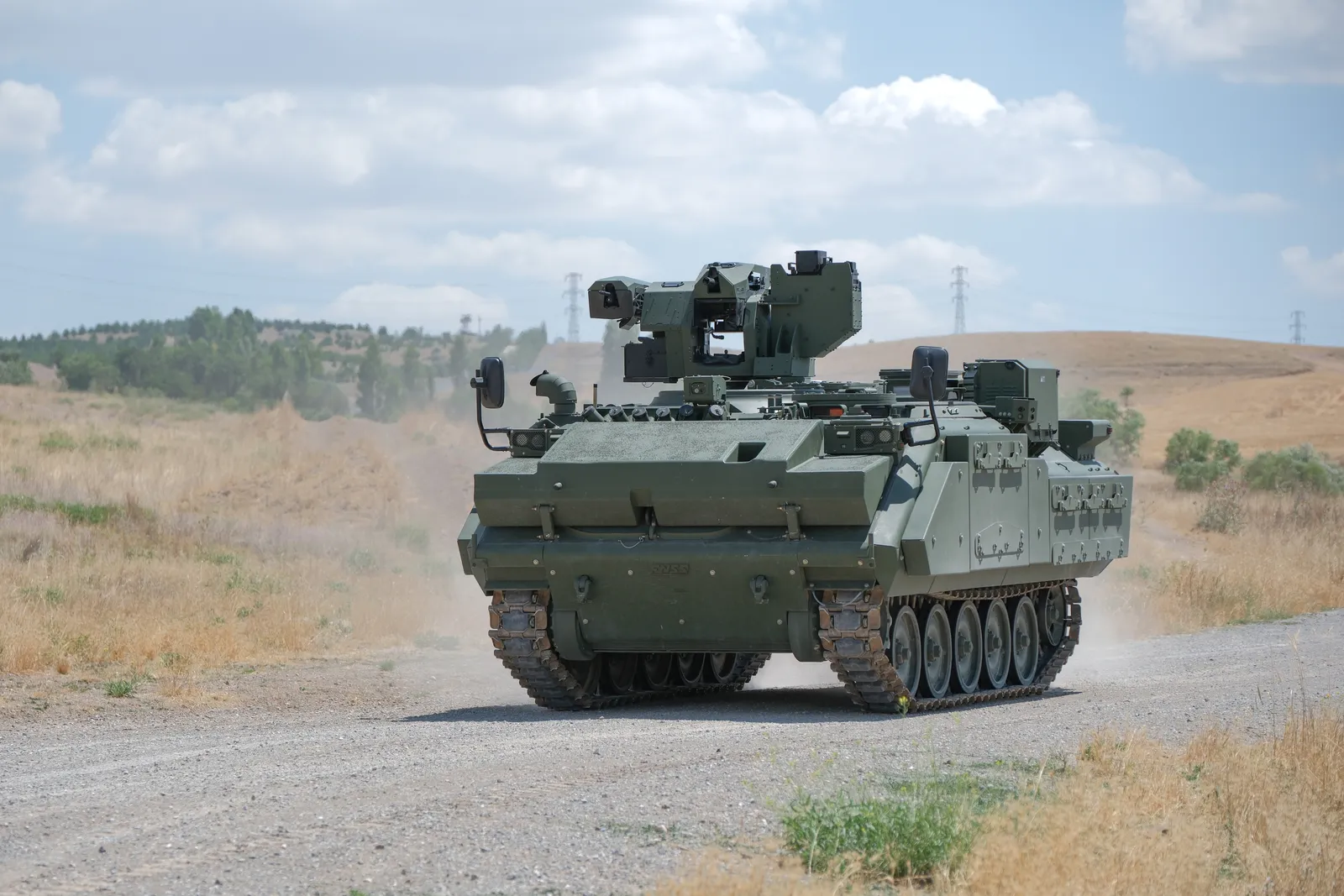
FNSS is giving the Turkish Land Forces’ advanced armoured personnel carriers a second life. Under a programme managed by Türkiye’s Presidency of Defence Industries (SSB), the GZPT modernisation adds a remote weapon station, new survivability and situational-awareness equipment, navigation and air conditioning to the ACV-15 AAPC fleet. Fifty-two upgraded vehicles were delivered by March 2025, and the Land Forces have already exercised an option for 80 more, a vote of confidence that speaks for itself.
Photo: Presidency of Defence Industries (SSB), Türkiye.
What is the GZPT?
GZPT is the Turkish abbreviation for Gelişmiş Zırhlı Personel Taşıyıcı, the Advanced Armoured Personnel Carrier. In English it is usually called the ACV-15 AAPC: the troop-carrying member of the tracked ACV-15 family that FNSS produced for the Turkish Land Forces from the 1990s onward. Like the rest of the family, it traces its design to the American AIFV and, before that, the M113, which is why its silhouette is instantly familiar to anyone who has served with M113-family vehicles.
The ACV-15 family was one of the foundations of Türkiye’s land-systems industry. FNSS built the vehicles in large numbers in Ankara, and in doing so created the design, production and support base that later produced the PARS wheeled family and the KAPLAN tracked vehicles. The GZPT modernisation returns that know-how to the original fleet, with the same company upgrading vehicles it built a generation ago.
SSB’s description of the goal is direct: give the GZPTs in the Land Forces inventory additional survivability and firepower, situational awareness, positioning and direction-finding capabilities, and improve the crew’s working conditions for their missions. The upgraded vehicles are designated ACV-15 AAPC-T1.
Key specifications
| Prime contractor | FNSS |
| Programme authority | Presidency of Defence Industries (SSB) |
| User | Turkish Land Forces Command |
| Upgraded designation | ACV-15 AAPC-T1 (FNSS) |
| Engine power | 305 hp |
| Maximum speed | 60 km/h |
| Combat weight | 15,500 kg |
| Trench crossing | 183 cm |
| Vertical obstacle | 73.6 cm |
| Range | 550 km |
| Phase I | 52 vehicles, deliveries completed March 2025 |
| Follow-on | 80 additional vehicles under a contract amendment using the Phase I option |
What the modernisation adds
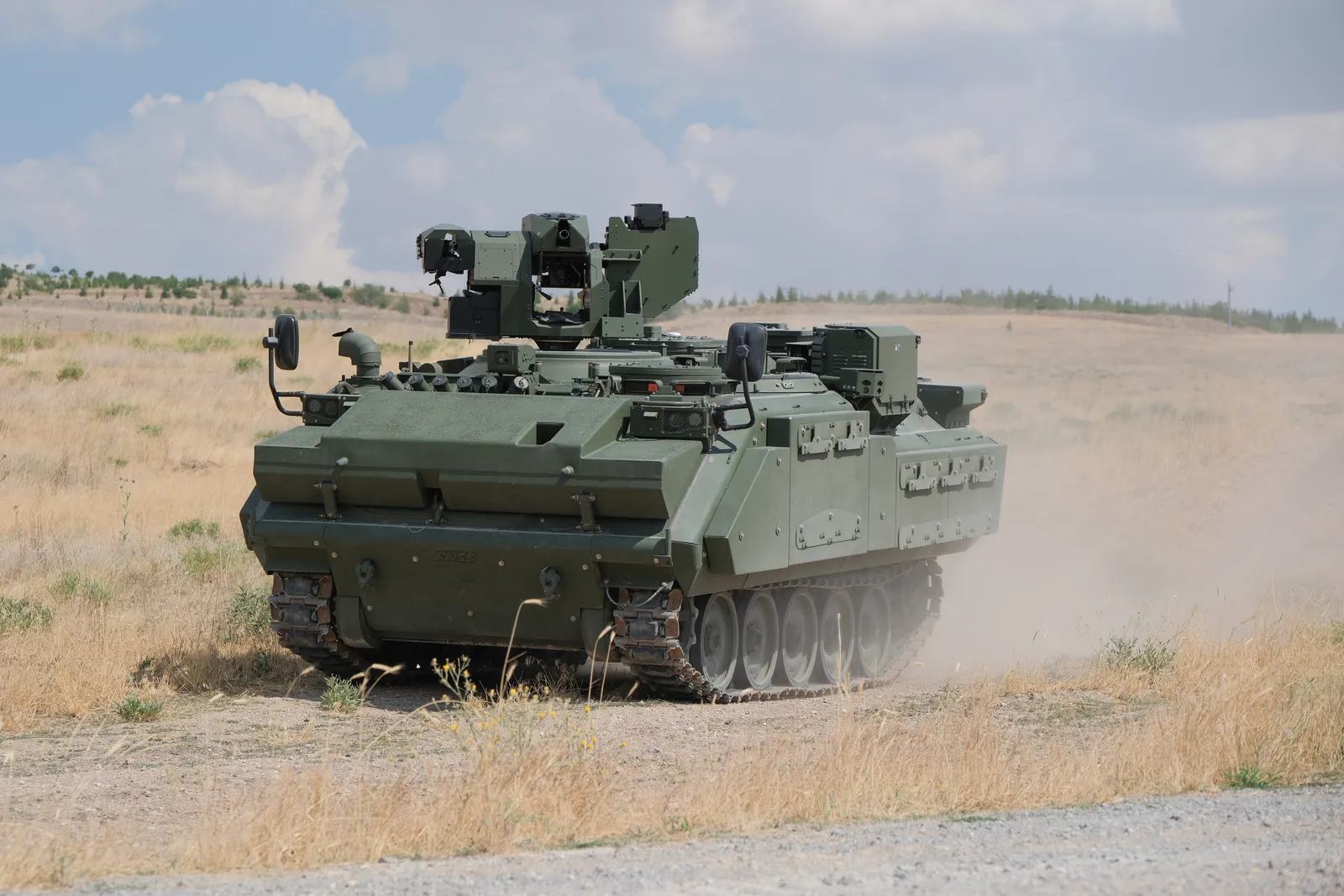
When SSB awarded the contract to FNSS in May 2023, the company set out the main elements of the package. The most visible change is a dual-weapon remote-controlled weapon station with a close-range surveillance system, which lets the crew engage targets from under armour and see around the vehicle without exposing anyone in a hatch. Protection improves through spall liners, which stop fragments from injuring the soldiers inside if the hull is penetrated, and an automatic fire suppression system.
For the driver and commander, the package adds a driver vision system, a gunshot detection capability and a navigation system, the positioning and direction-finding functions that SSB lists among the project’s core goals. An air-conditioning system and an auxiliary power unit improve life on board and allow the electronics to run without the main engine. The engine and transmission are overhauled as part of a complete rebuild of the vehicle, with improvements to mobility, electronics and reliability intended to reduce maintenance during deployments. FNSS has said the work extends the vehicles’ service life by more than 20 years.
The figures in SSB’s data show the result: a 15.5-tonne tracked carrier with a 305 hp engine, a top speed of 60 km/h and a 550 km range, still able to cross a 1.83 m trench and climb a 73.6 cm step. Those are the qualities that made the ACV family useful in rough terrain in the first place, now combined with modern sensors and crew protection.
The SSB programme and Turkish service
According to SSB, deliveries of all 52 Phase I vehicles were completed in March 2025. Rather than open a new competition, the Land Forces and SSB used the option built into the Phase I contract and signed a contract amendment for 80 more GZPTs, bringing the total to 132 vehicles. Exercising an option so soon after the first batch is the clearest sign that the upgraded vehicle met the user’s expectations.
The GZPT programme sits alongside ASELSAN’s separate modernisation of the ZMA, the armoured combat vehicle version of the same family, which received the NEFER 25 mm unmanned turret. You can read our file on the ZMA modernisation for that side of the effort. Taken together, the two projects show how SSB is managing a very large legacy fleet: upgrading the vehicles with the most life left in them, using domestic primes, rather than replacing everything at once.
Who operates it?
The modernised GZPT is in service with the Turkish Land Forces Command, which is the only confirmed user of the AAPC-T1 standard. DefenceMENA did not find an export contract for this modernisation package.
The ACV family itself has a solid export record. FNSS vehicles of this family serve with the United Arab Emirates, Malaysia (as the ACV-300 Adnan, built locally with DefTech), Jordan and the Philippines. FNSS also has a track record of modernisation programmes for foreign customers, which our FNSS company profile covers in more detail. The GZPT upgrade gives the company a proven, in-service package to offer that existing base and other M113-family users.
Can the GZPT modernisation go to Africa?
Africa has one of the world’s largest concentrations of M113-family vehicles. Egypt alone operates M113 carriers in the thousands and has its own upgrade experience. Morocco operates several hundred and recently displayed upgraded examples with a remote turret during African Lion 2026, a clear sign that life extension is on the agenda in Rabat. Tunisia, Libya, Sudan and Ethiopia also field M113s.
For these armies, a personnel-carrier upgrade like the GZPT is arguably more relevant than a full infantry fighting vehicle conversion. Most African M113s are used to move infantry, escort convoys and patrol, often in hot, dusty conditions far from depots. The GZPT package targets exactly those needs: a remote weapon station for convoy protection, spall liners and fire suppression for crew survival against roadside bombs and RPGs, navigation for long-range patrols, and air conditioning and an auxiliary power unit for long hours in desert heat. A 550 km range on the upgraded vehicle also suits the distances involved in Sahel-type operations.
Türkiye’s industrial approach adds to the case. FNSS has experience of local production partnerships abroad, and Turkish wheeled armour is already a familiar sight in African service, as our overview of Turkish systems in African service shows. A modernisation programme run partly in the customer’s own workshops would fit the preference of North African militaries for local maintenance capacity, with Egypt and Morocco the most natural candidates because of fleet size.
How it compares
Western and Israeli firms offer M113 upgrade kits, and some African armies have pursued their own local solutions. The GZPT stands out as a full-vehicle rebuild, combining weapons, protection, mobility overhaul and crew systems, that has been delivered in series and then extended by the user through an option. That combination of a proven configuration and a manufacturer that originally built the vehicles is difficult to match.
Frequently asked questions
What is the GZPT?
GZPT stands for Gelişmiş Zırhlı Personel Taşıyıcı, the Advanced Armoured Personnel Carrier, known in English as the ACV-15 AAPC. It is the troop-carrying version of the tracked ACV-15 family built by FNSS.
How many GZPTs are being modernised?
FNSS delivered 52 modernised vehicles under Phase I by March 2025, and a contract amendment covers 80 more, for a total of 132.
What does the modernisation include?
The package includes a dual-weapon remote weapon station, close-range surveillance, spall liners, automatic fire suppression, a driver vision system, gunshot detection, navigation, air conditioning, an auxiliary power unit and an engine and transmission overhaul.
Is the GZPT upgrade suitable for African M113 fleets?
Yes, the ACV-15 shares its lineage with the M113, and the package targets the convoy, patrol and hot-climate needs of African armies. Egypt and Morocco, with large M113 fleets, are the most likely candidates, although no African contract has been announced.
Related: FNSS company profile · ZMA with NEFER turret · Turkish systems in African service