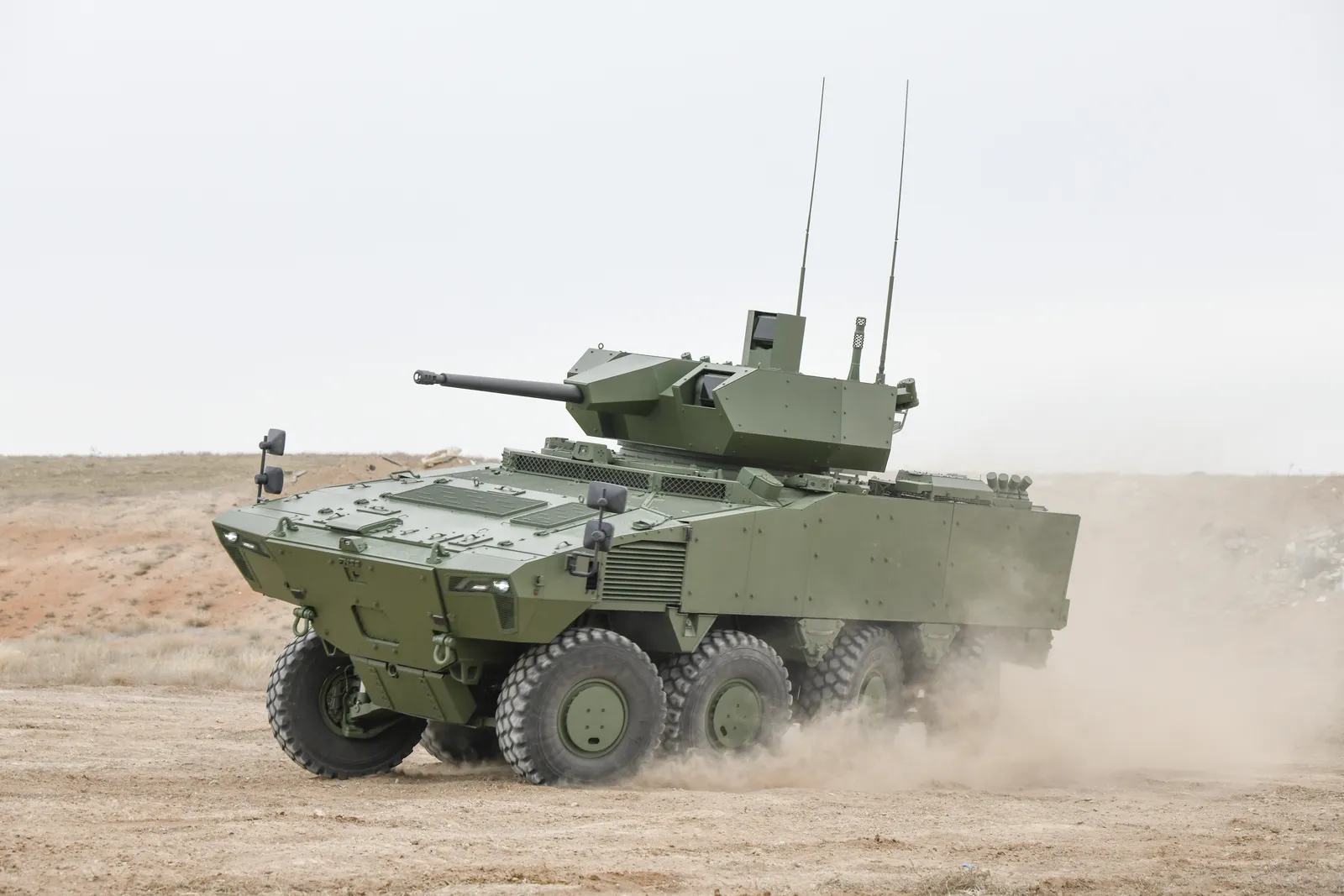
The 8×8 New Generation Vehicle (YNA) programme is Türkiye’s step towards a modern wheeled armoured fleet for the mechanised units of its Land Forces. FNSS is developing 12 heavily protected 8×8 vehicles in two configurations under a project run by Türkiye’s Presidency of Defence Industries (SSB), and the design has reached the critical design phase. The vehicle comes from the PARS family that already serves in Malaysia and Oman, which makes it highly relevant to African armies weighing their next 8×8.
Photo: Presidency of Defence Industries (SSB), Türkiye.
What is the 8×8 YNA?
YNA stands for Yeni Nesil Araç, or new generation vehicle. For decades the Turkish Land Forces’ mechanised infantry rode in tracked vehicles, above all the ACV-15 family that FNSS built in large numbers. The YNA programme marks a shift: it brings high-protection 8×8 wheeled vehicles into the mechanised armoured units, combining the road speed and range of wheels with the protection and firepower these units need.
SSB describes the requirement in demanding terms. The Land Forces want 8×8 armoured wheeled vehicles with high ballistic and mine protection and increased mobility, equipped with advanced command and control systems, able to detect the enemy at the maximum possible range and engage with high-firepower weapon systems, and fitted with high levels of active and passive protection. The first batch covers 12 vehicles in two different configurations, one of them a mobile repair vehicle with specialised maintenance equipment.
FNSS’s response is drawn from its PARS family. When SSB signed the new generation armoured vehicle contract with FNSS on 24 February 2025, the company announced that it would supply its PARS ALPHA 8×8 and 6×6 vehicles, with a first order of 25 vehicles across both configurations. FNSS said the first phase would deliver the PARS ALPHA 8×8 anti-armour squad vehicle and a mobile maintenance vehicle, which matches the two 8×8 configurations in SSB’s project description. The 6×6 command post variants are a separate strand of the programme. Turkish and European trade reporting has described the long-term Land Forces requirement as running into the thousands of vehicles.
Key specifications
| Manufacturer | FNSS Savunma Sistemleri (Ankara, Türkiye) |
| Platform | 8×8 wheeled armoured vehicle, PARS family (PARS ALPHA, as announced by FNSS) |
| Turkish user | Turkish Land Forces Command (mechanised armoured units) |
| Procurement authority | Presidency of Defence Industries (SSB) |
| Quantity (this project) | 12 vehicles in two configurations (SSB) |
| Configurations | Anti-armour squad vehicle; mobile maintenance / repair vehicle (as reported) |
| Protection | High ballistic and mine/IED protection; active and passive protection systems |
| Command and control | Integrated command, control and communications system |
| Repair variant | Repair-specific equipment for field maintenance |
| Status (Sept 2026) | Critical design phase activities continuing |
The SSB requirement puts weight on survivability. Mine and IED protection are now the baseline for any wheeled vehicle that expects to operate on roads, and the reference to active protection signals that the Land Forces expect these vehicles to face anti-tank missiles and loitering munitions, threats that have reshaped armoured warfare since 2020. FNSS has also highlighted the endurance of the PARS ALPHA, citing 5,000 km of cross-country and road driving without field maintenance in testing, a figure that matters for armies that operate far from depots.
The inclusion of a mobile repair configuration in the very first batch is telling. Wheeled fleets live or die by how quickly broken vehicles are returned to service, and planning the maintenance vehicle alongside the combat vehicle from the start is the kind of system thinking that separates a sustainable fleet from a showroom one.
The SSB programme and Turkish service
The YNA programme is a good example of how SSB develops land systems. Before the contract, PARS ALPHA candidates went through extensive field testing by SSB and the Ministry of National Defence. The contract then started with a small first batch, 12 8×8 vehicles in this project, so that the design can be refined through critical design review and qualification before full-rate production. SSB’s September 2026 status reports that critical design activities are continuing.
That phased path mirrors the approach that has worked in other FNSS programmes. The ÖMTTZA special-purpose vehicle fleet started with 100 vehicles and grew by 337 more in 2026; the STA weapon carrier fleet grew from 260 to 368 delivered vehicles through successive amendments. The YNA starts small for the same reason: to get the design right with user feedback before scaling up. It also continues SSB’s emphasis on domestic content, with protection, electronics and weapon systems sourced from Turkish industry.
Who operates PARS 8×8 vehicles?
The YNA itself will enter service with the Turkish Land Forces. The wider PARS 8×8 family, however, is already one of Türkiye’s most successful land-system exports.
Malaysia is the largest operator. Its Army ordered 257 AV8 Gempita 8×8 vehicles, developed from the PARS and built with local partner DefTech, in a 2011 contract that was at the time the largest single defence export deal in Türkiye’s history. The vehicles serve in many variants, including 25 mm and 30 mm turreted infantry fighting vehicles, anti-tank, command, recovery and ambulance versions. Oman is the second confirmed user: the Royal Army of Oman received 172 PARS III vehicles in 13 variants, 145 of them in 8×8 and 27 in 6×6 configuration. The first vehicle was delivered in July 2017 and deliveries were completed in 2020.
Both programmes show the features African buyers ask about most: many variants on one chassis, local assembly and industrial partnership in Malaysia, and support for a fleet operating in hot, dusty conditions in Oman.
Can the 8×8 YNA go to Africa?
African demand for 8×8 vehicles is rising. Large armies are replacing ageing Soviet-era BTRs and early Western wheeled vehicles, and the combination of long distances, poor roads and IED threats favours protected wheeled vehicles over tracks for most missions. A modern 8×8 with strong mine protection, good range and a full family of variants is high on many procurement lists.
The obvious candidates are the larger armies. Egypt operates large wheeled fleets and has deepened defence ties with Türkiye; Algeria and Morocco are both modernising their mechanised forces and value modern protection. Nigeria and Kenya run sizeable armies with continuing counter-insurgency commitments where mine-protected wheeled vehicles are essential. In West Africa, Senegal and Côte d’Ivoire have been expanding their armoured capabilities as they watch the Sahel, and Angola in the south has scale and an ageing fleet. Several of these countries already operate Turkish armoured vehicles or drones, which eases training and support.
The PARS family offers a few specific advantages. The mobile repair variant is ready from day one, which matters to armies with limited depot infrastructure. FNSS’s track record of local production in Malaysia and Indonesia gives governments a credible industrial offset. And because the YNA is being developed for the Turkish Land Forces’ own mechanised units, export customers would benefit from a design matured, qualified and supported by a large home fleet.
How it compares
The international 8×8 market is crowded, with the Patria AMV, Boxer, Piranha and Chinese and Russian designs all competing for African orders. The PARS family’s place in that field rests on a proven export record, a broad variant range and a supplier willing to share production. For many African buyers, the decisive factor will be the package around the vehicle, from financing to training to local assembly, where Türkiye and SSB have built a strong reputation.
FAQ
What does YNA stand for?
YNA stands for Yeni Nesil Araç, meaning new generation vehicle. The 8×8 YNA programme supplies wheeled armoured vehicles to the Turkish Land Forces’ mechanised armoured units.
How many 8×8 YNA vehicles are being procured?
According to SSB, this project covers 12 8×8 armoured wheeled vehicles in two configurations, including a mobile repair version. The overall new generation armoured vehicle contract signed in February 2025 was reported as an initial order of 25 8×8 and 6×6 vehicles.
Which vehicle is the 8×8 YNA based on?
FNSS announced that it would supply its PARS ALPHA 8×8, part of the PARS family of wheeled armoured vehicles, for the Turkish Land Forces’ new generation armoured vehicle programme.
What is the programme status?
SSB reports that critical design phase activities were continuing as of September 2026.
Which countries use PARS 8×8 vehicles?
Malaysia operates the PARS-derived AV8 Gempita (257 ordered), and Oman operates 172 PARS III vehicles, 145 of them in 8×8 configuration.
Related: FNSS company profile · ASELSAN company profile · Turkish systems in African service