ASELSAN Company Profile: Products, Customers and Africa Reach



This ASELSAN company profile covers Türkiye’s largest defence electronics group: who owns it, what it builds, how large it has become and where it sells in Africa and the Middle East. ASELSAN was founded in 1975 in Ankara and is controlled by the Turkish Armed Forces Foundation. Its order backlog reached $23.2 billion at the end of the latest reported half-year, and the Turkish state remains its main customer. Public information on African buyers is thin, so this guide separates confirmed deals from unnamed contracts and says plainly what has not been disclosed.
ASELSAN company profile: ownership, history and size
ASELSAN (Aselsan Elektronik Sanayi ve Ticaret) was founded in 1975 and is based in Ankara. The Turkish Armed Forces Foundation, known by its Turkish initials TSKGV, owns 74.2% of the shares, according to Turkish Minute’s May report on the company’s market value. The rest trades on Borsa Istanbul, where the company’s value passed 2 trillion lira (about $44.4 billion) that month, making it Türkiye’s most valuable listed company.
Ahmet Akyol, quoted by Defence Industry Europe in June, put the workforce at more than 14,000 people, over 10,000 of them engineers, with more than 5,500 hired in three years. The group runs six production facilities and 11 R&D centres in Türkiye and reports offices or operating sites in 25 other countries. It spends about 7% of annual turnover on research.
SIPRI ranked ASELSAN 47th in its 2024 list of the largest arms-producing and military services companies, and Defense News placed it 43rd in its 2025 Top 100. Investments now under way exceed $2.7 billion, including the Oğulbey Technology Base, a roughly $1.5 billion campus with more than 735,000 square metres of enclosed space.
Key products and programmes
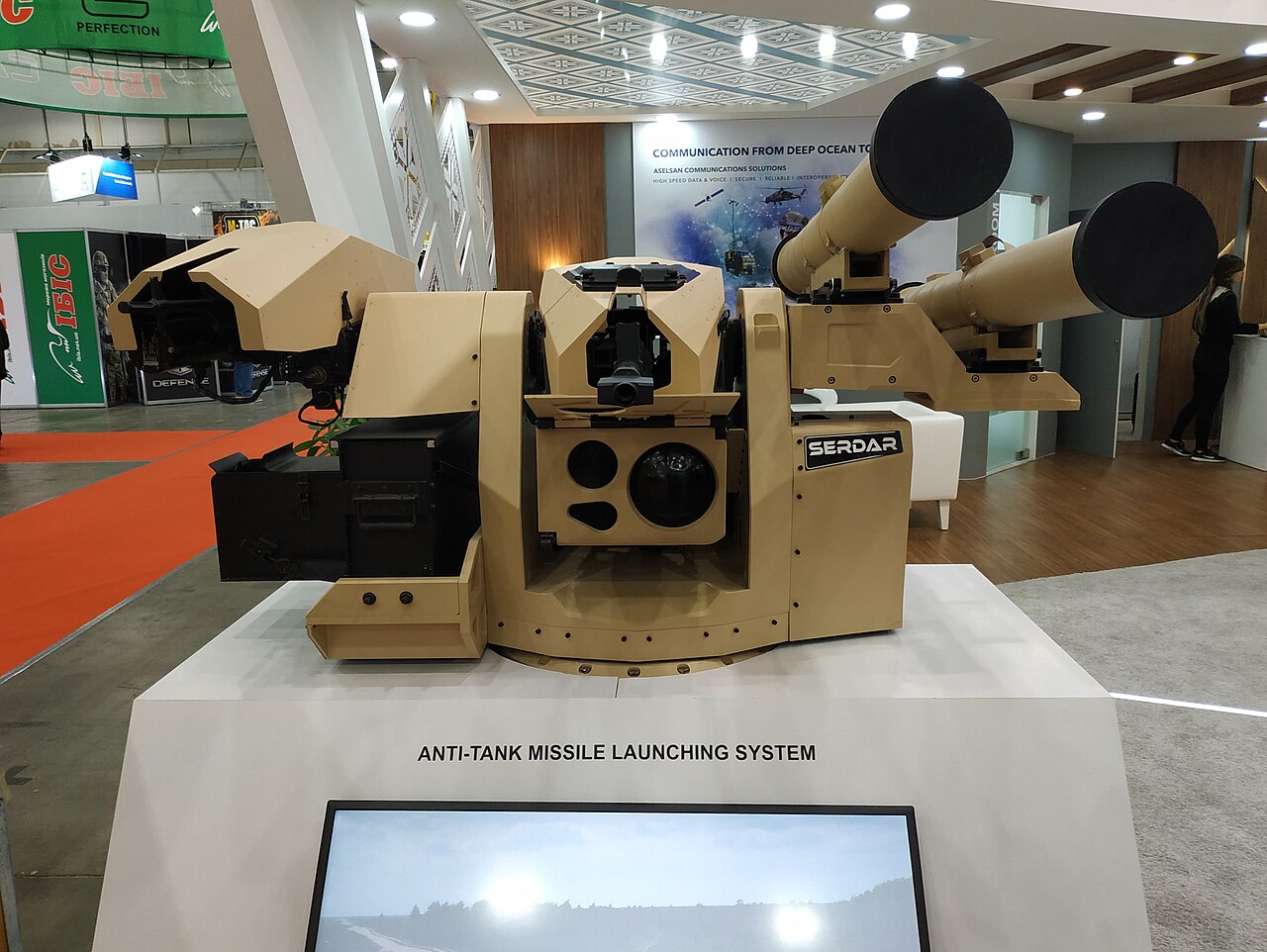
ASELSAN’s catalogue centres on air defence, counter-drone systems, electronic warfare, radars, electro-optics, communications and guided weapons. Its largest current programme is Çelik Kubbe, or Steel Dome, Türkiye’s layered air and missile defence project. Breaking Defense reported on 17 June that ASELSAN had won a €780 million ($900 million) deal for air defence technologies for the project, with deliveries from 2028 to 2032. The article does not say which systems the contract covers.
At the DIMDEX exhibition in Doha, EDR Magazine reported how ASELSAN presents the Steel Dome as linked layers. The table lists the named components.
| Layer | Named system | Role |
|---|---|---|
| Early warning | Alp 300-G (S-band); Alp 500-G and 600-G planned | Long-range surveillance radar |
| Command and control | Hakim | AI-enabled air defence battle management |
| Soft kill | İhtar 100, Kangal, Gökberk | Counter-UAS suite, programmable jamming, mobile laser |
| Gun layer | Korkut 100/25 SB | Close defence with Atom airburst rounds |
| Missile layers | Hisar family; Siper family | Short and medium range; long range |
The naval side includes the GÖKDENİZ close-in weapon system, a twin 35 mm gun with a brochure rate of fire of 1,100 rounds a minute. Our report on the deployable GÖKDENİZ sets out what ASELSAN has and has not disclosed about the containerised version. At IDEF 2025 the company showed 10 new products, among them the EJDERHA electromagnetic shield and the ASELFLIR-600 electro-optical system.
Contracts and customers in the Middle East
Gulf business is the best documented part of ASELSAN’s export record. In March 2022 it signed a contract with Qatar’s Barzan Holdings for communication systems and services for land platforms used by the Qatari armed forces. The package included four letters of intent, one covering a transfer of software-defined radio waveform expertise.
In February 2026 ASELSAN and the Saudi Ministry of Defense signed a contract at the World Defense Show in Riyadh. The value and the systems have not been disclosed; the company described it only as a step to take the strategic partnership to a higher level. At DIMDEX, ASELSAN pitched the Steel Dome to Gulf buyers as a modular, scalable package, and the sources reviewed report no Gulf order for it.
ASELSAN’s stock-exchange notices rarely name the buyer. On 23 October 2026 it disclosed a $442.5 million export contract for radar, UAV countermeasure and command-and-control systems with “an international customer”, with no delivery schedule. The table summarises the main publicly documented deals.
| Timing | Customer or partner | Scope | Status |
|---|---|---|---|
| March 2022 | Qatar (Barzan Holdings) | Land communication systems and services | Contract signed |
| July 2025 | Saudi Arabia (SAMI Land) | Technology transfer for combat turrets | Agreement signed |
| December 2025 | Poland | Electronic warfare, $410 million | Contract signed |
| World Defense Show, Riyadh | Saudi Ministry of Defense | Not disclosed | Contract signed |
| Stock-exchange notice, 23 October | Unnamed international customer | Radar, counter-UAV, command and control, $442.5 million | Contract disclosed |
ASELSAN in Africa: offices, licences and unnamed buyers
The African part of the ASELSAN company profile is the least documented. The company has not published a list of African customers. One trade site claims ASELSAN equipment is deployed in 21 African countries, but the company has not confirmed the figure and it is not used here.
In Nigeria, Military Africa reported that the company incorporated an Abuja base in June 2025 for sales, maintenance and training. No Nigerian contract value has been disclosed. In South Africa, ASELSAN opened an office in 2011 and in July 2025 signed its first technology-transfer agreement there, with the Pamodzi Group, to build the ASTELA P25 3710 handheld radio locally, according to Türkiye Today.
Other Turkish groups are building comparable positions. Our analysis of the HAVELSAN–DICON MoU covers the Nigerian market, and the Baykar company profile covers the drone side of Türkiye’s exports.
Partnerships and local production
Localisation is central to how ASELSAN sells abroad. In Saudi Arabia, Arab News reported on 24 July 2025 that SAMI Land signed a technology-transfer agreement with ASELSAN to localise the manufacture of combat turret systems. The work is tied to the SAMI Land Industrial Complex, scheduled to begin operations in the fourth quarter of 2025, and to Riyadh’s goal of localising 50% of defence spending by the end of the decade. Nurol Makina and FNSS signed similar vehicle-related deals, a field covered in our guide to Nurol Makina.
In Poland, ASELSAN signed a $410 million electronic warfare contract with the Polish Armed Forces in December 2025. In South Africa the Pamodzi licence moves radio production to a local partner, and in Qatar the 2022 letters of intent foresaw waveform technology transfer. The pattern is consistent: equipment sales are paired with local assembly, training or software know-how.
Financial snapshot and workforce
The financial figures in this ASELSAN company profile come from the full-year results reported by Hürriyet Daily News and from Quwa’s report on the first half (H1 2026). Outlets differ on some totals, such as research spending, so only figures that agree across sources are shown.
| Indicator | Figure | Period |
|---|---|---|
| Net sales | 180.5 billion lira, up 15% from 2024 | Full year 2025 |
| Net profit | 29.92 billion lira ($684 million), up 50% | Full year 2025 |
| EBITDA | 47.3 billion lira, up 20% | Full year 2025 |
| New order intake | $9.6 billion, up 46% | Full year 2025 |
| International deliveries | $958 million, up 89% | Full year 2025 |
| Order backlog | $20.4 billion | End of 2025 |
| Net sales | 88.5 billion lira, up 25% in real terms | Latest half-year |
| New contracts signed | $4.9 billion | Latest half-year |
| Order backlog | $23.2 billion | End of latest half-year |
Exports more than doubled in 2025: Turkish Minute reported 272 export contracts worth over $2 billion across 58 countries, bringing the total number of destinations to 95. International sales were 17% of half-year sales, against 25% of deliveries in 2025.
Strengths, challenges and outlook
The main strength is a domestic order book that funds capacity before exports arrive. The Steel Dome gives ASELSAN a multi-year programme spanning radars, guns, missiles, jammers and command software, and the backlog has risen in each reported period since mid-2025.
There are limits. The Turkish Ministry of Defence remains the main customer, so export growth depends on winning contracts abroad against established suppliers. The export share of sales was lower in the latest half-year than in 2025. Steel Dome deliveries run to 2032, so revenue conversion is gradual, and heavy capacity spending raises the cost of any delay. In Africa, the absence of named customers makes it hard to judge how far the Abuja and South African bases have turned into orders.
Taken together, the ASELSAN company profile shows a state-anchored group whose export pitch is air defence, electronic warfare and communications with local support and technology transfer. Future stock-exchange disclosures will show whether that converts into large African contracts. Readers interested in working for the group can start with our guide to ASELSAN careers, jobs and internships.
Frequently asked questions about ASELSAN
Who owns ASELSAN?
The Turkish Armed Forces Foundation (TSKGV) holds 74.2% of ASELSAN’s shares, according to a recent Turkish Minute report. The remaining shares trade on Borsa Istanbul. The company is therefore state-linked through the foundation, although it is a listed commercial business with minority shareholders.
Does ASELSAN sell to African countries?
ASELSAN has an Abuja base for sales, maintenance and training and a South African office, and it licenses radio production to South Africa’s Pamodzi Group. It has not published a list of African customers or contract values, so named African orders cannot be confirmed from public sources.
What is the Steel Dome?
The Steel Dome, or Çelik Kubbe, is Türkiye’s layered air and missile defence project linking radars, command software, jammers, guns and missiles under one command framework. ASELSAN leads it. A €780 million ($900 million) ASELSAN deal for related technologies was reported in June, with deliveries from 2028 to 2032.
How large is ASELSAN’s order backlog?
The backlog was $20.4 billion at the end of 2025 and $23.2 billion at the end of the latest reported half-year, up 45% year on year. The figures combine domestic and export orders and do not show how much comes from Gulf or African customers.
Sources
- Turkish Minute: ASELSAN becomes Türkiye’s most valuable listed company
- Hürriyet Daily News: ASELSAN’s net profit surges 50 percent in 2025
- Quwa: ASELSAN’s backlog hits $23.2 billion
- Defence Industry Europe: ASELSAN becoming a global defence player
- Breaking Defense: ASELSAN lands $900M deal for Steel Dome
- EDR Magazine: ASELSAN showcased its Steel Dome at DIMDEX
- Arab News: Saudi Arabia inks Turkish defense deals
- Yüzde 100 Yerli: ASELSAN and the Saudi Ministry of Defense
- EDR Magazine: ASELSAN and Barzan Holdings sign contract in Qatar
- Military Africa: ASELSAN opens Nigerian office
- Türkiye Today: ASELSAN and Pamodzi Group technology transfer
- Alomaliye: ASELSAN $442.5 million export contract notice