ASELSAN Unveils Containerised GÖKDENİZ CIWS to Shield Merchant Ships and Tankers From Drones

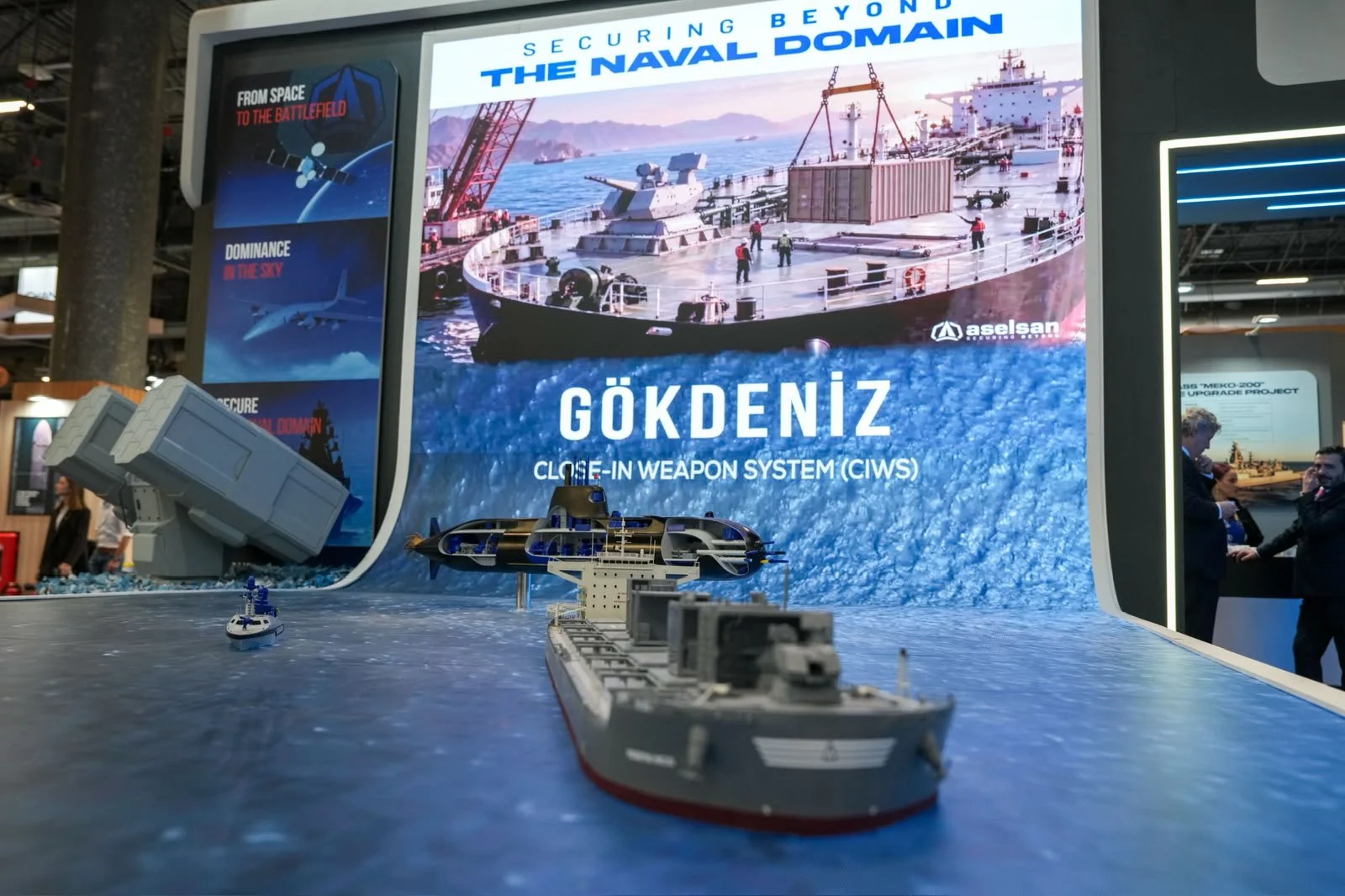


ASELSAN has shown a deployable, container-based version of its GÖKDENİZ close-in weapon system (CIWS) for the first time, at the EURONAVAL 2026 naval exhibition in Paris. The Turkish company says the new configuration can be put on civilian vessels and other critical assets to protect them from air threats, including drones. It names commercial ships and oil tankers “transiting strategically important and challenging waterways” as one of the main uses.
ASELSAN announced the system in a press release headed “ASELSAN Debuts Deployable Naval Solutions at EURONAVAL 2026”, dated 2 November on its website. It followed up on 3 November with a post on its official X account. Türkiye’s state news agency Anadolu Agency, İhlas News Agency and the specialist outlet Defense Arabia carried the release. All three describe the deployable GÖKDENİZ as a first public showing.
What ASELSAN says the deployable GÖKDENİZ does
According to the company, the deployable GÖKDENİZ is “a field-proven naval version of KORKUT air defense system”. It packages the system’s close-in defence capability into a self-contained, container-based unit. ASELSAN describes the following features:
- Independent of the host ship: the container has its own power supply and operator environment, so it does not depend on the vessel’s systems.
- Rapid installation: it “can be rapidly installed on civilian vessels and other critical assets”.
- Redeployable: it can be removed and moved to wherever protection is needed, including, ASELSAN’s X post says, critical facilities on land.
- Intended users: civilian and military vessels, plus critical facilities. Commercial ships and oil tankers are singled out.
Alongside it, ASELSAN showed a containerised GÖKSUR VLS point defence missile system (PDMS) for land and naval platforms. GÖKSUR consists of a Fire Control Center container and a launcher container, with their own sensors, launchers and built-in generators. ASELSAN says it can be deployed “without requiring permanent installation on the host platform”. GÖKDENİZ is gun-based and GÖKSUR is missile-based, so between them the company is presenting two layers of deployable ship self-defence.
“With the deployable GÖKDENİZ and GÖKSUR configurations, we are extending an established air defense capability to platforms and environments where flexible, rapidly deployable protection is needed,” said Ahmet Akyol, ASELSAN’s President and CEO, in the release.
What is known about GÖKDENİZ itself
The ship-mounted GÖKDENİZ is already in service with the Turkish Navy. ASELSAN’s product brochures describe it as follows:
- Gun: twin 35 mm guns firing 1,100 rounds a minute.
- Ammunition: it can load both high-explosive incendiary rounds and ASELSAN’s ATOM airburst ammunition and switch between them.
- Range: a stated 4 km effective range against air threats with ATOM rounds.
- Targets: anti-ship missiles, helicopters, fighters, UAVs and asymmetric surface threats.
- Operation: fully autonomous detection, tracking and firing.
- Test record: the brochure says the prototype was tested on a Turkish Navy ship in May 2018, against a target drone flying at more than 180 m/s in a sea-skimming scenario.
Not yet disclosed: ASELSAN has not published specifications for the containerised version. It has not said whether it uses the same gun, radar and sensor fit as the ship-mounted GÖKDENİZ 100/35. It has also not given the container’s size, weight or crew, its price, or any customer or order. The figures above come from the ship-mounted system’s brochure and should not be read as confirmed figures for the deployable configuration. For background on the wider family, see our guide to ASELSAN’s air defence and counter-drone systems, including KORKUT and GÖKDENİZ.
Why it matters for the Red Sea and Gulf of Aden
Commercial ships and tankers in “challenging waterways” are exactly the traffic that has been under attack around Africa and the Arabian Peninsula. ASELSAN did not name any region in its release.
According to ACLED analysis, the Houthis announced a blockade of Saudi-linked shipping in July 2026. They have since attacked 10 commercial ships, most of them tankers, in the Red Sea, the Bab el-Mandeb and the Gulf of Aden. ACLED says at least six were hit. ACLED also says no corroborated maritime attack has taken place since 24 August, and describes the pause as tactical, not a sign of moderation. Traffic has kept moving: S&P Global, citing CAS data, reported 1,196 transits through Bab el-Mandeb in October, including 408 tanker movements. On our own coverage, see Houthi strikes on Saudi energy sites, the fighting near Bab al-Mandab, and the Indian Navy’s Azini rescue off Somalia, which shows the separate piracy risk in the Gulf of Aden.
A ship-borne CIWS on a merchant vessel would raise questions that ASELSAN’s release does not address. These include who operates the system on board, under what flag-state and legal authority, and how it would fit with naval escort missions already working in the area. Defence Mena has found no announcement of any shipping company, flag state or navy ordering the deployable GÖKDENİZ.
ASELSAN’s MENA and African footprint
No African or Arab navy has been officially named as a GÖKDENİZ operator. The only reported export of the naval system is on Pakistan’s Babur-class corvettes. Regionally, ASELSAN’s 2025 annual report mentions a KORKUT 141/35 being integrated on a vehicle for a Middle East-based company and demonstrated to the end user, without naming the customer.
In Africa, ASELSAN told defenceWeb in 2024 that its equipment is in service in 21 African countries. Named naval use includes a 30 mm naval gun and STAMP weapon stations on two Nigerian Navy patrol ships. The company has offices in Pretoria, Abuja and Algiers. It has also been looking for a local manufacturing partner in Nigeria, and used AAD 2026 in South Africa to market its layered counter-drone line. More detail is in ASELSAN in Africa: which systems are in service, and where and our ASELSAN company profile.
Defence Mena’s view
The interesting thing about the deployable GÖKDENİZ is not a new gun. It is the packaging. ASELSAN is taking a CIWS that already exists and making it self-powered and removable, so it can be placed on ships and sites that were never designed to carry one. That speaks directly to the Red Sea and Gulf shipping risk of the past three years.
Whether it turns into orders is another matter. Arming merchant ships raises legal and operational questions, and ASELSAN has disclosed no specifications for the containerised version. The more realistic early buyers may be navies and state operators that want to add close-in defence quickly to auxiliaries, offshore platforms or ports, rather than shipping lines. We will update this article if ASELSAN publishes specifications or announces a customer.
Verified and unverified
- Verified (ASELSAN release and X post, carried by AA, İHA and Defense Arabia): a deployable, container-based GÖKDENİZ was shown for the first time at EURONAVAL 2026. It has its own power supply and operator environment, is designed for civilian vessels, tankers and critical assets, and is redeployable. A containerised GÖKSUR VLS was shown alongside it.
- From ASELSAN brochures (ship-mounted GÖKDENİZ 100/35): twin 35 mm guns, 1,100 rounds a minute, 4 km effective range with ATOM rounds.
- Not disclosed or unverified: specifications of the containerised version, customers, orders and price.
Sources
- ASELSAN, “ASELSAN Debuts Deployable Naval Solutions at EURONAVAL 2026”, press release, 2 November 2026 (aselsan.com/en/news)
- ASELSAN on X, 3 November 2026
- Defense Arabia: ASELSAN unveils deployable GÖKDENİZ and GÖKSUR VLS at EURONAVAL 2026
- Anadolu Agency (Turkish)
- İhlas News Agency (Turkish)
- ASELSAN GÖKDENİZ 100/35 brochure
- ACLED: Houthi gains around Bab al-Mandab raise risks to Red Sea shipping
- S&P Global: Hormuz and Red Sea traffic, October 2026