FA-50 vs Hürjet: What Korea’s Light Fighter and Türkiye’s New Jet Trainer Offer African Air Forces

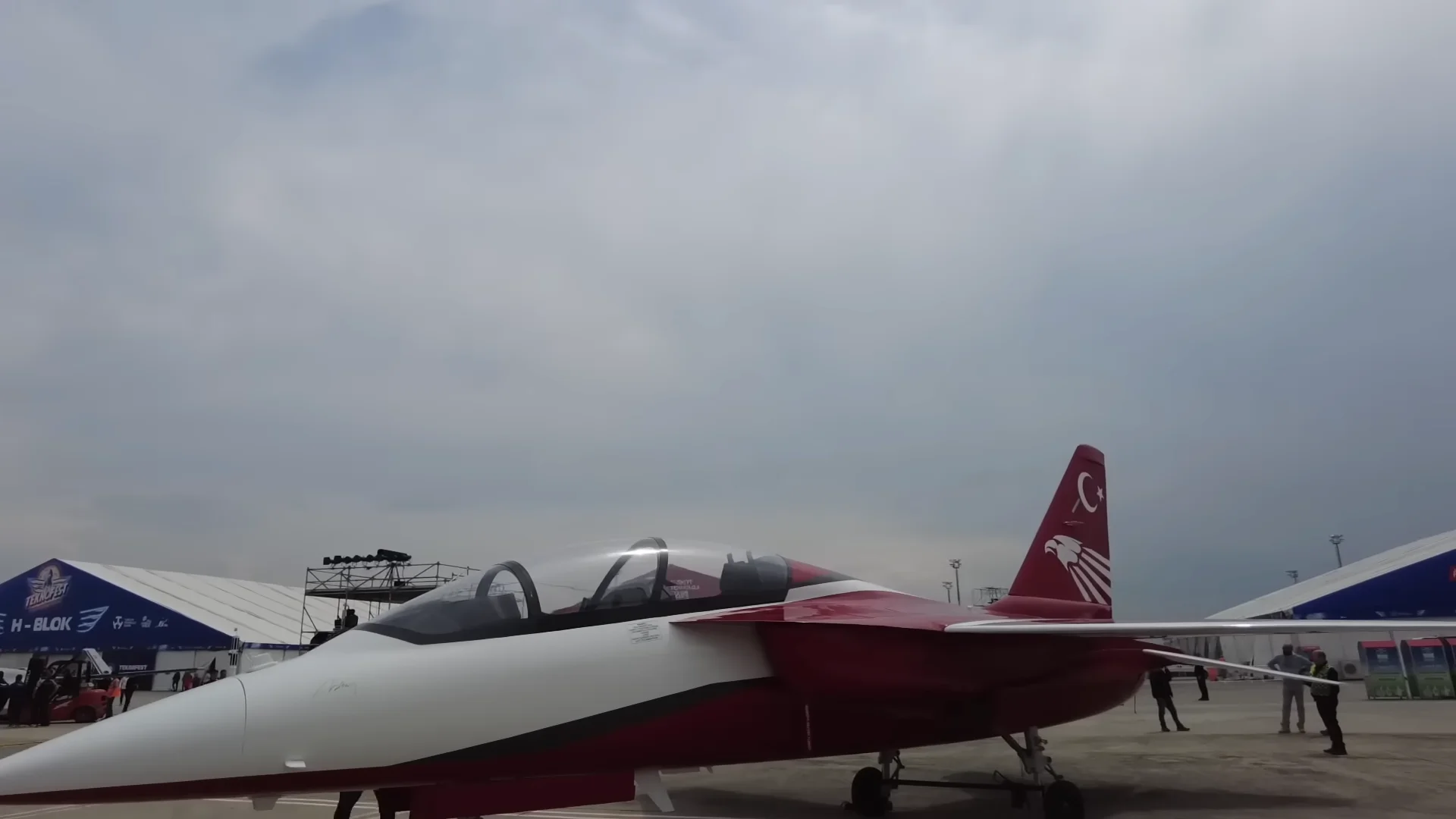


The FA-50 and the Hürjet are not the same kind of aircraft yet. Korea Aerospace Industries’ FA-50 is an armed, supersonic light combat jet that has been in Korean service since 2013 and has flown combat missions with the Philippine Air Force. Turkish Aerospace’s Hürjet is an advanced jet trainer whose first production aircraft flew in August 2026 and whose first export customer, Spain, expects deliveries from 2028. No African air force operates either type. Egypt is the African market where both have been actively marketed.
Photo: a Hürjet prototype on display at Teknofest 2023, Istanbul. Credit: tolgaozbekcom / Wikimedia Commons, CC BY 3.0 (https://creativecommons.org/licenses/by/3.0/)
This comparison is part of DefenceMENA’s Global Defence Industry series. It sets out what the two manufacturers and their customers have published, where the aircraft overlap, and where they do not. It does not name an overall winner: the right choice depends on whether an air force needs a trainer, a light fighter, or both in one airframe, and on financing, sustainment and export-licence questions that public data cannot settle.
The short answer for African air forces
- FA-50: a mature, armed light combat aircraft with four export customers and documented operational use. KAI lists a gun, AIM-9 air-to-air missiles and JDAM guided bombs among its equipment.
- Hürjet: a newer advanced jet trainer. Turkish Aerospace’s official roles are advanced training, introduction to fighter fundamentals, “red air” adversary training and aerobatic display. Armed variants have been discussed, but the manufacturer’s product page does not list a light-attack role.
- In Africa: neither type has an African operator. Egypt’s requirement for up to 36 new trainers is the clearest African opportunity, but no contract has been announced.
Who builds them
Both manufacturers appear in the latest SIPRI Top 100, which covers 2024 and was published in December 2025. SIPRI ranks Turkish Aerospace Industries 65th, with arms revenues of $2.16 billion, and Korea Aerospace Industries 70th, with $2.01 billion. SIPRI ranks companies by arms revenue only; the ranking says nothing about the quality of their products (SIPRI).
The FA-50 is derived from KAI’s T-50 supersonic trainer. KAI says it added a tactical data link, precision-guided munitions and self-protection equipment, and that the type has been operational with the Republic of Korea Air Force (ROKAF) since 2013 (KAI). The ROKAF describes it as a light attack aircraft developed from the T-50 and TA-50 to replace ageing F-5E/F fighters (ROKAF).
The Hürjet began as a privately funded Turkish Aerospace project; the Turkish government later signed a development agreement (Calibre Defence). It is intended to replace the Turkish Air Force’s T-38 trainers and the F-5s flown by its aerobatic team. The first prototype flew on 25 April 2023 and the second on 12 November 2024 (Turkish Aerospace).
Development and production status
FA-50: in series production and service. Poland declared its first 12 FA-50GF aircraft combat ready on 2 October 2026; its defence minister noted that they had been bought without armament (Janes). KAI is due to hand the first two of Malaysia’s 18 FA-50s over at the end of October 2026, according to Chosun Biz.
Hürjet: moving from flight test into series production. The first aircraft built for the Turkish Air Force made its maiden flight on 30 August 2026 (Calibre Defence). In January 2026 Turkish Aerospace’s chief executive said 12 aircraft were in production for the air force, alongside four prototypes, and that the company aimed to build two, then three, aircraft a month (Türkiye Today). The company’s product page says delivery to the air force is scheduled for 2026. DefenceMENA had not found a public announcement of a handover by 18 October 2026.
Published specifications
The figures below are the manufacturers’ own, unless another source is named. They are not test results, and some are defined differently. In particular, KAI does not publish a payload figure comparable to Turkish Aerospace’s “payload capacity”; the ROKAF gives a maximum weapons load for the FA-50 instead.
| Published figure | FA-50 | Hürjet |
|---|---|---|
| Crew | 2 | 2 (tandem) |
| Engine | 1 × GE F404-GE-102, 17,700 lb thrust | 1 × GE F404-104, 17,700 lb thrust |
| Maximum speed | Mach 1.5 | Mach 1.4 |
| Maximum take-off weight | 26,929 lb | Not published on the product page |
| Load | Maximum weapons load 4.8 tonnes (ROKAF) | Payload capacity 7,500 lb |
| Service ceiling | 45,000 ft | 45,000 ft |
| Maximum rate of climb | 37,000 ft/min | 48,500 ft/min |
| g limits | +8 / −3 | +8 / −3 |
| Range | Not published on the product page | 1,060 nautical miles |
| Length / span | 13.14 m / 9.45 m (ROKAF) | 13.6 m / 9.5 m |
| Weapons listed by maker | 20 mm three-barrel gun, AIM-9, JDAM | None listed |
Sources: KAI FA-50 page, KAI FA-50 export brochure (October 2025), ROKAF, Turkish Aerospace Hürjet page.
On paper the two airframes are close in size and use engines from the same General Electric F404 family. The bigger difference is mission equipment. KAI markets the FA-50 with Link 16, a helmet-mounted display and precision weapons (KAI brochure). Turkish Aerospace has not published an equivalent weapons and sensor fit for the Hürjet.
Operators and export record
FA-50
- South Korea: in ROKAF service since 2013 (KAI).
- Philippines: operates the FA-50PH. In June 2025 KAI signed a 975.3 billion won contract for 12 more aircraft with follow-on logistics support, which would take the fleet to 24 (Korea Herald).
- Poland: ordered 48 aircraft in 2022; KAI put the value at about $3 billion (Yonhap). Twelve FA-50GF have been delivered. Delivery of the 36 FA-50PL was pushed back to mid-2027 to early 2029 because integrating a US-supplied radar and AIM-9X missiles depends on US approvals, according to KDReview.
- Malaysia: signed for 18 FA-50 Block 20 in May 2023, worth $920 million (Korea Times).
The wider T-50 family has also been sold as trainers to Indonesia, Iraq and Thailand. Those are separate variants and are not counted here as FA-50 operators.
Hürjet
- Türkiye: launch customer; production aircraft in build, delivery planned (see above).
- Spain: first export customer. The contract covers 30 aircraft to replace the Spanish Air and Space Force’s F-5s, with Airbus Defence and Space as national lead. Delivery in initial configuration is planned for 2028–29, followed by conversion to Spanish standard between the second half of 2031 and 2035 (Airbus). Türkiye’s defence industry secretariat put the deal at €2.4 billion (Anadolu Agency); Janes reported a €1.56 billion award to Airbus in Spanish budget documents (Janes). The figures cover different scopes and should not be read as a price per aircraft.
Operational experience
The FA-50 has a documented combat record. Philippine Air Force FA-50PHs bombed militant positions in Butig, Lanao del Sur, in January 2017 (Philippine Daily Inquirer) and flew strike missions during the Marawi siege later that year. In July 2017 the fleet was briefly grounded after a bomb fell short of its target, killing two Philippine soldiers and wounding 11 (Philippine Daily Inquirer). Combat use shows the aircraft has been employed in counter-insurgency operations. It does not by itself prove that it is better than its rivals.
The Hürjet has no operational record. It has not yet entered service.
Why this matters in Africa
Egypt: the clearest opportunity
Egypt is the African country where both aircraft have been pitched directly. In September 2024 a Hürjet prototype flew across the Mediterranean to the Egypt International Airshow and performed a demonstration flight over the Giza pyramids (Turkish Aerospace); an Egyptian F-16 pilot flew in it during the show, and Turkish Aerospace’s general manager said the company hoped to go beyond an office in Egypt to a factory “in the future” (Türkiye Today/Anadolu). That is an aspiration, not an agreement. The Hürjet was displayed again at EDEX 2025 in Cairo (TURDEF).
KAI was the only Korean exhibitor at the Egypt International Airshow in September 2026, where it marketed the FA-50 (KDReview). According to EDR Magazine, the Egyptian Air Force wants up to 36 new trainers in a first tranche to replace its Alpha Jets, and the contenders are now the FA-50, China’s Hongdu L-15 and Leonardo’s M-346 Block 20. EDR did not list the Hürjet and reported that the programme appears stalled over funding. A 2025 report that Egypt was close to a deal for up to 100 FA-50s, with local assembly at Helwan, is not supported by more recent reporting and remains unconfirmed.
DefenceMENA’s guide to the fighter jets Egypt operates and our Egyptian Rafale programme tracker show the frontline fleets that a new lead-in trainer would feed.
Elsewhere on the continent
Nigeria, Africa’s other large buyer in this class, chose Leonardo’s M-346FA in 2023; DefenceMENA explains why Nigeria bought the M-346FA. Our comparison of light attack aircraft in African service covers the turboprop and jet options already flying with counter-insurgency air forces. For most African air forces, the practical question is whether they need a supersonic lead-in trainer at all, or a cheaper turboprop or subsonic jet that matches the aircraft they actually fly.
Procurement, sustainment and industrial points
- Export licences: both aircraft use a US-built GE engine. The FA-50 also contains British components, and the UK blocked a sale to Argentina in 2020 for that reason (FlightGlobal). Poland’s FA-50PL delays show how US-sourced radar and missiles can affect delivery schedules. Turkish Aerospace has not published a full breakdown of the Hürjet’s foreign content, so its licence exposure beyond the engine cannot be assessed from public sources.
- Training and support: the Spanish Hürjet package includes a conversion centre in Spain, refurbishment of the Talavera la Real training centre and operation and maintenance services (Airbus). The Philippine FA-50 follow-on order bundled logistics support (Korea Herald). Both suggest that sustainment is sold as part of the package; terms for an African buyer would be negotiated separately.
- Industrial participation: Spain secured national conversion work. Any Egyptian role, whether assembly or maintenance, remains unannounced for either type. A signed agreement would still not be the same as a working facility.
- Prices: published contract values include different mixes of aircraft, training systems, support and conversion. DefenceMENA does not derive unit prices from them.
Side-by-side summary
| Criterion | FA-50 | Hürjet |
|---|---|---|
| Manufacturer / origin | Korea Aerospace Industries, South Korea | Turkish Aerospace (TUSAŞ), Türkiye |
| Category | Light combat aircraft, also used for lead-in training | Advanced jet trainer |
| Status | In service since 2013; in production | Series production; first production aircraft flew August 2026 |
| Operators | South Korea, Philippines, Poland; Malaysia from late 2026 | Türkiye (planned), Spain (from 2028) |
| African operators | None | None |
| African marketing | Egypt trainer competition (EIAS 2026) | Egypt demonstration flight (2024), EDEX 2025 |
| Published contracts | Poland (48), Malaysia (18), Philippines (12 + 12) | Spain (30) |
| Documented operations | Philippine counter-insurgency strikes, 2017 | None |
| Known export constraints | US engine; UK components (Argentina case); US radar and missiles for Polish version | US engine; other foreign content not published |
Frequently asked questions
Is the Hürjet a fighter jet?
Not at present. Turkish Aerospace describes it as an advanced jet trainer and lists training, adversary and aerobatic roles. Armed versions have been discussed, but no armed configuration has been published by the manufacturer.
Does any African country fly the FA-50 or the Hürjet?
No. DefenceMENA found no African operator or signed African contract for either aircraft as of 18 October 2026.
Has Egypt ordered the FA-50?
No order has been announced. Egypt is assessing trainer options, and EDR Magazine reported in September 2026 that the programme appeared to be on hold over funding.
Which is faster?
The manufacturers quote Mach 1.5 for the FA-50 and Mach 1.4 for the Hürjet. These are maker figures, not independently tested results.
Do they use the same engine?
Both use a single engine from GE’s F404 family rated at 17,700 lb of thrust: the F404-GE-102 in the FA-50 and the F404-104 in the Hürjet, according to the manufacturers.
Is the FA-50 combat proven?
The Philippine Air Force has used it in combat against militants since 2017. That is documented operational use, not proof of superiority over other aircraft.
Sources
- Korea Aerospace Industries: FA-50 product page; FA-50 export brochure (October 2025)
- Republic of Korea Air Force: FA-50 data sheet
- Turkish Aerospace: HÜRJET product page
- SIPRI: The SIPRI Top 100 Arms-producing and Military Services Companies, 2024 (December 2025)
- Airbus: Airbus to lead Spain’s new combat training system (30 December 2025)
- Anadolu Agency: Spain inks deal to purchase 30 Hürjet; Janes: Spain awards Hürjet procurement contract
- Calibre Defence: First Hürjet for Turkish Air Force takes to the skies (3 September 2026)
- Türkiye Today: TAI targets monthly production of 3 Hürjet (January 2026); TAI export plans at Egypt airshow (September 2024)
- Yonhap: KAI signs $3bn deal with Poland for 48 FA-50s; Janes: Poland declares FA-50 combat ready
- Korea Times: KAI finalises FA-50 deal with Malaysia; Korea Herald: KAI signs W975bn deal for more FA-50s for the Philippines; Chosun Biz: Malaysia’s first FA-50M due end of October 2026
- KDReview: FA-50 news digest (Poland amendment, Egypt airshow)
- Philippine Daily Inquirer: Butig air strikes (January 2017); FA-50s grounded after friendly fire in Marawi
- FlightGlobal: UK shoots down Argentine FA-50 deal (2020)
- EDR Magazine: EIAS 2026: Egypt still searches for new trainer; TURDEF: Hürjet at EDEX 2025
Related DefenceMENA coverage
- Light attack aircraft for African counter-insurgency air forces
- Why did Nigeria buy the M-346FA?
- What fighter jets does Egypt operate?
- Fighter aircraft of African air forces
- JF-17 Thunder family explained
- Turkish defence systems in African military service
- Turkish defence companies active in Africa