Egypt’s Ministry of Military Production has signed a memorandum of understanding with Intel, using its subsidiary Toya Technology as the vehicle, to build artificial-intelligence skills and edge-AI assembly capacity inside the ministry’s factories. The deal, signed in mid-September, points toward AI-assisted design and production across Egypt’s ammunition and weapons lines rather than any single new weapon system.
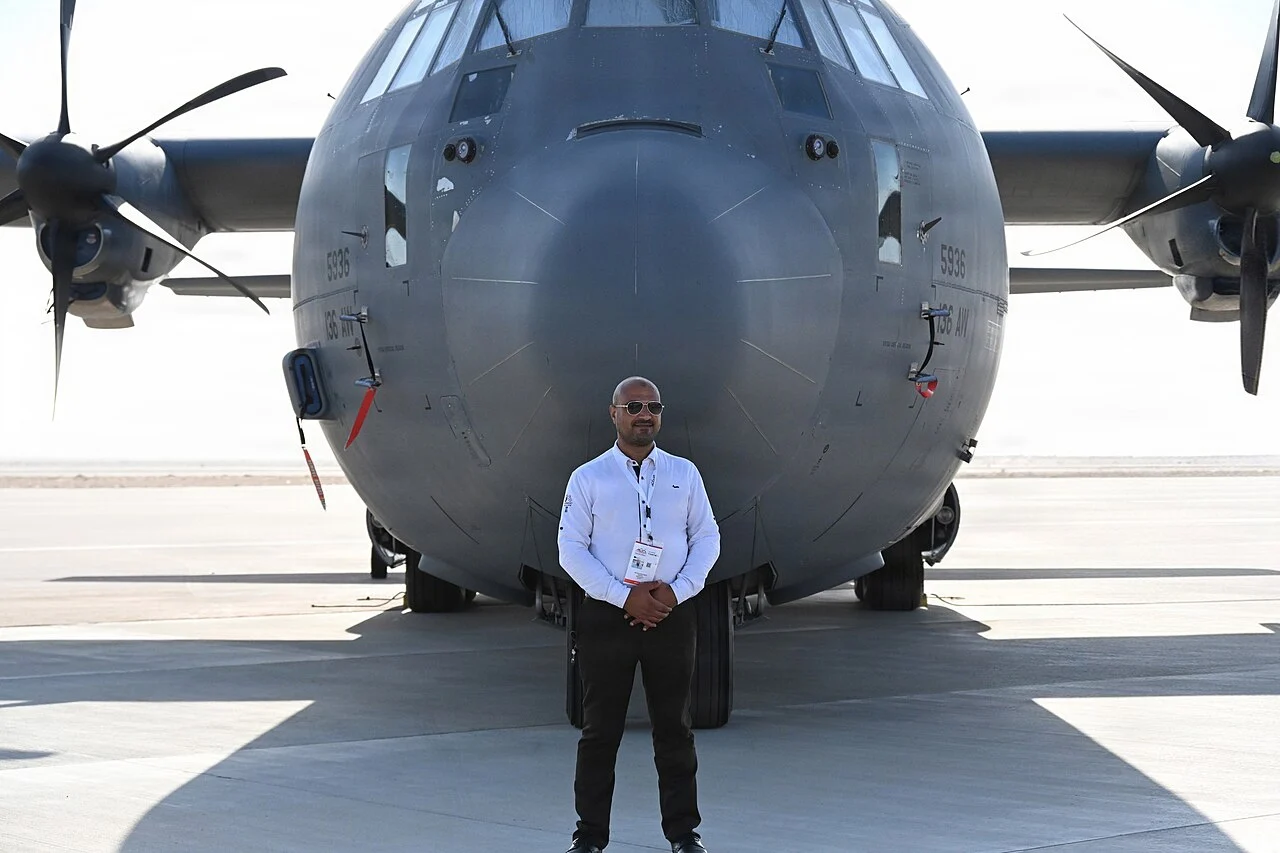
Photo: A visitor at the Egypt International Airshow 2026, El Alamein, illustrative of Egypt’s wider 2026 defence-technology push. Credit: U.S. Air National Guard photo by Tech. Sgt. Tia Hambrick, Public domain, via Wikimedia Commons
Toya Technology, a company affiliated with the ministry, signed the memorandum with Intel in the presence of Minister of State for Military Production Salah Gamblat, according to Egypt’s State Information Service. Intel was represented by Gisselle Ruiz Lanza and Taha Khalifa; Toya’s chairman, Khaled Mohamed Mahrous, signed for the Egyptian side. Gamblat described the agreement as part of “efforts to expand cooperation with specialised global companies and translate areas of cooperation into practical initiatives,” and tied it to President Abdel Fattah al-Sisi’s directives to localise advanced technology and deepen domestic manufacturing.
What the agreement covers
The memorandum sets out three main tracks: training and capacity-building for ministry personnel, including a “Training of Trainers” programme; technology and knowledge transfer from Intel; and local assembly of Intel-based edge-AI systems and personal computers inside Egypt. Daily News Egypt, which broke the story on 15 September, reported that the agreement follows an earlier round of talks in July 2026 covering industrial software, data centres, networking and smart cameras — a broader digitalisation push that the AI deal now formalises.
The Defense Post framed the deal as an attempt to reduce Egypt’s dependence on imported AI tools for its military-industrial base, rather than a one-off product purchase. No financial figures or delivery dates have been disclosed by either party, and the agreement remains a memorandum of understanding rather than a signed contract, so the scope could still change as the two sides work out implementation.
A ministry already used to industrial partnerships
The Ministry of Military Production runs a network of factories that already builds under licence for foreign partners: it assembles armoured vehicles, ammunition and, through its affiliate the Arab Organisation for Industrialization (AOI), has recently taken on production and sales work with outside firms. Just weeks before the Intel memorandum, Turkey’s MKE opened its first African subsidiary, Zafer, in Cairo, aiming at joint production of ammunition and command-and-control systems with Egyptian industry. AOI separately signed a sales agreement with Turkey’s Havelsan for the Hamza-1 drone. The Intel memorandum fits the same pattern: rather than buying finished Western or Turkish hardware outright, Cairo is trying to pull the underlying technology — AI tooling in this case — into its own factories.
That approach mirrors how Egypt has built the rest of its arsenal. Cairo already runs one of the most diversified militaries in Africa, with French Rafales, Mistral-class ships and Gowind corvettes alongside a US-supplied core of F-16s and M1A1 Abrams tanks, and it has an active request out to Dassault for 24 more Rafales. Layering an AI-localisation programme onto that mixed supplier base gives Egypt a way to extract technology transfer from each partner rather than depend on any single one.
Why it matters for Africa
Egypt’s defence-industrial base is one of the largest and most capable on the continent, and its choices tend to set a reference point for other African militaries weighing whether to buy finished weapons or build local production capacity. An AI-assembly line inside the Ministry of Military Production, even a modest one focused on training and edge computing rather than combat software, signals that Cairo sees data and software — not just steel and propellant — as the next front in reducing import dependence. For African defence ministries watching AAD 2026 and the wider push toward local content requirements, Egypt’s Intel deal is a test case for how a mid-sized industrial base can extract technology transfer from a global chipmaker without a full weapons contract attached. If the assembly and training tracks produce real output, it also gives Cairo a domestic AI-hardware base it could eventually offer to partners elsewhere in Africa, alongside the ammunition and vehicle production it already exports regionally.