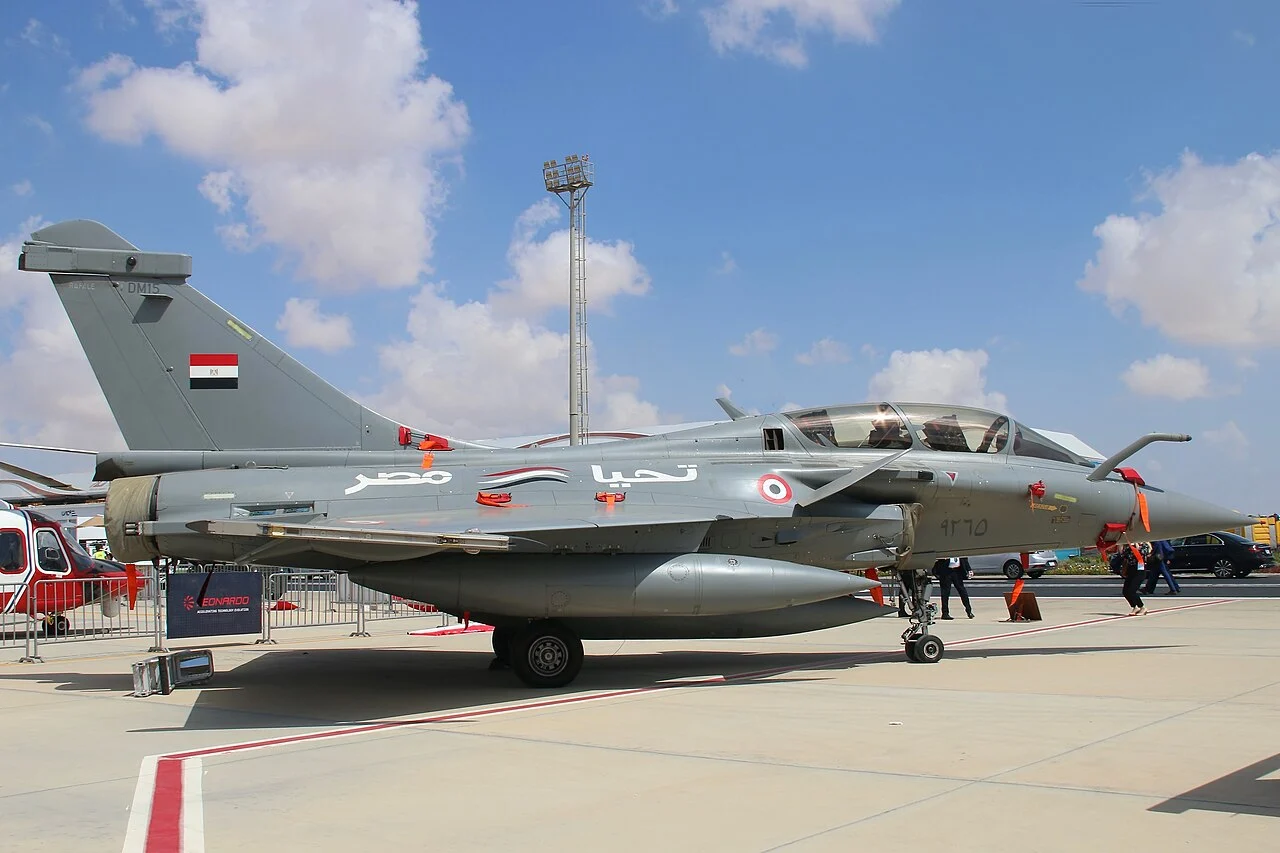
Egypt has submitted a formal request to Dassault Aviation for 24 additional Rafale fighters, a purchase that would take the Egyptian Air Force’s Rafale fleet to 78 aircraft and make Cairo the largest Rafale operator in the Middle East and North Africa.
Photo: An Egyptian Air Force Dassault Rafale fighter. Credit: Colin Cooke Photo, CC BY-SA 2.0, via Wikimedia Commons
Egypt submitted the Request for Proposal to Dassault on 1 September 2026, according to The Defense Post, which first reported the move. Army Recognition and Migflug have since carried the same figures. Neither Dassault nor Egypt’s Ministry of Military Production has commented publicly, and no contract has been signed — the request is, for now, exactly that: a request.
From 54 to 78
Egypt is on track to have 54 Rafales in service by the end of 2026, the result of three separate contracts signed since 2015 covering the original 24-jet order plus two follow-on batches. The new RFP would add 24 more, bringing the total to 78 — comfortably ahead of Qatar’s 24-strong fleet and closing in on the 80 Rafale F4s the United Arab Emirates has on order, though the UAE jets have not yet begun deliveries. For a full breakdown of Cairo’s current order of battle, see DefenceMENA’s Egypt military strength profile.
The timing lines up with the retirement schedule for Egypt’s oldest F-16s. The Egyptian Air Force’s Block 15, 32 and 40 airframes date to between 1982 and 1995, and Cairo has spent the past decade diversifying away from a fleet built almost entirely around US-made fighters. The Rafale purchases, alongside a fleet of Russian MiG-29M/M2s and older Mirage 2000s and F-16s, have given Egypt one of the most mixed combat-air inventories in the region — a hedge against reliance on any single supplier, and against the political conditions that sometimes come attached to US arms sales. That diversification also shapes how Egypt’s air power stacks up regionally, as detailed in DefenceMENA’s Egypt vs Algeria military comparison.
What comes next
An RFP is the opening move in a procurement process, not a purchase. Egypt’s own defence-acquisition timelines have historically stretched from initial request to signed contract over many months, and pricing, financing and delivery-schedule negotiations with Dassault would still need to be worked out. Egypt’s existing Rafale contracts were financed in part through French state-backed loans, a mechanism likely to be revisited for a fourth batch.
If a contract follows, it would be Egypt’s fourth Rafale order and would further cement Dassault’s position in the Egyptian market at a moment when France is also pursuing separate defence business with Morocco, including a potential Scorpène-class submarine sale, underlining how central North Africa has become to French arms exports.
Why it matters for Africa
A 78-jet Rafale fleet would make Egypt’s air force the largest and most diversified in Africa by a wide margin, reinforcing its position as the continent’s dominant air power alongside its Su-35 negotiations with Russia and its indigenous K-8E and locally assembled platforms. For the wider African market, the deal is also a signal: Egypt’s willingness to keep adding French combat aircraft on top of US, Russian and Chinese types shows how African air forces with the budget to do so are increasingly building multi-source fleets rather than staying loyal to a single supplier — a pattern also visible in Morocco’s helicopter and submarine shopping and in Algeria’s mixed Russian-Chinese-German inventory.