CAESAR vs G6 Rhino: Morocco and South Africa’s Wheeled 155mm Howitzers



Morocco and South Africa have each chosen a wheeled, truck-mounted 155mm howitzer to modernise their artillery, but from rival industrial bases: France’s Nexter CAESAR and South Africa’s own Denel G6 Rhino. Figures below are manufacturer-published or drawn from named outlets, with the year stated for each.
DEFENCE AFRICA | Evergreen head-to-head | Data as of November 2026
Towed artillery is slow to move and exposed once it fires. Wheeled self-propelled howitzers solve that by mounting the gun on a truck or armoured chassis that can shoot and then relocate within minutes, a capability several African armies have been buying into over the past two decades. Morocco and South Africa sit at opposite ends of that shopping list: Rabat imported its howitzer from France, while Pretoria built its own in the 1980s and still exports it.
The CAESAR and the G6 Rhino are not rivals in the sense of competing for the same contract today — Morocco’s order is closed and South Africa is not buying new guns — but they represent the two paths African militaries actually take: importing a NATO-standard wheeled howitzer with an established production line, or relying on a domestically designed gun-chassis that no longer has new-build orders but still defines what an African-made 155mm system can do. Both systems’ core specifications come from the manufacturer or from defence-reference literature, not fan estimates, and are presented here without declaring either one superior; the roles and user bases differ enough that “better” depends entirely on what a buyer already operates and can sustain.
Key facts
- Morocco’s Royal Armed Forces received a first batch of 36 Nexter CAESAR 6×6 systems in late August/early September 2022, under a roughly €200 million 2020 contract (Hespress, 3 September 2022; The Defense Post, 6 September 2022).
- The CAESAR 6×6’s published combat weight is under 18,000 kg, with a 155mm/52-calibre gun reaching 40 km with standard ammunition (Nexter/KNDS brochure; Army Recognition product page).
- South Africa’s G6 Rhino entered SANDF service in 1988; of the roughly 43 systems recorded, only about two remain in routine use, the rest held in storage (Wikipedia, citing IISS Military Balance 2024).
- The G6 Rhino’s gun-chassis weighs about 46 tonnes combat weight and reaches up to 67.4 km with Denel’s V-LAP long-range round (FAS; Wikipedia G6 howitzer entry).
- Denel’s G6-52 design was exported to the United Arab Emirates (78 systems) and Oman (24 systems), making it South Africa’s most successful artillery export (Wikipedia, IISS Military Balance 2024).
1. CAESAR (Nexter/KNDS) — delivered to Morocco, 2022
The CAESAR mounts a 155mm/52-calibre gun on a 6×6 truck chassis (originally a Renault Sherpa, later an Arquus Sherpa 5), reducing a self-propelled howitzer battery to a soft-skinned logistics footprint that can self-deploy at highway speed. Morocco signed for the system in 2020 as part of a roughly €400 million package with France that also covered MBDA’s VL MICA air-defence missile, with the Nexter contract itself worth about €200 million, €170 million for 36 guns and €30 million for ammunition (Hespress, 3 September 2022). Delivery slipped for two years; Moroccan outlets and The Defense Post reported the Royal Armed Forces received the first batch only in late August or early September 2022, after reports that part of France’s wider CAESAR production run had been redirected to Ukraine (The Defense Post, 6 September 2022). Status: delivered. Nexter’s own figures put the 6×6’s maximum range at 40 km with standard LU-family ammunition and 55 km class with extended-range rounds, a rate of fire up to six rounds per minute, and a 600 km self-deployment range on wheels (Nexter/KNDS CAESAR 6×6 brochure). Beyond Morocco, the CAESAR is in French Army service and has been exported to Indonesia, Thailand and, since 2022-23, Ukraine (Army Recognition CAESAR product page), giving Rabat access to a NATO-standard sustainment and ammunition chain shared with multiple other armies rather than a bespoke national system.
2. G6 Rhino (Denel Land Systems) — operational with South Africa, largely in storage
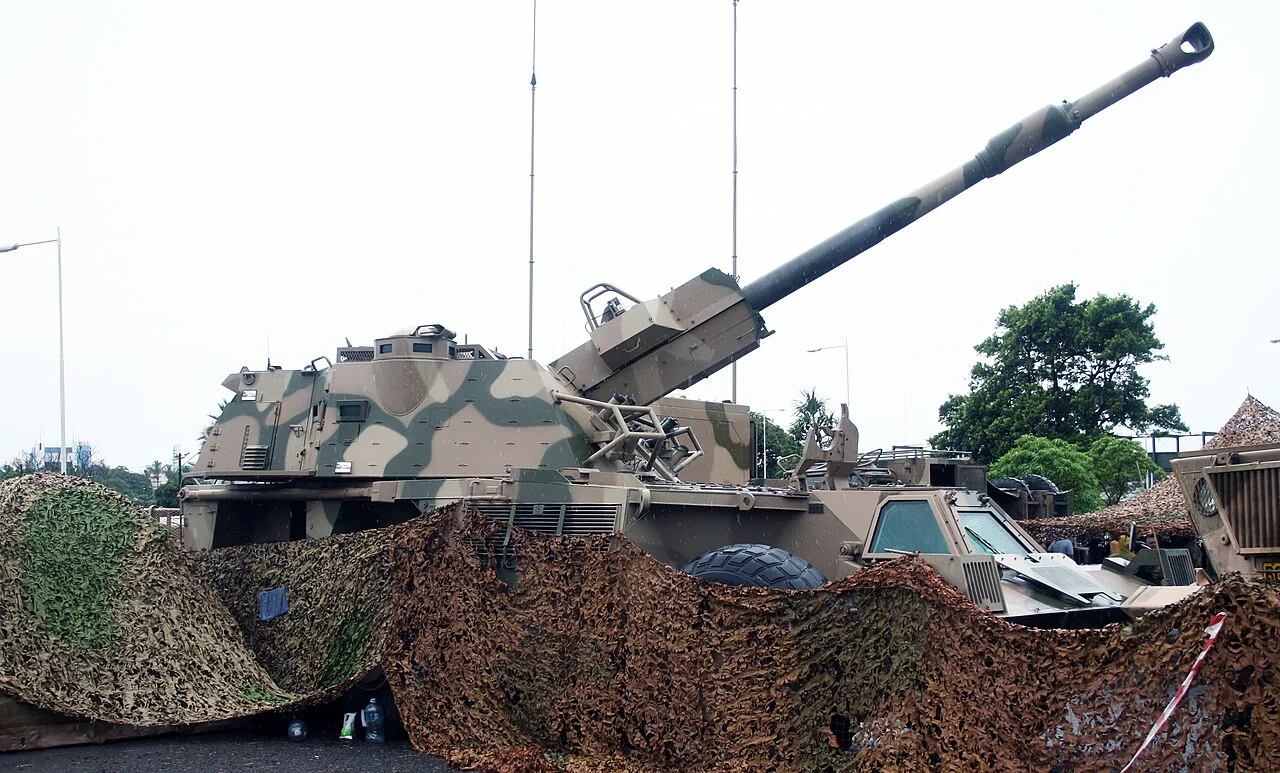
The G6 Rhino carries its 155mm gun on a six-wheeled armoured hull built on the Alvis OMC (later BAE Systems Land Systems South Africa) chassis, giving the crew mine protection the CAESAR’s unarmoured cab does not offer. Developed by what was then Armscor’s Lyttelton Engineering Works and brought into South African Defence Force service in 1988 during the Angolan border war, it was the first wheeled 155mm self-propelled gun fielded anywhere and set the template later copied by other wheeled systems (Wikipedia G6 howitzer entry; FAS). The later G6-52 variant, with a 52-calibre barrel, extends range further. Status: operational, though reduced. South Africa’s registered fleet of about 43 systems is reported to have only around two kept in day-to-day use, with the remainder held in reserve storage, per the IISS Military Balance 2024 as cited by Wikipedia’s G6 howitzer entry; combat weight is about 46 tonnes, with maximum range running from 30 km on standard HE to 39-42 km with base-bleed ammunition and up to roughly 67 km on Denel’s V-LAP round from the G6-52 (FAS; Wikipedia). Denel never secured a second production customer inside Africa, but the design did sell abroad: the United Arab Emirates operates 78 systems and Oman 24, both recorded in the IISS Military Balance 2024, making the G6 family a rare African-engineered artillery export even as the home fleet ages and the original production line has long been closed.
| Specification | CAESAR 6×6 (Nexter/KNDS) | G6 Rhino / G6-52 (Denel) |
|---|---|---|
| Manufacturer / country | Nexter (now KNDS France) — France | Denel Land Systems — South Africa |
| Chassis | 6×6 truck (Sherpa family), unarmoured cab | 6×6 armoured gun-chassis, mine-protected |
| Combat weight | Under 18,000 kg | About 46,000 kg |
| Crew | 3 to 5 | 6 |
| Main gun | 155mm/52-calibre | 155mm/45-calibre (G6-52: 52-calibre) |
| Published maximum range | Up to 40 km, standard ammunition (Nexter/KNDS) | Up to 67 km, V-LAP from G6-52 (FAS/Wikipedia) |
| Road speed / self-deploy range | 90 km/h; 600 km (Army Recognition) | 90 km/h; 700 km (Wikipedia) |
| African operator, status | Morocco — delivered, 2022 | South Africa — operational, mostly in storage |
| Other operators | France, Indonesia, Thailand, Ukraine | United Arab Emirates (78), Oman (24) |
Sustainment and the industrial angle
The two systems put African buyers in very different supply relationships. Morocco’s CAESAR ties the Royal Armed Forces into Nexter/KNDS’s NATO-standard 155mm ammunition family, shared with the French Army and other European and Southeast Asian users, and into a production line still active enough that France could reportedly redirect part of Morocco’s own order to Ukraine in 2022 without halting output (The Defense Post, 6 September 2022). That gives Rabat predictable spares and ammunition resupply but also exposure to the supplying country’s own wartime priorities, as the delivery delay showed. The South African National Defence Force‘s G6 Rhino sits at the other extreme: a fully domestic design, built when apartheid-era sanctions forced local self-sufficiency, that now has no open production line to draw fresh hulls or spares from, leaving Pretoria dependent on cannibalising its own reserve fleet to keep a handful of guns running. Denel’s continued export support to the UAE and Oman at least keeps some of the type’s logistics and ammunition-engineering expertise active inside the company, which could in principle support a future SANDF refurbishment, but no such programme has been publicly announced.
Why it matters for Africa
Few African armies can afford either a from-scratch domestic 155mm programme or an open-ended NATO import contract, so the CAESAR and G6 Rhino mark the two realistic routes other militaries weigh when modernising artillery: buy a current-production wheeled system from an established exporter, as Morocco did, or sustain a legacy indigenous design built decades ago, as South Africa does. Morocco’s route buys interoperability and a living supply chain at the cost of dependence on a foreign government’s export decisions, visible when its own order was reportedly tapped for Ukraine. South Africa’s route preserves full sovereignty over a design still potent enough to sell abroad, but without fresh orders or an active production line, the home fleet shrinks toward museum status even as two dozen-plus systems keep firing for Gulf customers. For procurement planners elsewhere on the continent, the comparison underlines that “self-propelled 155mm howitzer” covers two very different ownership models, and the right choice depends less on range or rate of fire than on which supply chain, and which country’s political risk, a buyer is willing to live with.
Sources
- Hespress English, “Morocco receives French Caesar artillery systems after long delay,” 3 September 2022
- The Defense Post, “Morocco Receives French Caesar Artillery Systems Amid Ukraine Diversion Claims,” 6 September 2022
- North Africa Post, “Morocco Reinforces Artillery Capabilities With Caesar Howitzers”
- Nexter/KNDS France, CAESAR 6×6 product brochure
- Army Recognition, CAESAR 6×6 155mm self-propelled howitzer, technical data sheet
- Wikipedia, “CAESAR self-propelled howitzer”
- Wikipedia, “G6 howitzer,” citing IISS Military Balance 2024
- Federation of American Scientists, “G6 Self-Propelled 155mm Howitzer”