


From Cheetah to Gripen: South Africa’s Fighter Transition

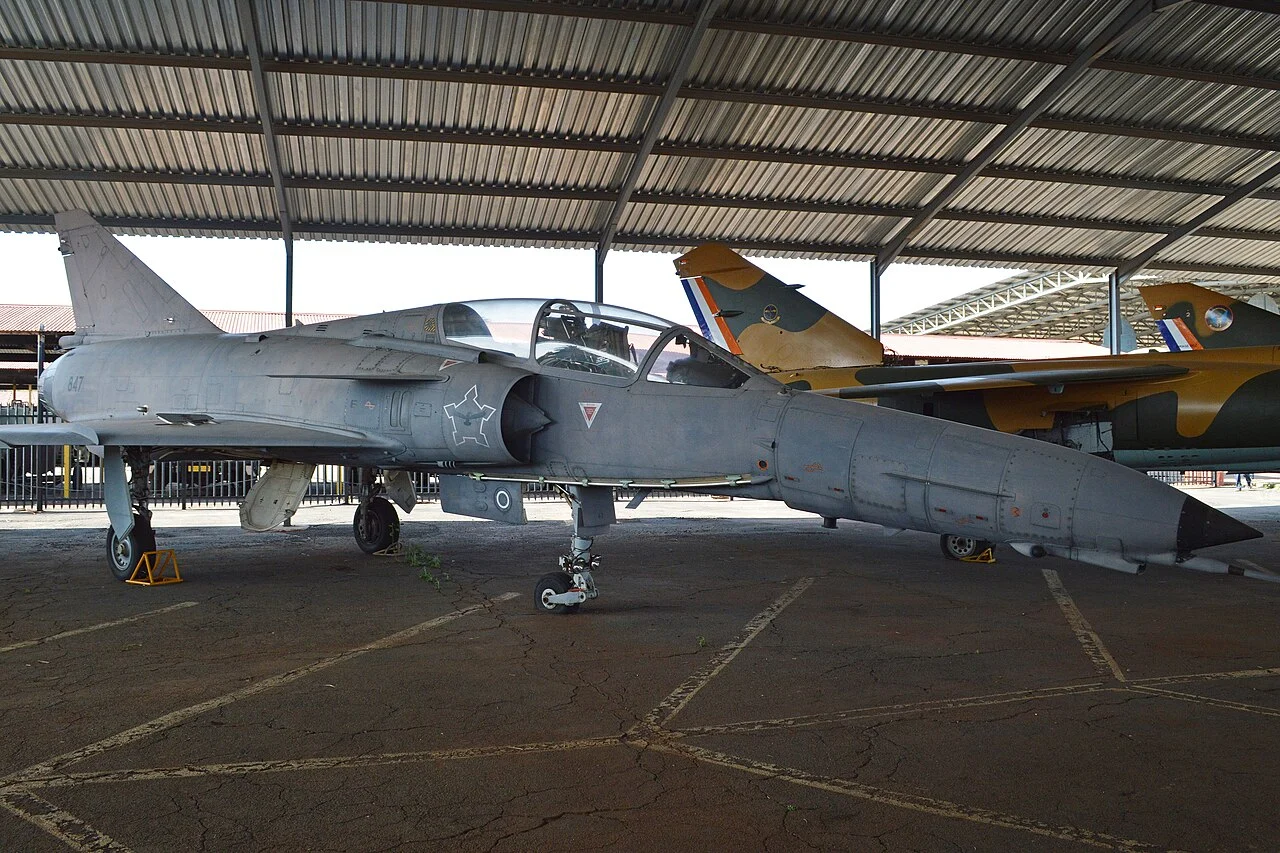


South Africa retired its last Atlas Cheetah fighters in April 2008 after more than two decades of service, replacing them with 26 Saab Gripen C/D multirole jets delivered through 2012. The transition traded a locally rebuilt, embargo-era airframe for a NATO-standard fighter, but it also opened a fighter-readiness gap that the South African Air Force (SAAF) has never fully closed.
DEFENCE AFRICA | Old vs new | Data as of October 2026
For most of the apartheid era, South Africa could not buy fighters on the open market. A United Nations arms embargo, in place from 1977, forced the SAAF to keep flying and progressively rebuild its 1960s-era Dassault Mirage III fleet rather than import new aircraft. The result was the Atlas Cheetah, a deep structural and avionics upgrade of the Mirage III airframe carried out by Atlas Aircraft Corporation (later Denel Aviation) with covert Israeli technical assistance, entering SAAF service from 1986. According to the SAAF’s own account, the air force fielded up to 58 Cheetahs at the height of the programme.
By the time the embargo ended and South Africa could again shop internationally, the Cheetah’s airframes and sensors were approaching the limits of what a 1960s delta-wing design could absorb. The 1998 Strategic Defence Packages chose the Saab JAS 39 Gripen, alongside BAE Systems Hawk Mk120 trainers, as the Cheetah’s successor. The last Cheetahs flew their retirement flypast at Air Force Base Makhado on 3 April 2008, and the first Gripen C/D was formally accepted into SAAF squadron service on 30 April 2008, according to FlightGlobal’s contemporary reporting.
| Category | Atlas Cheetah C/D (old) | Saab Gripen C/D (new) |
|---|---|---|
| Role | Day/night interceptor and strike fighter | Swing-role air-to-air, air-to-ground and maritime strike fighter |
| Generation | 1960s Mirage III airframe, extensively rebuilt in the 1980s-90s | Purpose-built 1990s fly-by-wire delta-canard design |
| Sensors | Elta EL/M-2001 lightweight multimode radar (airforce-technology.com, 2024) | Ericsson/Saab PS-05/A pulse-Doppler radar with track-while-scan (airforce-technology.com, 2024) |
| Weapons | 2× 30 mm DEFA cannon; V3C/U-Darter infrared and V4 R-Darter radar-guided air-to-air missiles; laser- and GPS-guided bombs | Internal 27 mm Mauser cannon; AIM-120B AMRAAM beyond-visual-range and AIM-9/IRIS-T short-range missiles; RBS-15 anti-ship missile capability; precision-guided bombs |
| Range | Combat radius about 1,300 km, ferry range about 2,600 km (airforce-technology.com, 2024) | Combat radius about 800 km, ferry range about 3,200 km (airforce-technology.com, 2024) |
| Performance | Maximum speed about 2,350 km/h (Mach 2.2); published figures vary slightly by source | Maximum speed about 2,470 km/h (Mach 2.0); published figures vary slightly by source |
| Survivability | No standard radar warning receiver or integrated electronic warfare suite | EWS39 integrated electronic warfare suite with radar warning and chaff/flare dispensers |
| Networking | No tactical data link; analogue cockpit instrumentation | Air-to-air tactical data link and Thales TSC2000 IFF for network-enabled targeting |
| Maintenance | Sustained through Atlas/Denel local rebuilds to work around the arms embargo | Supported under Saab through-life contracts; DefenceMENA reported in 2026 that lapsed support left only 2 of 26 jets combat-ready, with R4.96 billion needed to restore the fleet |
| Operational relevance | Gave the SAAF an indigenous fighter capability during isolation, but never used in combat | Delivered as the SAAF’s sole fighter type since 2008; its availability crisis has at times left South Africa effectively without a ready fighter force |
What capability existed before?
The Atlas Cheetah C and D were South Africa’s answer to an arms embargo that cut it off from Western fighter suppliers for two decades. Rather than a new design, Atlas Aircraft Corporation took existing Mirage III airframes and rebuilt them with a new nose radome, canard foreplanes for better low-speed handling, and a SNECMA Atar 9K50C-11 turbojet, rated at around 10,500 lb of dry thrust and 15,050 lb with afterburner, according to airforce-technology.com (2024). The result carried South Africa’s locally developed V3C and U-Darter infrared-guided air-to-air missiles and the radar-guided V4 R-Darter, alongside twin 30 mm DEFA cannon and a range of laser- and GPS-guided bombs.
What the Cheetah could not offer was a beyond-visual-range missile integrated with a modern multimode radar, nor the digital avionics and data links that NATO and most Western air forces had already standardised on by the 1990s. Its airframes, however extensively rebuilt, were still built around a 1960s delta-wing structure with a finite fatigue life.
Why was replacement or modernization needed?
With the end of apartheid and the lifting of the UN arms embargo in 1994, South Africa could again buy fighters on the open market, and the Cheetah’s rebuilt-Mirage airframes were reaching the point where further life-extension made less sense than replacement. The 1998 Strategic Defence Packages selected the Gripen alongside the Hawk Mk120 lead-in trainer, with Denel Aviation producing part of the centre fuselage as an industrial-participation commitment, according to airforce-technology.com (2024). The order covered 28 aircraft (19 single-seat C and 9 two-seat D) when it was placed in November 1998; South Africa ultimately took delivery of 26 (17 C and 9 D) by 2012, according to DefenceMENA’s 2026 review of a written parliamentary reply on Gripen readiness. The goal was a fighter interoperable with NATO weapons and data standards, able to fly BVR engagements the Cheetah could not.
What does the new platform add?
The Gripen C/D brought South Africa its first fighter-mounted beyond-visual-range missile, the AIM-120B AMRAAM, paired with the Ericsson/Saab PS-05/A pulse-Doppler radar’s track-while-scan mode. It added an integrated EWS39 electronic warfare suite, a tactical data link, and Thales TSC2000 identification-friend-or-foe equipment that let the SAAF plug into a networked air picture for the first time, according to airforce-technology.com (2024). The aircraft can also carry the Saab RBS-15 anti-ship missile, giving the SAAF a maritime-strike option the Cheetah never had, and in-flight refuelling extends its reach without relying solely on internal fuel.
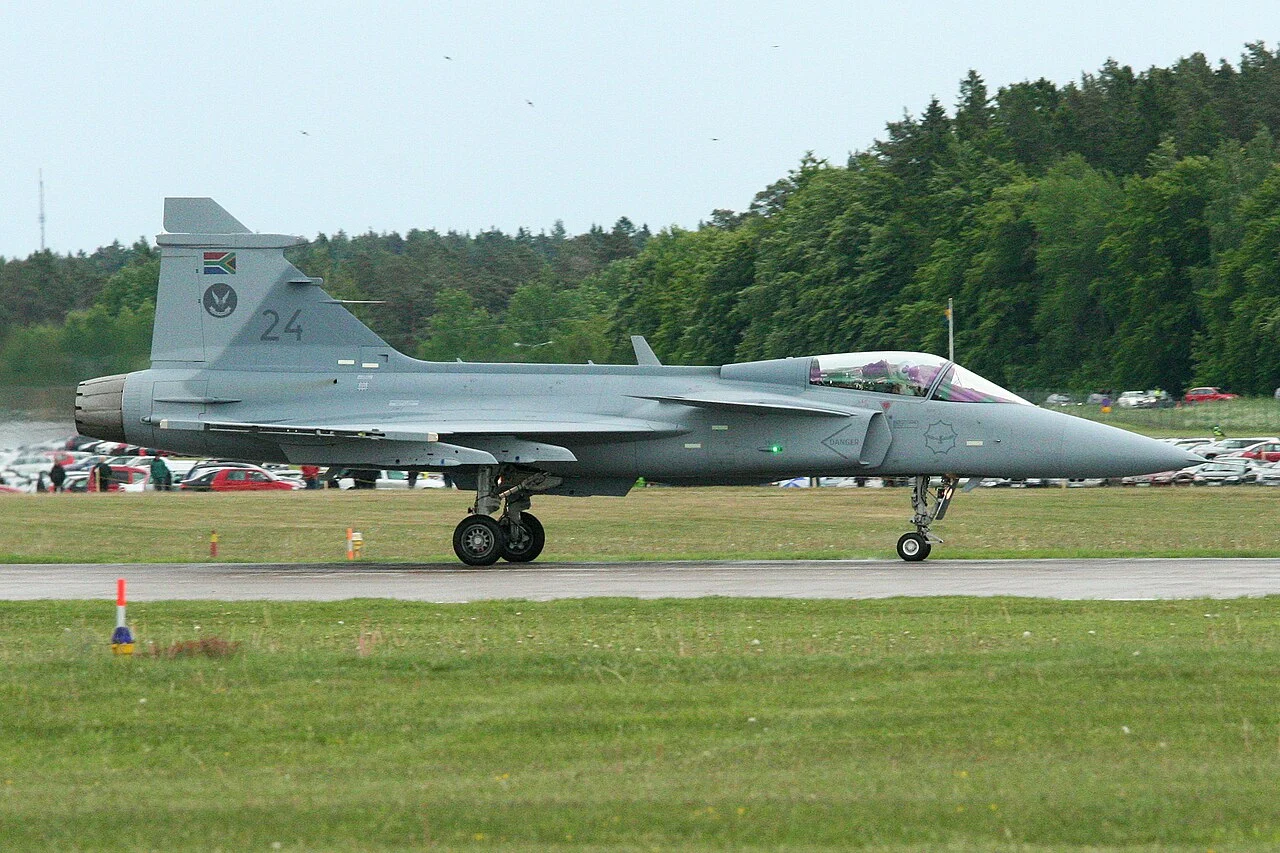
The Gripen is operational with the SAAF, delivered in full by 2012, though as DefenceMENA has reported, actual availability has fallen far short of the fleet’s paper strength in recent years.
What capabilities remain unchanged?
Both types were, and remain, single-engine, single-source fighters flown from the same main operating bases, now centred on 2 Squadron. Neither the Cheetah nor the Gripen has been used in combat; South Africa’s air force has not fought an air war since the Cheetah’s predecessor, the Mirage III, flew over Angola in the 1970s-80s. The dependency that defined the Cheetah era, on a single foreign or quasi-foreign source for spares and support, has resurfaced with the Gripen: where the Cheetah’s vulnerability was the arms embargo, the Gripen’s has been lapsed through-life support contracts with Saab, which DefenceMENA’s 2026 reporting ties directly to the fleet’s readiness collapse. Fleet size has also stayed in the same broad band, in the 20s rather than the squadrons of 50-plus aircraft the SAAF fielded at the height of the Cheetah programme.
Why it matters for Africa
The Cheetah-to-Gripen transition is one of the continent’s clearest cases of a capability upgrade that did not translate into sustained operational capacity. South Africa gained a far more capable, NATO-interoperable fighter, with a modern radar, beyond-visual-range missiles and networked avionics the Cheetah could never have carried. But the same industrial base that once kept the embargoed Cheetah flying through local rebuilds has not kept the Gripen flying through ordinary peacetime sustainment, and the SAAF’s broader aircraft inventory shows similar readiness strain across other fleets. For other African air forces weighing a move from legacy Soviet- or Western-derived fighters to a modern type, the lesson is that the harder problem is usually not the acquisition contract but the decade-by-decade cost of keeping a smaller, more complex fleet flying without the kind of parallel local industrial capacity that Denel once provided for the Cheetah.
Sources
- South African Air Force Association, “End of the Runway for Cheetah Fighter Jets”
- FlightGlobal, “South Africa Fields First Gripen Fighter”
- Airforce Technology, “Cheetah Fighter” project profile
- Airforce Technology, “Gripen” project profile
- South African Air Force Association, Gripen aircraft page
- DefenceMENA, “How Many Gripens Does South Africa Have? (2026)”
- SIPRI Arms Transfers Database


