South Africa’s Defence Budget Grows on Paper, But Treasury Leaves the SANDF to Absorb Its Own Wage Bill



South Africa’s mid-term budget statement gives the SANDF a defence vote that looks bigger on paper, but most of the increase is money the department already earns itself, and Treasury has not addressed an overspend on soldiers’ salaries that is approaching R4 billion this year alone.
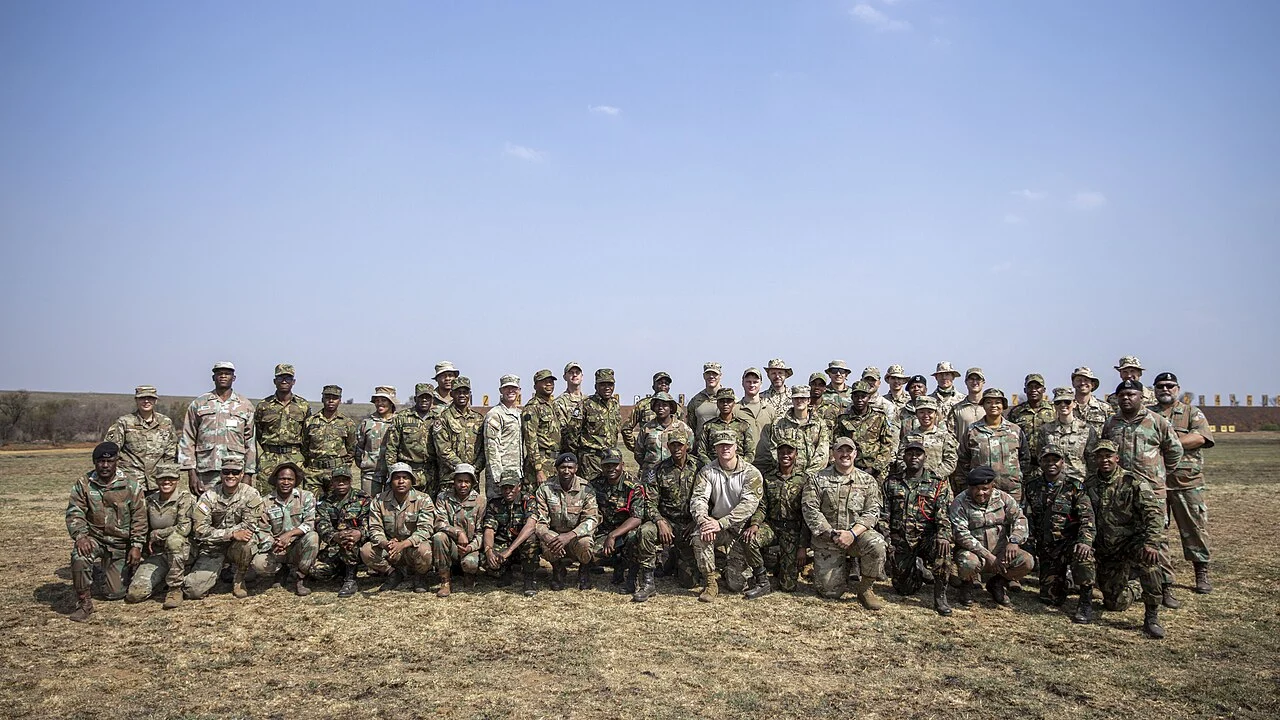
Photo: South African and New York National Guard teams compete at a SANDF Military Skills Competition in Potchefstroom. Credit: U.S. Army National Guard photo by Staff Sgt. Jonathan Pietrantoni, Public domain, via Wikimedia Commons
Finance Minister Enoch Godongwana’s medium-term budget policy statement (MTBPS), delivered to Parliament this week, was the government’s answer to a Defence and Military Veterans Committee request for urgent talks with Defence Minister Angie Motshekga on two problems: a persistent overspend on salaries and reported shortages of basic kit for soldiers on deployment. As defenceWeb reported on 29 October, citing an analysis by Chris Hattingh of the Centre for Risk Analysis published in The Daily Friend, the numbers in the statement suggest the committee’s concerns were heard but not funded.
What the budget actually shows
The Defence vote rises from R57.6 billion to R61.5 billion this year, a 6.7% increase on paper. But most of that growth is not new Treasury allocation. Around R2 billion of it is the department’s own income — largely reimbursements from the United Nations and the Southern African Development Community (SADC) for South Africa’s troop deployment to the Democratic Republic of Congo, plus equipment sales. A further R823 million is new funding specifically for soldiers supporting police operations against illegal mining and gang violence in five provinces, confirming an allocation DefenceMENA reported in late September when it first appeared in budget documents.
Strip out the self-generated income and the earmarked police-support money, and the vote is still about R0.9 billion below what the department actually spent last year (R62.3 billion in 2025/26).
The salary overspend Treasury did not fix
The sharpest number in the statement concerns personnel costs. The SANDF’s salary budget for this year is R37.8 billion, but the department spent R40.4 billion on salaries in 2025/26. By September, the analysis found, the department had already used 55% of this year’s salary allocation — a pace that implies an overspend of roughly R3.8 billion by year-end if nothing changes. That is the exact problem the parliamentary committee asked Motshekga and Treasury to resolve, and the MTBPS leaves it unaddressed: no new money is allocated to close the gap, and no costed plan to bring the wage bill back in line with the budget was presented alongside the statement.
The strain is not new. South Africa’s defence budget has been squeezed for years by a personnel bill that consumes the large majority of available funds, leaving little for equipment, spares, fuel and flying hours — the “hollowing out” that defence analysts and the SANDF’s own reviews have flagged since well before this budget cycle.
Readiness numbers tell the same story
The Hattingh analysis points to the South African Air Force’s flying-hour statistics as evidence of the squeeze reaching operational units. The SAAF flew 52.8% of its targeted hours in 2025/26 — 6,340 of a planned 12,000 — which the department’s own annual report attributes to late maintenance contracts and insufficient funding for flying programmes. South Africa’s combat fleet, a small number of Saab Gripen fighters, has for several years had only a fraction of its aircraft combat-ready at any given time, a problem DefenceMENA detailed earlier this year; flat or declining flying hours make it harder to reverse that trend regardless of how many airframes are nominally in the fleet.
A multi-year squeeze, not a one-year problem
Looking beyond this year, the broader defence and state security budget function is projected to grow from R62.4 billion to R65.5 billion by 2029/30 — about 1.6% a year on average, and with a dip to R61.3 billion in 2027/28. Against Treasury’s own inflation forecasts of 3.1% to 3.8% a year, the analysis estimates that the 2029/30 budget will buy roughly 5% less in real terms than today’s already-constrained one. Debt service costs, by contrast, will consume R441.5 billion this year alone; defence receives the equivalent of about R168 million a day.
The analysis also draws a contrast with state guarantees issued elsewhere in the same budget: South African Airways (R1 billion), the Land Bank (R10 billion), Ithala (R2.2 billion) and the state-owned defence and technology group Denel (R889 million) received new guarantees totalling roughly R13.2 billion — about sixteen times the R823 million earmarked for the SANDF’s domestic deployment this year. Denel itself has now logged nine consecutive years of audit disclaimers, even as the state continues to backstop it financially, a pattern DefenceMENA has tracked alongside the broader South African defence-industrial base’s efforts to grow exports past R10 billion a year through state procurement agency Armscor’s programmes.
Why it matters for Africa
South Africa fields one of the continent’s most capable, if constrained, conventional militaries, and it is currently the lead contributor to SADC’s mission supporting Mozambique and has troops committed to peace enforcement in the DRC through SAMIDRC. A defence budget that cannot cover its own wage bill has direct consequences for those deployments: less money for spares, ammunition, vehicle maintenance and flying hours translates into readiness gaps that show up first in exactly the kind of expeditionary operations South Africa has pledged troops to across the region. It also raises the stakes for Armscor and Denel’s push to rebuild the local defence-industrial base through exports, since a defence ministry that cannot fund its own force structure is a weaker anchor customer for the equipment that industry needs to sell both at home and abroad.
Sources
- defenceWeb: “Treasury tells the SANDF to make do,” 29 October 2026
- defenceWeb: coverage of the MTBPS and Operation Prosper allocation