The UAE walked away from a $23 billion deal for 50 F-35s rather than accept the conditions attached to it, then built EDGE Group into a $20 billion order-backlog defence conglomerate. Neither move means Abu Dhabi has cut the cord to its foreign suppliers — it means the cord now has more knots in it.
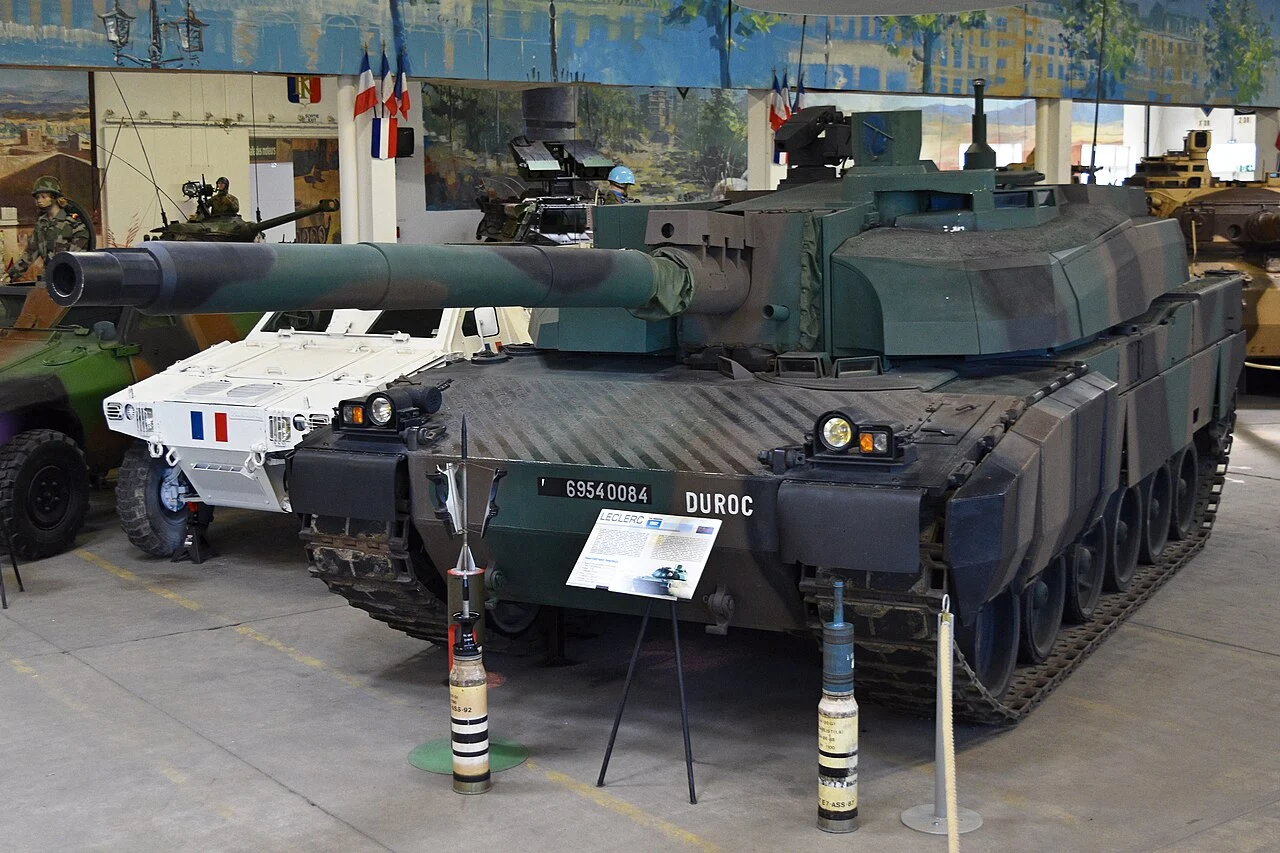
Photo: A French-built Leclerc Main Battle Tank, the same type operated by the UAE armed forces, on display at the Musée des Blindés, Saumur. Credit: Alan Wilson, CC BY-SA 2.0, via Wikimedia Commons
Key points
- The UAE suspended F-35 negotiations itself in 2021 over sovereignty and technology-access terms, and as of 2026 its own officials say the talks are not being reopened — a rare case of a MENA buyer walking away from a US platform rather than the reverse.
- EDGE Group, formed in 2019 from 25 state entities, now reports over 80% of its systems made locally and a $20.4 billion order backlog, but its flagship programmes still run on licensed foreign technology: Korean missile designs, French tank hulls, Italian propulsion.
- Washington approved a $4.5 billion THAAD radar upgrade and a $1.32 billion CH-47F Chinook sale in 2025-2026, showing the US relationship keeps deepening in parallel with the F-35 freeze.
- UAE-supplied Chinese-made munitions have been documented in Sudan despite a UN arms embargo on Darfur, an episode that sits in the political-dependence column for very different reasons than CAATSA.
- Every major UAE platform — F-16 Block 60/61, Mirage 2000-9, Leclerc, THAAD, Patriot — depends on a single foreign OEM for software, engines or munitions resupply that no local programme yet replaces.
A buyer with more leverage than most of its neighbours
The United Arab Emirates ranked among the world’s ten largest arms importers through the early 2020s, with the United States supplying roughly 64% of its purchases and France around 10% in the most recent full SIPRI accounting period, a concentration that has only partly loosened since (DefenceTalk/SIPRI, Dec 2025). South Korea, Russia (legacy systems only) and, increasingly, domestic EDGE Group output fill the remainder. That supplier list looks diversified on paper. The dependency structure underneath it is not: almost every major UAE platform still needs one specific foreign company to keep flying, shooting or sailing.
What sets the UAE apart from Saudi Arabia or Egypt in this series is not the supplier list but the posture. Abu Dhabi has shown it will suspend a marquee US deal on its own terms when the conditions do not suit it, while simultaneously building the Gulf’s most capitalised indigenous defence conglomerate. That combination of financial weight, political confidence and still-heavy platform dependence is the subject of this analysis.
| Capability | Main supplier | Dependency level | Main risk | Alternative |
|---|---|---|---|---|
| Fighter aircraft (F-16 Block 60/61) | United States (Lockheed Martin, GE engines) | High | ITAR software locks, FMS/DCS licensing, no F-35 follow-on contracted | Mirage 2000-9 (France), Korean KF-21 interest, none yet fifth-generation |
| Fighter aircraft (Mirage 2000-9) | France (Dassault, Thales, Safran) | Medium-High | Single-OEM engine/radar/weapons ecosystem, ageing airframe | Further F-16 orders, longer-term Korean or European jets |
| Air defence (THAAD/Patriot) | United States (Lockheed Martin, Raytheon) | High | Interceptor stock replenishment, radar/software control, FMS case timelines | Korean L-SAM/M-SAM (EDGE-Hanwha), Pantsir-S1 for short-range only |
| Tanks/armour (Leclerc) | France (KNDS France) | Medium-High | Sole-source spares and ammunition for an orphan fleet outside France’s own army standard | Local BHE/EDGE maintenance under tech transfer, no alternative MBT supplier contracted |
| Helicopters (CH-47F, AH-64) | United States (Boeing) | High | FMS licensing, spares pipeline, training dependency | French/Korean rotary options exist but none operational in UAE service |
| Naval systems (Baynunah, Falaj) | France (CMN design origin) / Italy (Fincantieri) / local ADSB build | Medium | Combat-management software and some propulsion still foreign-sourced | ADSB has absorbed more hull and systems-integration work over time |
| UAVs and loitering munitions | EDGE Group (domestic) with imported components | Low-Medium | Engines, optics and some guidance components still imported | Genuinely the UAE’s strongest diversification case |
| Missiles/munitions | Mixed: US (PAC-3, JDAM-class), South Korea (L-SAM/M-SAM), EDGE (precision-guided air-to-surface) | Medium-High | Stock replenishment timelines, export-licence renewal per batch | EDGE’s own PGM lines reduce but do not eliminate import need |
Dependency levels are DefenceMENA’s editorial assessment based on the sources listed below, not an official rating.
Dependence by category: not one number, seven
Platform. The UAE Air Force operates roughly 80 F-16E/F Block 60 “Desert Falcons” — the most heavily customised F-16 variant ever exported — plus about 30 more Block 61s UAE has separately pursued as a direct commercial sale with Lockheed Martin, alongside a smaller Mirage 2000-9 fleet upgraded by Dassault under a November 2019 contract worth roughly $490 million (AIN Online; FlightGlobal). DefenceMENA’s full account of France’s arms deals with the UAE covers that upgrade alongside the Rafale, Leclerc and naval programmes. Both fleets are delivered, operational types; no fifth-generation jet is currently contracted.
Engine. F-16 engines are US General Electric F110s maintained under FMS sustainment cases; the Mirage 2000-9’s Snecma M53 engines are now supported by a dedicated Safran Aircraft Engines/Global Aerospace Logistics (GAL) partnership announced at IDEX 2025, under which the French OEM and the UAE-based MRO firm jointly manage the entire engine fleet’s “operational readiness and sustained performance” (Safran Group, Feb 2025). That arrangement illustrates the model the UAE increasingly prefers: keep a foreign OEM in the loop for engineering authority, but localise the depot-level work through a joint venture rather than ship the engine abroad.
Weapons. Precision munitions for the F-16 and Mirage fleets remain almost entirely US- and French-sourced (JDAM-class kits, MBDA air-to-air and air-to-ground weapons under a AED93 million Mirage-related contract) (Defense News). EDGE Group’s own precision-guided air-to-surface munitions lines are real but still a minority share of the inventory.
Sensor. Radar and electronic-warfare suites on the F-16 Block 60 (APG-80 AESA) and the upgraded Mirage 2000-9 (Thales RDY-3) are foreign-designed and foreign-maintained; a AED232 million Thales maintenance-and-spares contract covers the Mirage fleet specifically (Defense News).
Software. Mission computers, data links and avionics source code on US-origin platforms remain under ITAR control, meaning integration of non-US weapons or sensors onto the F-16 fleet requires Washington’s sign-off — the same structural constraint documented for Egypt and Saudi Arabia elsewhere in this series.
Maintenance. This is where the UAE has made its most concrete progress. Global Aerospace Logistics (GAL), an EDGE Group subsidiary, now holds joint sustainment roles across the Mirage 2000 engine fleet (with Safran) and broader regional MRO contracts; KNDS France has partnered with the Emirati firm BHE (Bin Hilal Enterprises) to perform “all maintenance and modernisation activities” on the Leclerc fleet locally, with technology transfer drawing on more than 40 years of former GIAT/Nexter expertise, under KNDS France’s continued technical supervision (KNDS France).
Political. Every US case above runs through DSCA notification, Congressional review and end-use monitoring; French cases carry their own export-licence regime. The F-35 episode is the clearest illustration: Washington conditioned the sale on the UAE curbing Huawei 5G infrastructure near future F-35 bases, and Abu Dhabi judged the sovereignty cost too high (Washington Institute).
Industrial. EDGE Group, formed in 2019 by consolidating 25 state-owned entities including NIMR Automotive, reported AED596 million in local “in-country value” added in 2025 and said over 80% of its systems are now produced domestically, with new orders of $7.96 billion taking its backlog to $20.4 billion (WAM, 2026). That is a genuinely large industrial base by regional standards — but “systems produced locally” covers assembly and integration of many imported subcomponents, not full-stack indigenous design.
Sanction and export-control exposure
The UAE carries three distinct and largely unrelated risk threads, which should not be collapsed into one:
CAATSA/Russia. The UAE’s Russian-origin inventory is legacy and limited — Pantsir-S1 short-range air defence ordered in 2000 is the most significant holdover — and Abu Dhabi has not pursued major new Russian platforms since, unlike Algeria or Egypt’s now-abandoned Su-35 case. CAATSA exposure here is latent rather than active.
ITAR/US technology security. This is the live issue. The 2021 F-35/MQ-9 package (reported at roughly $23 billion including 50 F-35s and MQ-9B drones) was suspended by the UAE itself in December 2021 after Washington pressed Abu Dhabi to restrict Huawei 5G equipment near future F-35 operating areas, among other conditions US officials described as addressing “sovereign operational restrictions” (FlyingMag). As of 2026, a senior UAE official stated the country does “not plan to re-open” F-35 talks regardless of the outcome of US domestic politics, calling the original technical and sovereignty concerns unchanged (Jerusalem Post). This makes the UAE case distinct from every other MENA F-35 discussion in this series: it is not Washington withholding the jet, but Abu Dhabi declining the terms attached to it.
End-use and re-export concerns, third countries. A May 2025 Amnesty International investigation documented Chinese-manufactured GB50A precision-guided bombs and AH-4 155mm howitzers in use by Sudan’s Rapid Support Forces, which Amnesty assessed were “likely” supplied via the UAE in what it characterised as a breach of the UN arms embargo on Darfur — a claim the UAE has disputed (Amnesty International, May 2025). US congressional hearings in 2026 referenced continued concern over third-country weapons flows into Sudan (Sudan Tribune). This is a genuinely different risk category from CAATSA or ITAR: it concerns UAE re-export and end-use practices rather than UAE import dependence, but it shapes how Western legislators view future UAE arms requests and is relevant to any reader assessing the UAE’s export-control standing.
Local industry and what it can take over
EDGE Group is the UAE’s central industrial vehicle, and on paper it is the most capitalised defence conglomerate in the Gulf: a $20.4 billion order backlog, over 80% locally produced systems by its own count, and 68 “Industry 4.0” manufacturing-transformation projects completed in 2025 alone (WAM). Its NIMR Automotive subsidiary builds armoured vehicles under full UAE control; its naval arm has absorbed more combat-system integration work over successive Baynunah and Falaj-class patrol vessel and corvette programmes built at Abu Dhabi Ship Building, which in 2021 won its largest-ever order, a $982 million contract for four Falaj-3 offshore patrol vessels (Breaking Defense).
What EDGE cannot yet take over is harder-edged. Its 2025 agreement with South Korea’s Hanwha to cooperate on an integrated air-defence system — covering the L-SAM long-range interceptor, additional M-SAM capability and the Chunmoo rocket system, with a joint venture and “phased localisation” explicitly still being negotiated — shows that even EDGE’s most ambitious air-defence ambitions currently run through a foreign design house, not an indigenous one (Trade Arabia). Likewise, the Leclerc maintenance transfer to BHE is real and substantial — more than 400 skilled jobs, four decades of GIAT/Nexter know-how transferred — but it remains maintenance and modernisation under KNDS France’s supervision, not an indigenous main battle tank programme (KNDS France).
Alternatives
For the US-dependent fighter fleet, the realistic alternatives are narrow. A further Mirage 2000 or Rafale order from France would deepen rather than reduce foreign dependence, simply shifting it from Washington to Paris; South Korea’s KF-21 has drawn UAE interest in principle but is not contracted and would require building an entirely new sustainment ecosystem from scratch. For air defence, EDGE’s Hanwha partnership offers a genuine Korean-sourced alternative to further THAAD/Patriot purchases, but it remains at the cooperation-agreement stage rather than delivered hardware. For armour, no alternative main battle tank supplier is under discussion; the Leclerc fleet’s logic is to extend its life through local maintenance rather than replace it. For precision munitions, EDGE’s own air-to-surface lines are the most credible domestic alternative, though they do not yet cover the full range of weapons the F-16 and Mirage fleets require.
Switching cost
The UAE’s own F-35 decision is itself a switching-cost case study: having built doctrine, basing and training plans around an eventual fifth-generation US jet, Abu Dhabi chose to absorb the sunk cost of years of negotiation rather than accept conditions it judged too restrictive — and has shown no sign of replacing that gap with a different fifth-generation type. More broadly, switching any of the UAE’s anchor platforms away from their current OEMs would mean retraining pilots and technicians, rebuilding parts inventories, re-certifying munitions compatibility, and in some cases reworking base infrastructure built around a specific aircraft’s logistics footprint. The Mirage 2000-9 upgrade programme itself illustrates the alternative path the UAE generally prefers: rather than replace an ageing but paid-for fleet, it re-invests in deeper, longer OEM partnerships (Dassault, Thales, Safran/GAL) to extend the platform’s service life, accepting continued foreign dependence as the lower-cost option against a clean-sheet replacement.
Diversification: what it solved, and what it complicated
The UAE’s diversification strategy differs from Egypt’s multi-bloc balancing act covered elsewhere in this series. Rather than spreading platforms evenly across US, European, Russian and Chinese suppliers, Abu Dhabi has concentrated on building one very large domestic industrial group (EDGE) while keeping its core platforms Western — and using the one marquee decision it could make unilaterally, the F-35 suspension, as a demonstration of strategic autonomy. This has reduced political dependence in a narrow but visible sense: the UAE is not waiting on Washington for a deal it has already declined. It has not reduced platform or software dependence on the aircraft, tanks and air-defence systems already in service, all of which remain tied to their original OEMs for parts, software updates and weapons integration. The EDGE-Hanwha missile-defence cooperation adds a second logistics chain (Korean) to the first (American), which strengthens the UAE’s negotiating position but, if it matures into fielded systems, will also mean maintaining two separate air-defence ecosystems rather than one.
DefenceMENA Autonomy Index: United Arab Emirates
| Criterion (weight) | Score | Justification |
|---|---|---|
| Domestic manufacturing (20) | 12/20 | EDGE Group’s >80% local-production claim is real for vehicles, naval hulls and small arms, but critical combat aircraft, tanks and air-defence interceptors are not manufactured domestically. |
| Local maintenance (15) | 9/15 | Strong and growing: GAL/Safran Mirage engine partnership, KNDS/BHE Leclerc maintenance transfer, ADSB naval sustainment — but all under continued foreign OEM technical authority. |
| Local ammunition (15) | 6/15 | EDGE produces some precision-guided munitions domestically; the bulk of air-to-air and air-to-ground stocks for F-16/Mirage fleets remain US/French-sourced. |
| Supplier diversification (15) | 9/15 | Concentrated on US and France for platforms; South Korea (Hanwha) is a newer, not-yet-fielded third leg; limited by the UAE’s own F-35 refusal rather than externally imposed. |
| Critical components (15) | 5/15 | Engines (GE, Safran), AESA/RDY radars, and mission software remain entirely foreign-sourced across every major platform. |
| Technology transfer (10) | 7/10 | Above-average for the region: KNDS/BHE and Safran/GAL arrangements involve genuine depot-level technology transfer, not just licensed assembly. |
| Export-control exposure (10) | 6/10 | Low CAATSA exposure, but real and distinct ITAR/technology-security friction (F-35/Huawei) and separate end-use/re-export scrutiny over third-country transfers (Sudan). |
| Total | 54/100 |
DefenceMENA editorial analytical index, not an official ranking.
Why it matters for the MENA region
The UAE is the test case for whether a Gulf state can convert financial weight into genuine negotiating leverage over a superpower supplier — and the F-35 episode suggests it can, at least on the narrow question of walking away from a deal. But walking away from a future purchase is a different kind of autonomy from reducing dependence on platforms already in service, and on that second measure the UAE looks similar to its neighbours: every fast jet, tank and air-defence battery in its inventory still needs a specific foreign company for engines, software or munitions resupply. EDGE Group’s scale gives Abu Dhabi more room to localise maintenance and production over time than most MENA states have, and its Korean outreach shows a credible route to a genuine third supplier bloc. Whether that converts into reduced platform dependence, rather than simply a bigger and more diverse set of foreign partners, will be the question to track as the Hanwha cooperation and EDGE’s own weapons lines mature.
Sources
- DefenceTalk/SIPRI data summary, Dec 2025
- WAM (Emirates News Agency), EDGE Group manufacturing progress, 2026
- FlyingMag, UAE suspends F-35 talks, 2021
- The Jerusalem Post, UAE does not plan to re-open F-35 talks, 2026
- The Washington Institute, Unpacking UAE F-35 Negotiations
- Safran Group press release, Mirage 2000 engine support partnership, Feb 2025
- AIN Online, UAE Mirage 2000-9 upgrade
- Defense News, Mirage 2000-9 upgrade contract details
- KNDS France, 30 years of expertise for the Emirates Armed Forces, 2025
- Trade Arabia, EDGE-Hanwha cooperation agreement
- Breaking Defense, ADSB Falaj-3 patrol vessel contract, 2021
- Amnesty International, Sudan weapons investigation, May 2025
- Sudan Tribune, Congressional hearing coverage, Sep 2026
- DSCA, UAE F-16 Sustainment notification, May 2025