Is Oman’s Small Military Too Dependent on Just a Few Suppliers?



Oman fields one of the Gulf’s smallest militaries, built almost entirely on British, American and, increasingly, Turkish equipment, and it sits astride the Strait of Hormuz. Its supplier list is short enough that a single licensing decision in London or Washington can shape how it keeps its own jets flying.
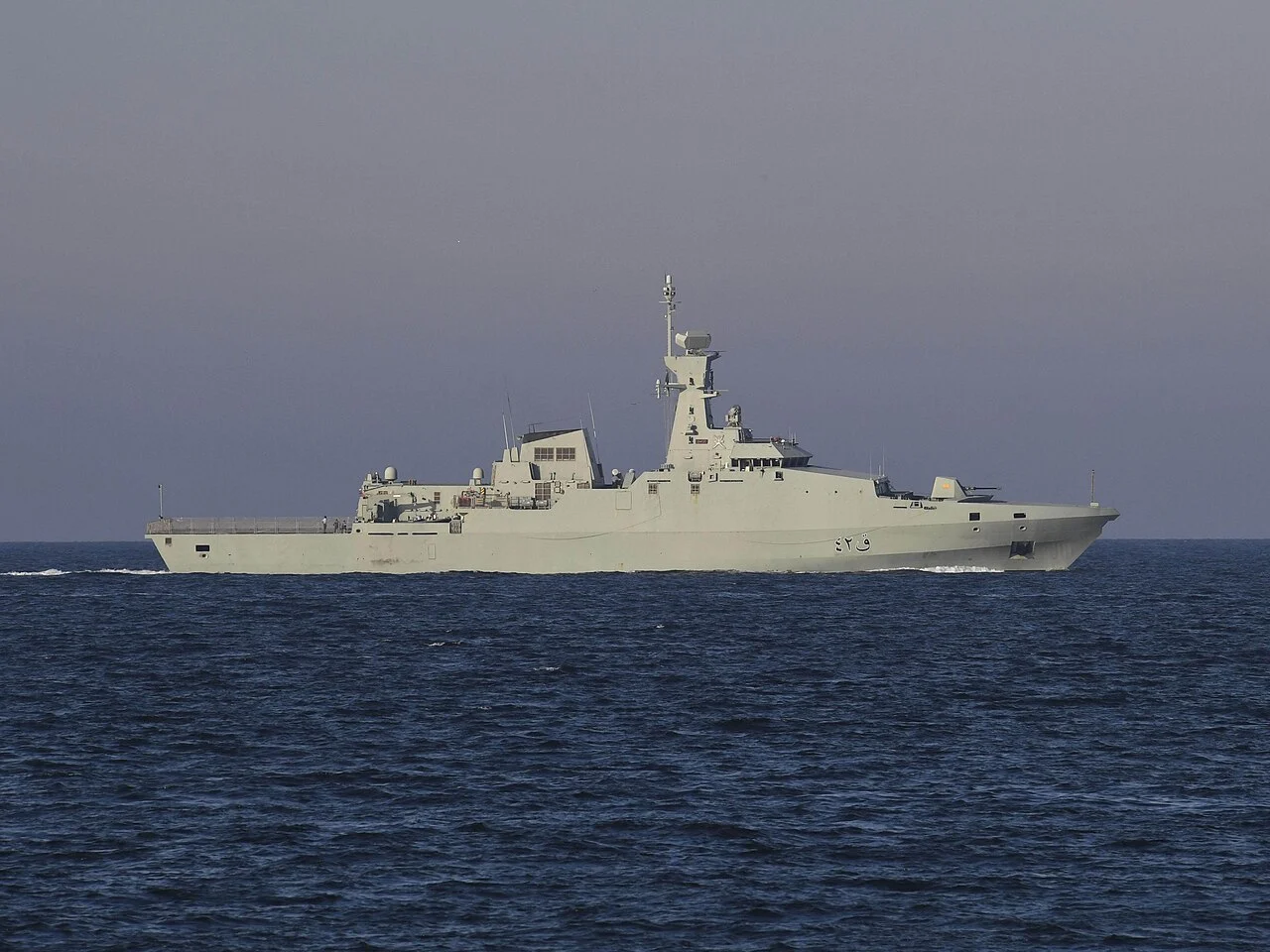
Photo: The Royal Navy of Oman Khareef-class corvette Al-Rasikh, built by BAE Systems in the United Kingdom, during a multilateral exercise in the Arabian Gulf, 6 February 2018. Credit: U.S. Navy photo by MC2 Kevin J. Steinberg, public domain, via Wikimedia Commons.
Key points
- Oman’s entire combat-aircraft fleet — 12 Eurofighter Typhoons and roughly two dozen F-16C/Ds — runs through two separate export-licensing regimes: a UK General Export Licence that restricts Typhoon-related goods for Oman to maintenance use, and US Foreign Military Sales rules that gate F-16 spares, software and munitions.
- Oman carries no meaningful CAATSA exposure: it holds no significant Russian or Chinese major platforms, the cleanest sanctions picture of any country covered so far in this series.
- Local industry is narrow and recent: a 2015 small-arms ammunition plant and a 2022 depot-level maintenance facility for Turkish-built army vehicles are, in practice, the country’s only genuine local production and sustainment nodes.
- A September 2026 US approval for F-16 sustainment and a June 2026 technology-transfer deal with a European ammunition maker both arrived the same year Iranian strikes hit Omani ports, underlining how little slack the supply chain has.
- Oman has added Turkish, Singaporean, Thai and Norwegian suppliers alongside its traditional British and American ones, but diversification has mostly added new logistics lines rather than reducing dependence on the US and UK for its frontline combat aircraft.
A small force with a short supplier list
Oman’s armed forces are built for a narrow set of jobs: securing the approaches to the Strait of Hormuz, policing a long and mostly empty coastline, and maintaining enough of a conventional deterrent to be taken seriously by larger neighbours. The air force numbers under 40 combat aircraft, the army fields fewer than 300 tanks and the navy has never operated more than a handful of corvette-sized surface combatants. That smallness changes how dependency works here: Oman is not juggling seven suppliers across a dozen large platform families the way Egypt is, nor is it operating three incompatible fighter types simultaneously the way Qatar does. It is relying on two or three governments for almost everything that flies or shoots, which concentrates risk even as it keeps the logistics simpler.
The core of the air force is British and American. The Royal Air Force of Oman (RAFO) operates 12 Eurofighter Typhoons delivered under a roughly £2.5 billion, 2012 contract with BAE Systems that also covered eight BAE Hawk Mk166/203 advanced jet trainers, with deliveries running from 2016 into 2017 (FlightGlobal; Quwa). Alongside the Typhoons sit roughly two dozen F-16C/D Block 50s, the first 12 delivered from 2005 and a further 12 ordered in December 2011 under a separate US Foreign Military Sales case, with deliveries from 2014 (F-16.net). In September 2026 the US State Department approved a further $188 million F-16 sustainment package covering spares, software support and ground-handling equipment — a routine-sounding notification that nonetheless confirms how much of the fleet’s day-to-day serviceability still runs through Washington (The Defense Post).
On the ground, the army’s heaviest armour is still the British Challenger 2, 38 of which arrived between 1993 and 2001, backed by older American M60A1/A3 tanks bought in the 1980s and 1990s (Army Technology). The more modern part of the land force is Turkish: 172 FNSS PARS III 6×6 and 8×8 wheeled armoured vehicles, ordered in a roughly $500 million 2015 contract and delivered in full by 2020 (Quwa). At sea, three BAE-built Khareef-class corvettes, delivered under a 2007 contract worth about £400 million, form the backbone of the Royal Navy of Oman’s combat capability, supported by four Al-Ofouq-class patrol vessels built by Singapore’s ST Marine and fitted with a Thales combat-management system, Thales Variant surveillance radar and Thales STIR electro-optical tracker — a reminder that even a “Singaporean” hull carries French sensors (Shephard Media). A December 2024 contract with Thailand’s Marsun for four landing craft, described by the ministry of defence as including a localisation component, points toward a widening but still shallow pool of naval suppliers (Naval News).
No comprehensive, Oman-specific 2021–2025 SIPRI supplier-share breakdown was available ahead of publication; Oman does not appear in SIPRI’s published top-10 lists of global arms importers for the period, which instead feature larger Gulf states such as Saudi Arabia and Qatar, consistent with the small absolute size of Oman’s purchases (The Week, citing SIPRI).
| Capability | Main supplier | Dependency level | Main risk | Alternative |
|---|---|---|---|---|
| Fighter aircraft | United Kingdom (Typhoon), United States (F-16) | High | UK maintenance-only export licence; US FMS/ITAR conditionality on spares and software | No contracted alternative; expansion of existing types more likely than a new supplier |
| Air defence | United States/Norway (NASAMS — Raytheon/Kongsberg) | Medium-High | Single mid-range system family; missiles and software under US export control | South Korean Cheongung-II or European systems theoretically available, none contracted |
| Tanks/armour | United Kingdom (Challenger 2), Turkiye (FNSS PARS III) | Medium | Ageing Challenger 2 fleet with no confirmed upgrade contract; PARS fleet reliant on FNSS for spares | Possible future Challenger upgrade via UK’s RBSL, or further Turkish/Asian armour |
| Helicopters | Multinational (NH90 — France/Italy/Netherlands), United States (Bell), United Kingdom-origin (Super Lynx) | Medium | NH90 sustainment runs through a four-nation industrial consortium, not a single OEM | Already diversified across three supplier blocs; limited need to add more |
| Naval systems | United Kingdom (BAE, Khareef class), Singapore/France (ST Marine hulls, Thales sensors), Thailand (Marsun, prospective) | High | A tiny fleet spread across four shipbuilding countries and at least two sensor suppliers | Marsun partnership suggests a shift toward Asian yards; no indigenous shipbuilder yet |
| UAVs | Unclear/mixed — reported US (Insitu ScanEagle-linked contracts) and South Korean (Gryphon) types | Low-Medium (data limited) | Open-source reporting on exact types and numbers is thin and partly unconfirmed | Insufficient public information to assess |
| Missiles/munitions | United States (JSOW, TOW), Norway/US (NASAMS missiles) | High | Guided munitions entirely imported; domestic production limited to small-arms ammunition | 2026 MoU with Czech/Slovak maker MSM Group for medium/heavy-calibre technology transfer, unproven |
Dependency levels are DefenceMENA’s editorial assessment based on the sources listed below, not an official rating.
Dependence by category
Platform: concentrated in two Western types for fast jets (Typhoon, F-16) and one Turkish family for wheeled armour (PARS III), with the Challenger 2 and M60 tank fleets now dated. Engine: Eurojet EJ200 (four-nation European consortium) for Typhoon and Pratt & Whitney/General Electric for the F-16 fleet — neither built or overhauled in Oman. Weapons: guided air-to-ground munitions (JSOW), anti-tank missiles (TOW) and NASAMS interceptors are all US- or Norwegian-sourced; only small-arms ammunition is made domestically. Sensor: the Al-Ofouq patrol vessels’ Thales radar and electro-optical suite, and the Typhoon’s Captor radar (a four-nation European product), sit outside Omani control. Software: mission software for both the F-16 and Typhoon fleets is proprietary to the respective OEM consortia; Oman has no disclosed indigenous mission-software capability. Maintenance: the one clear exception is FNSS’s July 2022 depot-level maintenance and repair facility for the PARS III fleet in Oman, which also aims to build local spare-parts capacity — a genuine, if narrow, local-maintenance node (Army Technology). Political: every major F-16, JSOW and TOW transaction runs through the US Arms Export Control Act notification process, while Typhoon-related goods reaching Oman are governed by a UK Open General Export Licence reissued on 11 March 2026 that explicitly limits final exports to Oman (along with Kuwait, Qatar, Saudi Arabia and Türkiye) to maintenance use for the collaborative Typhoon programme (UK Government). Industrial: Oman Munition Production Company (OMPC), founded in 2014 and financed by the security and army pension funds rather than the state budget, makes 5.56mm, 7.62mm and 9mm small-arms ammunition; a June 2026 memorandum of understanding with the Czech/Slovak group MSM aims to extend this to medium- and heavy-calibre rounds through technology transfer, though no production has yet been reported (Aviation & Defence Universe).
Export-control exposure without CAATSA
Oman is the first country covered in this series with essentially no CAATSA-relevant exposure: open-source reporting turns up no significant Russian or Chinese major-platform acquisitions, and no joint exercises or procurement talks with Moscow or Beijing at a scale that would draw US sanctions scrutiny. That sets it apart from Algeria or Egypt, where a single Russian order created years of diplomatic friction.
What Oman does carry is a dense layer of allied export control. Every F-16 sustainment case, including the $188 million package approved in September 2026, is notified to the US Congress under the Arms Export Control Act and subject to end-use monitoring once delivered (The Defense Post). The 48 AGM-154C JSOW stand-off weapons notified in November 2022, worth an estimated $385 million, and a 2024 Federal Register notice covering 301 TOW 2B missiles both carry the same conditions: Oman can operate the munitions, but cannot modify, re-export or reverse-engineer them without US approval (The Defense Post; Federal Register). On the British side, the Typhoon-specific Open General Export Licence is narrower still: it permits UK and partner-nation firms to ship Typhoon-related collaborative-programme goods to Oman only for maintaining the aircraft already in service, not for new production or capability upgrades, which require a separate, case-by-case licence (UK Government). In practice this means two of Oman’s three fast-jet types are kept flying under licences that a change of policy in London or Washington could narrow at any time — a political dependency that long predates, and is unrelated to, CAATSA.
What local industry can take over
Two concrete nodes exist, and both are narrow by design. OMPC’s small-arms ammunition line, running since 2016, covers the calibres used by Oman’s own infantry and security forces but nothing larger; the 2026 MSM Group MoU is a first step toward medium- and heavy-calibre production, still at the memorandum stage with no confirmed output (Aviation & Defence Universe). FNSS’s 2022 depot-level facility for the PARS III fleet is the clearer technology-transfer success: a 20-year logistics-support agreement tied to the original 2015 vehicle contract, plus a dedicated repair facility built specifically to reduce round-trips to Turkey for major maintenance (Army Technology). Neither node touches the fast-jet fleet, the air-defence system or guided munitions, which remain entirely dependent on foreign sustainment.
Alternatives
For fighter aircraft, Oman has no contracted alternative to its UK and US types; a shift toward, say, Korean FA-50s or additional Typhoons from a different partner-nation production line would be technically possible but has not been reported as under negotiation. For air defence, South Korea’s Cheongung-II (already sold to the UAE and Iraq) and various European systems are plausible future options if Oman wanted to reduce reliance on a single mid-range US/Norwegian family, though nothing suggests this is imminent. For armour, continuing to rely on FNSS for PARS III sustainment is the practical path; replacing the ageing Challenger 2 fleet would most likely mean either a UK-sourced Challenger 3-style upgrade through RBSL or a wholly new tank purchase, neither confirmed. For munitions, the MSM Group technology-transfer track is the only visible diversification route, and it will take years, if it proceeds, to reach meaningful output. None of these is a near-term fix; each would require years of parallel qualification, training and spares build-up before it reduced Oman’s reliance on its current suppliers.
Switching cost
Oman’s switching costs are high relative to the size of its force precisely because that force is so small: there is no large domestic pilot or technician pool to redeploy across a new type, so introducing a different fighter, air-defence system or main battle tank means retraining a proportionally larger share of the entire force at once. Typhoon and F-16 pilots, maintainers and ground crews have been trained against UK and US syllabi for a decade or more; NASAMS crews are tied to Norwegian/American doctrine and data links; PARS III mechanics work to FNSS technical manuals. Switching any one of these means new simulators, new spare-parts warehousing, new munitions stockpiles compatible with new seekers and launchers, and new integration with existing command and sensor networks — costs that fall particularly hard on a military this size, where there is little redundancy to absorb a transition period.
Diversification: solving one problem, creating another
Oman’s gradual addition of Turkish armour, Singaporean and Thai shipbuilders, and Norwegian air-defence technology alongside its traditional British and American core has reduced the risk that any single relationship failure would ground the entire force. It has not meaningfully reduced political dependence on the US and UK, because the two suppliers that matter most — for fast jets and guided munitions — have not changed. What diversification has done is multiply the number of logistics chains, training pipelines and spare-parts systems a small defence ministry has to manage: PARS III parts from Turkey, NH90 support from a four-nation European consortium, Thales sensors routed through a Singaporean hull-builder, and now a prospective ammunition-technology partner in Central Europe. For a force this size, that administrative complexity is itself a cost, even where it buys some insurance against any one supplier’s political weather.
Autonomy Index
| Criterion | Weight | Score | Justification |
|---|---|---|---|
| Domestic manufacturing | 20 | 3 | No platform manufacturing; only small-arms ammunition produced domestically |
| Local maintenance | 15 | 4 | Genuine depot-level facility for PARS III only; fast jets, air defence and naval combat systems sustained abroad |
| Local ammunition | 15 | 3 | Small-arms self-sufficiency since 2016; medium/heavy-calibre still at MoU stage, unproven |
| Supplier diversification | 15 | 5 | Three core suppliers (UK, US, Türkiye) plus smaller Singaporean, Thai and Norwegian links; fewer than Egypt or Qatar |
| Critical components | 15 | 2 | Engines, radars, sensors and guided munitions almost entirely foreign-sourced |
| Technology transfer | 10 | 4 | FNSS’s 20-year logistics deal and depot facility, plus the 2026 MSM Group MoU, are real but limited examples |
| Export-control exposure | 10 | 4 | No CAATSA risk, but documented, binding US FMS/ITAR conditions and a UK maintenance-only Typhoon licence |
| Total | 100 | 25 |
DefenceMENA editorial analytical index, not an official ranking.
Why it matters for the MENA region
Oman is a reminder that dependency risk does not scale only with the size of a military’s shopping list. A small force concentrated on two or three suppliers can be just as exposed as a larger one spread across seven, because it has fewer pilots, technicians and spare airframes to cushion any disruption. Sitting on the Strait of Hormuz sharpens that exposure: Oman absorbed Iranian strikes on its own ports during 2026 while its frontline combat aircraft remained dependent on UK and US licensing systems for their day-to-day serviceability (see DefenceMENA’s companion profile, How Strong Is Oman’s Military?, on how the 2026 Iran war reached Omani territory). For a region where several smaller Gulf and Red Sea states face a similar arithmetic — limited budgets, limited personnel, and a handful of allied suppliers — Oman’s experience with narrow but genuine local-maintenance nodes, such as the Türkiye-linked FNSS depot facility, suggests that meaningful autonomy gains for smaller militaries are more likely to come from a few well-chosen sustainment partnerships than from attempts at broad domestic manufacturing. The same calculus applies to Oman‘s long-running relationship with the United Kingdom, which remains the single most consequential supplier the country has never formally diversified away from.
Sources
- FlightGlobal — Oman Typhoon order
- Quwa — Oman Typhoon deliveries
- F-16.net — Oman F-16 deliveries, 2014
- The Defense Post — US approves $188m F-16 sustainment for Oman, September 2026
- Army Technology — Challenger 2 main battle tank
- Quwa — FNSS delivers first batch of PARS III to Oman
- Army Technology — FNSS depot-level maintenance facility contract, Oman
- Shephard Media — ST Marine Al-Ofouq patrol vessel deliveries
- Naval News — Oman taps Marsun for landing craft, December 2024
- The Defense Post — US approves JSOW sale to Oman, November 2022
- Federal Register — Oman TOW 2B missile notification, August 2024
- UK Government — Open General Export Licence, Typhoon collaborative goods, March 2026
- Aviation & Defence Universe — OMPC-MSM Group MoU, June 2026
- The Week, citing SIPRI — Trends in International Arms Transfers, 2025
- Wikipedia — 2026 Iranian strikes on Oman (background/context)