F-16 Fighting Falcon: Specs, Variants and Who Flies It in the MENA Region



The F-16 Fighting Falcon is Lockheed Martin’s single-engine multirole fighter, in service with about 29 air forces and roughly 2,800 aircraft worldwide. The current production standard, Block 70/72, adds an AESA radar and a structural life of 12,000 flight hours; Bahrain, Slovakia, Bulgaria, Jordan and Morocco have ordered new-build Block 70/72 jets, and Bahrain’s has already flown combat missions. Nine Middle Eastern and three African air forces operate earlier F-16 blocks.
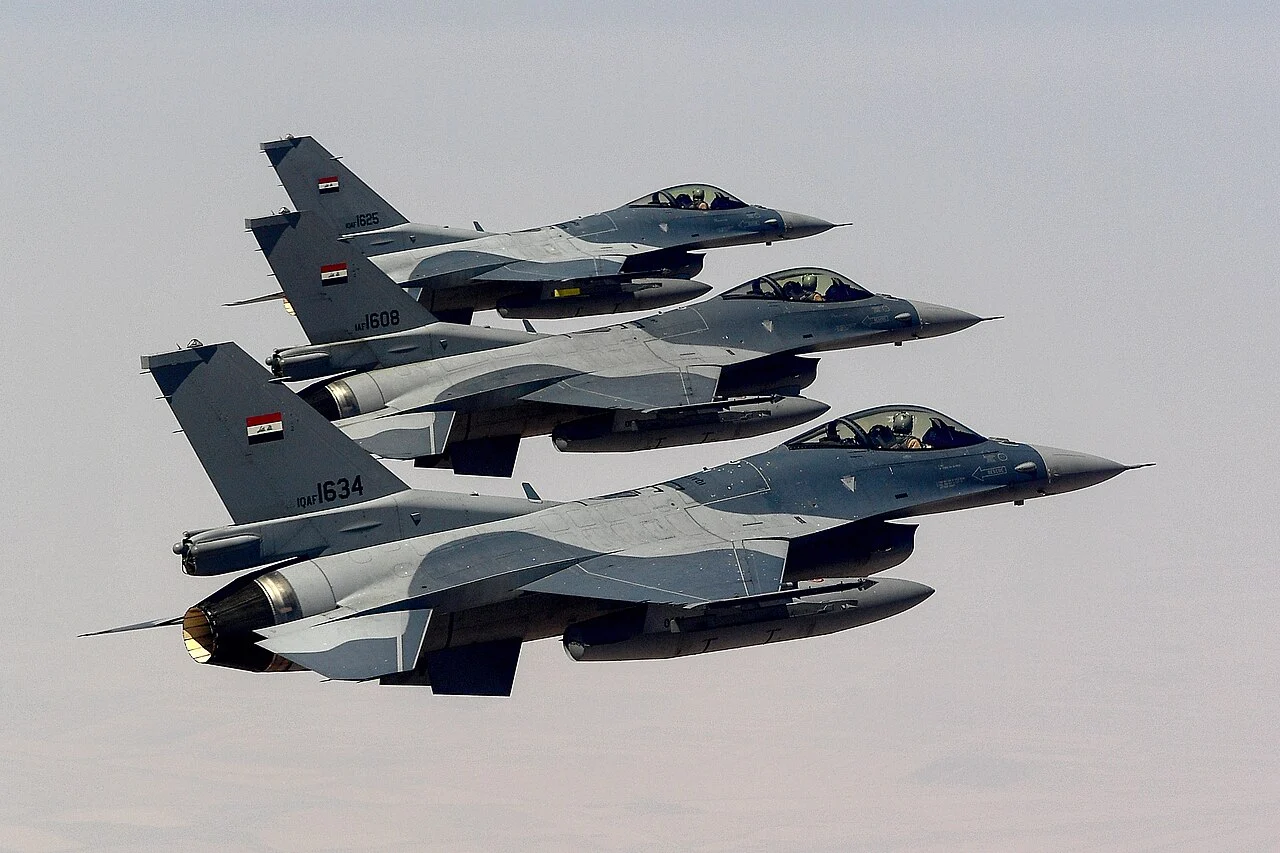
Photo: Three Iraqi Air Force F-16 Fighting Falcons fly in formation during a training sortie, 18 July 2019. Credit: Staff Sgt. Christopher Drzazgowski, U.S. Air Force, public domain, via Wikimedia Commons.
F-16 Fighting Falcon at a glance
- Maker: Lockheed Martin (originally General Dynamics; production transferred in the 1993 acquisition of GD’s aircraft division)
- Class: single-engine, single/twin-seat multirole fighter
- First flight: 1974 (YF-16 prototype)
- Current production standard: Block 70/72 (“F-16V”)
- Global fleet: about 2,800 aircraft, about 29 operating air forces (Lockheed Martin, Sep 2026)
- MENA/Africa operators: Morocco, Egypt, Jordan, Bahrain, Iraq, Oman, UAE (F-16E/F Desert Falcon)
- New Block 70/72 MENA customers: Bahrain, Jordan, Morocco
What is the F-16, and who builds it today?
The F-16 was designed by General Dynamics and first flew as the YF-16 prototype in 1974, entering US Air Force service in 1978 as a lightweight day fighter that grew into a multirole workhorse. Lockheed Martin became the manufacturer when it acquired General Dynamics’ Fort Worth aircraft division in 1993. Production of new-build F-16s today is the Block 70/72 standard, assembled at Lockheed Martin’s Greenville, South Carolina facility; Lockheed Martin describes the international fleet as able to operate to 2060 and beyond, and says it has certified more than 3,300 carriage and release configurations across more than 180 weapon and store types over 36-plus years of weapon integration work.
Specifications
No single Lockheed Martin spec sheet gives a complete current Block 70/72 dimensional table; dimensions below are the long-standing F-16C/D airframe figures common to the family, from a US Air National Guard fact sheet, while engine, radar and structural-life figures are Block 70/72-specific from Lockheed Martin’s own product page.
| Item | Figure | Source / note |
|---|---|---|
| Length | 14.8 m (49 ft 5 in) | US Air National Guard fact sheet (F-16C/D airframe) |
| Wingspan | 9.8 m (32 ft 8 in) | US Air National Guard fact sheet |
| Height | 4.8 m (16 ft) | US Air National Guard fact sheet |
| Maximum take-off weight | 16,875 kg (37,500 lb) | US Air National Guard fact sheet (F-16C/D); Block 70/72-specific figure not published |
| Maximum speed | Mach 2.05 at altitude | US Air National Guard fact sheet |
| Service ceiling | Above 15,000 m (50,000 ft) | US Air National Guard fact sheet |
| Engine (Block 70) | General Electric F110-GE-129, 29,000 lbf thrust | Lockheed Martin / engine-maker data |
| Engine (Block 72) | Pratt & Whitney F100-PW-229, 29,000 lbf thrust | Lockheed Martin / engine-maker data; same engine family as earlier Block 50/52+ aircraft, easing fleet commonality for upgrade customers such as Morocco |
| Radar (Block 70/72) | Northrop Grumman APG-83 AESA | Official (Lockheed Martin product page) |
| Structural life (Block 70/72) | Extended to 12,000 flight hours, “more than 50% beyond” earlier production | Official (Lockheed Martin product page) |
| Ejection seat (Block 70/72) | Martin-Baker US18E | Official (Lockheed Martin product page) |
Variants that matter for this region
The F-16 family spans five decades of production, but three standards cover almost every MENA and African operator on this page. F-16A/B is the original, analog-cockpit generation; Egypt, Jordan, Morocco and others began with these before later upgrades. F-16C/D, the most widely exported standard, covers blocks from 25 through 52, and is what most regional air forces – Egypt, Jordan, Bahrain, Iraq, Oman and Morocco’s existing fleet – fly today. F-16V / Block 70/72 is the current new-build standard with the APG-83 AESA radar and extended structural life; it is also sold as an upgrade kit for older C/D airframes, which is the route Morocco is using for 23 of its existing jets. A fourth, regionally specific variant is the F-16E/F “Desert Falcon,” Block 60, built only for the UAE: it adds conformal fuel tanks as standard, a more powerful GE F110-GE-132 engine, and its own Northrop Grumman APG-80 AESA radar, making it a distinct configuration rather than a standard C/D with local paint.
Who operates the F-16 in the Middle East and Africa?
Seven states across the Middle East and North Africa fly the F-16 today, from Egypt’s decades-old fleet to Bahrain’s newly delivered, combat-tested Block 70s.
| Country | Standard / fleet | Status | Notes | Source |
|---|---|---|---|---|
| Egypt | F-16C/D, multiple blocks (15/32/40/52) | OPERATIONAL | Largest Arab F-16 fleet; seven “Peace Vector” procurement programmes since 1982 delivered roughly 218-220 jets to date (precise current total not officially published); deliveries paused 2013-2015 after a change of government, then resumed | GlobalSecurity.org |
| Morocco | Existing F-16C/D Block 52+ upgrading to F-16V; 25 new-build Block 72 on order | CONTRACTED (new-build); UNDER MODERNIZATION (upgrade) | 48 aircraft eventually (23 upgraded + 25 new); first new-build jet completed its US maiden flight Oct 2026; deliveries expected from 2027. Full detail on the Morocco Block 72 first-flight article | TWZ |
| Jordan | Existing F-16A/B MLU (“Peace Falcon”); Block 70 new-build on order | OPERATIONAL (existing); CONTRACTED (new-build, disputed quantity) | Letter of Offer and Acceptance reportedly covers 8 new Block 70 jets; some 2024 reporting puts the eventual total at 12, which this page could not independently confirm | Key.Aero |
| Bahrain | Existing F-16C/D Block 40; 16 new-build Block 70 on order, upgrading 20 Block 40s to the same standard | OPERATIONAL | First newbuild Block 70 delivered 2023-24; a Royal Bahraini Air Force Block 70 reportedly scored the type’s first air-to-air kill, downing Iranian UAVs during the 2026 Iran-Gulf conflict. See Bahrain’s military strength after a year of Iranian strikes | Janes |
| Iraq | F-16C/D Block 52 | OPERATIONAL | Delivered from 2015; readiness and sustainment problems documented. Full detail on Iraq’s F-16 self-sufficiency article | DefenceMENA |
| Oman | F-16C/D Block 50 | OPERATIONAL | 24 aircraft across two batches: 12 ordered 2002 (delivered from 2005), a further 12 delivered from 2014 | F-16.net database |
| UAE | F-16E/F Block 60 “Desert Falcon” | OPERATIONAL | 80 aircraft ordered (2000); first jets arrived May 2005, deliveries targeted for completion by 2008. A UAE-unique configuration, not a standard C/D | Lockheed Martin |
Within the current Block 70/72 production backlog, Lockheed Martin’s most recent public tally (reported by Key.Aero) puts Bahrain at 16, Jordan at 12, Morocco at 25 and Taiwan at 66 out of a combined 149 new-build jets, alongside Slovakia (14) and Bulgaria (16, reported elsewhere as an initial 8). Earlier reporting gave smaller figures for Jordan (8) and Bulgaria (8) as the originally signed Letters of Offer and Acceptance; this page could not confirm whether every later increase has been formally signed, so treat the higher figures as the latest public reporting rather than confirmed contracts.
No African air force outside Morocco and Egypt operates the F-16. Algeria, Morocco’s regional rival, flies Russian and Chinese types instead; see how Morocco and Algeria compare militarily.
Competing fighters
The F-16 competes across two different markets in this region: new-build fourth-generation jets against the Gripen and the JF-17, and within NATO-aligned air forces against the Eurofighter and Rafale for higher-end requirements.
| Aircraft (maker, country) | Class | Engines | MENA / Africa operators or bidders |
|---|---|---|---|
| F-16 Block 70/72 (Lockheed Martin, USA) | Single-engine, 4th-gen+ | 1 | Bahrain, Jordan, Morocco (new-build orders) |
| Gripen E/F (Saab, Sweden) | Single-engine, 4th-gen+ | 1 | No confirmed MENA/Africa operator as of this page’s verification |
| JF-17 Thunder (PAC/CAC, Pakistan/China) | Single-engine, lighter 4th-gen | 1 | Nigeria (operational); reported Somalia interest, not independently confirmed by this page |
| Eurofighter Typhoon (consortium, Europe) | Twin-engine, 4.5-gen | 2 | Saudi Arabia, Qatar, Kuwait, Oman |
| Dassault Rafale (Dassault, France) | Twin-engine, 4.5-gen | 2 | Egypt, Qatar, UAE, Morocco (reported interest) |
The F-16 and Gripen both compete as lower-cost, single-engine alternatives to twin-engine types, but no MENA or African air force has placed a confirmed Gripen order to date. Against the JF-17, the F-16’s advantage in this region has been Western interoperability and an established regional supply chain (Egypt, Jordan, Bahrain, Oman and the UAE all already fly earlier F-16 blocks), not a documented performance gap; this page does not claim one. Where states operate both classes, such as Egypt’s F-16s alongside its Rafales, the mix reflects separate procurement decisions over different decades rather than a head-to-head replacement.
FAQ
Who makes the F-16?
Lockheed Martin builds the F-16 today. It was originally designed by General Dynamics, which first flew the YF-16 prototype in 1974; Lockheed Martin became the manufacturer through its 1993 acquisition of General Dynamics’ Fort Worth aircraft division.
Which Middle Eastern countries fly the F-16?
Egypt, Jordan, Bahrain, Iraq, Oman and the UAE all currently operate F-16s, and Morocco is both upgrading its existing fleet and adding new-build jets.
What is the F-16 Block 70/72?
Block 70/72 is the current new-build production standard. It adds a Northrop Grumman APG-83 AESA radar, extends structural life to 12,000 flight hours, and is sold with a General Electric engine (Block 70) or a Pratt & Whitney engine (Block 72, matching the engine family already used by customers like Morocco’s existing Block 52+ fleet).
How many F-16s has Morocco ordered?
Morocco is upgrading 23 existing F-16C/D jets to the F-16V standard and has ordered 25 new-build Block 72 aircraft, for an eventual fleet of 48. The first new-build jet completed its US maiden test flight in October 2026, with deliveries expected to begin in 2027.
Is the UAE’s F-16 the same as other countries’ F-16s?
No. The UAE flies the F-16E/F “Desert Falcon,” Block 60, a configuration built only for the UAE with conformal fuel tanks as standard, a more powerful engine, and its own AESA radar. It is not the same aircraft as the F-16C/D flown by Egypt, Jordan, Bahrain, Iraq or Oman.
Has an F-16 seen combat in the Gulf recently?
Yes. Janes reported that a Royal Bahraini Air Force F-16 Block 70, newly delivered, scored the type’s first air-to-air kill by downing Iranian UAVs during the 2026 Iran-Gulf conflict.
Sources
- Lockheed Martin – F-16 product page
- US Air National Guard – F-16 fact sheet
- GlobalSecurity.org – Egypt F-16 Peace Vector
- F-16.net – Royal Air Force of Oman inventory
- Lockheed Martin – UAE celebrates arrival of first F-16E/Fs
- Janes – Bahrain scores first air-to-air kill for F-16 Block 70
- Key.Aero – F-16 Block 70/72 export backlog
- TWZ – What’s in Morocco’s F-16 deal
Last updated: 13 Oct 2026. This page is updated in place when new contracts, deliveries or variants appear.