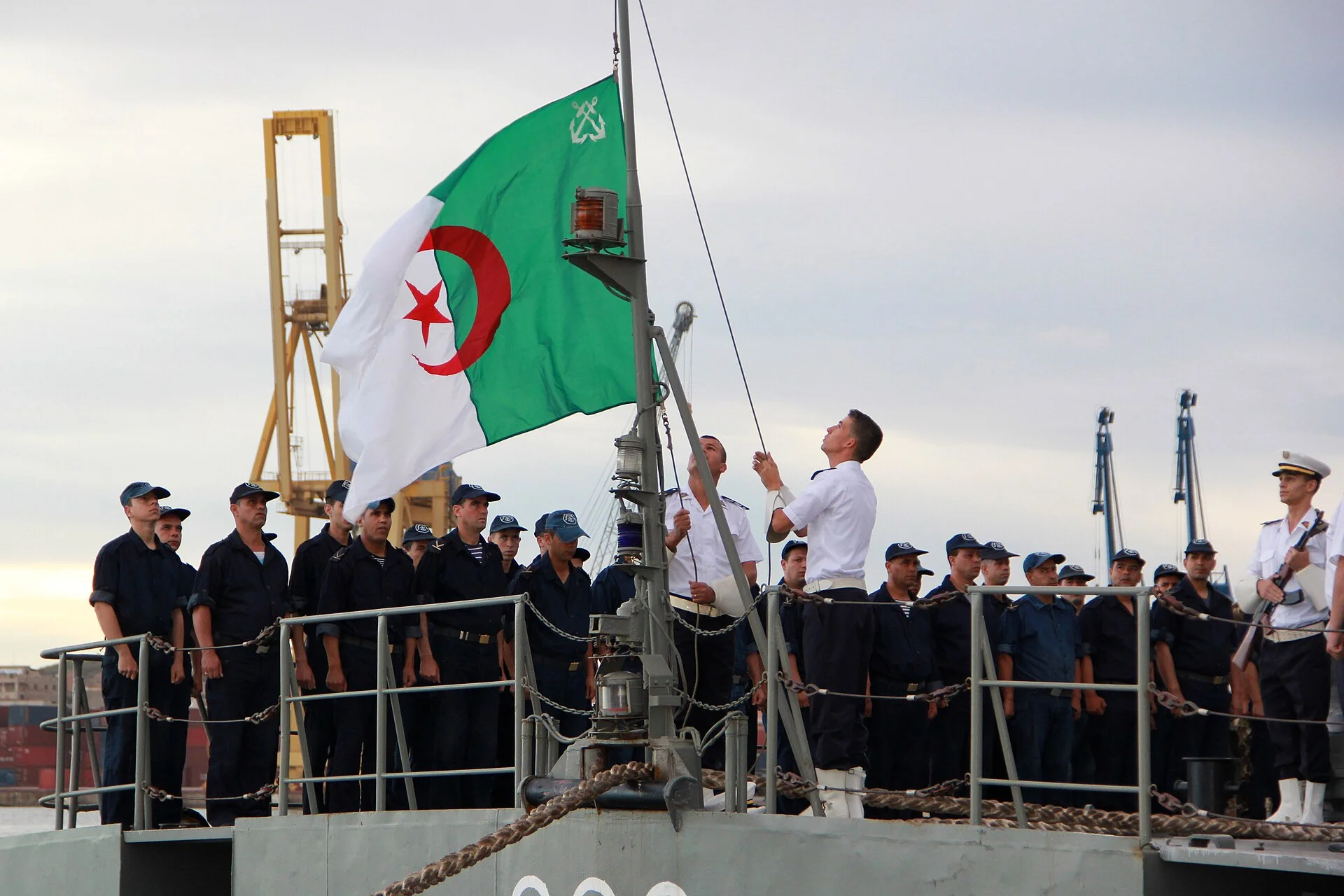
Algeria now spends more on defence than any other African state, its 2026 budget running close to US$25 billion, and it has become the first export customer for Russia’s Su-57 stealth fighter. This profile sets out what the Algerian People’s National Army (ANP) actually operates in 2026, what is only ordered or reported, and where the open-source record should be read with caution.
The short answer to the headline question: by budget, tank numbers and air defence depth, Algeria fields the largest and most heavily armed military in Africa, built almost entirely on Russian and, increasingly, Chinese equipment. The longer answer is about transparency and rivalry. Algiers publishes no inventory and is notably secretive about arms deals, so SIPRI’s own analysts flag that their import figures for Algeria may understate the real picture. Spending has been pushed up sharply by the rearmament race with Morocco over Western Sahara and by instability on the Sahel border with Mali and Niger. The sections below go service by service, with a status label on every line: Operational, Delivered, On contract, Ordered, Under modernization, Estimated, Retired or Reported (unconfirmed).
| Indicator | Figure | Year / source |
|---|---|---|
| Active personnel | 130,000 (service-by-service breakdown not consistently published) | IISS-derived / Global Firepower 2026, Estimated |
| Reserves / paramilitary | 150,000 reserve; about 150,000 paramilitary (Gendarmerie Nationale) | Global Firepower 2026, Estimated |
| Conscription | Compulsory, 12 months (six months basic training, six months service), reduced from 18 months in 2014 | Algerian National Service Code; Echorourk Online |
| Military expenditure | US$25.4 billion in 2025, up about 11% in real terms on 2024 (8.8% of GDP) | SIPRI Milex fact sheet, April 2026, Estimate |
| Official 2026 budget | DZD 3,208 billion (about US$25 billion) of DZD 17,636 billion in total state expenditure, around 20% of the national budget | 2026 Finance Law, approved October 2025 |
| Foreign military aid | None; procurement is funded entirely from hydrocarbon revenue | Open source |
| Arms imports rank | 33rd in the world in 2021–25 (0.9% of global imports, down 78% on 2016–20); SIPRI flags its own estimate as possibly too low given Algeria’s secrecy | SIPRI, March 2026 |
| Main suppliers, 2021–25 | Russia 39%, China 27%, Germany 18% | SIPRI |
| Combat aircraft | About 150–160 (Su-30MKA, Su-35, Su-57E, Su-34ME, MiG-29, Su-24) | World Air Forces 2026, Estimated |
| Main battle tanks | About 1,485 (T-90SA, T-72M1, T-62, T-55AMV) | IISS-derived, Estimated |
| Submarines | 6 Kilo-class (2 Project 877EKM, 4 Project 636) | Operational |
Current military overview
Algeria’s military stands apart from the rest of Africa mainly on money and firepower depth rather than personnel. At 130,000 active troops it is smaller than Egypt’s armed forces, but its declared 2026 defence budget of roughly US$25 billion is the largest openly reported figure on the continent, and it funds a tank fleet, a submarine force and a surface-to-air missile network with no real African peer. The force is built almost entirely on Russian hardware going back to Soviet-era ties, with China now the clear second supplier after a decade of growth. Algiers has also become the launch export customer for Russia’s Su-57E stealth fighter, taking delivery of the first aircraft in late 2025, a status no other air force in the world currently shares.
Two drivers sit behind the build-up. The first is the rivalry with Morocco, which has deepened since Rabat and Algiers severed diplomatic relations in August 2021 over Western Sahara; Algerian and Moroccan state media now track each other’s purchases closely, and Algiers’ spending runs at roughly four times Morocco’s. The second is the Sahel: with Mali, Niger and Libya all unstable, Algeria has reinforced its southern military regions and conducts regular live-fire exercises near its borders. Global Firepower’s composite index, which DefenceMENA treats only as an indicative ranking and never as an inventory source, placed Algeria 27th of 145 countries in 2026, up several places on prior years.
Defence budget: what the numbers do and do not show
Algeria’s 2026 Finance Law, approved in October 2025, sets total state expenditure at DZD 17,636 billion, with defence allocated DZD 3,208 billion — close to US$25 billion at the exchange rate used when the law passed, and about 20% of the whole budget. SIPRI’s independently modelled figure for calendar 2025 is slightly higher, at US$25.4 billion, a real increase of about 11% on 2024 and equivalent to roughly 8.8% of GDP, among the highest shares in the world. SIPRI itself cautions that Algeria is one of the more secretive states it tracks and that some reported Russian arms deals for 2021–25 are unverified, meaning the true level of military-related spending could run higher still. The budget covers force modernisation, personnel and the domestic arms-production push described below; it does not include the value of Russian-financed or barter-style defence cooperation, where terms are rarely disclosed.
Active personnel
Open sources converge on about 130,000 active personnel, with a further 150,000 reserves and roughly 150,000 paramilitary gendarmerie, though no Algerian government source publishes an official breakdown by army, navy and air force the way Egypt’s does. Compulsory national service applies to men from age 19, and the term was cut to 12 months in 2014 (six months of basic training followed by six months of service), down from 18 months between 2002 and 2014 and 24 months before that, according to Algerian press reporting on the change.
Army
| System | Origin | Quantity | Status | Source |
|---|---|---|---|---|
| T-90SA | Russia | 600 | Operational | IISS, 2025 |
| T-72M1 | Russia/USSR | 325 | Operational | Estimated |
| T-62 | USSR | 290 | Under modernization / reserve | Estimated |
| T-55AMV | USSR/modernized | 270 | Under modernization / reserve | Estimated |
| BMPT-72 Terminator | Russia | 26 or more (reports of up to 300 unverified) | Reported (unconfirmed) | Open source |
| BMP-2M / BMP-2 | Russia | 760 / 220 | Operational | Estimated |
| Fuchs 2 APC | Germany (local build, Rheinmetall Algérie, Aïn Smara) | 1,034 | Operational | Rheinmetall / open source |
| Nimr APC/4×4 | UAE (local production, Khenchela) | 3,000 on contract | On contract / Under production | Open source |
| BTR-80 / BTR-60 / OT-64 | Russia/USSR/Czechoslovakia | 150 / 250 / 150 | Operational | Estimated |
| 2S1 / 2S3 / PLZ-45 (self-propelled) | Russia / China | 140 / 30 / 54 | Operational | Estimated |
| Towed artillery (all types) | Mixed | 483 | Operational | Estimated |
| BM-21 / BM-30 Smerch / SR-5 / TOS-1A (MLRS/thermobaric) | Russia/China | 48 / 18 / 70 / 52 | Operational | Estimated |
| Iskander-E | Russia | Undisclosed | Operational | Reported, not officially confirmed |
| Pantsir-S1/SM (army-operated) | Russia | About 100–108 | Operational | Estimated |
| Kornet / Metis-M1 / HJ-12 / Skif (ATGM) | Russia / China / Ukraine | Kornet 8,000+ on contract; HJ-12 100 | On contract / Operational | Open source |
The Army’s tank park, at roughly 1,485 hulls, is the largest in Africa by a wide margin, though a significant share — the T-62 and T-55AMV totals above — is older Soviet-era stock whose combat readiness is harder to verify than the more recent T-90SA fleet. Reports of several hundred locally assembled BMPT-72 Terminator fire-support vehicles circulate in open sources but are not confirmed at that scale. Personnel carriers increasingly come from local production lines: Rheinmetall’s joint venture builds the Fuchs 2 at Aïn Smara, and a 3,000-vehicle Nimr contract is in production at Khenchela, both aimed at reducing reliance on direct imports for lower-end vehicles even as the heaviest systems stay Russian.
Air Force
| System | Origin | Quantity | Status | Source |
|---|---|---|---|---|
| Su-30MKA | Russia | 63–72 (sources vary; 9 more reported on order) | Operational | Eduard, World Air Forces 2026 |
| Su-35 | Russia | 9 delivered, 6 on order | Delivered / On contract | World Air Forces 2026 |
| Su-57E | Russia | 2 delivered of a reported 14-aircraft order | Delivered (launch export customer); remainder Ordered | UAC confirmation; The Aviationist / Military Watch Magazine |
| Su-34ME | Russia | 8–14 (order for 14; at least 4 more reported for 2026) | Delivered / On contract | Military Africa, 2026 |
| MiG-29 | Russia/USSR | 35–46 | Operational | Estimated |
| Su-24 | Russia/USSR | 33–42 | Operational / aging | Estimated |
| Yak-130 / L-39 (trainers) | Russia / Czech | 16–18 / 43–54 | Operational | Estimated |
| Il-76 / Il-78 (transport/tanker) | Russia | 11 / 4–6 | Operational | Estimated |
| C-130 / C-295 (transport) | United States / Spain | 15–18 / 5 | Operational | Estimated |
| Mi-28NE / Mi-24 Super Hind (attack helicopters) | Russia / South Africa-refurbished | 42 / 32 | Operational | Estimated |
| Mi-171Sh / Mi-26T2 / Mi-8/17 (transport helicopters) | Russia | 37 / 14 / 104 | Operational | Estimated |
| Airborne early warning | — | None in service; KJ-500 order reported | None / Reported (unconfirmed) | Open source |
Algeria became the first export customer for the Su-57 when Russia’s state manufacturer United Aircraft Corporation confirmed deliveries of two aircraft in late 2025, following a February 2025 announcement that Algerian pilots were training in Russia. Footage reviewed by Military Watch Magazine in early 2026 indicated the jets had begun flight operations from an Algerian base. Open-source tracking of a reported 14-aircraft order suggests further batches arriving through 2027, though neither Moscow nor Algiers has published a delivery schedule, so the later tranches are best read as ordered rather than delivered. Alongside the Su-57E, Algeria continues to receive Su-35s and Su-34MEs under older contracts and is reported to be adding to its Su-30MKA fleet, which remains the backbone of the fighter force.
Navy
| System | Origin | Quantity | Status | Source |
|---|---|---|---|---|
| Kilo-class submarine (Project 636 / 877EKM) | Russia | 4 (636) + 2 (877EKM) | Operational | Open source |
| MEKO A-200AN frigate (Erradii, El Moudamir) | Germany | 2 | Operational | Delivered 2016–17 |
| Koni-class frigate (Mourad Rais) | USSR | 3 | Operational | Aging |
| C28A Adhafer-class corvette | China | 3 | Operational | Army Recognition |
| Type 056 / F-15A corvette (El Moutassadi) | China (local assembly planned) | 1 delivered 2023 of 6 on order | Delivered / On contract | Military Africa, defenceWeb |
| Djebel Chenoua-class corvette | Algeria (indigenous) | 3 | Operational | Open source |
| Nanuchka II-class missile corvette | USSR | 3 | Operational, aging | Open source |
| Kalaat Beni Abbes LPD | Italy | 1 | Operational | Delivered 2014 |
| Landing ship tank | Poland/Algeria | 2 | Operational | Open source |
| Kebir-class OPV | Algeria (ECRN Mers el-Kébir) | Several | Operational / in production | Open source |
The six-boat Kilo-class submarine fleet is the largest in Africa and the main reason naval analysts rank Algeria’s navy ahead of every other on the continent bar Egypt’s. The surface fleet is older but is being refreshed through local construction: the first Chinese-designed Type 056/F-15A corvette, El Moutassadi, was delivered in 2023, and reporting from Military Africa and Ships Monthly suggests the roughly two-year gap before further hulls appear reflects a deliberate transfer of production from Chinese yards to Algerian ones rather than a stalled programme. In October 2025 the corvette ANS Adhafer made a rare visit to Portsmouth, UK — an unusual port call for a navy that mostly operates close to home, and one picked up by Naval Defense-focused outlets as a sign of growing outreach.
UAV and drone fleet
Algeria’s drone inventory is a genuine dual-sourcing case, mixing delivered Chinese systems with Turkish orders that remain unfulfilled. On the Chinese side, the Air Force operates 24 Wing Loong II and about 10 CH-3/CH-4 armed drones, plus four WJ-700 jet-powered UAVs delivered in 2024; Algeria’s own El Djazair UAV family (also marketed as Yabhon United 40) is built under local licence at roughly 40 units, and six CH-5 drones were ordered in 2022. On the Turkish side, Ankara has sold Algeria six Aksungur long-endurance UAVs, ordered in October 2022, and reportedly ten Anka-S drones — but FlightGlobal’s 2026 World Air Forces survey records zero confirmed deliveries of either type, so both sit at Ordered status rather than Operational. That puts Algeria well behind Morocco and Nigeria, where Turkish Bayraktar TB2s and other systems are already flying combat or surveillance missions. As Envantermedya’s analysis of Turkish-Chinese drone dual-sourcing in Africa notes, several states now hedge between the two suppliers rather than committing to one, and Algeria is a clear example: Chinese drones already flying, Turkish drones paid for but still waiting on the tarmac.
Air defence
| Tier | System | Origin | Status |
|---|---|---|---|
| Long-range | S-400 | Russia | Operational (first public live-fire, Al-Sumoud exercise, May 2025) |
| Long-range | S-300PMU-2 | Russia | Operational (delivered 2008–11) |
| Long-range | HQ-9B | China | Reported (unconfirmed by Algiers) |
| Medium-range | Buk-M2E | Russia | Operational |
| Short-range | Tor-M2E | Russia | Operational |
| Short-range | Pantsir-S1/SM | Russia | Operational (about 100–108 units) |
| Short-range | HQ-17 | China | Reported (unconfirmed); images circulated Sept 2026 |
| Short-range | S-125 Pechora-2M | Russia (upgraded) | Operational |
| Point / SHORAD | Osa-AK, Shilka-M (ZSU-23-4) | USSR/Russia | Operational, aging |
| MANPADS | Various Soviet/Russian types | Russia | Operational |
Algeria runs one of the densest, most layered air defence networks in Africa, organised under a separate Territorial Air Defence Forces command rather than folded into the Army or Air Force. The long-range tier leans on Russian S-300/S-400 systems, the latter publicly fired for the first time during the Al-Sumoud exercise in May 2025. China has been adding to the lower tiers: the HQ-9B long-range system has been reported in Algerian service for some time, and in September 2026 Military Watch Magazine and the Spanish outlet Infodefensa separately reported that images circulating on Chinese and Algerian military-watching social media accounts showed vehicles matching the HQ-17 short-range system, modelled on Russia’s Tor-M1. Neither the Algerian defence ministry nor CASIC, the Chinese manufacturer, has confirmed the acquisition, so it is listed here as reported rather than delivered. If confirmed, it would close a gap in low-altitude coverage beneath the long-range Russian umbrella.
Missiles and artillery
Beyond the air defence network, Algeria fields the Russian Iskander-E short-range ballistic missile system in undisclosed numbers — its presence is widely reported in open sources but never officially confirmed by Algiers — alongside a large towed and self-propelled artillery park (483 towed pieces and roughly 224 self-propelled guns) and multiple-launch rocket systems including the Chinese SR-5 and TOS-1A thermobaric launcher. Anti-tank coverage rests on a large Kornet order (8,000 or more missiles reported on contract) plus Metis-M1, Chinese HJ-12 and Ukrainian-origin Skif missiles, giving infantry and mechanised units a mixed but numerically deep anti-armour capability.
Defence industry
Algeria’s domestic arms sector sits under the Ministry of Defence’s Directorate of Military Industries and remains focused on assembly and licensed local production rather than indigenous design or exports. Rheinmetall Algérie builds the Fuchs 2 APC at Aïn Smara; Nimr Algérie assembles the UAE-designed Nimr 4×4 at Khenchela under a reported 3,000-vehicle contract; SAFAV-MB produces Mercedes-Benz-derived trucks and light vehicles; and the naval yard ECRN at Mers el-Kébir builds Kebir-class OPVs and landing craft, with a Chinese-licensed Type 056/F-15A corvette line now transitioning to local construction. Ammunition comes from state firms ERIS and ONEX, while the El Djazair UAV and a BMPT-62 conversion programme represent the more ambitious end of local engineering. None of this amounts to exportable, fully indigenous major platforms yet, and Algeria has no defence export record to speak of; the shipbuilding push is the area most often cited by Algerian officials as the next priority.
Main defence suppliers
| Period | World import rank | Russia | China | Germany |
|---|---|---|---|---|
| 2021–25 | 33rd (0.9% of world imports, −78% vs 2016–20) | 39% | 27% | 18% |
| 2020–24 | 21st | 48% | 19% | 14% |
SIPRI’s own trend notes flag Algeria as a secretive importer whose declared figures may undercount actual deliveries, particularly from Russia. Even so, the trajectory is clear: Russia’s share has fallen from the high 40s to the high 30s as China’s has grown from under a fifth to more than a quarter of the total, driven by corvettes, air defence systems and drones. One side effect of Algeria’s reporting gaps is that Morocco, a far smaller spender in absolute terms, now ranks ahead of it as an arms importer in SIPRI’s 2021–25 table (28th versus 33rd) — a reminder that import rankings measure reported transfers, not total military strength.
Recent procurement
| Date | Event | Value | Status |
|---|---|---|---|
| October 2025 | Corvette ANS Adhafer makes a rare port visit to Portsmouth, UK | n/a | Operational (port call) |
| October 2025 | Reports of a record 2026 military budget increase ahead of the Finance Law | Reported ~US$25bn | Reported |
| November 2025 | Russia confirms delivery of first two Su-57E fighters, making Algeria the type’s launch export customer | Undisclosed (part of a reported 14-jet order) | Delivered |
| December 2025 | 2026 Finance Law approved: defence allocation DZD 3,208 billion | ~US$25 billion | Approved |
| February 2026 | Footage reviewed by Military Watch Magazine shows Su-57E flight operations under way at an Algerian base | n/a | Operational (reported) |
| March 2026 | SIPRI’s Trends in International Arms Transfers report ranks Algeria 33rd global importer for 2021–25, with Morocco overtaking it at 28th | n/a | Published |
| May 2026 | Army chief of staff Saïd Chengriha oversees a live-fire exercise at Béchar / Hammaguir, near the Moroccan border | n/a | Exercise |
| July 2026 | Moroccan outlet Médias24 publishes an analysis contrasting Algeria’s rising defence spending with Morocco’s smaller, more targeted budget | n/a | Published (analysis) |
| September 2026 | Military Watch Magazine and Infodefensa report images suggesting delivery of the Chinese HQ-17 short-range air defence system | Undisclosed | Reported (unconfirmed) |
| September 2026 | President Tebboune announces a 2026 phase of “complete electronic modernisation” for the ANP | n/a | Announced |
Turkish systems in Algeria
| System | Maker | Quantity | Status |
|---|---|---|---|
| Aksungur UAV | Turkish Aerospace | 6 | Ordered (October 2022); no confirmed deliveries as of World Air Forces 2026 |
| Anka-S UAV | Turkish Aerospace | 10 reported | Reported (unconfirmed); no confirmed deliveries |
Unlike Morocco, where Bayraktar TB2s, Akıncı drones and Otokar Cobra II vehicles are confirmed in frontline service, and Nigeria, where TB2s and T129 ATAK helicopters are already operational, Algeria’s relationship with Turkish defence industry has so far produced orders rather than deliveries. Ankara sold Algiers six Aksungur long-endurance UAVs in October 2022 and is reported to have agreed a follow-on order for ten Anka-S drones, but FlightGlobal’s 2026 World Air Forces directory lists neither type as delivered. Turkey’s defence industry sells to both sides of the Morocco–Algeria rivalry without exclusivity, a position Moroccan outlet Bladi.net has described bluntly: Ankara “sells its drones to everyone.” Until Algeria’s Aksungur and Anka-S orders actually arrive, there is no operational Turkish advantage to assess here — only a pending one.
What is changing?
Three trends define where Algeria’s military is headed. First, the Su-57E programme will keep building out through 2027 on the public timeline reported so far, giving Algeria a stealth-fighter capability no other African or Middle Eastern air force currently operates, though how large and how fast that fleet grows depends on deliveries Moscow has not formally scheduled — see DefenceMENA’s dedicated breakdown of what is confirmed and what is not. Second, local production is expanding beyond assembly lines for trucks and APCs into warships, with the Type 056/F-15A corvette programme shifting from Chinese to Algerian yards and President Tebboune’s September 2026 announcement of a broader “electronic modernisation” drive for the ANP. Third, the rivalry with Morocco shows no sign of easing: both sides continue to track and respond to each other’s purchases, Algeria’s southern military regions remain on a heightened footing over the Sahel, and reported but unconfirmed Chinese systems — the HQ-9B and now the HQ-17 — suggest Algiers is filling out its air defence network with Chinese kit faster than it is disclosing it.
How Algeria compares in Africa
No other African military fields six attack submarines, roughly 1,485 main battle tanks or a layered S-300/S-400 air defence network, and none has been handed a stealth fighter before Algeria was. Egypt remains ahead on personnel, combat aircraft numbers and naval surface combatants, and its forces are generally read as the more balanced of the two — DefenceMENA’s Egypt vs Algeria comparison sets out that balance in detail, including the caveat that Egypt’s SIPRI-reported budget figure understates real spending because it excludes off-budget military income, so the headline gap between Cairo’s reported US$2.5 billion and Algiers’ US$25.4 billion overstates the true difference. Morocco is Algeria’s most direct rival and spends roughly a quarter as much, a comparison covered in DefenceMENA’s Morocco vs Algeria military comparison; Envanter Media’s ranking of Africa’s strongest militaries in 2026 and DefenceMENA’s own continental ranking both place Algeria among the top two or three on the continent. On the Chinese air defence question specifically, DefenceMENA’s earlier report on the reported HQ-17 acquisition and its broader look at Algeria’s Russian-built arsenal go into more depth than this profile allows.
A note on the numbers
Algeria publishes no official equipment inventory, and Algerian state media rarely confirms individual arms deals before, and sometimes after, delivery. The figures above come from IISS-derived open-source trackers, SIPRI’s arms transfer and expenditure databases, FlightGlobal’s World Air Forces directory, manufacturer and Russian state-media statements, and specialist reporting by Military Watch Magazine, Shephard Media, Army Recognition, Military Africa, defenceWeb and Infodefensa, cross-checked against Algerian and Moroccan French-language press including Radio Algérie, Algérie360, TSA and Médias24. Global Firepower is used here only for its composite ranking, never as an inventory source. Where sources disagree, the table gives a range and the label Estimated; where Algiers has not confirmed a reported system, it is labelled Reported (unconfirmed). This profile was published on 2 October 2026 and will be updated as deliveries are confirmed; the Algeria desk carries the running news.
Sources
- SIPRI, Trends in International Arms Transfers 2025 (March 2026)
- Military Spend Country Profile: Algeria (SIPRI-derived expenditure data)
- The New Arab, “Once again, military spending tops Algeria’s budget priorities for 2026”
- North Africa Post, Algeria’s 2026 budget allocates record military spending
- Radio Algérie, Président de la République : modernisation complète du pays et de l’ANP en 2026
- Algérie360, Défense : l’Algérie parmi les 30 armées les plus puissantes du monde en 2026
- Médias24, Dépenses militaires : la dérive budgétaire d’Alger face à la stratégie d’efficience du Maroc
- Military Watch Magazine, Footage shows Algerian Su-57 operations under way
- Air Data News, Algeria acknowledges deal for Sukhoi Su-57 fighters
- Military Watch Magazine, Algeria strengthens Chinese-origin air defence with HQ-17
- Infodefensa, Argelia refuerza su defensa aérea con el sistema chino HQ-17
- Shephard Media, Algeria orders Aksungur UAV
- Army Recognition, Algerian Navy corvette ANS Adhafer spotted in UK harbour in rare visit
- Military Africa, Algeria to build Chinese corvettes locally
- Echorouk Online, Official duration of national service in Algeria curtailed to one year