Photos circulating on Chinese and Algerian military-watching social media accounts appear to show Algeria’s army has taken delivery of the Chinese HQ-17 short-range air defence system, a mobile launcher built to the same template as Russia’s Tor-M1. The Algerian defence ministry has not confirmed the acquisition, but it would mark another step in Algiers’ growing reliance on Chinese air defence technology as its rivalry with Morocco deepens.
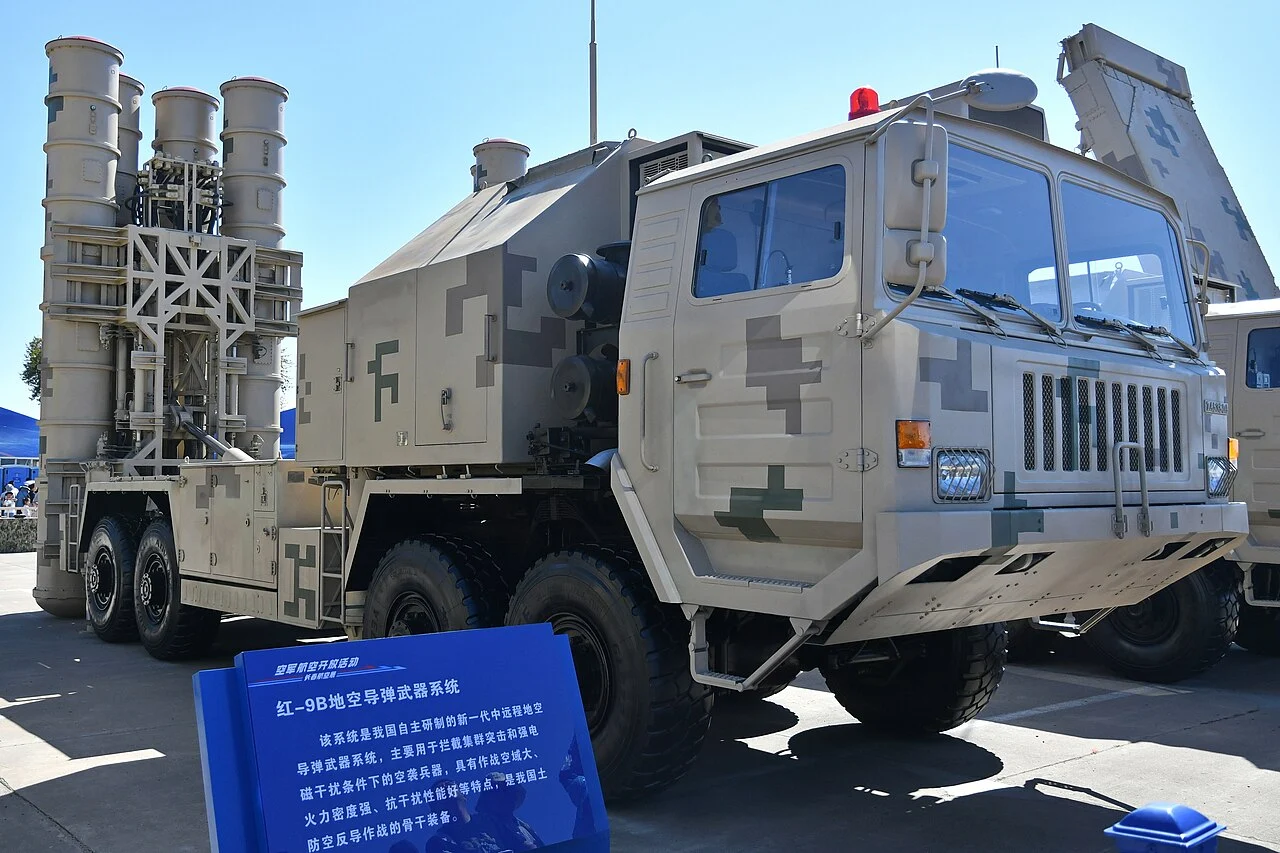
Photo: A Chinese HQ-9B surface-to-air missile system, part of the Chinese-built network Algeria has been expanding. Credit: 颐园居, CC BY-SA 4.0, via Wikimedia Commons
What the images show
Military Watch Magazine reported this week that vehicles matching the HQ-17’s distinctive single-platform design, radar dome and camouflage pattern consistent with Algerian army equipment had appeared in images shared by Chinese-language defence accounts, with several identifying Algeria as the destination. Neither the Algerian defence ministry nor CASIC, the Chinese state manufacturer, has issued a statement, and Infodefensa, which separately reported on the same images, likewise flagged the acquisition as unconfirmed.
The HQ-17 mounts a radar, fire-control system and eight missiles on a single tracked chassis capable of engaging four targets at once while on the move, with an engagement envelope of roughly 1.5 to 20 kilometres and intercepts up to about 10 kilometres in altitude. Western analysts generally regard it as an upgrade on the Tor-M1 it was modelled on, designed to protect manoeuvring ground forces and fixed sites from aircraft, helicopters and precision-guided munitions that get past longer-range interceptors.
A Chinese-Russian air defence network
If confirmed, the HQ-17 would slot into an Algerian ground-based air defence architecture that already blends Russian and Chinese equipment. Algeria operates Russian S-300PMU-2 and S-400 long-range systems alongside Buk-M2 medium-range batteries, and has previously bought Chinese HQ-9B long-range missiles and CHL-906 mobile electronic-warfare and reconnaissance vehicles, as DefenceMENA has detailed in its look at Algeria’s Russian-built arsenal. Layering a short-range Chinese system underneath that network would close a gap in low-altitude coverage that long-range SAMs are not built to fill.
China has steadily gained ground in the Algerian market over the past decade, a trend consistent with Beijing’s wider push into North African air defence sales. SIPRI data shows China supplied around 19% of Algeria’s arms imports in the 2020-2024 period, second only to Russia’s 48% share, with Algeria alone accounting for an estimated 53% of major weapons imports across North Africa in that window.
The Morocco arms race
The reported delivery comes against the backdrop of a defence spending gap between Algeria and Morocco that has widened sharply. According to IISS figures cited by Infodefensa, Algeria’s 2025 defence budget of roughly $25.5 billion was more than three times Morocco’s $7.5 billion, even as the two countries — which have had no diplomatic relations since 2021 over the Western Sahara dispute — race to modernise their militaries.
Morocco has moved almost entirely in the opposite procurement direction, drawing about 64% of its imports from the United States, 15% from France and 11% from Israel. Rabat has approved a $825 million package for 600 FIM-92K Stinger man-portable air defence missiles, fields the Israeli-supplied Barak MX medium-range system, and is still awaiting delivery of F-16 Block 72 fighters to round out its own air defence and strike posture, as DefenceMENA has previously reported.
Why it matters for Africa
North Africa remains the continent’s most heavily armed and most polarised sub-region, and an unconfirmed HQ-17 delivery still says something concrete about where that competition is heading. Algeria’s air defence build-up is no longer a story about Russian dependence alone: China is emerging as a parallel supplier willing to sell systems Moscow cannot easily deliver on schedule given its own war-driven production constraints. For Morocco and its Gulf and Western partners, a denser, layered Algerian air defence network raises the bar for any future strike package and reinforces the logic behind Rabat’s own missile-defence shopping list. For other African militaries watching from Cairo to N’Djamena, the deal — if confirmed — is a reminder that Chinese short and long-range air defence systems are becoming a normal fixture of African order books, not an exception.
Sources
- Military Watch Magazine: “Algeria Strengthens Chinese-Origin Air Defence with HQ-17”
- Infodefensa: “Argelia refuerza su defensa aérea con el sistema chino HQ-17”
- HQ-17 system background