Egypt Receives First Boeing CH-47F Chinook Helicopter

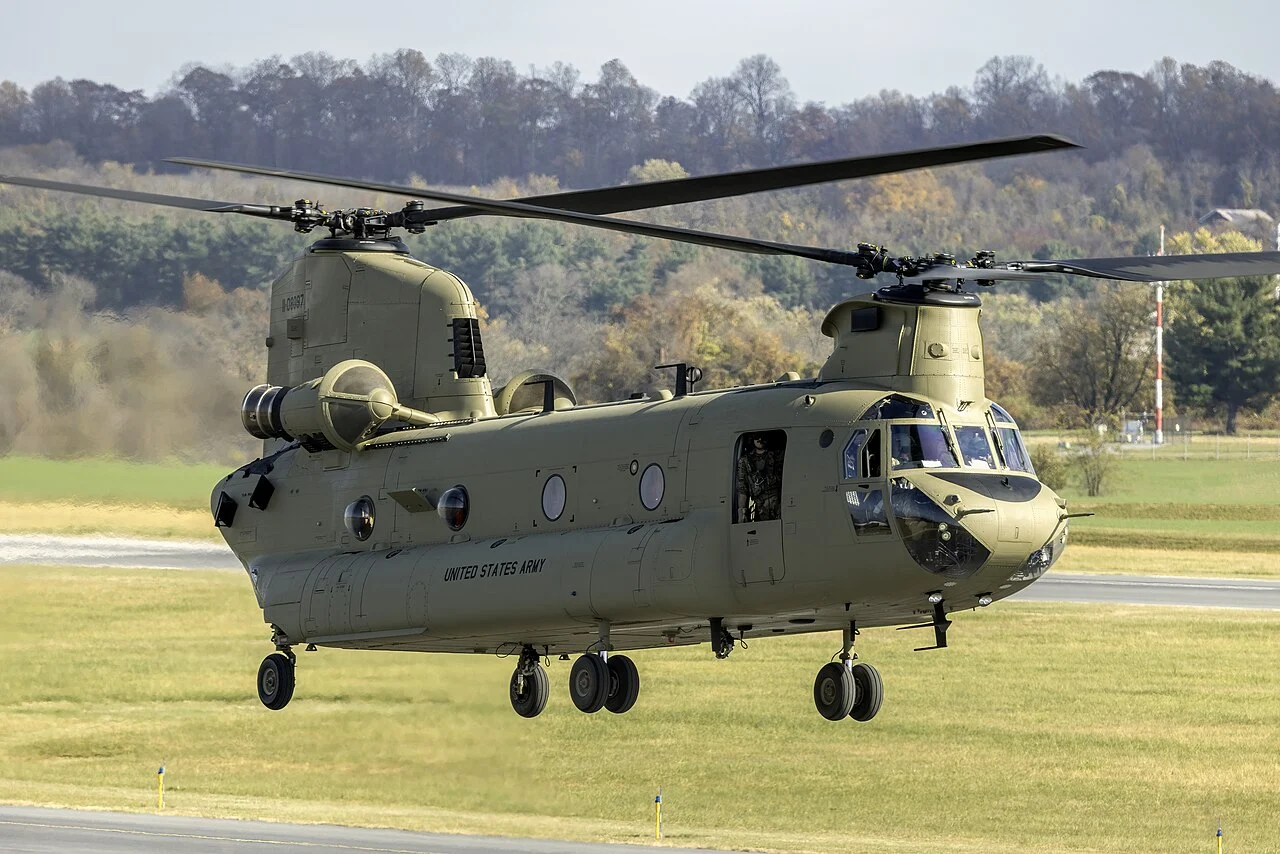


The Egyptian Air Force has taken delivery of its first Boeing CH-47F Chinook, the opening aircraft in a 12-helicopter order that will retire Cairo’s ageing CH-47D fleet. The handover was marked publicly at the El Alamein International Airshow in September, under a $426 million deal first signed in 2023.
Photo: A Boeing CH-47F Chinook, the same model now entering Egyptian Air Force service. Credit: Acroterion, CC BY-SA 4.0, via Wikimedia Commons
The first CH-47F was formally handed over to the Egyptian Air Force (EAF) at the El Alamein International Airshow, held 8-10 September, where Boeing displayed the aircraft alongside its AH-64 Apache and KC-46A Pegasus, defenceWeb reported. The US Embassy in Cairo confirmed the delivery in a statement on 17 September, calling it “another concrete example of the expanding commercial and defence partnership between the United States and Egypt.”
A long-planned replacement
Washington approved the sale of 12 new-build CH-47Fs to Egypt in 2022, and Boeing was awarded a $426 million contract for the aircraft in January 2023. Egypt holds an option for 11 more. The order replaces a CH-47D fleet that dates back decades: Egypt received 15 CH-47C Chinooks in the early 1980s, followed by four CH-47Ds in 1998-99, with most of the C-model airframes understood to have been upgraded to D standard around 2002. A 2009 Egyptian request for six additional CH-47Ds reportedly never progressed.
Egypt’s Chinooks are flown by 18 Squadron (546 Air Wing) and the Chinook Operational Conversion Unit, 33 Squadron, based at Kom Awshim Air Base roughly 50 km south of Cairo. Boeing has supported the Egyptian Air Force’s Chinook fleet for close to five decades. “We are committed to keeping this fleet flying, and Egypt’s aircrews safe for years to come,” said Kathleen (KJ) Jolivette, Boeing’s vice president and general manager for Vertical Lift Programmes.
What the F model changes
The CH-47F Block I is a significant step up from the D model it replaces. It is easier to maintain, carries a digital automatic flight control system in place of the D’s analogue cockpit, and offers more advanced cargo-handling electronics. Power comes from two Honeywell T55-GA-714A turboshaft engines rated at 4,777 shaft horsepower each, giving the aircraft a cruise speed of roughly 290 km/h and a useful load of about 12,565 kg, carried internally or slung beneath the fuselage.
For the EAF, the upgrade matters operationally as much as technically. Egypt’s Chinooks support heavy-lift tasks across the Sinai counter-insurgency campaign, Western Desert operations against smuggling and militant networks, and disaster response, roles where the D model’s age and declining parts support had become a growing constraint. The new airframes also bring Egypt’s heavy-lift fleet into closer alignment with the US Army’s own CH-47F standard, simplifying future support, upgrades and interoperability with American forces during joint exercises such as Bright Star.
Part of a broader US-Egypt pipeline
The Chinook delivery lands alongside a wider run of recent US-origin equipment in Egypt’s inventory, from F-16s to M1A1 Abrams built under licence, detailed in DefenceMENA’s look at the American core of Egypt’s arsenal. Egypt’s helicopter fleet is now a mix of US, French and Russian-origin types, reflecting Cairo’s long-standing strategy of diversifying suppliers while keeping its US relationship, and the associated Foreign Military Financing, as the anchor of its airlift and attack-helicopter inventories. For how that compares with the continent’s other large air force, see DefenceMENA’s breakdown of where Egypt and Nigeria’s militaries differ most, and the full Egypt military strength profile.
Why it matters for Africa
Egypt operates the largest and most diversified air force on the continent, and its procurement choices are closely watched by other African air arms weighing heavy-lift options. A modern CH-47F fleet extends Egypt’s ability to move troops, artillery and disaster-relief supplies quickly across the Sinai, the Western Desert and the Nile Delta, all theatres where speed of response has direct security implications for the wider region, including Libya’s unstable west and the Red Sea corridor. The deal also reinforces the pattern of continued US defence engagement with Egypt even as Cairo diversifies toward European and Gulf suppliers, a balance several other African militaries, from Morocco to Kenya, are also trying to strike between legacy US partnerships and newer entrants.
Sources
- defenceWeb: “Egypt receives first CH-47F Chinook”
- Boeing: “Boeing delivers Egypt’s first modernized Chinook helicopters”
- Janes: “Egypt receives first new CH-47F Chinook helicopter”