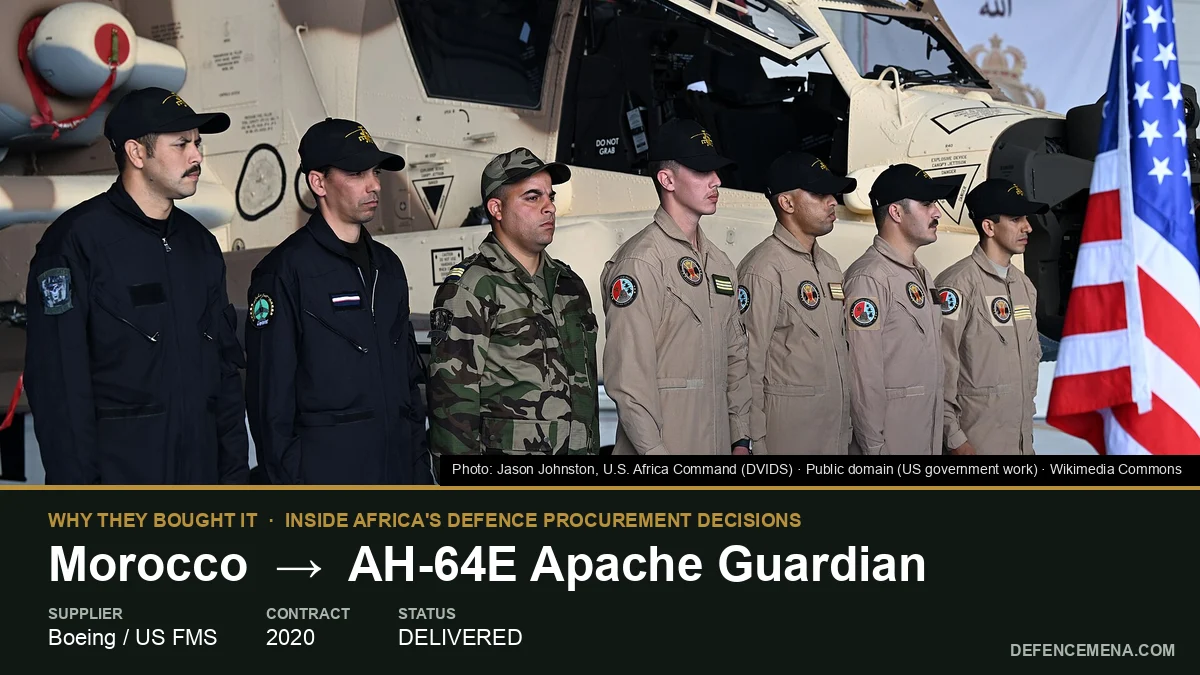
Morocco bought the AH-64E Apache Guardian because it had no dedicated attack helicopter at all: its anti-armour rotary wing rested on roughly two dozen SA342 Gazelles delivered in the late 1970s. Washington framed the 2019 approval as support for “a major Non-NATO ally”, and Rabat ordered 24 aircraft through US Foreign Military Sales in June 2020, with an option for 12 more. Eighteen had reached the 7th Air Base at Khouribga by September 2026; the last six are due in 2027.
Photo: Royal Moroccan Air Force aircrew beside one of the first six AH-64E Apache Guardians at the handover ceremony in Rabat, 5 March 2025. Photo: Jason Johnston / U.S. Africa Command (public domain). Credit: Jason Johnston, U.S. Africa Command (DVIDS), Public domain (US government work), via Wikimedia Commons.
- Country
- Morocco (Royal Moroccan Air Force)
- System
- AH-64E Apache Guardian
- Supplier
- Boeing via US Army FMS (United States)
- Quantity
- 24 firm + 12 option (36 approved)
- Contract year
- 2020
- Status
- DELIVERED 18 of 24
- Main requirement
- First dedicated attack helicopter; Gazelle/HOT replacement
- Training
- Pilots and technicians trained in the United States from 2021; simulators at Khouribga
- Localisation
- None announced
- Known alternatives
- T129 ATAK (reported); no documented competition
What capability did Morocco need?
Until 2025 the Royal Moroccan Air Force had never flown a purpose-built attack helicopter. The anti-armour and armed scout role belonged to a fleet of Aérospatiale SA342 Gazelles carrying HOT wire-guided missiles, a combination that entered Moroccan service in 1978. Military Africa put the fleet at 23 aircraft in 2019 and at 24 in 2025; defenceWeb describes “approximately two dozen” Gazelles split between Army Aviation and the air force. Whatever the exact tally, the fleet was over forty years old and lacked the sensors for night attack at stand-off range.
That gap mattered because Morocco’s ground forces had been re-equipped around American armour: 222 M1A1 Abrams tanks from 2012, HIMARS launchers and Javelin missiles (see how the United States became a major supplier to Morocco). A modern armoured force with no helicopter able to escort it or hunt enemy armour at night was an obvious hole in the order of battle.
No Moroccan requirement document has been published, so the capability case has to be read from the US notification and the fleet it replaced. The DSCA package shows a buyer that wanted the full set: Longbow radar, Hellfire anti-tank missiles, APKWS laser-guided rockets, Stinger air-to-air missiles, and manned-unmanned teaming kits so the Apache can work with the drones Morocco has bought from Türkiye, Israel and China.
What did it already operate?
Morocco’s rotary-wing force in 2019 was a transport and utility fleet with a light attack appendix. The backbone was the SA330 Puma, now being replaced by ten Airbus H225M Caracals ordered in 2025, alongside CH-47D Chinooks, Bell 205/212s and AB206s. The armed element was the Gazelle/HOT fleet described above, which Military Africa and defenceWeb both characterise as a light anti-tank and scout capability rather than a true attack helicopter force.
The air force already operated a substantial American inventory: F-16C/D Block 52s since 2011, with 25 Block 72s on order, plus C-130H transports. That familiarity with US logistics and FMS case management is part of the context for the Apache choice, even if no official has said so in public. DefenceMENA’s inventory of Morocco’s military strength lists the full fleet.
What system was selected?
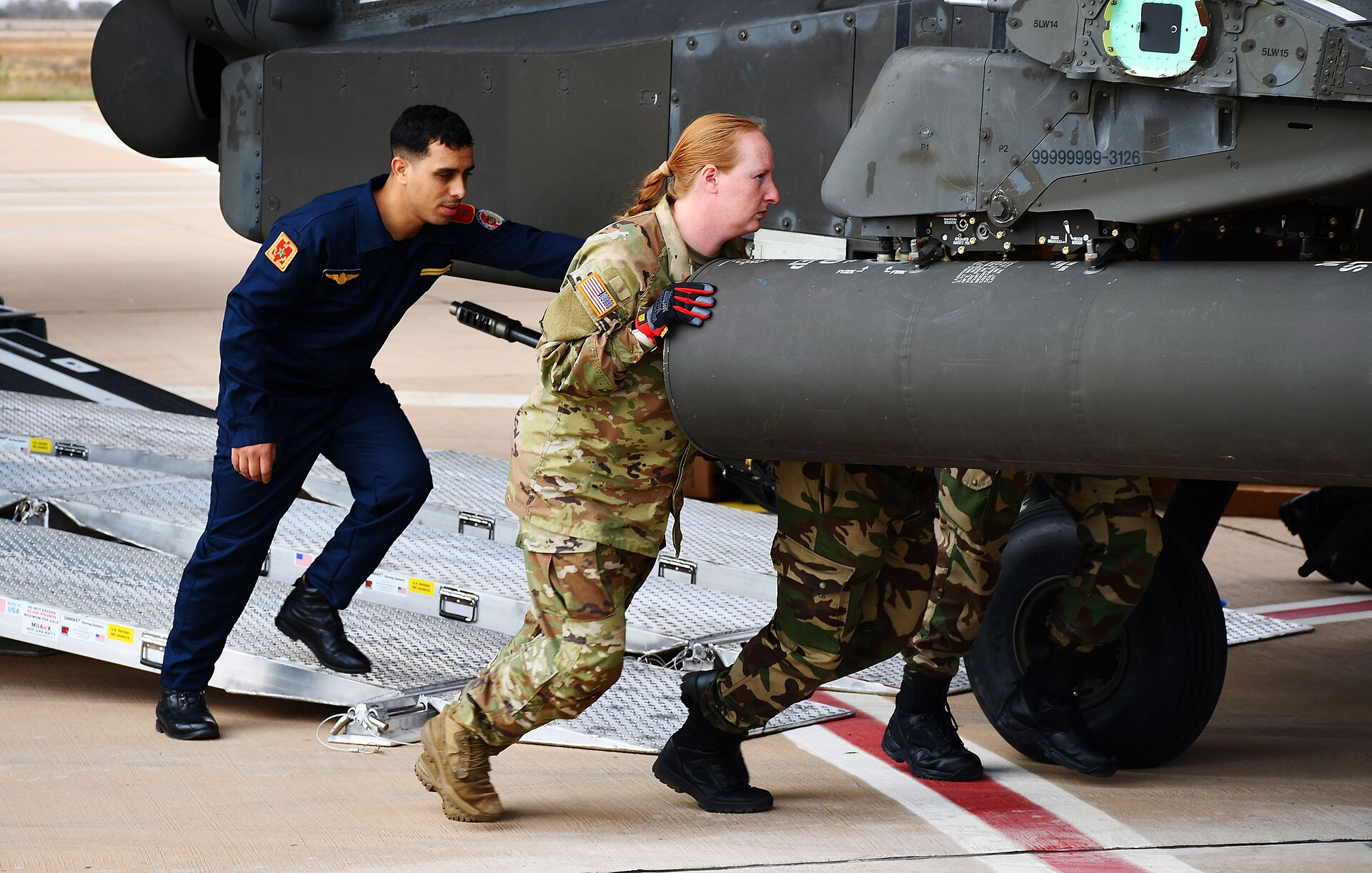
The AH-64E Apache Guardian is the current production version of Boeing’s attack helicopter, built at Mesa, Arizona. The Moroccan configuration, as notified to Congress in November 2019 and summarised by The Defense Post and Military Africa, includes the AN/APG-78 Longbow fire-control radar, the Modernized Target Acquisition Designation Sight and Pilot Night Vision Sensor (M-TADS/PNVS), T700-GE-701D engines, the 30 mm M230 chain gun, and manned-unmanned teaming video receivers and air-ground kits. The munitions package was 551 AGM-114R Hellfire missiles, 200 AIM-92H Stinger missiles and 558 APKWS guidance kits with more than 5,000 70 mm rockets.
Boeing described Morocco as the 17th Apache operator when the order was announced on 25 June 2020. On the African continent only Egypt flies the type, with 43 AH-64Ds that are being remanufactured to E standard under contracts reported by defenceWeb. Morocco is the first African customer to buy the AH-64E new.
Which alternatives were considered?
There was no open tender. The Apache came through a government-to-government FMS case, and no Moroccan competition between attack helicopters has ever been documented. What the record does show is a long flirtation with the Turkish T129 ATAK. Military Africa reported in June 2018 that a Royal Armed Forces delegation visited Turkish Aerospace to discuss the T129, and the helicopter was shown at the Marrakech Airshow that year. In July and August 2021, a year after the Apache order, Morocco World News and Aeronautique.ma, both citing Tactical Report and Le360, said Rabat was in “advanced negotiations” for 22 T129s with missiles and avionics worth about 1.3 billion dollars. Those reports also noted that the T129’s LHTEC T800 engines need a US export licence, which the December 2020 US sanctions on Turkish defence procurement had frozen. No contract has ever been announced, so the T129 remains a reported alternative, not a confirmed competitor.
| Alternative | Class | Status of consideration | Source |
|---|---|---|---|
| TAI T129 ATAK | Medium attack helicopter | REPORTED ALTERNATIVE (2018 delegation visit; 2021 reports of talks for 22; no contract) | Military Africa 2018; Morocco World News / Aeronautique.ma 2021 |
| Bell AH-1Z Viper | Marine attack helicopter | SAME-CLASS MARKET ALTERNATIVE (no Moroccan evaluation documented) | DefenceMENA (Nigeria AH-1Z case) |
| Airbus Tiger HAD | Medium attack helicopter | SAME-CLASS MARKET ALTERNATIVE (no Moroccan evaluation documented) | None found |
| Mil Mi-28NE | Heavy attack helicopter | SAME-CLASS MARKET ALTERNATIVE (ordered by Algeria; never linked to Morocco) | Army Recognition 2026 (Algerian context) |
Why was the AH-64E selected?
Officially stated (United States). The only published rationale comes from the US side. The DSCA notification of 20 November 2019 says the sale “will support the foreign policy and national security of the United States by helping to improve the security of a major Non-NATO ally that is an important force for political stability and economic progress in North Africa”. At the March 2025 handover in Rabat, AFRICOM commander General Michael Langley said that “by acquiring these Apache helicopters, Morocco is making a significant leap in capability, thereby enhancing its security and strategic position”, as reported by Yabiladi. Boeing’s Jeff Shockey called the order “another step forward in our long partnership with the Kingdom of Morocco”.
Officially stated (Morocco). Rabat has issued no procurement rationale. The Royal Armed Forces’ General Staff statement on the May 2026 handover at Cap Draa, reported by Assahifa, described the reception as taking place “in implementation of High Instructions” from King Mohammed VI, which is a statement of authority rather than of motive.
Documented in procurement material. The structure of the FMS package itself is evidence. It bundles the airframes with Longbow radars, M-TADS/PNVS, the three guided-weapon families and the MUM-T kits, and the June 2020 US Army contract modification that funded the Moroccan aircraft also covered Longbow Crew Trainer simulators, according to GovCon Wire’s report of the Pentagon’s announcement. Morocco bought a complete system with its training infrastructure rather than bare helicopters.
Reported by Military Africa, Atalayar and defenceWeb. All three outlets present the purchase as the replacement of the 1978-vintage Gazelle/HOT fleet and as Morocco’s first dedicated attack helicopter. That is the most consistent explanation in the public record.
Analysts assess. Army Recognition and Atalayar place the buy in the context of the Western Sahara dispute and of Algeria’s orders of Russian Mi-28NE attack helicopters, and Army Recognition notes the US recognition of Moroccan sovereignty over Western Sahara in December 2020, six months after the order. Those are interpretations by the outlets concerned, not statements by either government. DefenceMENA’s comparison of Morocco and Algeria sets out the balance in more detail.
Possible but unconfirmed. Interoperability with the US-equipped Moroccan army and with US forces during the annual African Lion exercise, where Utah National Guard Apaches have deployed to Morocco since at least 2022, is a plausible factor. The Utah-Morocco State Partnership Program dates from 2003 and Utah hosted Moroccan pilots for Apache familiarisation flights. No official has linked it to the purchase decision.
What was included in the contract?
Two documents frame the deal. The DSCA notification (Transmittal 19-63, dated 19 November 2019 and published the next day) set a ceiling of 36 AH-64Es and the full munitions and support list at an estimated 4.25 billion dollars, naming Boeing (Mesa) and Lockheed Martin (Orlando) as prime contractors and including “related equipment, support, training, and logistics”. The order itself, announced by Boeing on 25 June 2020, covered 24 aircraft “under contract with the U.S. Army through the U.S. government’s Foreign Military Sales process”, with deliveries planned from 2024.
Boeing’s statement does not give a value or list the weapons. Which Hellfire, Stinger and APKWS quantities were actually ordered against the notified ceiling has not been disclosed. DefenceMENA has not seen a Letter of Offer and Acceptance, and the DSCA and AFRICOM pages that reproduce the notification and the signing announcement refused automated access during verification; the figures above are taken from The Defense Post and Military Africa, which reprinted the DSCA text in full.
How much did it cost?
Three different numbers circulate, and they measure different things. The 4.25 billion dollar figure is the DSCA estimate for the maximum package of 36 helicopters plus all weapons, spares, training and support; it is a ceiling, not a bill. The US Department of Defense’s contract announcement of 25 June 2020, reported by GovCon Wire and defenceWeb, was a 439.2 million dollar modification to an existing Boeing Apache contract covering the Moroccan airframes and Longbow Crew Trainers, with work in Mesa and a completion date of 1 March 2025. That figure covers Boeing’s airframe production line, not the Lockheed Martin sensors, the engines, the weapons or the training.
Aerospace Global News and Military Africa put the June 2020 order at “roughly 1.5 billion dollars”, a figure that matches the value Military Africa attached to Morocco’s original request for 24 aircraft in August 2019. Neither Boeing nor the Moroccan government has confirmed it, and DefenceMENA treats it as a press estimate. Dividing any of these figures by 24 would not give a unit price, and none is attempted here.
How many were ordered?
Twenty-four firm, with an option for twelve more. The option was written into the 2019 notification and is repeated in every delivery report since, but there is no public evidence that it has been exercised. Military Africa’s May 2026 count of seven aircraft in the second batch, taking the fleet to 13, is the only report that departs from the six-plus-six-plus-six pattern described by Aerospace Global News, Army Recognition and North Africa Post; DefenceMENA records both counts below and uses the 18-aircraft total reported after the September 2026 delivery.
Training, maintenance and support
Training started well before the first airframe arrived. Military Africa reported in January 2021 that Royal Moroccan Air Force pilots and operations staff would train in Utah in two-month batches, under the US Army’s FMS arrangements. The US Army’s own account of African Lion 2022 says the Utah National Guard’s 1st Battalion, 211th Aviation Regiment had hosted Moroccan pilots for familiarisation rides on its ranges. By March 2025, according to AFRICOM figures reported by Yabiladi, 24 Moroccan pilots including five instructors had completed training in the United States, three more were in the pipeline, and full operational capability was targeted within six months.
On the ground, the 7th Air Base at Khouribga, roughly 130 km south-east of Casablanca, was rebuilt for the type. Heliops and North Africa Post describe two Apache squadrons there with a training wing equipped with two full mission simulators; North Africa Post and Atalayar also cite more than 160,000 square metres of climate-controlled hangars and hardened dispersal bays, figures DefenceMENA has not been able to confirm from an official source. The Longbow Crew Trainers were funded in the 2020 US Army contract. Depot-level support and spares flow through the FMS case; no Moroccan maintenance contract with Boeing has been announced.
Local production or technology transfer
None. The aircraft are built in Mesa and shipped complete. Boeing’s 2020 announcement pointed instead to its existing industrial footprint in Morocco: the MATIS Aerospace joint venture in Casablanca, which makes wire bundles and harnesses for commercial aircraft, and a 2016 memorandum of understanding with the government to build a supplier ecosystem. Neither is linked to the Apache programme, and no offset agreement has been published. For a kingdom that has made local assembly a condition of other deals (see the Turkish and Israeli cases in how Morocco balances its suppliers), the Apache is a pure off-the-shelf purchase.
Delivery and operational status
Boeing planned deliveries from 2024 and began building the Moroccan aircraft at Mesa in November 2023, according to defenceWeb. The first six arrived by ship and were confirmed by the Royal Armed Forces on 3 March 2025, with a ceremony in Rabat two days later attended by General Langley and the Inspector General of the Royal Armed Forces, General Mohammed Berrid. The second six (serials 2407 to 2412) reached Khouribga on 7 April 2026, followed by a formal reception at Cap Draa on 8 May at the close of African Lion 26 in the presence of AFRICOM commander General Dagvin Anderson. The third six were flown in by US Air Force C-17s on 17 September 2026, bringing the fleet to 18. Aerospace Global News reported in April 2026 that the remaining aircraft would follow “in phased batches through late 2026 and 2027”. The air force was still in its initial test and evaluation phase in spring 2026 and had not declared initial operational capability.
- Aug 2019Morocco’s request for 24 AH-64Es first reported (Military Africa).
- 19–20 Nov 2019DSCA notifies Congress of a possible sale of up to 36 AH-64Es and munitions, estimated 4.25 billion dollars.
- 25 Jun 2020Boeing announces Morocco’s order for 24 aircraft; US Army awards a 439.2 million dollar contract modification for the airframes and crew trainers.
- 2021Moroccan pilots and technicians begin training in the United States.
- Nov 2023Production of the Moroccan aircraft starts at Mesa, Arizona.
- 3–5 Mar 2025First six delivered; handover ceremony in Rabat with AFRICOM.
- 7 Apr 2026Second six (2407–2412) arrive at Khouribga; reception ceremony at Cap Draa on 8 May.
- 17 Sep 2026Third six arrive by C-17; fleet reaches 18.
- 2027Final six of the firm order expected; option for 12 unexercised.
Has it been used operationally?
No. Morocco’s Apaches have flown training sorties from Khouribga and appeared in exercises, including the African Lion 26 closing demonstration at Cap Draa, but the air force had not declared the type operational by the time of writing and no combat employment has been reported. The ceasefire line in Western Sahara has seen low-intensity exchanges since late 2020, and no source places the Apache in them.
Did Morocco order more?
Not yet. The 12-aircraft option approved in 2019 remains open on paper. Morocco’s other helicopter spending has gone elsewhere since: ten H225M Caracals from Airbus in 2025 to replace the Pumas, part of a French relationship examined in what France still sells to Morocco. Whether the option is taken up will depend on how the first 24 perform in Moroccan service and on budget priorities already stretched by the F-16 Block 72 and Abrams upgrade programmes.
What does this tell us about African procurement?
The Moroccan Apache is the clearest example on the continent of what US Foreign Military Sales can deliver when a buyer has the budget, the political alignment and the time. Morocco paid from its own resources, with no grant aid, for a package that bundled airframes, sensors, three families of guided weapons, simulators, training and logistics into a single government-to-government case. That is the opposite of the fragmented buying seen elsewhere in Africa, where airframes arrive without weapons, or weapons without training. The price of that completeness is time: five and a half years from notification to the first delivery, and eight years to the last.
It also shows how narrow the market for a top-tier attack helicopter is in Africa. Only Egypt and Morocco operate the Apache, both long-standing US partners with Major Non-NATO Ally status, and both using the type to complement American-built armour. The rest of the continent’s attack helicopter fleets are Mi-24/35s, or in Nigeria’s case the Bell AH-1Z and the Turkish T129, decisions DefenceMENA has examined in why Nigeria bought the AH-1Z Viper. The Apache’s cost, its US export conditions and its support burden put it beyond most African budgets, which is why it will remain a two-country type for the foreseeable future.
The T129 episode is instructive in a different way. Morocco’s reported interest in the Turkish helicopter did not disappear when the Apache was ordered; it resurfaced in 2021 and was described as held up by US engine export licences rather than by Moroccan preference. Rabat has since bought Bayraktar TB2 and Akinci drones from Türkiye, so the attack helicopter was never a test of loyalty to one supplier. It was a case where the complete American package, with its weapons already approved, was available and the alternative was not.
Finally, the Apache purchase shows the limits of what buyers tell their own publics. Morocco has issued no requirement, no rationale and no contract value in six years. Everything in this article that explains the decision comes from Washington, from Boeing or from the press. That is a pattern across the series, and it is the reason the motive labels above are necessary: the strongest single piece of evidence for why Morocco bought the Apache is still the 1978 Gazelle it is replacing.
Procurement record
| Field | Value |
|---|---|
| Country | Morocco |
| Service | Royal Moroccan Air Force (Forces Royales Air) |
| System | AH-64E Apache Guardian |
| Manufacturer | Boeing (Mesa, Arizona); Lockheed Martin sensors and Hellfire |
| Origin | United States |
| Category | Attack helicopter |
| Requirement | First dedicated attack helicopter; replacement of SA342 Gazelle/HOT fleet (reported) |
| Order date | Request reported Aug 2019; DSCA notification 19–20 Nov 2019 |
| Contract date | 25 June 2020 (Boeing announcement; US Army FMS contract modification) |
| Quantity | 24 firm + 12 option |
| Contract value | Not disclosed. DSCA ceiling 4.25 billion dollars for 36 + munitions; US Army airframe contract modification 439.2 million dollars; press estimate ~1.5 billion dollars for the 24 |
| Delivery | 6 in Mar 2025; 6 in Apr 2026; 6 in Sep 2026; remainder due 2027 |
| Operational status | DELIVERED (18 of 24); test and evaluation phase, IOC not declared |
| Training | Pilots and technicians trained in the US from 2021; 24 pilots incl. 5 instructors by Mar 2025; Longbow Crew Trainers and two full mission simulators at Khouribga |
| Support | FMS logistics and spares; base upgrade at 7th Air Base Khouribga |
| Localisation | None |
| Tech transfer | None announced |
| Confirmed competitors | None (FMS, no tender) |
| Follow-on order | Option for 12 not exercised (as of Oct 2026) |
| Primary source | DSCA Transmittal 19-63 (via The Defense Post); Boeing release 25 Jun 2020 |
| Last verified | 5 October 2026 |
FAQ
How many Apache helicopters does Morocco have?
Eighteen AH-64E Apache Guardians had been delivered by September 2026, out of 24 on firm order. The remaining six are expected in 2027, and Morocco holds an unexercised option for 12 more.
When was the Morocco Apache helicopter delivery?
The first six arrived on 3 March 2025 and were received at a ceremony in Rabat on 5 March. A second six reached Khouribga on 7 April 2026, and a third six were flown in by US Air Force C-17 on 17 September 2026.
How much did Morocco pay for the AH-64E Apaches?
The contract value has not been published. The US approval set a ceiling of 4.25 billion dollars for up to 36 helicopters with weapons, training and support; the US Army’s June 2020 contract modification for the airframes was 439.2 million dollars; press reports estimate the 24-aircraft order at about 1.5 billion dollars.
Where are the Moroccan Apache helicopters based?
At the 7th Air Base in Khouribga, about 130 km south-east of Casablanca, which was rebuilt with new hangars and a simulator-equipped training wing to host two Apache squadrons.
What did the Apache replace in Morocco?
The SA342 Gazelle light helicopters armed with HOT anti-tank missiles, a fleet of roughly two dozen aircraft in service since 1978. Morocco had no dedicated attack helicopter before the AH-64E.
Which African countries operate the Apache?
Only two: Egypt, which flies AH-64Ds being upgraded to E standard, and Morocco, the first African customer to buy the AH-64E new.
Did Morocco consider the Turkish T129 ATAK?
Press reports from 2018 and 2021 describe Moroccan interest and talks for up to 22 T129s, but no contract was ever announced and the talks were reportedly held up by US export licences for the helicopter’s engines. The T129 is a reported alternative, not a documented competitor.
Sources
- Boeing – Morocco Orders 24 Boeing AH-64E Apache Helicopters (25 June 2020)
- US Army – Utah’s Apache helicopters arrive in Morocco (20 June 2022)
- The Defense Post – US approves $4 billion sale of 36 AH-64E Apache helicopters to Morocco, reprinting DSCA Transmittal 19-63 (21 November 2019)
- Military Africa – Morocco all set to buy 36 Boeing AH-64E Apache attack helicopters (November 2019)
- GovCon Wire – Boeing awarded $439M Army FMS contract for Apache helicopters, trainers (26 June 2020)
- Vertical – Morocco orders 24 Boeing AH-64E Apache helicopters (26 June 2020)
- FlightGlobal – Morocco signs up for 24 AH-64E Apaches (26 June 2020)
- Military Africa – US training for Moroccan Apache pilots (7 January 2021)
- defenceWeb – Boeing begins Moroccan Apache production ahead of 2024 deliveries (15 November 2023)
- Military Africa – Boeing begins deliveries of Apache Guardians to Morocco (27 January 2025)
- defenceWeb – Morocco receives first AH-64 Apache helicopters (March 2025)
- Army Recognition – Royal Moroccan Air Force confirms the arrival of its first AH-64E Apache attack helicopters (March 2025)
- Yabiladi – AFRICOM: 24 Moroccan pilots complete Apache helicopter training (7 March 2025)
- Aerospace Global News – Morocco receives second batch of AH-64E Apache Guardian gunships (25 April 2026)
- Army Recognition – Morocco receives second batch of US AH-64E Apache helicopters (April 2026)
- Assahifa – Morocco receives second batch of US-made Apache helicopters during African Lion 2026 (9 May 2026)
- Military Africa – Morocco expands combat helicopter fleet with additional Boeing AH-64E Apache attack helicopters (May 2026)
- North Africa Post – Morocco expands Apache attack helicopter fleet to 18 aircraft (19 September 2026)
- Atalayar – Why do the new AH-64E Apache helicopters represent Morocco’s greatest military advance? (17 September 2026)
- Morocco World News – Morocco reignites negotiations for Turkish helicopters (30 July 2021)
Last updated: 5 October 2026. This article is updated in place when the procurement status changes.