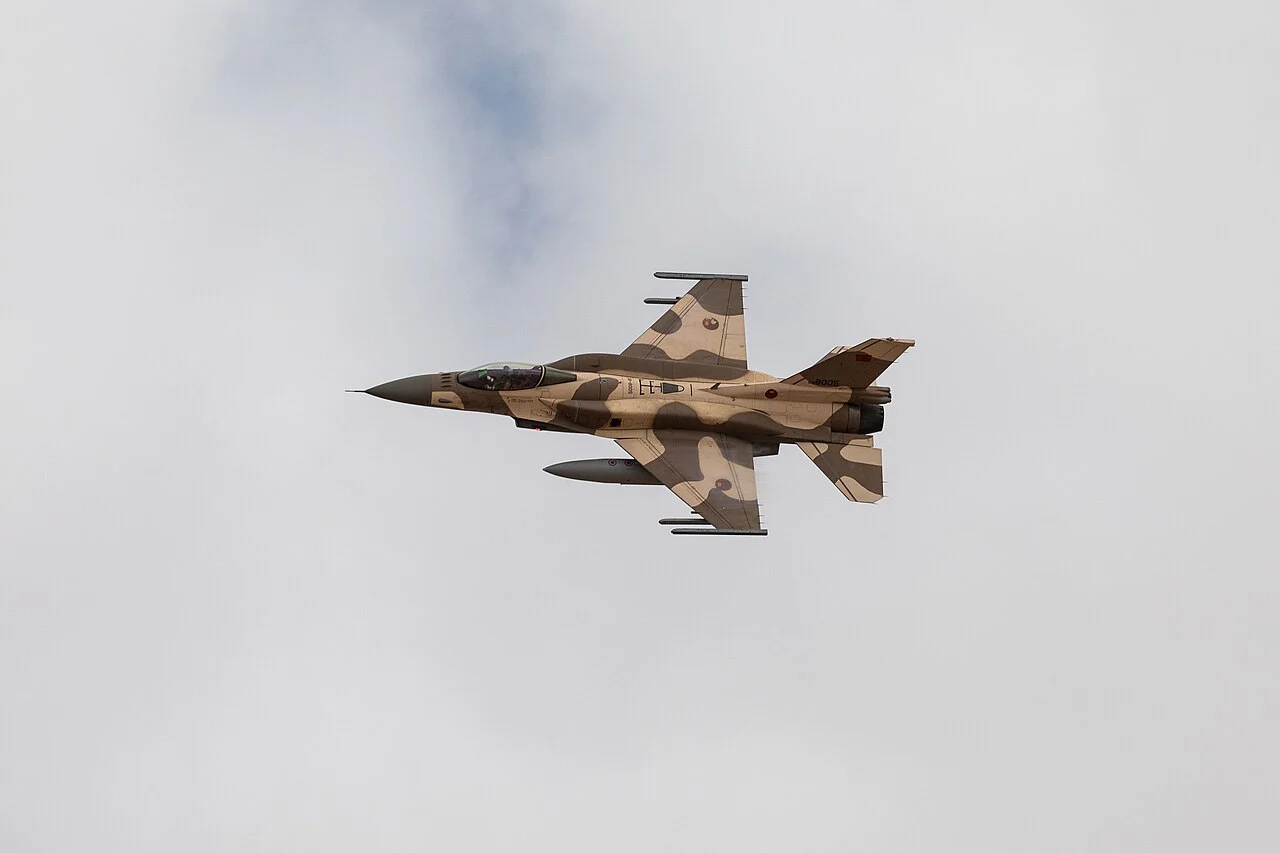
Morocco now buys more weapons than any other country in Africa, and it buys them from three very different sources at once: the United States for combat aircraft and armour, Israel for missiles, radar and loitering munitions, and Turkey for armed drones. Each relationship carries its own rules on what Rabat can do with the equipment afterward.
Photo: Royal Moroccan Air Force F-16C during Exercise African Lion, June 2022. Credit: U.S. Army National Guard photo by Spc. Mackenzie Willden, Public domain, via Wikimedia Commons
Key points
- SIPRI’s 2021-25 data puts the United States at 60% of Morocco’s arms imports, Israel at 24% and France at 10% – a reversal of the France-centred posture Morocco held a decade ago.
- The US relationship is the least flexible: F-16 Block 72 jets, M1A1 Abrams upgrades and Apache helicopters all move through Foreign Military Sales, with end-use monitoring and re-export restrictions attached.
- Israel has become the fastest-growing supplier, exporting the Barak MX air-defence system and licensing local loitering-munition production at a new Benslimane factory – politically sensitive but industrially generous.
- Turkey’s Bayraktar Akinci and TB2 drones came with a Moroccan assembly and maintenance subsidiary, Atlas Defence, giving Rabat something the US and Israeli deals do not: a stated production target on Moroccan soil DefenceMENA covers that relationship programme by programme, including the Otokar Cobra II order and the ASELSAN Koral deal, in a dedicated anatomy of Turkey’s arms deals with Morocco.
- Morocco carries none of the CAATSA exposure that complicates Algeria’s or Egypt’s procurement, because it has walked away from Russian-origin systems almost entirely.
- A domestic ammunition producer, MMI Ammunition, and new defence-industrial zones mark the first real attempt to convert import spending into local manufacturing capacity.
The supplier picture: how three countries reshaped the inventory
For most of the 2000s, Morocco’s armed forces were built around a French and, to a lesser extent, Soviet-legacy core. That picture no longer holds. SIPRI’s Trends in International Arms Transfers report for 2021-25 shows the United States supplying 60% of Moroccan arms imports, Israel 24% and France 10%, with Morocco’s overall import volume up 12% on the previous five-year period and large enough to make it Africa’s largest arms importer, ahead of Algeria for the first time (SIPRI Fact Sheet, March 2026; Morocco World News, March 2026).
The United States is now the anchor supplier for Morocco’s most expensive and most strategically important platforms. Twenty-five F-16C/D Block 72 aircraft and twenty-nine Pratt & Whitney F100-229 engines were cleared by the State Department in 2019 for an estimated $3.787 billion, and by mid-2026 deliveries were reportedly imminent, running on the same production line as Taiwan’s order (DSCA, Morocco F-16 Block 72 New Purchase notification). In August 2026 Washington approved a further Foreign Military Sale for two F-16 Block 72 full-mission trainers to support pilot conversion (Army Recognition, August 2026). Separately, General Dynamics Land Systems is under a $1.259 billion contract to upgrade around 162 M1 Abrams tanks to the M1A1 Situational Awareness or M1A2M standard, and Morocco was named in September 2025 among eight countries receiving a fresh $27 million Abrams technical-support award (DSCA, Abrams Tank Enhancement, Support, and Equipment; Morocco World News, September 2025). AH-64E Apache helicopters began arriving in March 2025 (delivery ceremony, Rabat).
Israel’s rise has been faster and less visible in Western reporting. Elta, a subsidiary of Israel Aerospace Industries, has supplied around 20 radars for Morocco’s F-5E fleet, and IAI’s Barak MX modular air-defence system – built around the ELM-2084 AESA radar – was ordered in a reported $500 million deal. Rafael’s SPYDER short-and-medium-range air-defence system is also in Moroccan service. In November 2025, an Israeli company opened a factory at Benslimane to produce SpyX loitering munitions on Moroccan soil, with Moroccan technicians reportedly training at BlueBird’s Israeli plant (The Defense Post, November 2025; Jerusalem Post).
Turkey’s Baykar delivered the first Bayraktar Akinci drones in February 2025 under a 2023 agreement, following an earlier $70 million order for 13 TB2s. The Akinci deal included the registration of a Moroccan subsidiary, Atlas Defence, in December 2024, intended to run maintenance and, according to Moroccan officials, eventually assemble airframes locally (The Defense Post, November 2024; Military Africa, February 2025). France, once the default supplier, retains a smaller footprint: Caesar self-propelled guns, Gazelle and incoming H225M Caracal helicopters, and two FREMM frigates including the Mohammed VI – detailed further in DefenceMENA’s earlier profile of what France still sells to Morocco. The parallel American relationship is covered in how the United States became a major supplier to Morocco’s armed forces.
| Capability | Main supplier | Dependency level | Main risk | Alternative |
|---|---|---|---|---|
| Fighter aircraft | United States (F-16 Block 52/72) | High | FMS conditionality, ITAR end-use monitoring, engine and software lock-in | None comparable at same capability tier; France (Rafale) politically available but costly |
| Air defence | Israel (Barak MX, SPYDER) and US (Patriot-class systems reportedly discussed) | Medium-High | Israeli export-licence approval (DECA); integration dependent on Israeli software updates | European systems (SAMP/T) or additional US Patriot batteries |
| Tanks/armour | United States (M1A1/M1A2M Abrams) | High | Long FMS upgrade cycles; spares and depot-level maintenance routed through US contractors | Limited; older French AMX-10 stock remains as fallback, not a real substitute |
| Helicopters | United States (Apache) and France (Caracal, Gazelle) | Medium | Dual-sourcing raises training and spares complexity but reduces single-supplier leverage | Cross-supply between US and French fleets already partially achieved |
| Naval systems | France/Netherlands consortium (FREMM), Netherlands (Sigma frigates) | Medium | European yards retain design authority; combat-system software support external | Limited; naval platforms are the least diversified category |
| UAVs | Turkey (Bayraktar TB2/Akinci) and Israel (loitering munitions) | Medium (falling) | Political sensitivity of Turkish-Israeli parallel sourcing; both suppliers under domestic assembly deals | Local assembly under Atlas Defence and the Benslimane plant already reduces this risk |
| Missiles/munitions | Israel (SPYDER interceptors, loitering munitions) and United States (precision-guided munitions via FMS) | High | Munitions resupply tied to two separate export-control regimes | New domestic 155mm/30mm production by MMI Ammunition covers only conventional artillery rounds, not guided munitions |
Dependency levels are DefenceMENA’s editorial assessment based on the sources listed below, not an official rating.
Dependency by category
Platform. The F-16 fleet and the Abrams upgrade programme make the United States Morocco’s platform anchor for air and land power. Both are Foreign Military Sales, meaning Rabat buys through the US government rather than directly from Lockheed Martin or General Dynamics, and both carry congressional notification and end-use monitoring obligations typical of FMS cases.
Engine. The F100-229 engines ordered alongside the Block 72 jets are Pratt & Whitney products, sold and supported under the same FMS umbrella as the airframes – an engine dependency that cannot be separated from the platform contract. The Abrams’ Honeywell/Textron AGT1500 gas turbine is likewise a US-controlled component with its own overhaul and parts pipeline.
Weapons. Morocco’s munitions picture is split three ways: US precision-guided munitions for the F-16 fleet, Israeli interceptors and loitering munitions for air defence and strike, and now domestic 155mm and 30x173mm rounds from MMI Ammunition at Sidi Yahya, certified to NATO STANAG standards (Express TV, July 2026). The domestic line covers conventional artillery ammunition, not the guided weapons that arm the air-defence and strike systems.
Sensor. Israel’s Elta has become the sensor supplier of record: roughly 20 radars for the F-5E fleet and the ELM-2084 AESA radar inside the Barak MX system. This is a newer and, in policy terms, more delicate dependency than the American one, since Israeli defence exports are licensed case-by-case through Israel’s Defense Export Control Agency and are more exposed to shifts in the bilateral relationship than a decades-old US FMS pipeline.
Software. Mission software on the F-16 fleet, including the Block 72’s active electronically scanned array radar and defensive systems, is controlled under US ITAR rules; source code and most software modifications require US government and contractor sign-off. The same is true of the Barak MX and SPYDER command-and-control software, which is Israeli-proprietary and updated by IAI/Rafael technical teams.
Maintenance. F-16 and Abrams depot-level maintenance still routes largely through US contractors and FMS support cases; the 2025 Abrams technical-support award and 2026 F-16 trainer contract are both sustainment, not new-equipment, spending. Baykar’s Atlas Defence subsidiary is a partial exception, since it was set up specifically to handle in-country maintenance of the Akinci and TB2 fleets rather than shipping airframes back to Turkey.
Political. Every major system in Moroccan service today – American, Israeli or Turkish – requires an export licence and is subject to some form of end-use monitoring or re-export restriction. The US relationship is the most codified (FMS, ITAR, congressional notification); the Israeli relationship is newer and more discretionary; the Turkish relationship, built around direct commercial sales rather than government-to-government FMS, is comparatively the least encumbered on paper, though still licensed under Turkish export law.
Industrial. Morocco’s own industrial base is the newest piece of the picture: MMI Ammunition’s artillery and medium-calibre production, new defence-industrial zones announced in 2025 with a reported $260 million investment target and over 2,500 jobs, and a partnership with India’s Tata Advanced Systems to assemble WhAP 8×8 armoured vehicles domestically (Morocco World News, November 2025; Hespress).
Sanction and export-control exposure
Morocco is close to a clean case on the CAATSA question that dominates coverage of Algeria and, until recently, Egypt: its Soviet and Russian-origin equipment was phased out years ago, and none of its current major suppliers is Russian, so the Countering America’s Adversaries Through Sanctions Act has essentially no live application to Moroccan procurement today. That removes an entire category of risk that complicates its neighbours’ choices.
The exposure that does exist is more conventional FMS and ITAR conditionality: US Congress can and does place holds or conditions on notified sales, end-use monitoring visits are a standard part of the F-16 and Abrams programmes, and re-export of US-origin technology – including onward transfer to a third country or integration with non-US systems – generally requires separate US approval. Because Morocco is simultaneously operating US platforms alongside Israeli sensors and Turkish drones, weapons-integration approval (can an Israeli radar or seeker be paired with a US-origin airframe, for instance) is a live administrative question even where it is not a public controversy.
A second, more political layer of export-control exposure comes from Morocco’s supplier states’ own domestic politics rather than from Rabat’s conduct. Spain increased arms exports to Morocco by 40% in 2025, to about €29.6 million, but the sales remain contested inside Spain’s governing coalition, where junior partners Sumar and Podemos have pushed for a Western Sahara-linked arms embargo that the government has so far rejected (Morocco World News, February 2026; Yabiladi). This is not a sanction on Morocco, but it illustrates how a European supplier’s internal politics can introduce friction even where the buyer faces no restriction of its own.
Local industry and what it can take over
Morocco’s industrial base was minimal a decade ago and remains modest by regional standards, but it has moved from near zero to a handful of concrete production lines. MMI Ammunition’s Sidi Yahya plant already produces six types of NATO-standard ammunition, covering 155mm artillery shells and 30x173mm medium-calibre rounds – the categories that consume the largest share of any army’s peacetime ammunition budget, even if they are not the guided munitions that arm precision strike systems. The government’s 2025 announcement of dedicated defence-industrial zones, alongside the Tata-partnered WhAP 8×8 assembly line, signals an intent to localise armoured-vehicle production rather than rely solely on imports or donated Excess Defense Article stock. Baykar’s Atlas Defence subsidiary adds a maintenance and, on paper, an assembly capacity for Turkish UAVs specifically. None of this yet reaches into engines, radars, guided-munitions seekers or mission software – the categories that remain fully foreign-controlled – but it is a genuine, if narrow, first step toward reducing the maintenance and conventional-ammunition dependence that used to run entirely through foreign suppliers.
Alternatives
For the US-supplied fighter and armour fleet, alternatives are limited by cost and integration: France’s Rafale remains the most discussed option regionally (as Egypt’s build-out shows) but would require Morocco to stand up an entirely separate maintenance, munitions and training pipeline alongside its F-16s rather than replacing them – diversification, not substitution. South Korean platforms (KF-21, K2 Black Panther) have entered MENA conversations elsewhere in the region and could in principle offer a lower-cost hedge, but Morocco has no current programme in that direction. For air defence, the Israeli Barak MX and SPYDER systems could in theory be supplemented by European SAMP/T batteries or additional US Patriot-class equipment, both of which are politically simpler for Washington-aligned European partners but slower to deliver and more expensive per battery. For UAVs, Morocco has already diversified across two suppliers (Turkey and Israel) plus a domestic assembly line, which is arguably the category where alternatives have been most successfully built in rather than merely discussed.
Switching cost
Every one of Morocco’s core platforms carries a switching cost well beyond the sticker price of a new system. F-16 pilots and ground crews are trained on US syllabi and simulators; replacing the type would mean retraining an entire pilot corps and rebuilding a maintenance infrastructure built around Pratt & Whitney engines and Lockheed Martin avionics. The Abrams fleet requires depot facilities, spares inventories and crew training specific to the M1 family; swapping to a different main battle tank would strand that investment. Israeli air-defence systems are integrated with Moroccan early-warning and command networks in ways that are not easily unplugged without a period of reduced coverage. Even the comparatively young Turkish drone relationship now has sunk costs in the form of the Atlas Defence facility and locally trained maintenance technicians. In every category, the constraint is less “could Morocco buy something better” than “could Morocco afford the multi-year retraining, infrastructure and munitions-stockpile transition that switching would require” – which is why even publicly discussed alternatives (Rafale, SAMP/T, KF-21) remain additions under consideration rather than replacements.
Diversification: what it solved and what it complicated
Morocco’s shift from a largely French-anchored force to a US-Israeli-Turkish tripod has clearly reduced single-country political leverage: no one capital can now hold Moroccan readiness hostage the way a French or Russian supplier once might have. It has also opened access to capability France was reluctant or slow to offer, particularly in air defence and armed drones. The cost has been complexity: three different export-control regimes, three different software ecosystems, and – as the Spain example shows – exposure to the domestic politics of supplier states even when Morocco itself is not the subject of controversy. Naval systems remain the least diversified category, still concentrated in French and Dutch-built platforms, which is where a future supply disruption would be hardest to absorb quickly.
DefenceMENA Autonomy Index – Morocco
| Criterion | Weight | Score | Justification |
|---|---|---|---|
| Domestic manufacturing | 20 | 6 | New ammunition and armoured-vehicle assembly lines exist but cover a narrow slice of the inventory |
| Local maintenance | 15 | 5 | Atlas Defence handles Turkish UAVs in-country; F-16/Abrams depot work still largely US-based |
| Local ammunition | 15 | 7 | MMI Ammunition covers conventional artillery and medium-calibre rounds to NATO standard |
| Supplier diversification | 15 | 12 | Three substantial, independent suppliers (US, Israel, Turkey) plus a residual French/Dutch naval relationship |
| Critical components | 15 | 3 | Engines, AESA radars and guided-munitions seekers remain entirely foreign-sourced |
| Technology transfer | 10 | 5 | Present in the Turkish and Indian (Tata) deals; largely absent from the US and Israeli relationships |
| Export-control exposure | 10 | 6 | No CAATSA exposure, but ITAR/FMS conditionality on the two most expensive programmes |
| Total | 100 | 44 |
DefenceMENA editorial analytical index, not an official ranking.
Why it matters for the MENA region
Morocco is a useful counter-example to the CAATSA-heavy stories that dominate coverage of Algeria, Egypt and Iraq: a MENA military can build a genuinely diversified supplier base – American, Israeli and Turkish at once – without triggering the sanctions exposure that comes with Russian or Chinese-origin systems. That diversification has bought Rabat flexibility and capability it would not have had from a single supplier, but it has not yet translated into the industrial depth that would let it absorb a serious disruption to any one relationship. The Morocco case shows both halves of the diversification thesis clearly: political risk has fallen because no single supplier holds full leverage, but logistical and technical complexity has risen because three different export-control systems, training pipelines and software ecosystems now have to be run in parallel.
Sources
- SIPRI, Trends in International Arms Transfers 2025 (March 2026)
- Morocco World News, “SIPRI: Morocco Overtakes Algeria as Africa’s Top Arms Importer” (March 2026)
- Defense Security Cooperation Agency, “Morocco – F-16 Block 72 New Purchase”
- Army Recognition, F-16 Block 72 full-mission trainers contract (August 2026)
- DSCA, “Abrams Tank Enhancement, Support, and Equipment”
- Morocco World News, Abrams technical-support contract (September 2025)
- The Defense Post, Israeli loitering-munition plant at Benslimane (November 2025)
- Jerusalem Post, Israeli drones in Morocco
- The Defense Post, Morocco Bayraktar Akinci order (November 2024)
- Military Africa, first Akinci deliveries (February 2025)
- Express TV, MMI Ammunition NATO-standard production (July 2026)
- Morocco World News, defence-industrial zones investment (November 2025)
- Hespress, Morocco’s shift toward joint defence production
- Morocco World News, Spanish arms exports up 40% (February 2026)