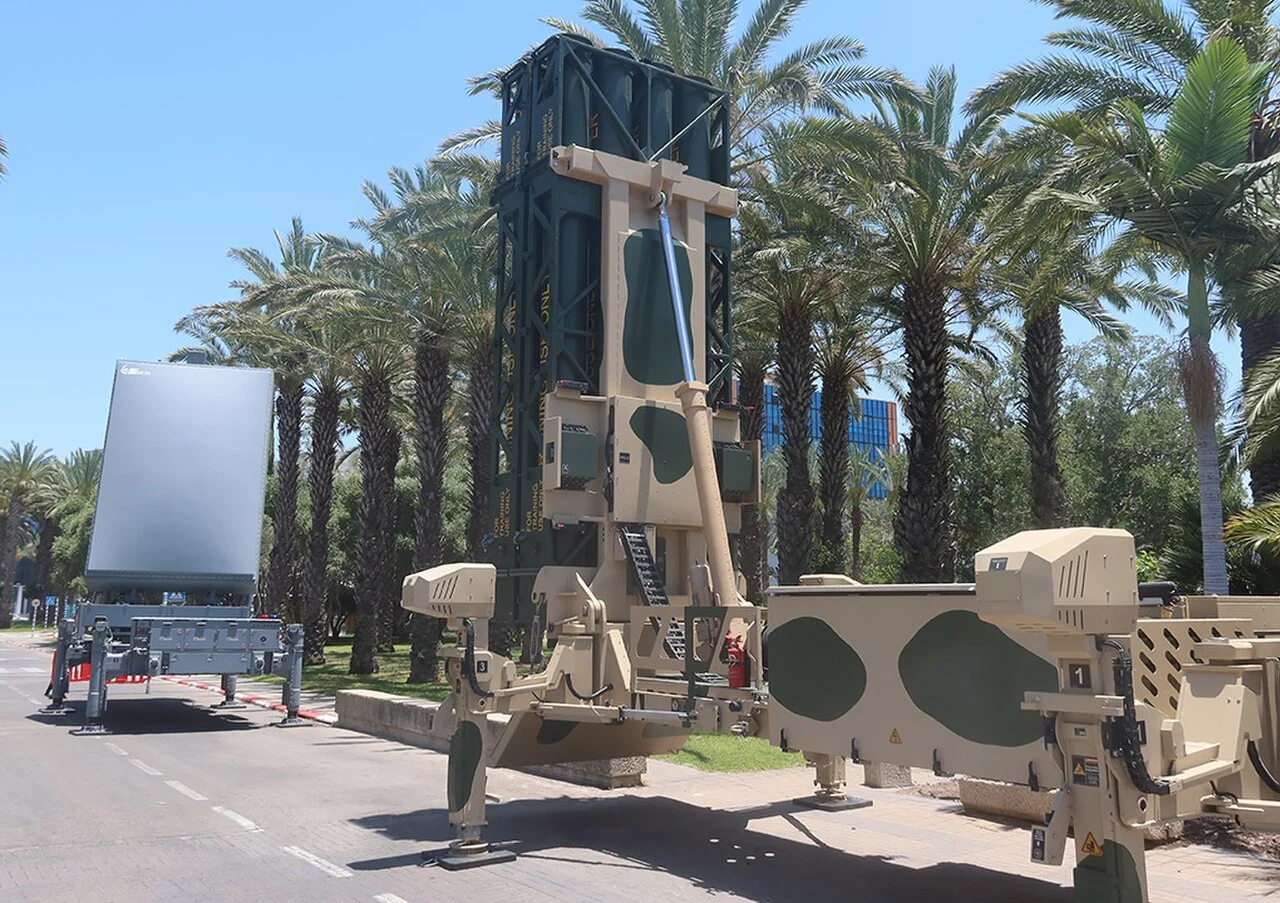
Morocco bought Israel’s Barak MX air and missile defense system because its ground-based air defenses, built around ageing US-supplied MIM-23 Hawk batteries, had no answer to the mixed threat that emerged after 2020: a resumed Polisario Front insurgency using drones and loitering munitions in Western Sahara, and an Algerian military buying advanced Russian aircraft and missiles after the two countries severed diplomatic relations in 2021. The deal followed, within three months, the first defense memorandum Morocco and Israel ever signed, itself a direct product of their December 2020 normalization of relations. Rabat paid a reported $500 million for a layered interceptor system covering 35 to 150 kilometers, the components began arriving in 2023, and by January 2026 open-source satellite analysis indicated the system had gone live — without either government confirming it.
Photo: An IAI Barak MX air defense fire unit displayed alongside its ELTA Systems EL/M-2084 Multi-Mission Radar. Credit: JamesBondonMission, Wikimedia Commons (CC BY-SA 4.0). This unit is not confirmed to be the specific battery deployed to Morocco.
This explainer follows one question: why did this African and Arab customer choose this system? The answer below comes from Israeli and Moroccan defense-trade reporting, satellite-imagery analysis cited by named outlets, and government statements where they exist. Neither Rabat nor Tel Aviv has officially confirmed the deployment; where the record is silent or contested, this article says so.
| Item | What the record shows | Status |
|---|---|---|
| Customer | Royal Moroccan Armed Forces (air defense command) | Reported, not officially confirmed |
| System | Barak MX modular air and missile defense system (Israel Aerospace Industries, with ELTA EL/M-2084 MMR radar) | Confirmed sale; deployment reported |
| Interceptor tiers | Barak-MRAD (35km), Barak-LRAD (70km), Barak-ER (150km) | Confirmed by manufacturer specifications |
| Quantity | Not disclosed (number of batteries/launchers unknown) | Unknown |
| Route | Direct government-to-government sale following a bilateral defense MoU; not a US Foreign Military Sale | Confirmed |
| Contract value | Reported as “more than $500 million” by most outlets; one outlet reported $600 million | Reported, figures diverge |
| Base | Reported at the Sidi Yahya el Gharb air defense site, north-east of Rabat | Reported via satellite imagery analysis |
| Operational status | Said to be active since around January 2026, based on satellite-detected electronic emissions | Unconfirmed by either government |
| Local production | None documented for Barak MX specifically | — |
What capability did Morocco need?
Morocco’s ground-based air defense inventory going into the 2020s was built around the MIM-23 Hawk, a US medium-range system dating to the Cold War; some batteries had received life-extension work, but the architecture had no long-range, multi-target, sensor-fused answer to modern threats. GlobalSecurity.org‘s assessment of the Royal Moroccan Air Force describes the air defense arm as having “very few modern components” and being “very much in need of medium range options.”
Two developments sharpened the requirement. First, the Western Sahara ceasefire that had held since 1991 collapsed in November 2020, and the Algeria-backed Polisario Front resumed low-intensity attacks; Dutch conflict researchers Oryx catalogued the group’s drone and loitering-munition inventory from that period. Second, Morocco’s relationship with Algeria deteriorated sharply, culminating in Algeria’s severance of diplomatic relations in August 2021; regional reporting ties Morocco’s subsequent air-defense shopping, including Patriot evaluation, directly to Algeria’s acquisition of advanced Russian combat aircraft, including Su-35s and an anticipated Su-57 order (Defence Security Asia).
The opening that made an Israeli solution possible came earlier and separately: Morocco and Israel normalized relations in December 2020 as part of a US-brokered deal in which Washington recognized Moroccan sovereignty over Western Sahara, reported at the time by Al Jazeera to include a parallel US arms package worth roughly $1 billion. For the current inventory, see our Morocco military strength overview.
What did Morocco operate before?
Before Barak MX, Morocco’s layered air defense consisted of ageing Hawk batteries and shorter-range systems; a separate, more recent Israeli acquisition, the Rafael SPYDER (20–80km), was deployed at the same Sidi Yahya el Gharb site and confirmed by satellite imagery in May 2026, according to Medias24. Morocco has separately pursued the US MIM-104 Patriot for the top tier of its air-defense architecture; as of March 2025 it was reported to be field-testing the system rather than operating it (Army Recognition). None of these programmes replaced the others; they describe a single military building several tiers of a layered shield at once, a strategy Medias24 traces to a “territorial air defense” plan Morocco launched in 2011.
Procurement timeline
| Stage | Date | What happened | Source |
|---|---|---|---|
| Normalization | 10 Dec 2020 | Morocco and Israel agree to normalize relations; US recognizes Moroccan sovereignty over Western Sahara; a parallel ~$1bn US arms package reported | Al Jazeera |
| Ceasefire collapse | Nov 2020 | Polisario Front resumes armed action in Western Sahara after the 1991 ceasefire breaks down | Oryx |
| Requirement / framework | 24 Nov 2021 | Israeli Defense Minister Benny Gantz visits Rabat; first Morocco-Israel defense MoU signed, covering operational planning, procurement, R&D and training | Al Jazeera |
| Diplomatic rupture (context) | Aug 2021 | Algeria severs diplomatic relations with Morocco | Regional reporting |
| Selection / contract | 13–15 Feb 2022 | IAI and Morocco sign a direct government-to-government contract for Barak MX, reported at “more than $500 million”; one outlet reports $600 million | Globes; The Defense Post; Jewish Press |
| First deliveries | By Aug 2023 | First Barak MX components/shipments arrive in Morocco | Atalayar |
| Parallel Patriot evaluation | Mar 2025 | Morocco reported field-testing the US Patriot system, a separate and longer-range acquisition track | Army Recognition |
| SPYDER confirmed | May 2026 | Satellite imagery shows the shorter-range Israeli SPYDER system active at Sidi Yahya el Gharb | Medias24 |
| Barak MX reported operational | Jan 2026 | Satellite-detected electronic emissions consistent with Barak MX activation reported by Israeli media; no official confirmation | The Defense Post; Hespress |
| Operational status reaffirmed | 14 Sep 2026 | Trade press reports deployment and operational activation “completed,” alongside a wider list of Israeli-sourced Moroccan systems | euro-sd |
| Additional order | — | None found | Unknown |
The gating step here was not a lengthy foreign approval process of the kind that delayed Nigeria’s Super Tucano by two years. It was diplomatic: the MoU could not exist before the December 2020 normalization, and once it existed, contract to first deliveries took under eighteen months — fast by regional standards, and consistent with a direct state-to-state sale rather than an open tender.
What was purchased?
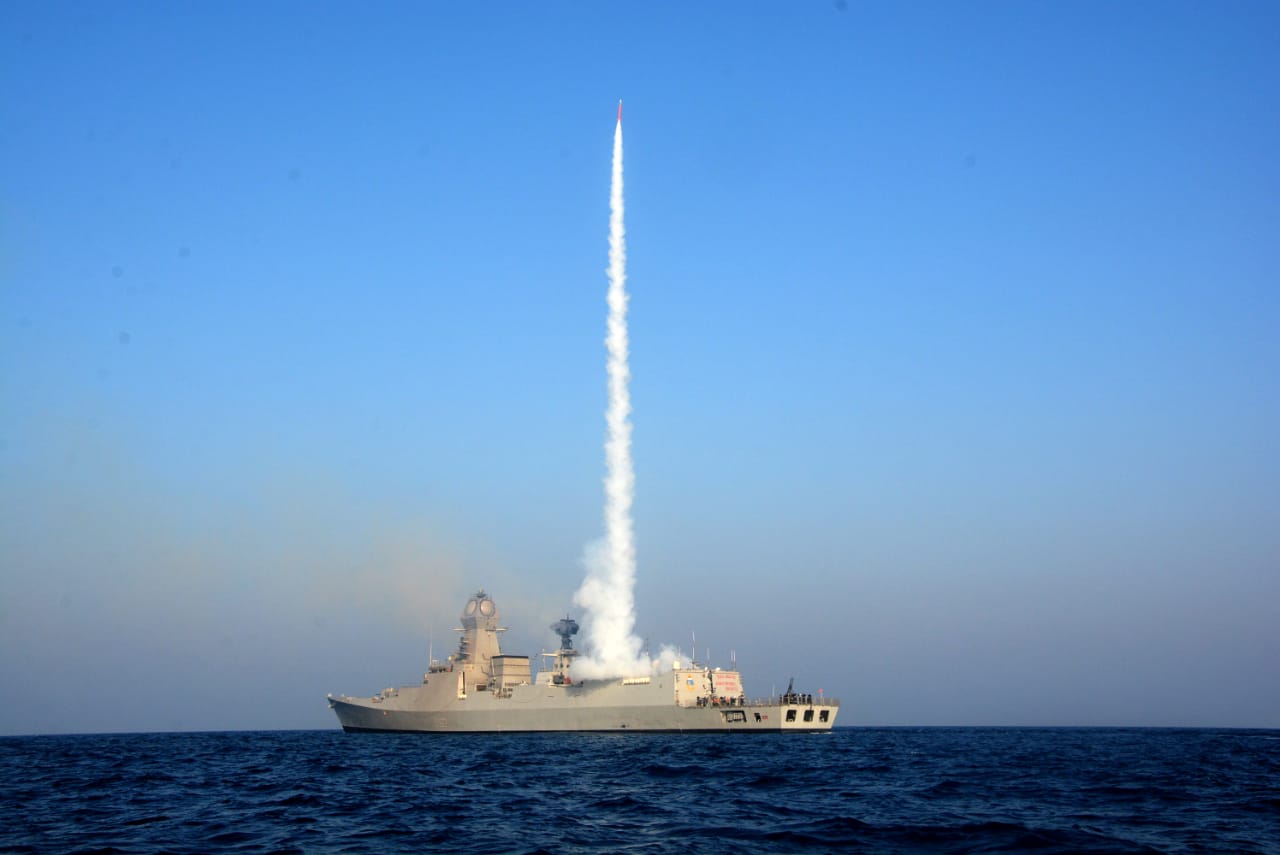
Reporting on the contract describes Barak MX as a “flexible and modular” system managing three interceptor types in one architecture: Barak-MRAD out to 35 kilometers, Barak-LRAD out to 70 kilometers, and Barak-ER out to 150 kilometers, plus radar and launchers, intended to cover aircraft, helicopters, drones, cruise missiles and both air-to-ground and ballistic missile threats (Globes). No public source gives the number of fire units, launchers or interceptor rounds Morocco bought, and neither government has published a package breakdown of the kind the US discloses for FMS sales.
What did it cost?
| Figure | What it is | Source |
|---|---|---|
| “More than $500 million” | Contract value cited by most outlets covering the February 2022 signing | Globes; The Defense Post; Israel Hayom |
| $600 million | Higher figure reported by one Israeli outlet for the same deal | Jewish Press |
| ~$1 billion (separate) | Broader US arms package reported alongside the December 2020 normalization, not part of the Barak MX contract | Al Jazeera |
| ~$150 million (separate) | Reported value of Morocco’s Israeli PULS multiple rocket launcher purchase, a different programme | euro-sd |
| ~$1 billion (separate) | Reported 2024 value of an Israeli-built Moroccan reconnaissance satellite, a different programme | euro-sd |
These figures should not be combined: they cover different programmes negotiated at different times by different Moroccan and Israeli entities. For Barak MX itself, the $500–600 million range is a total contract figure with no public division between interceptors, radars, launchers, training and support, so no reliable unit price for a battery or a single interceptor can be derived from it.
Why was the system selected?
| Factor | Evidence | Strength |
|---|---|---|
| Political opening via normalization | Barak MX talks followed directly from the Nov 2021 defense MoU, itself a product of Dec 2020 normalization | Documented sequence of events |
| Speed of a direct state-to-state sale | MoU to signed contract took about three months (Nov 2021–Feb 2022); contract to first deliveries under 18 months | Documented dates, no confirmed cause-and-effect on “speed” as a factor Morocco cited |
| Multi-tier capability in one architecture | Three interceptor ranges (35/70/150km) against aircraft, missiles and drones in a single system | Manufacturer and trade-press description |
| Fit against the specific threat mix | Covers both lower-end drone/loitering-munition threats (Polisario) and longer-range aircraft/missile threats (Algeria) | Analyst inference from regional reporting, not a Moroccan government statement |
| Price versus Patriot or SAMP/T | No published comparison | Unknown |
| Local production or technology transfer | None documented for Barak MX; Morocco did later secure drone assembly from a different Israeli company (BlueBird) | Documented for the separate drone programme, not for Barak MX |
| Financing | Not disclosed | Unknown |
No Moroccan official statement explains the choice in capability or cost terms; the government has not publicly acknowledged the deal at all. What is documented is the sequence — normalization, a defense MoU, then a fast-moving contract — and the fact that Morocco kept pursuing other tiers (SPYDER, Patriot) in parallel rather than treating Barak MX as a complete answer.
Were alternatives considered?
| Category | System | Evidence |
|---|---|---|
| Confirmed competitor | None found | No public tender or head-to-head evaluation located; this was a negotiated government-to-government sale |
| Reported parallel acquisition (not a rejected alternative) | MIM-104 Patriot (US) | Different, higher-end tier; pursued separately and tested as late as March 2025, years after the Barak MX contract (Army Recognition) |
| Reported parallel acquisition (not a rejected alternative) | Rafael SPYDER (Israel) | Shorter-range complement deployed at the same base in 2026 (Medias24) |
| Theoretical same-class alternative | Franco-Italian SAMP/T | Same broad role; no evidence Morocco evaluated it for this requirement |
It would misstate the record to say Morocco “chose Barak MX over” any named system. The available reporting shows a single track that ran from a political opening to a negotiated contract, alongside separate acquisitions for other parts of the air-defense architecture rather than a competition Barak MX won.
Training and support
No Moroccan or Israeli source reviewed for this article discloses pilot or crew training numbers, a field-service-representative arrangement, or a sustainment contract for Barak MX, in contrast to the detailed US Air Force and AFRICOM disclosures that accompany American FMS deals elsewhere in the region. What is documented, for a related but distinct programme, is that BlueBird Aero Systems — an IAI subsidiary — sent a Moroccan technical team to train in Israel before opening a SpyX loitering-munition production line in Benslimane in November 2025 (Globes). That training and local-production arrangement applies to the SpyX drone programme, not to Barak MX, and should not be read across.
Delivery and operational service
| Claim | Who made it | Grade |
|---|---|---|
| First components arrived in Morocco by August 2023 | Atalayar, citing the original February 2022 agreement | Media reporting, undisputed |
| System active at Sidi Yahya el Gharb since around January 2026 | Israeli media (Times of Israel blog) via satellite-detected electronic emissions, relayed by The Defense Post and Hespress | Independent, signals-based, unverified by either government |
| Deployment and operational activation “completed” | euro-sd trade press, September 2026 | Independent trade press, no primary government source cited |
| Official Moroccan or Israeli confirmation | Neither government | None found |
No source reviewed reports Barak MX being used in an engagement, and none claims the Polisario Front’s drone inventory has forced an interception. The entire operational picture rests on open-source satellite and signals analysis rather than official disclosure, which is itself consistent with the broader pattern: Morocco has not publicly confirmed any of its Israeli-sourced hardware purchases since 2020, even as the purchases themselves have been reported in detail by Israeli, Moroccan and international trade press.
Industrial cooperation
No local assembly, maintenance-repair-overhaul capability or technology transfer is documented for Barak MX itself; it was delivered as a finished system under a direct contract. This is distinct from Morocco’s broader push to localize parts of its Israeli-sourced defense supply chain: BlueBird Aero Systems opened a SpyX drone production line at Benslimane in November 2025 after training a Moroccan team in Israel, and the same Benslimane site has also been linked to a Turkish Baykar drone project, according to Medias24. Local drone assembly is not the same as local missile-defense manufacturing, and nothing in the public record extends Benslimane’s drone work to Barak MX.
Was it a good fit? Documented trade-offs
| Dimension | Evidence in favour | Trade-off or open question |
|---|---|---|
| Mission | Three interceptor tiers cover both drone/loitering-munition threats and higher-end aircraft and missile threats in one management system | Number of fire units is undisclosed, so area coverage cannot be independently assessed |
| Environment | Reported siting at Sidi Yahya el Gharb and, per some accounts, further south, suits both coastal and desert geography | Performance data in Moroccan conditions is not public |
| Layered architecture | Sits alongside SPYDER (short/medium) and a parallel Patriot evaluation (long-range, different supplier) as part of a 2011-origin territorial air-defense plan | Multiplies the number of training pipelines, spares chains and command-and-control integrations the Royal Armed Forces must manage |
| Political | Opened a fast-moving, low-friction Israeli supply channel outside the US congressional-notification process | Defense ties with Israel are politically sensitive domestically, which may explain the absence of any official Moroccan acknowledgment |
| Transparency | Multiple independent outlets, across several years, corroborate the broad shape of the deal | No official confirmation exists for quantities, unit costs, training or current operational status |
How it compares with same-class alternatives
A specification-for-specification comparison would overstate what is public, because Morocco has not published one and the systems below sit at different tiers of the same architecture rather than competing for the same role. What the record supports: the Hawk is the 1960s-design system Barak MX effectively supersedes at the upper end of Morocco’s older inventory; SPYDER is a shorter-range (20–80km) complement reported active at the same base; and Patriot, if Morocco eventually fields it, would sit above Barak MX’s 150km ceiling against the highest-end threats. No independent cost or performance comparison between Barak MX and Patriot in Moroccan service has been published.
Regional consequence
Morocco’s purchase made it, according to euro-sd, one of the largest buyers of Israeli defense equipment among the states that normalized relations with Israel from 2020, alongside the UAE. The newspaper The New Arab has reported domestic criticism in Morocco of continued defense cooperation with Israel during the Gaza war, underlining that the relationship carries a political cost at home that the government has managed partly through silence rather than public justification. Nothing in the sources reviewed shows that Morocco’s purchase directly caused Algeria to buy any specific system in response, so the rivalry should be read as context for both countries’ acquisitions, not proof that one caused the other.
What happened next
Morocco continued building out the same layered air-defense architecture rather than stopping at Barak MX: SPYDER followed in 2026, the Patriot evaluation continued separately, and Israeli suppliers expanded into drones (Heron, Harop, WanderB, ThunderB per euro-sd), counter-UAS systems (SkyLock, 2021), the PULS rocket system and a reconnaissance satellite. For the wider pattern across US, Israeli and Turkish suppliers, see our analysis of how Morocco balances its suppliers, and for the Algeria dimension, our comparison of the two militaries.
FAQ
Why did Morocco buy the Barak MX?
To fill a gap left by its ageing Hawk air-defense batteries against a threat mix that broadened after 2020: Polisario drones and loitering munitions in Western Sahara, and Algeria’s acquisition of advanced Russian aircraft, at a moment when normalization with Israel had just opened a fast, direct procurement channel.
How much did Morocco pay for Barak MX?
Most reporting puts the contract at “more than $500 million,” signed in February 2022; one Israeli outlet reported $600 million. No official figure has been published.
Is Barak MX confirmed to be operational in Morocco?
Not officially. Satellite-detected electronic signals reported by Israeli media and relayed by trade press indicate activity consistent with an operational system since around January 2026, but neither Rabat nor Tel Aviv has confirmed this.
Did Morocco choose Barak MX over the Patriot?
No evidence supports that framing. Patriot is a separate, longer-range system Morocco has evaluated on its own timeline, years after the Barak MX contract, as part of a layered architecture rather than a single either-or decision.
Does Morocco manufacture or assemble Barak MX locally?
No such arrangement is documented. Morocco does have a separate Israeli-backed drone assembly line (BlueBird’s SpyX loitering munitions at Benslimane), but that is a different programme.
What other Israeli systems has Morocco bought?
Reported purchases include the SPYDER air-defense system, SkyLock counter-drone systems, PULS rocket artillery, Heron, Harop, WanderB and ThunderB drones, and a reconnaissance satellite, according to euro-sd.
Related reading
- Morocco’s military arsenal in 2026 (country inventory)
- How Morocco balances American, Israeli and Turkish suppliers
- How Morocco and Algeria compare militarily in 2026
- 5 alternatives to Patriot for MENA
- Military equipment database
Sources
- Al Jazeera, US moving ahead with $1bn arms sale to Morocco (12 December 2020)
- Al Jazeera, Morocco, Israel sign first-ever defence agreement in Rabat (24 November 2021)
- Globes, IAI agrees $500m missile defense systems deal with Morocco (13 February 2022)
- The Defense Post, Israel, Morocco sign $500 million air defense deal (15 February 2022)
- Jewish Press, IAI to sell Morocco Barak MX missile system for $600 million (14 February 2022)
- Atalayar, Israel’s Barak MX arrive in Morocco for the first time (12 August 2023)
- Army Recognition, Morocco field-testing Patriot amid Algeria’s Su-57 purchase (March 2025)
- The Defense Post, Morocco starts deployment of Israeli Barak MX defense system (6 January 2026)
- Hespress, Israeli media: Morocco’s Iron Dome-style shield may be live, as Barak MX emits signals (7 January 2026)
- Medias24, Morocco’s Royal Armed Forces deploy new SPYDER shield in Sidi Yahia (11 May 2026)
- European Security & Defence, Morocco eyes Israeli defence system (14 September 2026)
- Globes, IAI unit opens suicide-drone production plant in Morocco
- Medias24, Benslimane: future hub of Morocco’s defense industry, Baykar and BlueBird projects unveiled (13 November 2025)
- The New Arab, Morocco opens Israeli drone factory amid normalisation debate
- Oryx, Desert Storm: listing the Polisario’s arsenal (December 2021)
- GlobalSecurity.org, Royal Moroccan Air Force modernization