How Israel Became One of Morocco’s Top Arms Suppliers



In barely five years, Israel has gone from having no diplomatic relationship with Morocco to becoming one of the three or four countries that actually equip the Royal Moroccan Armed Forces, selling Rabat air-defence radars, rocket artillery, reconnaissance satellites and, increasingly, the factories to build the ammunition itself.
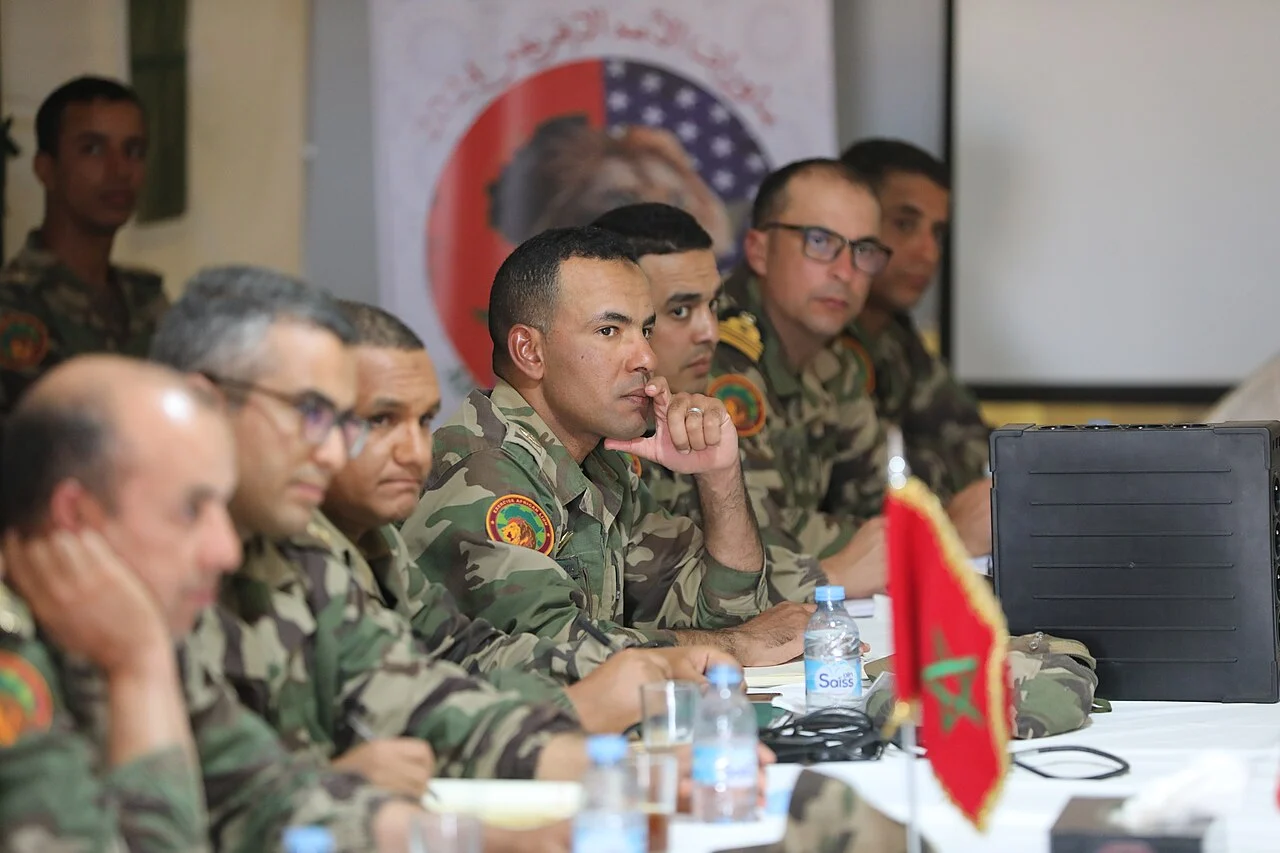
Photo: Royal Moroccan Armed Forces personnel meet New York National Guard counterparts during Exercise African Lion, May 2024. Credit: U.S. Army photo by Avery Schneider, Public domain, via Wikimedia Commons.
Morocco and Israel had no formal ties until December 2020, when Rabat agreed to normalise relations with Israel as part of a US-brokered deal that also saw Washington recognise Moroccan sovereignty over Western Sahara. Within a year, the two countries had moved from diplomacy to weapons: a defence memorandum of understanding signed in November 2021 opened the door to intelligence-sharing, defence-industrial cooperation and arms sales. Since then, Israeli systems have moved into the Royal Moroccan Armed Forces’ air-defence batteries, artillery parks, drone fleets and now its armaments factories, built around three companies — Israel Aerospace Industries (IAI), Elbit Systems and Rafael — competing and cooperating with the longer-established American and French suppliers Morocco has relied on for decades. This profile sets out what Morocco has actually ordered, received and put into service from Israel, and what is still only reported. It is a companion to DefenceMENA’s wider Morocco military-strength profile and to its anatomies of Morocco’s other two main suppliers, the United States and France, as well as a look at Israeli-built weapons systems across African armed forces more broadly.
| Diplomatic normalisation | December 2020 (US-brokered) |
| Defence MoU signed | 23–24 November 2021, Rabat (Gantz–Loudiyi) |
| Israel’s rank among Morocco’s suppliers | 2nd or 3rd largest by value, depending on the measure used (see Suppliers section) — behind the United States |
| Flagship air-defence system | Barak MX (IAI), contracted Feb 2022, deployed since 2023 |
| Flagship artillery deal | 36 ATMOS 2000 self-propelled howitzers (Elbit), reported Feb 2025 |
| Largest single contract reported | ~$1bn for 2 Ofek-13 reconnaissance satellites (IAI), reported Aug 2024 |
| Local production | Moroccan Military Industry (MMI, Elbit subsidiary, Casablanca); BlueBird Aero Systems drone plant, Benslimane |
How the relationship formed
Morocco’s security relationship with Israel did not start from zero in 2020. Analysts who have followed the file, including former Israeli deputy national security adviser Chuck Freilich, have said the 2021 understanding mainly formalised security contacts that already existed quietly. What changed after December 2020 was that cooperation could move into the open: Israel’s then defence minister Benny Gantz travelled to Rabat on 23–24 November 2021 and signed, with Moroccan counterpart Abdellatif Loudiyi, the first defence memorandum of understanding Israel has concluded with an Arab country. Israel’s defence ministry said the deal covered intelligence-sharing, defence-industrial ties, procurement and joint exercises; Moroccan officials described it as covering technology transfer, training and defence-industrial cooperation, alongside a separate cybersecurity agreement signed the same visit.
There is no mutual-defence treaty or NATO-style alliance between the two countries — the relationship runs on memoranda, a bilateral Joint Military Committee and individual commercial contracts. The third session of that committee met in Tel Aviv in January 2026 and signed an action plan for the year covering professional exchanges, visits to Israeli defence-industry sites and technical cooperation, a sign the relationship has settled into a routine institutional track rather than a one-off arms-sales spree.
| System | Manufacturer | Contract / Announcement | Quantity | Delivery | Current status | Source |
|---|---|---|---|---|---|---|
| SkyLock counter-drone system | Sky Sapience / SkyLock Systems | Reported 2021 | Undisclosed | Reported 2021 | Reported (unconfirmed) | JNS, Africa Intelligence (via Military Africa) |
| Heron / Harfang surveillance UAV | IAI | ~$48m deal | Undisclosed | Delivered 2021 | In service | Army Recognition, Military Africa |
| Barak MX air & missile defence system | IAI | Contracted Feb 2022, reported value $500m–$600m | Not disclosed | Deliveries from mid-2023; full operational status reported early 2026 | In service (deployed, Sidi Yahya El Gharb base) | Globes, Jewish Press, Atalayar, Raksha Anirveda |
| PULS multiple rocket launcher | Elbit Systems | Reported 2023, ~$150m | Launchers, number undisclosed | Deliveries through 2026 | In service; EXTRA guided munition reportedly test-fired Aug 2025 | Globes, Bladi.net, Morocco World News, Army Recognition |
| SPYDER air defence system | Rafael (with IAI/ELTA) | Announced March 2023 | Not disclosed | Imagery suggests deployment by May 2026 | Reported (unconfirmed by Rabat) | Defence Industry Europe, Medias24, Morocco World News |
| Ofek-13 reconnaissance satellites | IAI | Reported Aug 2024, ~$1bn (IAI stock-exchange filing) | 2 satellites | Over ~5 years from 2024 | Contracted (buyer unconfirmed by either government) | Space in Africa, The Defense Post, Military Africa |
| ATMOS 2000 self-propelled howitzer | Elbit Systems | Reported Feb 2025 | 36 guns, on Tatra 8×8 chassis | Not disclosed | Reported (unconfirmed by Rabat) | Medias24, Morocco World News, Army Recognition, Hespress |
| LORA tactical ballistic missile | IAI | “Advanced talks” reported by Calcalist | Not disclosed | Not signed as of this writing | Reported (unconfirmed) | Calcalist |
| UT30 Mk II unmanned turret (30mm) on Tata WhAP 8×8 | Elbit Systems / MMI | Shown at Marrakech Airshow; MMI-ADN agreement reported Oct 2026 | Not disclosed | Turret deliveries to start March 2027 | Contracted (per MMI general manager) | Reuters, via DefenceMENA reporting |
Two figures that look alike are easy to confuse here. The $500–600m range quoted for Barak MX and the roughly $150m reported for PULS are contract-value estimates from trade sources, not figures either government has confirmed; the $1bn Ofek-13 number comes from IAI’s own disclosure to the Tel Aviv Stock Exchange, which did not name the buyer, so Morocco’s identity as the customer rests on Israeli and Moroccan press sourcing, not an official statement from either side. None of these programmes should be read as proof of what is operational today — see the status column, and the sections below.
Air defence: the backbone of the relationship
Air and missile defence is where the Israeli relationship has gone furthest. Barak MX, IAI’s modular, multi-layer interceptor system, was the first major deal: talks reportedly began during Gantz’s November 2021 visit and were signed in February 2022, with IAI chief executive Boaz Levy said to have travelled to Morocco personally to close the details. The system uses three interceptor variants reaching roughly 35km, 70km and 150km, giving the Royal Moroccan Armed Forces a layered shield against aircraft, missiles and drones. Satellite-imagery analysts tracking open-source signals say deliveries began around mid-2023 and that deployment at the Sidi Yahya El Gharb air-defence base, roughly 60km northeast of Rabat, was complete by early 2026, though neither government has formally confirmed the deployment.
A second, shorter-to-medium-range system, Rafael’s SPYDER (built with IAI and ELTA components, covering roughly 20–80km), was announced in March 2023 to fill the gap below Barak MX and above Morocco’s legacy MIM-23 I-HAWK batteries. Satellite imagery reported by Moroccan outlet Medias24 and Morocco World News in May 2026 suggested SPYDER units had also reached Sidi Yahya, though this too is unconfirmed by Rabat. Morocco has separately sought US clearance for MIM-104 Patriot (State Department approval given in early 2023) without a confirmed acquisition contract, so the kingdom’s layered air-defence architecture is being built from Israeli, American and legacy Franco-American stock rather than a single supplier.
Artillery and rocket fire: Elbit displaces a French order
Morocco’s move into Israeli ground-fire systems followed a rockier French chapter. Rabat had ordered Caesar self-propelled howitzers from France’s KNDS in 2020, worth around €200m, but press reporting in 2025 said some of the delivered guns suffered reliability problems from 2022 and that KNDS was slow to respond — reporting Rabat denies formally but which several outlets, including Army Recognition and Morocco World News, cite as the trigger for Morocco turning to Elbit’s ATMOS 2000, a 155mm gun mounted on a Czech Tatra 8×8 truck chassis, firing extended-range rounds beyond 40km. Reports from February 2025 put the order at 36 guns; neither government has confirmed a value or delivery date, and the episode has also affected the French armoured-vehicle maker Arquus, which had hoped to supply additional vehicles alongside the Caesar order.
Alongside the towed/self-propelled guns, Morocco has built up Elbit’s PULS multiple rocket launcher, reportedly contracted in 2023 for about $150m with deliveries running through 2026. PULS fires a family of munitions up to the EXTRA guided rocket (306mm, 120kg warhead, range up to roughly 150km) and, further out, the Predator Hawk missile, which extends the Royal Armed Forces’ reach to roughly 300km — and in August 2025 Moroccan state media reported a live-fire EXTRA test, though Rabat gave no official confirmation of the exercise.
Drones, loitering munitions and local assembly
Morocco’s Israeli-sourced unmanned fleet began with Heron/Harfang reconnaissance drones, delivered in 2021 in a deal reported at roughly $48m, and has since added loitering munitions. BlueBird Aero Systems — half-owned by IAI — has moved its SpyX kamikaze-drone production from announcement to apparent operation over 2024–2025: Moroccan forces tested BlueBird aircraft in March 2024, a Moroccan technical team trained at BlueBird’s Israeli facility through 2024–2025, and press reporting in November 2025 described an inaugurated production line in Benslimane, which would make Morocco the first producer of the SpyX outside Israel in North Africa or the Middle East. SpyX is reported to carry a 2.5kg warhead, reach speeds around 250km/h and strike targets up to roughly 50km away. None of this has been officially confirmed by Moroccan authorities, who have historically stayed silent on the specifics of the Israeli relationship even as it has expanded.
These Israeli drone programmes sit alongside, rather than replace, Morocco’s larger Turkish-supplied fleet of Bayraktar TB2 and Akıncı unmanned aircraft and Chinese Wing Loong II/TB-001 types — a diversified unmanned inventory that mirrors the kingdom’s broader habit of spreading risk across suppliers rather than depending on one country, as it has also done with manned aircraft (American F-16s) and armour.
Space and strike: the Ofek-13 satellites and LORA
The largest single figure in the relationship is also its least confirmed. In August 2024, IAI disclosed to the Tel Aviv Stock Exchange a roughly $1bn contract for two Ofek-13 synthetic-aperture-radar reconnaissance satellites, to be delivered over about five years, without naming the customer; Israeli and Moroccan press, citing unnamed sources, identified Morocco as the buyer and described the satellites as a replacement for Morocco’s ageing French-built Airbus and Thales reconnaissance satellites bought in 2013. Neither government has confirmed the deal publicly, and several outlets call it the largest contract between the two countries since the Abraham Accords.
Further along the escalation ladder, Israel’s Calcalist reported that IAI and Morocco were in “advanced” talks over the LORA tactical ballistic missile, a roughly 300km-range precision-strike weapon; no contract value or signing has been reported, and this item should be treated as a reported negotiation, not an acquisition.
Local production: from buyer to manufacturer
The most recent phase of the relationship is industrial rather than transactional. Elbit’s Moroccan subsidiary, Moroccan Military Industry (MMI), based in the Midparc industrial zone near Casablanca, already produces weapons systems and is building a second plant at Sidi Yahya, north of Rabat, for medium- and large-calibre ammunition. MMI’s general manager, Kaduri Naor, told Reuters at the October 2026 Marrakech Airshow that MMI had reached a separate agreement with Morocco’s Administration de la Défense Nationale to produce turrets and ammunition for the India-designed Tata WhAP 8×8 armoured vehicle Morocco assembles locally, with deliveries to the Royal Armed Forces starting March 2027; Naor said 99 percent of MMI’s staff, including engineers, are Moroccan, and that the company is already positioning Morocco as an export base for the turrets. Separately, BlueBird’s Benslimane facility gives Morocco its own assembly line for Israeli-designed loitering munitions rather than only importing finished rounds.
This local-production push mirrors, and in places competes with, parallel Turkish (Baykar has also announced a Moroccan production and maintenance plant) and Indian (Tata’s WhAP line) industrial investments — part of a stated Moroccan policy of building defence-industrial autonomy rather than remaining a pure buyer, a goal Morocco World News and other outlets have tied explicitly to the kingdom’s wider modernisation drive.
How Israel compares with Morocco’s other suppliers
SIPRI’s Arms Transfers Database put Israel at roughly 24 percent of the value of Morocco’s arms deliveries in 2021–2025, against about 60 percent for the United States and 10 percent for France — a reading that, if accurate, would make Israel the kingdom’s second-largest arms source by that specific five-year measure, ahead of France. Several 2025 press reports, citing SIPRI more loosely or over a different period, instead describe Israel as Morocco’s “third-largest” supplier at around 11 percent, behind both the US and France — a discrepancy likely explained by how much weight is given to older French-origin platforms (Mirage F1 jets, the FREMM frigate, VAB armoured vehicles) that remain in service but fall outside a narrow recent-delivery window. Either way, Israel’s rise from zero in 2020 to a top-three or top-two supplier within five years is the fastest of any country in Morocco’s current supplier mix, which is dominated by the United States (F-16s, M1A1/M1A2 Abrams, AH-64E Apache, HIMARS), France (Caesar legacy guns, the FREMM frigate, VAB vehicles) and, in unmanned systems, Türkiye (Bayraktar TB2/Akıncı).
| Supplier | SIPRI 2021–25 share (approx.) | Signature systems | Distinguishing edge |
|---|---|---|---|
| United States | ~60% | F-16 Block 72/V, M1A2 Abrams, AH-64E Apache, HIMARS | Deepest platform range, financing (FMF/FMS), long-term interoperability |
| Israel | ~24% (SIPRI 2021–25 TIV) / lower by some press estimates | Barak MX, PULS, SPYDER, Ofek-13, ATMOS 2000 | Fast contracting, local-production offers (MMI, BlueBird) tied directly to each sale |
| France | ~10% | FREMM frigate, Caesar (legacy), VAB vehicles, Mirage F1 | Decades of legacy stock and training relationships, though recent contract losses (Caesar) to Elbit |
| Türkiye | Not separately broken out by SIPRI in this window | Bayraktar TB2/Akıncı, Otokar Cobra II | Low-cost combat-proven drones, local production plant announced 2025 |
What is pending or only reported
Several items in this profile remain at the rumour-and-reported stage rather than confirmed fact: the LORA missile talks, the exact value and delivery schedule of the ATMOS 2000 order, official confirmation that Morocco is indeed the Ofek-13 buyer, and the precise operational status of SPYDER at Sidi Yahya. Moroccan authorities have, as a matter of policy, avoided confirming the details of defence purchases from Israel even as the relationship visibly deepens — a pattern consistent across nearly every programme in this piece and one readers should keep in mind when comparing Morocco’s Israeli procurement to its publicly itemised American and French contracts.
A note on the numbers
Contract values for Barak MX, PULS and the Ofek-13 satellites come from Israeli business press (Globes, Calcalist) and trade-source reporting rather than government disclosure; SIPRI’s supplier-share percentages are derived from its Trend Indicator Value methodology, which approximates the volume of arms transfers rather than their cash price, and can diverge from press figures expressed in dollars. Where Moroccan or Israeli officials have not confirmed a deal, this piece labels it “Reported (unconfirmed)” rather than treating press sourcing as fact.
DefenceMENA follows this relationship as it develops under our Morocco and Israel tags, alongside the wider North Africa coverage.
Sources
- Al Jazeera
- The Algemeiner
- Globes
- Globes
- Atalayar
- Defence Industry Europe
- Morocco World News
- Army Recognition
- Morocco World News
- Space in Africa
- The Defense Post
- North Africa Post
- Medias24
- DefenceMENA — Morocco’s MMI to arm Tata’s new 8×8 with turrets