Drones, Armour and Now a Factory: What Morocco Buys From Türkiye



Turkey has sold Morocco combat drones, armoured vehicles and an electronic-warfare system over the past decade — and is now trying to become the first foreign supplier to build armed drones on Moroccan soil, through a factory under construction near Casablanca. Here is what Rabat has actually ordered, received and put into service from Türkiye, and what remains only talk.
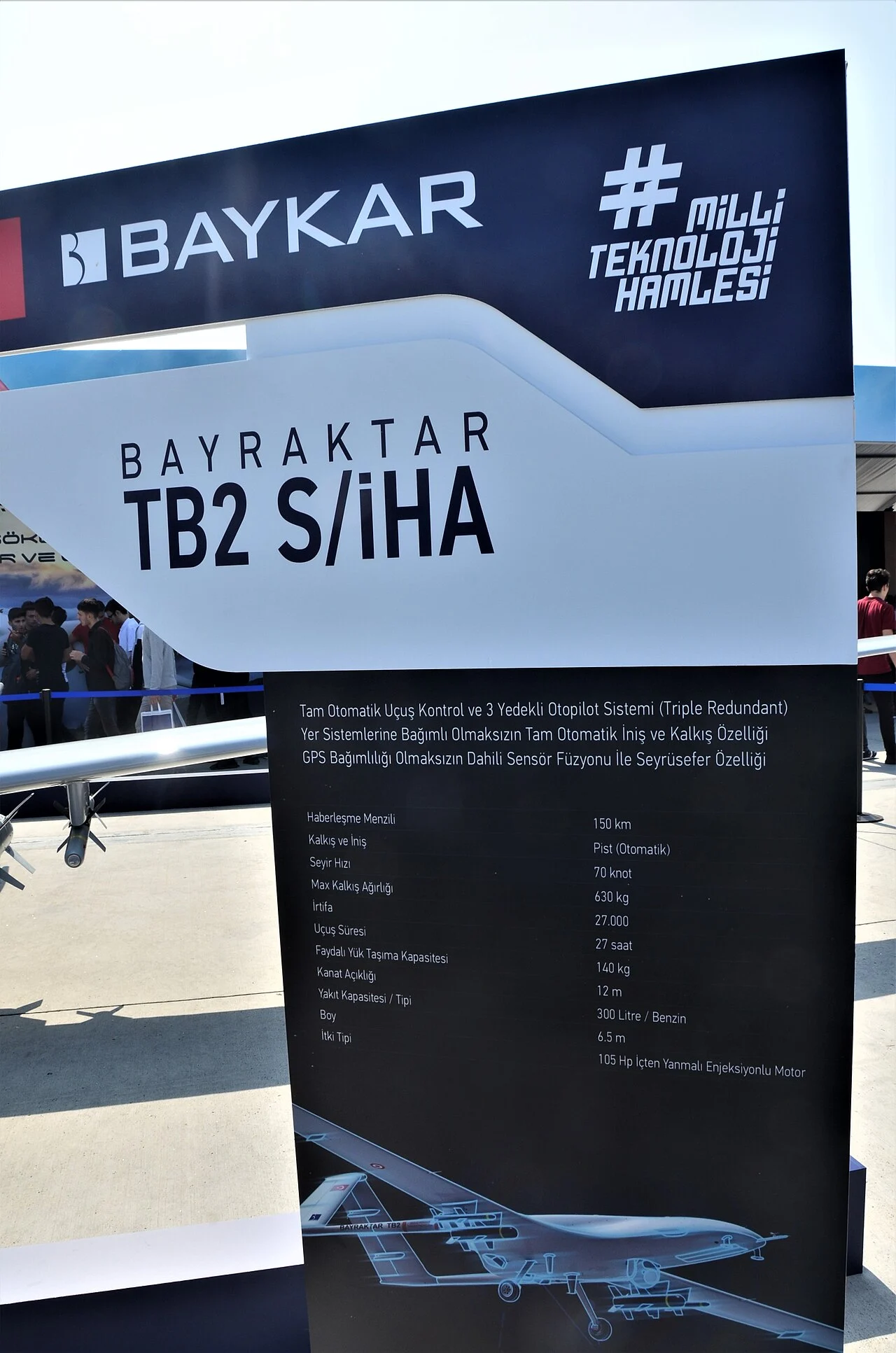
Photo: A Bayraktar TB2 unmanned combat aerial vehicle, the Turkish-made drone that anchors Morocco’s unmanned fleet (file photo, not the Moroccan air arm). Credit: CeeGee, CC BY-SA 4.0, via Wikimedia Commons.
Morocco buys more weapons than any other African country, and the United States, Israel and France still dominate the value of what it imports. Türkiye occupies a smaller but distinctive niche: combat-proven drones bought early and cheaply, a mid-size armoured-vehicle order, one confirmed electronic-warfare contract, and — most recently — a declared ambition to manufacture drones in Morocco rather than simply sell them there. This profile sets out that relationship system by system. It is a companion to DefenceMENA’s Morocco military-strength profile, to its anatomies of Morocco’s other suppliers — the United States, France and Israel — and to DefenceMENA’s wider look at how Morocco balances its American, Israeli and Turkish suppliers.
| Earliest documented procurement contact | 2017 (Nurol Makina Ejder Yalçın talks, unconfirmed) |
| First confirmed contract | Bayraktar TB2 drones, ordered April 2021 (12–13 units, ~$70m) |
| Türkiye’s rank among Morocco’s suppliers | Not separately broken out by SIPRI in the 2021–25 window; behind the United States (~60%), Israel (~24%) and France (~10%) by value |
| Flagship land deal | 200 Otokar Cobra II 4×4 vehicles, ~$136m, announced Dec 2023/Jan 2024 |
| Flagship electronic-warfare deal | ASELSAN Koral system, $50.7m, contracted June 2021, delivered 2023–2024 |
| Local production | Atlas Defence (Baykar subsidiary), Benslimane drone plant, agreement Dec 2024, targeted operational 2026 |
| What is still only reported | Nurol Makina Ejder Yalçın order; ASELSAN naval combat-management system; full scope of the Benslimane plant |
How the relationship formed
Unlike Morocco’s ties with the United States, France or Israel, there is no single treaty or normalisation date that marks the start of Turkish-Moroccan defence trade. The earliest documented procurement-level contact found in open sources dates to 2017, when Turkish press reported that the Royal Armed Forces (FAR) had opened negotiations with Nurol Makina to buy around thirty Ejder Yalçın armoured vehicles; Janes later wrote that Morocco “appears to have ordered” the vehicle, but Nurol declined to confirm it, and no delivery or signing has been reported since (Daily Sabah, Le Desk).
The relationship became concrete in 2021, when Morocco placed its first confirmed Turkish arms order — a batch of Bayraktar TB2 attack drones from Baykar — and, separately, a $50.7m electronic-warfare contract with ASELSAN for the Koral system. Both moved from paper to the battlefield fast: Moroccan forces received their first TB2s within months of ordering them, and by November 2021 one was photographed flying armed combat air patrols over Laâyoune in Western Sahara. Since then, the relationship has broadened from single-item purchases into an armoured-vehicle order, intermittent talks over naval electronics, and, as of December 2024, a declared plan for Turkish industry to build drones inside Morocco rather than only sell them to it — a step Morocco has not taken with any of its other three main suppliers.
| System | Manufacturer | Contract / Announcement | Quantity | Delivery | Current status | Source |
|---|---|---|---|---|---|---|
| Ejder Yalçın 4×4 armoured vehicle | Nurol Makina | Negotiations reported from 2017 | ~30 (reported) | Not reported | Status unclear | Daily Sabah, Le Desk, Janes |
| Bayraktar TB2 combat drone (initial order) | Baykar | Ordered April 2021, ~626m MAD (~$70m) | 12–13 | Delivered from September 2021 | In service | Bladi.net, h24info.ma |
| Koral electronic-warfare system | ASELSAN | Contracted June 2021, $50.7m (€42.59m) | Not disclosed | Delivered 2023–2024 | Delivered | Global Defense Corp, Caliber.az |
| MAM-L smart micro munition (on TB2) | Roketsan | No separate contract disclosed | Not disclosed | Observed in use Nov 2021 (Laâyoune) | Reported (unconfirmed) | Defensa (via h24info.ma) |
| Combat management system (naval) | ASELSAN | Talks reported from 2022, reiterated Jan 2025 | Not disclosed | Not signed as of this writing | Reported (unconfirmed) | Tactical Report (via Yabiladi), The Defense Post |
| Bayraktar Akıncı heavy combat drone | Baykar | Agreement reported August 2023 | Not disclosed | First batch reported delivered early 2025 | In service (reported; unconfirmed by Rabat) | The Defense Post, Hespress |
| Cobra II 4×4 armoured vehicle | Otokar | Announced Dec 2023/Jan 2024, ~$136m; buyer confirmed by Africa Intelligence, not named by Otokar | 200 (~20 earmarked for UN peacekeeping contingents) | Deliveries from late 2024 into 2025 | Under delivery | Army Recognition, The Defense Post, Overt Defense |
| Bayraktar TB2 (follow-on deliveries) | Baykar | Confirmed by Baykar August 2024 | Total fleet now reported above 20 | Delivered August 2024 | In service | Military Africa, Atalayar |
| Atlas Defence local drone plant | Baykar (Atlas Defence subsidiary) | Strategic agreement Dec 2024; subsidiary announced Jan 2025 (Rabat, 2.5m MAD capital) | N/A (facility) | Recruitment began Feb 2026; plant targeted operational 2026 | Planned / under construction | Morocco World News, Bladi.net, North Africa Post |
Two of these rows are easy to overstate. The Ejder Yalçın has never had its order confirmed by Nurol or Rabat at any point since 2017, so it should not be read as part of Morocco’s current Turkish inventory. And the Benslimane plant’s scope is disputed even among Moroccan outlets: some sources describe it as primarily a maintenance and assembly line for drones Morocco has already bought, others as a future production site for the Akıncı and even Baykar’s stealth Kızılelma — neither claim has been confirmed by Baykar or the Moroccan government.
Drones: the backbone of the relationship
Unmanned systems are where Türkiye has gone furthest with Morocco, and where the relationship started. The Royal Armed Forces ordered their first batch of Bayraktar TB2s — reported at 12 or 13 airframes, depending on the outlet, for roughly $70m — in April 2021, and received them within months; Moroccan media reported a formal reception ceremony and a contractual test flight in September 2021 (Bladi.net). By November that year, open-source analysts and the Spanish outlet Defensa had already photographed a Moroccan TB2 flying combat air patrols over Laâyoune in Western Sahara, armed with Roketsan’s MAM-L laser- and GPS/INS-guided munition — the first confirmed sighting of an armed Turkish drone over Moroccan-administered territory, though neither government has officially confirmed the munition fit (h24info.ma).
Morocco kept buying rather than stopping at one batch. A second lot of roughly six TB2s was reported for 2022, and in August 2024 Baykar itself confirmed further deliveries, with Spanish and Moroccan reporting in 2026 putting Morocco’s total TB2 fleet above 20 airframes — the exact figure remains unconfirmed by Rabat (Military Africa). Morocco then moved up Baykar’s product line: an agreement for the heavier, longer-endurance Bayraktar Akıncı was first reported in August 2023, and Moroccan and Spanish open-source reporting in 2025–2026 — based on satellite imagery of Ben Guerir air base rather than an official announcement — concluded that the first Akıncı airframes had reached Morocco in early 2025 and were operating alongside the TB2 fleet (The Defense Post, Hespress). These Turkish types sit alongside, rather than replace, Morocco’s Chinese Wing Loong II/TB-001 drones and Israeli Heron/Harfang and BlueBird loitering munitions — part of the same multi-supplier pattern Morocco applies to its manned aircraft and armour.
Land systems: a confirmed order and a decade of talk
Türkiye’s land-systems footprint in Morocco rests almost entirely on one confirmed deal. Otokar announced in mid-January 2024 — without naming the buyer — an order for 200 Cobra II protected 4×4 vehicles worth roughly $136m, covering spare parts, maintenance support and operator training; Africa Intelligence subsequently reported Morocco as the customer, with deliveries expected from late 2024 through 2025 and around 20 vehicles earmarked for Moroccan contingents in United Nations peacekeeping missions (Overt Defense, The Defense Post). The Cobra II is a nine-seat wheeled armoured vehicle built in reconnaissance, ambulance, anti-tank and command variants, and DefenceMENA has separately compared it with Türkiye’s other two main export designs in Ejder Yalçın vs Kirpi vs Cobra II.
The Ejder Yalçın talks that opened the relationship in 2017 have never produced a confirmed contract. Janes reported in 2021 that Morocco “appears to have ordered” the vehicle based on trade-source information, but Nurol told the publication it could not comment on whether Morocco had placed an order, and no delivery, signing date or unit price has surfaced in the five years since. This profile treats the Ejder Yalçın as a reported, unconfirmed item rather than part of Morocco’s current Turkish-built fleet, pending an official statement from either government or a Nurol Makina announcement, which the company has made for other export customers but not, so far, for Morocco.
Electronic warfare and the quieter deals
Morocco’s only fully confirmed Turkish contract away from drones and armour is ASELSAN’s Koral electronic-warfare system, a ground-based, vehicle-mounted platform designed to detect, jam and deceive hostile radars. ASELSAN announced the $50.7m (€42.59m) export deal in June 2021, with deliveries scheduled for 2023–2024 (Global Defense Corp); later press recaps in January 2025 repeated the same figures while reporting that Morocco and ASELSAN were by then also discussing further cooperation (Caliber.az). Those further discussions have not, however, produced a second confirmed contract: a Turkish naval-electronics contractor, Emtekno, presented systems to Morocco’s Royal Navy and ASELSAN has reportedly been in talks since 2022 over a next-generation naval combat-management system to help reorganise Morocco’s coastal defence, but both items remain at the discussion stage, repeated in Moroccan and Turkish press through January 2025 without a signed agreement (Yabiladi).
Local production: from customer to manufacturing partner
The newest and most consequential phase of the relationship is industrial, not transactional. In December 2024, Baykar and Moroccan authorities signed a strategic agreement to establish a drone-manufacturing and maintenance plant at Benslimane, near Casablanca; in January 2025 Baykar formally announced the Moroccan subsidiary behind the project, Atlas Defence, based in Rabat and jointly owned by Baykar’s Bayraktar brothers, Haluk and Selçuk, with 2.5m dirhams in registered capital (Morocco World News, Bladi.net). Atlas Defence began recruiting specialists for the plant in February 2026, and Moroccan press reporting from March 2026 described the facility as close to inauguration, with no confirmed opening date found as of this profile (Morocco World News).
What the plant will actually build is still contested in the Moroccan press itself. Some reporting describes Atlas Defence as set up mainly to service and assemble drones Morocco has already purchased; other outlets report a broader production mandate that could eventually include the Akıncı and, further out, Baykar’s stealth Kızılelma unmanned combat jet — a claim industry sources floated to North Africa Post but which neither Baykar nor Rabat has confirmed. If completed on anything like the broader description, Benslimane would be Türkiye’s most significant drone-manufacturing transfer in Africa, ahead of the assembly and maintenance arrangements Baykar has set up elsewhere on the continent, and would give Morocco a second track toward defence-industrial autonomy alongside the ammunition and turret production Israeli (MMI, BlueBird) and Indian (Tata) partners are separately building there.
How Türkiye compares with Morocco’s other suppliers
SIPRI’s Arms Transfers Database, covering 2021–2025, puts the United States at roughly 60% of the value of Morocco’s arms deliveries, Israel at about 24% and France at about 10% — Türkiye does not appear as a separately broken-out line in that measure, reflecting the relatively low unit cost of drones and armoured vehicles next to F-16 fighters, M1A2 Abrams tanks or Barak MX interceptors. That understates Türkiye’s practical footprint: drones bought in 2021 for a fraction of the cost of a single fighter jet gave the Royal Armed Forces an armed overwatch capability years before the Apache or Patriot evaluation matured, and the Benslimane plant — if it delivers on even the narrower “assembly and maintenance” description — would be the first Moroccan-based production line any of its four main suppliers has committed to for an unmanned platform.
| Supplier | SIPRI 2021–25 share (approx.) | Signature systems | Distinguishing edge |
|---|---|---|---|
| United States | ~60% | F-16 Block 72/V, M1A2 Abrams, AH-64E Apache, HIMARS | Deepest platform range, financing (FMF/FMS), long-term interoperability |
| Israel | ~24% | Barak MX, PULS, SPYDER, Ofek-13 satellites | Fast contracting, local-production offers (MMI, BlueBird) |
| France | ~10% | FREMM frigate, Caesar (legacy), VAB vehicles, Mirage F1 | Decades of legacy stock, though recent contract losses (Caesar) to Elbit |
| Türkiye | Not separately broken out by SIPRI in this window | Bayraktar TB2/Akıncı, Otokar Cobra II, ASELSAN Koral | Low-cost, combat-proven drones bought early; only supplier with a declared local manufacturing plant for an unmanned platform |
What is pending or only reported
Several items in this profile remain unconfirmed by either government: the Ejder Yalçın order, now five years without a signing date; the ASELSAN naval combat-management system, under discussion since at least 2022; the precise unit count of the current TB2 fleet; and the true production scope of the Benslimane plant. Morocco, like Türkiye, has generally avoided confirming defence-contract specifics in public, which is why most of the figures above trace back to Turkish trade press, Moroccan outlets citing Africa Intelligence or satellite-imagery analysts, and company statements rather than ministry announcements on either side.
A note on the numbers
Contract values for the Cobra II order and the Koral system come from manufacturer and trade-press statements rather than government disclosure, and SIPRI’s supplier-share percentages use its Trend Indicator Value methodology, which approximates transfer volume rather than cash price and can diverge from dollar figures quoted in the press. Where a deal has not been named by either government — the Cobra II buyer, the Ofek-13-style pattern seen with Morocco’s Israeli deals — this piece labels it accordingly rather than treating press attribution as official confirmation.
DefenceMENA follows this relationship under our Morocco and Türkiye tags, alongside our wider coverage of Turkish defence companies active in Africa and the North Africa category.
Sources
- Daily Sabah
- Le Desk
- Bladi.net
- h24info.ma
- Military Africa
- Atalayar
- The Defense Post
- Hespress
- Overt Defense
- The Defense Post
- Global Defense Corp
- Caliber.az
- Yabiladi
- Morocco World News
- Morocco World News
- Bladi.net
- SIPRI Arms Transfers Fact Sheet, March 2026