Spanish Special Forces Train Mauritania’s Commandos on ISR Drones



Spanish special forces have completed a month-long course teaching Mauritanian commandos to operate rotary-wing surveillance drones, the latest step in a bilateral security relationship that Madrid has built with Nouakchott as instability spreads across the wider Sahel.
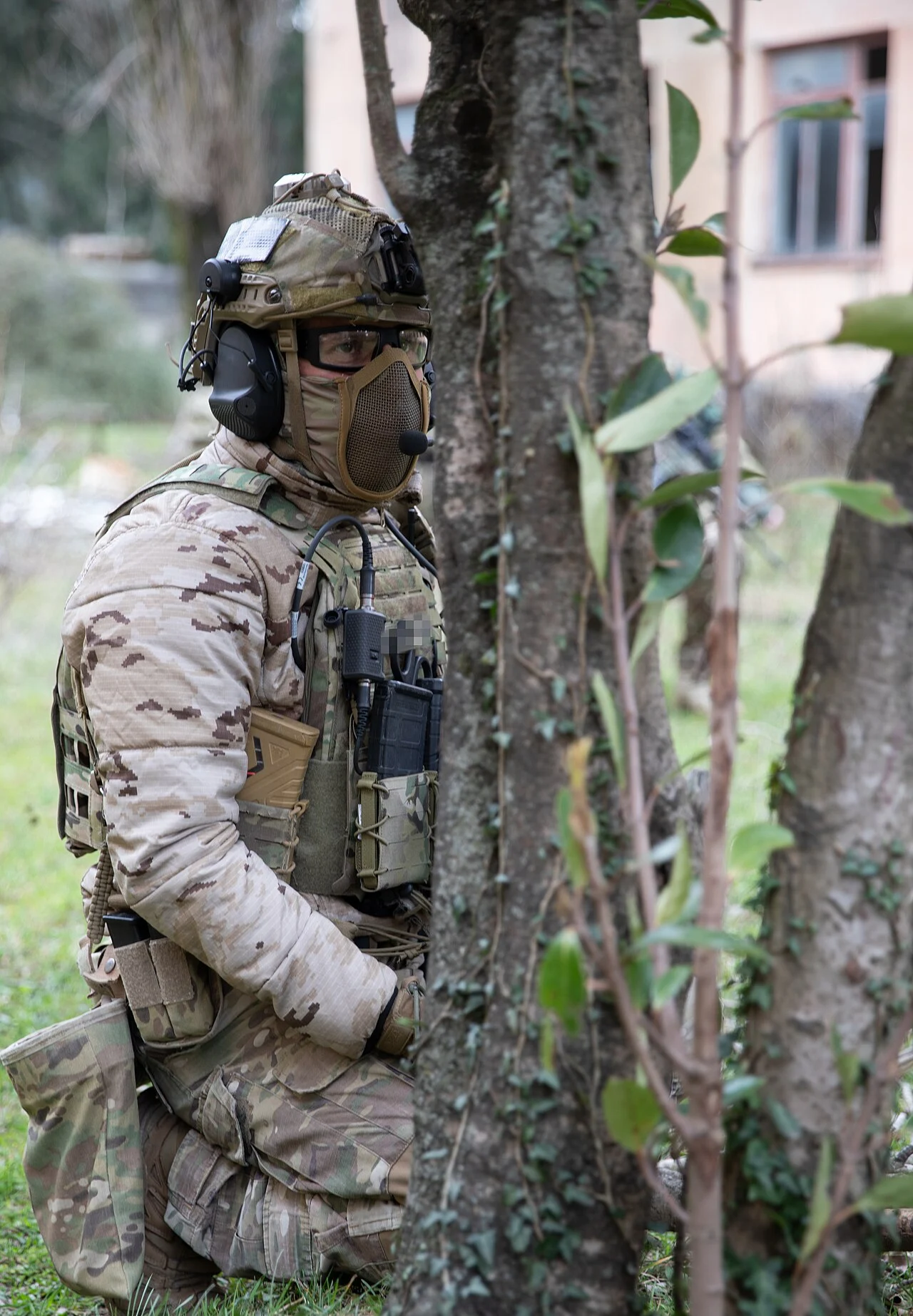
Photo: Spanish special operations forces (MOE) soldier during the NATO exercise Trojan Footprint, Georgia, March 2024 (file photo, illustrative of the type of unit involved). Credit: Sgt. 1st Class Cahugh Giles, US Army, Public Domain, via Wikimedia Commons
According to Infodefensa, personnel from Spain’s Mando de Operaciones Especiales (MOE) ran the four-week course in Nouakchott and Atar for soldiers of Mauritania’s 1st and 2nd Commando Battalions. Training moved from classroom instruction to flight simulators before trainees flew real drones, with day and night missions of increasing difficulty and endurance built in as the course progressed.
Spain’s Defence Staff (Emad), which coordinated the programme through its Joint Special Operations Command (MCOE), said the course focused on intelligence, surveillance and reconnaissance (ISR) tasks using rotary-wing drones, and that it brought Mauritanian operators to an advanced piloting level. The stated goal is a cascading one: the Mauritanian soldiers who completed the course are expected to train further personnel within their own units, expanding the army’s in-house instruction, command and planning capacity rather than leaving it dependent on repeated foreign-led courses.
A long-running security partnership
Spain has deepened military cooperation with Mauritania over the past decade as both countries track the movement of jihadist groups and smuggling networks across the western Sahel and the Atlantic approaches to the Canary Islands. Madrid has periodically rotated army and civil guard trainers through Mauritania and keeps a naval presence off the West African coast to track irregular migration and trafficking routes that run through Mauritanian waters.
This course falls under what Emad calls its “Actividades de Seguridad Cooperativa” (Cooperative Security Activities) with Mauritania, a standing bilateral framework rather than a one-off deployment. Infodefensa did not report the number of drones used, their make or model, or the cost of the programme, and Spanish officials have not disclosed those details publicly.
Mauritania’s drone and ISR gap
Mauritania’s armed forces have historically leaned on French- and American-supplied light aircraft and ground vehicles for border and desert surveillance rather than a dedicated drone fleet, leaving persistent-surveillance coverage of its vast, thinly populated desert interior thin compared with neighbours such as Mali, which has fielded Turkish Bayraktar TB2s, and Niger and Burkina Faso, which also operate armed Chinese- and Turkish-made systems. A small, rotary-wing ISR capability of the kind Spain is now teaching would give Mauritanian commando units an organic reconnaissance tool for border and desert operations that does not depend on fixed-wing assets based far from the area of operations.
Mauritania has largely avoided the kind of large-scale jihadist attacks that have hit Mali, Burkina Faso and Niger in recent years, a record Nouakchott and outside analysts often credit to its own counter-terrorism posture and to cooperation with Western and regional partners. Maintaining that record as Mali-based al-Qaeda affiliate JNIM and Islamic State-linked groups continue to operate near Mauritania’s eastern border is a stated priority for both Nouakchott and its partners.
Why it matters for Africa
Mauritania sits at a hinge point in the Sahel: it borders Mali’s conflict zones but has stayed outside the Alliance of Sahel States bloc formed by Mali, Burkina Faso and Niger, keeping closer ties to Western partners and to Morocco and the European Union instead. Spain’s willingness to keep investing special-forces training time in Mauritania reflects both a shared interest in denying militant groups a foothold near the Atlantic coast and migration routes, and a recognition that few other Sahel governments remain as open to Western military partnership.
For the wider region, a Mauritania that can field its own ISR drone operators adds a data point to a broader pattern across West Africa and the Sahel, where crewed and uncrewed surveillance aircraft have become central to counter-insurgency operations, even as the sourcing of those systems increasingly splits between Western partners, Turkey, China and Russia depending on the government in power. Mauritania’s continued alignment with Spain and the EU, rather than Russian-linked suppliers active elsewhere in the Sahel, is itself a notable data point for the region’s security map.
Sources
- Infodefensa: Los guerrilleros del MOE instruyen durante un mes a las fuerzas especiales de Mauritania en el uso de drones
- DefenceMENA: Military Drones in the Sahel: Who Operates What, and Who Is Actually Supplying Them
- DefenceMENA: Algeria’s Niamey Deployment: Why Analysts Call It a Sahel Policy Shift