Why Did Chad Buy the Anka and Aksungur Drones?



Chad bought TUSAŞ Anka-S and Aksungur armed drones, with three Hürkuş-C light attack turboprops, because its air force had no persistent armed surveillance of its own over Lake Chad, the Libyan frontier and the Sudanese border, and because N’Djamena was already deep into a Turkish defence relationship that began with armoured vehicles in 2018. The Chadian military framed the purchase as a tool against “terrorism, mercenary activities, kidnappings for ransom, and various forms of banditry”. Two Anka-S and three Hürkuş-C were unveiled at Adji Kosseï air base in July 2023; the first Aksungur flew armed from N’Djamena in April 2024, making Chad the first African air force to operate the type. Chad has never bought a Bayraktar TB2 or Akıncı.
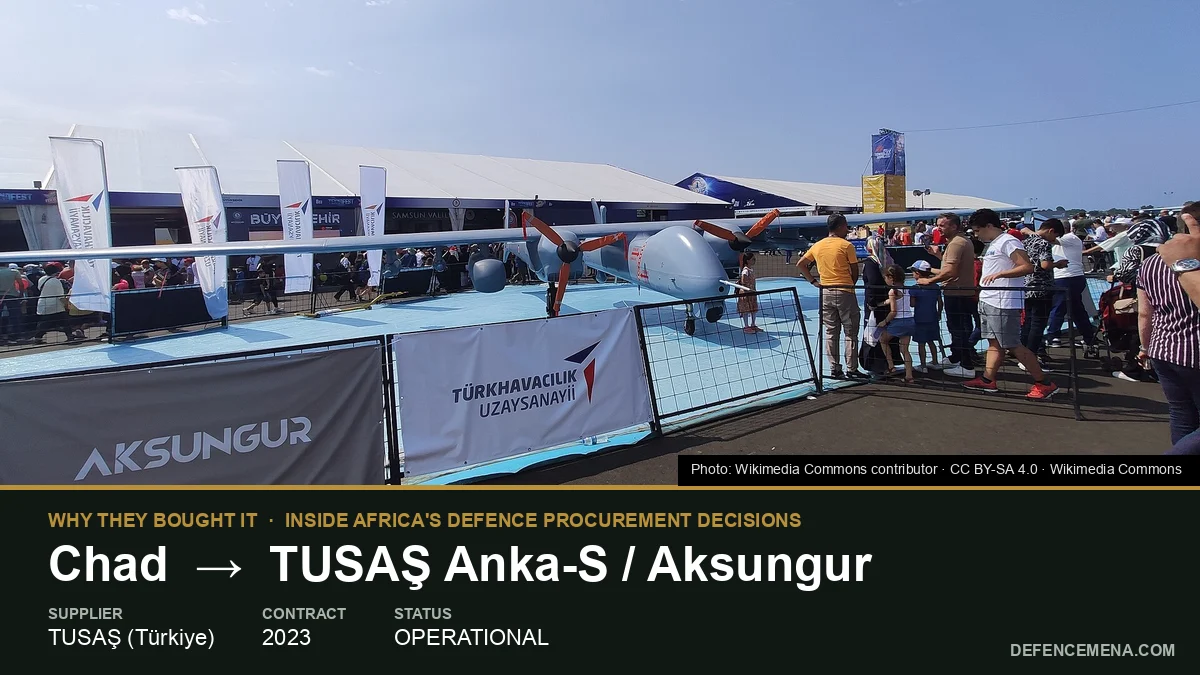
Photo: A TUSAŞ Aksungur on display at TEKNOFEST 2022 in Samsun. Chad's aircraft, serial 23013, was filmed taking off from N'Djamena with eight MAM-L munitions in April 2024. Photo: Wikimedia Commons user 𐰇𐱅𐰚𐰤 (CC BY-SA 4.0). Credit: Wikimedia Commons user 𐰇𐱅𐰚𐰤 (own work), CC BY-SA 4.0, via Wikimedia Commons.
- Country
- Chad (Armée de l’Air Tchadienne)
- System
- TUSAŞ Anka-S (2) and Aksungur (at least 1) armed UAVs; Hürkuş-C light attack aircraft (3)
- Supplier
- TUSAŞ / Turkish Aerospace (Türkiye)
- Quantity
- 2 Anka-S; 1+ Aksungur; 3 Hürkuş-C; MAM-L and MAM-C munitions
- Contract year
- 2022 (Hürkuş-C announced); Anka-S order reported Feb 2023; Aksungur not announced
- Status
- OPERATIONAL
- Main requirement
- Armed ISR and light strike against jihadist, rebel and bandit groups (officially stated)
- Training
- Crews and 20 engineers trained at TUSAŞ in Türkiye; 3 pilots and 7 technicians qualified on Hürkuş by Jan 2024
- Localisation
- None announced
- Known alternatives
- No documented competition; Chinese CH-4 later seen at Abéché (Aug 2026, unannounced)
What capability did Chad need?
Chad fights on three fronts at once, and none of them is close to the capital. In the west, Boko Haram and its Islamic State offshoot operate from the islands of Lake Chad; in the north, rebel columns have driven on N’Djamena from Libya, most recently in April 2021; in the east, the Sudanese civil war that began in April 2023 has pushed more than 900,000 refugees across the border and brought drone strikes to Chadian towns. Each of those theatres is several hundred kilometres from the main air base at Adji Kosseï.
Until 2023 the Chadian air force had nothing that could watch those spaces for hours at a time. Its combat aircraft were Su-25 ground-attack jets and Mi-24/Mi-35 gunships, fast but short-legged, with no persistent surveillance behind them. For intelligence from the air Chad relied on French aircraft at the Kossei camp in N’Djamena: information it did not control, as the events of 2024 would prove.
The stated requirement, as the Chadian military put it when it released footage of the Aksungur in April 2024, was to combat “terrorism, mercenary activities, kidnappings for ransom, and various forms of banditry”. The Barkaram massacre of October 2024, when Boko Haram overran a garrison of 200 men on a Lake Chad island and killed around 40 soldiers, showed what that requirement means in practice: a remote post with no warning and no armed aircraft overhead.
What did it already operate?
Chad’s air force is small and has been rebuilt more than once. Military Africa’s April 2021 inventory, published when at least two Mi-35 gunships came back from overhaul in Georgia, listed three Mi-35s, four Mi-24Vs, seven Mi-8MTV/Mi-171 transports, six AS550C2 Fennecs and one SA316B Alouette. The fixed-wing combat element was a handful of Su-25s and L-39s; a July 2017 storm at N’Djamena damaged Mi-35s, a MiG-29 and two Su-25s on the ground, which says much about how thin the fleet was.
What Chad did have was a growing Turkish relationship on the ground. The UN Register of Conventional Arms recorded 20 wheeled armoured vehicles from Türkiye in 2018, later identified as Nurol Makina Ejder Yalçın 4x4s and paraded in N’Djamena in August 2021; SIPRI’s transfers database adds 30 Nurol NMS vehicles in 2021, and defenceWeb put the NMS total at 70 by September 2026. DefenceMENA’s list of Ejder Yalçın operators and its survey of MRAPs used in the Sahel place Chad among the earliest African buyers of Turkish protected mobility.
No Chadian armed drone is documented before 2023. Chinese CH-4 airframes were filmed at Abéché only in August 2026, and N’Djamena has not announced them.
What system was selected?
Chad bought a package, all of it from TUSAŞ (Turkish Aerospace).
The Anka-S is TUSAŞ’s medium-altitude long-endurance UAV: a 1,700 kg aircraft with a 350 kg payload, up to 24 hours’ endurance and a satellite communications link that lets it fly beyond the line of sight of its ground station. Janes noted the satcom bulges on the Chadian aircraft and read them as a sign the drones were meant for “extended operations across northern Chad”. Two were delivered, with Turkish-format serials 21-062 and 22-080 recorded at the August 2023 handover.
The Aksungur is the twin-engine growth version of the same airframe family, powered by two Turkish PD-170 diesel engines, with a maximum take-off weight of 3,300 kg, a payload above 750 kg and endurance of around 50 hours in a light configuration. The aircraft filmed at Adji Kosseï on 21 April 2024 carried serial 23013, eight Roketsan MAM-L laser-guided munitions and a Hensoldt Argos II electro-optical turret. At least one has been delivered; no larger number has been confirmed.
The Hürkuş-C is the armed version of TUSAŞ’s tandem-seat turboprop trainer, with a forward-looking infrared sensor and MAM-L and Cirit laser-guided weapons. Three were delivered, making Chad the second export customer after Niger. The weapons came with the aircraft: President Mahamat Idriss Déby Itno inspected MAM-L bombs and what Janes identified as a Cirit pod at the base on 10 July 2023.
One point needs correcting because it is repeated often. Chad does not operate the Bayraktar TB2 or Akıncı. Neither Baykar nor N’Djamena has announced such a sale, and every Turkish drone identified in Chadian markings is a TUSAŞ aircraft. For the actual TB2 operators on the continent, see DefenceMENA’s survey of military drones used in Africa.
Which alternatives were considered?
No tender has been published and no Chadian official has described a competition. What can be said is which systems existed in the same class in 2022–23 and which have since appeared in Chad.
| Alternative | Class | Status of consideration | Source |
|---|---|---|---|
| CASC CH-4 (China) | MALE armed UAV | REPORTED ALTERNATIVE – at least four airframes filmed at Abéché in Aug 2026, not announced by N’Djamena; no evidence they were weighed against the Turkish types in 2022–23 | defenceWeb, 2 Sep 2026; Militarnyi, Aug 2026 |
| Baykar Bayraktar TB2 (Türkiye) | Tactical armed UAV | SAME-CLASS MARKET ALTERNATIVE – in service with Niger, Mali, Togo and others; no Chadian evaluation documented | Military Africa (Niger order), Nov 2021 |
| AVIC Wing Loong II (China) | MALE armed UAV | SAME-CLASS MARKET ALTERNATIVE – no Chadian evaluation documented | DefenceMENA operator survey |
| French ISR support from Kossei | Allied capability, not a purchase | REPORTED ALTERNATIVE – the status quo Chad relied on until the November 2024 break with Paris | France 24, 30 Jan 2025 |
In short: no documented competition. Chad chose a supplier it already trusted, and that supplier’s range set the options.
Why was the TUSAŞ package selected?
Counter-insurgency and border control (officially stated). The Chadian armed forces’ own framing, released with the Aksungur footage and relayed by Military Africa and Turdef, lists terrorism, mercenaries, kidnapping for ransom and banditry. That list maps onto Lake Chad, the Libyan border and the eastern frontier, and the satcom-equipped Anka-S configuration noted by Janes fits a country that must fly long distances from a single base.
An established Turkish defence relationship (documented). Mahamat Déby’s visit to Ankara on 27 October 2021 produced bilateral accords including defence and security; President Erdoğan said Chad would “become one of Turkey’s pioneering partners in Africa” and that Türkiye was ready to cooperate with a country “simultaneously fighting terrorist organizations and armed opposition groups”. By then Chad had taken 20 Ejder Yalçın and was receiving NMS vehicles. The air package extended a relationship rather than starting one.
A single-supplier logistics chain (analysts assess). Turdef pointed out that the Anka-S and Aksungur share an airframe family, which simplifies maintenance, training and spares; the Hürkuş-C uses the same MAM-L munition as both drones. Chad sent 20 engineers to TUSAŞ and had three pilots and seven technicians qualified on the Hürkuş by January 2024. A one-stop package has obvious appeal for a small air force, although no Chadian official has said so.
Reducing dependence on French intelligence (analysts assess; events support it). Chad ended its defence agreement with France on 28 November 2024; the two Mirage 2000Ds left Kossei on 11 December, Faya-Largeau was handed back on 26 December, Abéché on 11 January 2025 and Kossei on 30 January. Déby said the agreements had become “completely obsolete in light of the political and geostrategic realities of our time”. The Turkish aircraft, delivered a year and a half earlier, meant Chad kept armed surveillance through that transition. Whether the 2022–23 purchase was made with the French exit in mind is possible but unconfirmed.
Price, financing and delivery speed: not publicly disclosed. No contract value, credit arrangement or comparative offer has been published for any element of the package.
Envanter Media keeps a Turkish-language delivery tracker for the Aksungur fleet, useful for placing Chad’s single confirmed aircraft against the type’s production run.
What was included in the contract?
The visible contents are the aircraft, the munitions and the training. TUSAŞ announced on 14 July 2023 that it had delivered “3 HÜRKUŞ and 2 ANKA to the Chad Air Force”; Déby’s inspection on 10 July showed MAM-L bombs and a Cirit pod, and Military Africa’s April 2024 report added MAM-C munitions. The Aksungur appears to have been a separate, later acquisition: it was absent from the July 2023 unveiling, and a model of the type was presented to the Chadian delegation at the August 2023 ceremony. Ground control stations and satcom terminals are implied but not itemised. No offset, infrastructure or financing component has been disclosed.
How much did it cost?
Not publicly disclosed. Neither TUSAŞ nor the Chadian government has published a price for the Hürkuş-C, the Anka-S or the Aksungur. The only African Aksungur figure on record is Angola’s, approved at $93 million in October 2022 for an undisclosed quantity, and it cannot be transferred to Chad.
How many were ordered?
Two Anka-S, three Hürkuş-C and at least one Aksungur. The Hürkuş number was given by TAI deputy general manager Atilla Doğan at Africa Aerospace and Defence in September 2022, with delivery due in the first quarter of 2023. Military Africa reported the two-aircraft Anka-S order on 28 February 2023. The Aksungur count rests on a single serial seen in April 2024; no order quantity has been stated. One discrepancy: DefenceTurk recorded only two Hürkuş-C, registered TT-QAV and TT-QAW, at the 9 August 2023 ceremony, whereas TUSAŞ and Janes both say three were delivered.
Training, maintenance and support
Training is the most visible part of the support package. The April 2024 Chadian video showed air force personnel under instruction at TUSAŞ in Türkiye, and Military Africa reported that 20 engineers had been sent to the company; in January 2024 the air force certified three pilots and seven technicians on the Hürkuş. Maintenance arrangements beyond that have not been published. See DefenceMENA’s overview of Turkish systems in African service and its profile of Turkish defence companies active in Africa.
Local production or technology transfer
None announced. Chad’s state arms manufacturer, examined in DefenceMENA’s profile of Sahel Défense Industrie, works on small arms and ammunition, not aerospace, and no assembly or maintenance work has been linked to the TUSAŞ deliveries.
Delivery and operational status
The Anka-S and Hürkuş-C are OPERATIONAL: delivered in 2023, crews qualified by January 2024, aircraft shown flying from N’Djamena. The Aksungur is DELIVERED and has flown armed from Adji Kosseï since April 2024; with one airframe confirmed and no public account of its missions, DefenceMENA records it as OPERATIONAL on the strength of the Chadian footage. The package as a whole is OPERATIONAL.
- 2018UNROCA records 20 Turkish wheeled armoured vehicles (Ejder Yalçın) delivered to Chad.
- 27 Oct 2021Mahamat Déby in Ankara; bilateral accords signed including defence and security.
- Sep–Nov 2022TAI confirms three Hürkuş-C for Chad with delivery due in Q1 2023 (Shephard, 2 Nov 2022).
- 28 Feb 2023Military Africa reports Chad has ordered two Anka-S.
- May 2023TUSAŞ confirms delivery of three Hürkuş-C and two Anka (per Janes).
- 10 Jul 2023Déby inspects the aircraft and MAM-L/Cirit weapons at Adji Kosseï; TUSAŞ announces the deliveries on 14 July.
- 9 Aug 2023Formal handover with Armed Forces Minister Daoud Yaya Brahim and TUSAŞ chief Temel Kotil.
- Jan 2024Three pilots and seven technicians qualified on the Hürkuş.
- 21 Apr 2024Chadian video shows Aksungur 23013 taking off from N’Djamena with eight MAM-L.
- 28 Nov 2024 – 30 Jan 2025Chad ends its defence agreement with France; French forces leave Faya-Largeau, Abéché and Kossei.
- Aug 2026At least four Chinese CH-4 UAVs filmed at Abéché; not announced by N’Djamena.
Has it been used operationally?
Partly documented. The Chadian military has not published mission reports for the drones or the Hürkuş-C, and this article does not attribute specific strikes to specific aircraft. What is on the record is that Chad has conducted repeated air strikes on Lake Chad since 2024. After the Barkaram attack of 27–28 October 2024, Déby launched Operation Haskanite and said on 8 November that “we carried out several air strikes on enemy positions that resulted in many dead and wounded”. Le Diplomate’s February 2025 analysis reported that the new drones were used during Haskanite against suspected Boko Haram boats, and that fishermen were hit by mistake; Le360 records the late-October 2024 strike on Tilma island that killed Nigerian fishermen. After Boko Haram killed 23 soldiers on Barka Tolorom island on 4 May 2026, Chadian aircraft struck Shuwa island for several days and around 40 Nigerian fishermen were reported missing. The army did not say which aircraft flew.
In the east, the drones Chad has faced have mattered as much as the ones it flies. In March 2026 the RSF was blamed for a drone strike on a funeral in Tiné that killed 20 people, and a Sudanese army drone hit a fuel depot nearby days later; N’Djamena responded by sending more than 100 military vehicles east. DefenceMENA’s record of drones in the Sudan war sets out that context, as does the 2024 UN Security Council report on Chad’s role in RSF supply lines cited by ISS Africa.
What has operational use shown?
Three things, at public level. First, that a small air force can keep a MALE drone armed and flying from a single base for years with Turkish training behind it. Second, that surveillance over Lake Chad has not prevented mass-casualty attacks on island garrisons, in October 2024 and again in May 2026; drones find targets, they do not hold ground. Third, that strikes on the lake’s islands have produced repeated reports of fishermen killed, which is now part of the political cost of the capability.
Did Chad order more?
Not from TUSAŞ, as far as the public record shows. No follow-on Anka, Aksungur or Hürkuş order has been announced since 2024. Two developments bear on the question. In early 2025 Military Africa and Le Diplomate reported an agreement under which Türkiye would use Abéché as a drone hub with Turkish advisers, a claim the Atlantic Council noted had “not been independently confirmed”. And in August 2026 footage showed at least four CH-4s at the same base, which defenceWeb described as “apparently being prepared for service” and which N’Djamena has not acknowledged. French trainers also returned in April 2026, eighteen months after the break.
What does this tell us about African procurement?
The Chad case is the clearest example in this series of procurement by relationship rather than by competition. There was no tender, no published requirement and no price. There was a supplier whose vehicles the army already drove, a presidential visit that produced a defence accord, and then a package of aircraft from a single Turkish company. For a government that had just survived a rebel offensive and a contested succession, speed and trust counted for more than a comparison of brochures. That pattern recurs across the Sahel and is why Türkiye’s state-linked companies, not only Baykar, have become serious African suppliers.
It also shows the appeal of the package. Chad did not buy a drone; it bought two drone types, a light attack aircraft, their shared munition and a training pipeline from one address. For an air force with a handful of qualified crews, that reduces the relationships it must manage. The limit is visible too: with the manufacturer as sole source of spares and expertise, any strain in the relationship or the budget is felt directly in availability, which is presumably what Military Africa’s unsourced cost remark was pointing at.
Third, timing matters more than motive. Chad bought Turkish aircraft while French forces were still at Kossei, and only afterwards ended the French presence. Whatever the intention in 2022, N’Djamena walked away from Paris with its own eyes in the sky already delivered and its crews trained. Niger, examined in the TB2 decision of 2021–22, followed a similar path with a different supplier. The lesson other African capitals have drawn is that owning armed surveillance is what makes a break with a security partner survivable.
Finally, the sequel is instructive. Two years after becoming the first African Aksungur operator, Chad appears to have accepted Chinese CH-4s at Abéché and welcomed French trainers back. That is less a verdict on the Turkish aircraft than a reminder that buyers under acute threat keep every door open. Supplier diversification in the Sahel is less a strategy than a reflex, and the Anka and Aksungur were one step in it, not the last.
Procurement record
| Field | Value |
|---|---|
| Country | Chad |
| Service | Armée de l’Air Tchadienne (Chadian Air Force) |
| System | TUSAŞ Anka-S and Aksungur armed UAVs; Hürkuş-C light attack aircraft; Roketsan MAM-L/MAM-C munitions |
| Manufacturer | TUSAŞ (Turkish Aerospace); munitions by Roketsan |
| Origin | Türkiye |
| Category | UCAV / light attack |
| Requirement | Armed ISR and strike against terrorism, mercenaries, kidnapping and banditry (officially stated) |
| Order date | Hürkuş-C: announced by TAI Sep 2022; Anka-S: reported Feb 2023; Aksungur: not announced |
| Contract date | Not publicly disclosed |
| Quantity | 2 Anka-S; 3 Hürkuş-C; at least 1 Aksungur (serial 23013) |
| Contract value | Not publicly disclosed |
| Delivery | Anka-S and Hürkuş-C by May 2023, unveiled 10 Jul 2023, handed over 9 Aug 2023; Aksungur shown flying 21 Apr 2024 |
| Operational status | OPERATIONAL |
| Training | Crews and 20 engineers at TUSAŞ in Türkiye; 3 pilots and 7 technicians qualified on Hürkuş, Jan 2024 |
| Support | Not publicly detailed; Military Africa (Aug 2026, unsourced) reports sustainment cost concerns |
| Localisation | None |
| Tech transfer | None announced |
| Confirmed competitors | None documented |
| Follow-on order | None announced from TUSAŞ; at least 4 Chinese CH-4 observed at Abéché, Aug 2026 (unannounced) |
| Primary source | TUSAŞ delivery announcement, 14 Jul 2023; Chadian armed forces video, 21 Apr 2024 (via defenceWeb/Janes) |
| Last verified | 5 October 2026 |
FAQ
Does Chad have Bayraktar TB2 drones?
No. Chad’s Turkish drones are the TUSAŞ Anka-S and Aksungur, not Baykar’s TB2 or Akıncı. No TB2 sale to Chad has been announced by Baykar, Türkiye or N’Djamena.
Why did Chad buy the Anka and Aksungur drones?
The Chadian military said the aircraft were for combating terrorism, mercenary activity, kidnapping for ransom and banditry. The purchase extended a Turkish defence relationship that began with Nurol Makina armoured vehicles in 2018 and a 2021 presidential visit to Ankara.
How many Turkish drones does Chad have?
Two Anka-S, delivered in 2023, and at least one Aksungur, first seen flying in April 2024. Chad also received three Hürkuş-C light attack aircraft in 2023.
Is Chad the first African country to operate the Aksungur?
Yes, as an operator. Angola signed for the Aksungur earlier, in 2022, but had not shown an aircraft in service when Chad’s flew from N’Djamena in April 2024. Chad was the second export operator worldwide after Kyrgyzstan.
How much did Chad pay for the Turkish drones?
The price has not been made public by TUSAŞ or the Chadian government. No contract value exists on the record for the Anka-S, Aksungur or Hürkuş-C sold to Chad.
Where are Chad’s drones based?
At Adji Kosseï air base in N’Djamena, where the Anka-S and Hürkuş-C were unveiled in July 2023 and the Aksungur was filmed in April 2024. Reports of a Turkish-assisted drone hub at Abéché from 2025 have not been independently confirmed.
Has Chad also bought Chinese drones?
Footage from August 2026 showed at least four CH-4 armed drones at Abéché air base. The Chadian government has not announced the acquisition.
More from Why They Bought It
- Why Did Morocco Buy the AH-64E Apache?
- Why Did Nigeria Buy the VT-4 Tank?
- Why Did Côte d'Ivoire Buy the Wing Loong II?
- Why Did Kenya Buy 118 Katmerciler HIZIR Armoured Vehicles?
- Why Did Nigeria Buy the M-346FA?
- Why Did Egypt Buy (and Build) the K9 Howitzer?
- Why Did Niger Buy the Bayraktar TB2?
- Why Did Senegal Buy the OPV 58 S?
- Why Did Kenya Buy the MD 530F Cayuse Warrior?
- Why Did Uganda Buy the Su-30MK2?
- Why Did Burkina Faso Buy Chinese Armoured Vehicles?
- Why Did Senegal Buy the Ground Master 400 Radar?
- Why Did Kenya Buy the SPYDER Air-Defence System?
Sources
- Haber.aero – TUSAŞ announces delivery of 3 HÜRKUŞ and 2 ANKA to the Chad Air Force (14 Jul 2023)
- Daily Sabah – Turkey to boost defense, security cooperation with Chad: Erdoğan (28 Oct 2021)
- Shephard Media – TAI to confirm Hürkuş-C delivery to Niger and Chad (2 Nov 2022)
- Military Africa – Chad and Algeria opt for Turkish ANKA-S drones (28 Feb 2023)
- Janes – Chad confirms delivery of Hürkuş, Anka aircraft from Turkey (11 Jul 2023)
- Military Africa – Turkish Aerospace has delivered HÜRKUŞ and ANKA drone to Chad (17 Jul 2023)
- Hürriyet Daily News – Chad receives new aircraft, UAVs from Türkiye (15 Jul 2023)
- DefenceTurk – ANKA and HÜRKUŞ handover ceremony for the Chadian Army, Adji Kosseï (13 Aug 2023)
- defenceWeb – Chad operating Aksungur UAVs (25 Apr 2024)
- Military Africa – Chad enhances Air Force capabilities with Turkish Aksungur drones (26 Apr 2024)
- Janes – Chadian Air Force unveils Aksungur UAV (23 Apr 2024)
- Turdef – Chad uses TUSAŞ’s Aksungur armed UAV (21 Apr 2024)
- Military Africa – Chadian Air Force Mi-35 Hind helicopters overhauled in Georgia (21 Apr 2021)
- Military Africa – Chad operating Turkish-made Nurol Ejder Yalçın 4×4 armoured vehicles (16 Aug 2021)
- France 24 / AFP – Boko Haram attack on Chad army garrison kills scores of people (28 Oct 2024)
- The Defense Post / AFP – Chad army kills ‘many’ Boko Haram jihadists in air strikes (8 Nov 2024)
- France 24 / AFP – France ends military presence in Sahel region with handover of last base in Chad (30 Jan 2025)
- Anadolu Agency – Factbox: France’s fading military presence in Africa (17 Jul 2025)
- Le Diplomate – Turquie–Tchad, une alliance sous le signe des drones (15 Feb 2025)
- Military Africa – Turkey takes control of Abéché military base in Chad (9 Feb 2025)
- Atlantic Council – The Sahel is pivoting toward Turkey (23 Jul 2025)
- ISS Africa – Urgent AU action could defuse rising Chad–Sudan tensions (3 Apr 2025)
- Africa Defense Forum – Eastern Chad an emerging frontline in Sudan war (9 Jun 2026)
- Al Jazeera – Boko Haram attack kills 23 soldiers in Chad’s Lake Chad region (5 May 2026)
- Le360 Afrique – Frappes antijihadistes tchadiennes sur le lac Tchad, des dizaines de pêcheurs nigérians présumés morts (11 May 2026)
- Military Africa – Chad rebuilds military ties with France (11 Aug 2026)
- defenceWeb – Chinese UCAVs at Chadian military base apparently being prepared for service (2 Sep 2026)
- Militarnyi – Chad expands its fleet with Chinese CH-4 UAVs (25 Aug 2026)
Last updated: 5 October 2026. This article is updated in place when the procurement status changes.