
Sudan war drones have moved from the margins of the conflict to its centre. Since fighting between the Sudanese Armed Forces (SAF) and the Rapid Support Forces (RSF) began on 15 April 2023, both sides have acquired foreign-made unmanned aircraft that reach far beyond the front line, and the United Nations now documents drones as a leading cause of civilian deaths. This file sets out what the evidence shows, system by system.
Photo: A Mohajer-6 at an Iranian exhibition in 2019. Satellite imagery showed the type at Sudan's Wadi Seidna air base in January 2024. Credit: Erfan Kouchari/Tasnim, CC BY 4.0, via Wikimedia Commons. Credit: Erfan Kouchari (Tasnim News Agency), CC BY 4.0, via Wikimedia Commons.
Direct answer
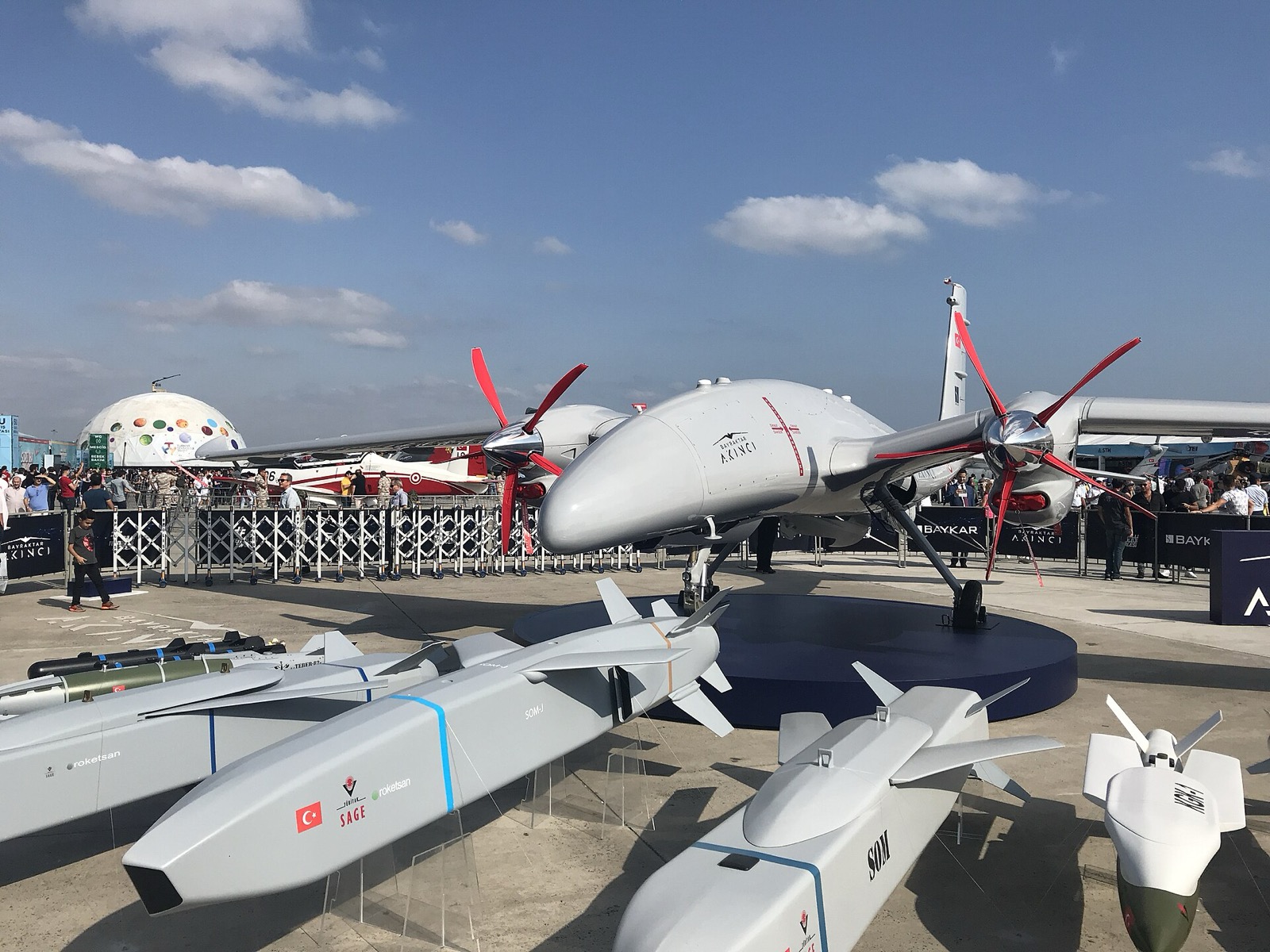
The SAF has used Iranian Mohajer-6 drones since early 2024 and Turkish Baykar systems from 2024; UN investigators identified Bayraktar Akıncı and Yiha III components in 2026 SAF strikes. The RSF uses Chinese-designed FH-95/CH-95 drones and, according to Amnesty International, the Wing Loong II, linked by Amnesty and UN investigators to supply routes involving the UAE, which denies arming the RSF. The UN documented more than 1,000 civilians killed in drone strikes between January and May 2026.
| System | Mohajer-6, Bayraktar TB2, Akıncı, Yiha III (SAF); FH-95/CH-95, Wing Loong II (RSF, attributed); multirotor drones (both) |
| Manufacturer | Qods Aviation Industries (Iran); Baykar (Türkiye); Chinese state aerospace groups (FH-95/CH-95, Wing Loong II); Sudan’s Military Industry Corporation (Safaroog, displayed 2025) |
| Origin | Iran, Türkiye, China, Sudan; supply routes via third countries are alleged and disputed |
| Operator(s) in this conflict | Sudanese Armed Forces; Rapid Support Forces (with foreign contractors, per UN investigators); Egyptian-based Akıncı operations reported by The New York Times |
| Period | April 2023 to September 2026 |
| Evidence level summary | Mohajer-6: independently reported and visually documented. TB2: independently reported (leaked records). Akıncı and Yiha III: verified by UN investigators from imagery. FH-95/CH-95: verified wreckage (UN). UAE supply: officially alleged, denied by the UAE. |
Where was it used?
In 2023-2024 the SAF used Iranian-made drones to support its ground push in Khartoum and Omdurman. RSF drone use was then mostly shorter-range, although a July 2024 strike on an army graduation at Gebeit in eastern Sudan, attended by army chief General Abdel Fattah al-Burhan, killed five people, the army said.
In 2025 the geography widened: drones hit the Merowe Dam power station in January and, in May, Port Sudan, the government’s Red Sea seat more than 1,000 km from RSF bases in Darfur. After the RSF took El Fasher in October 2025, both sides’ drones struck across Kordofan, including El Obeid, Kadugli, Dilling and Kalogi. By 2026 SAF drones reached Nyala and Ad-Da’ein deep in RSF-held Darfur, and fighting in Blue Nile brought cross-border allegations involving Ethiopia.
What was the mission?
For the SAF, drones supplemented a small, ageing manned air force with reconnaissance, fire direction and precision strikes on RSF vehicles, supply lines and, from 2025, the Nyala airport hub that UN investigators call the RSF’s main supply entry point.
The RSF, which began the war with no air arm, used drones, launched in part by foreign contractors according to UN investigators, to hold at risk cities far behind SAF lines, concentrating on airports, fuel depots, power stations and bases. The UN Fact-Finding Mission for Sudan found that by 2025-2026 “both parties possessed systems capable of surveillance and attacks across front lines and at considerable distance”, from multirotor drones to one-way attack platforms.
What does the public evidence show?
The strongest single source is the Fact-Finding Mission’s report A/HRC/63/23 (1 September 2026), which verified imagery, wreckage and witness accounts. Press investigations and party statements fill in the rest, at lower certainty.
| Claim / event | Date | Evidence level | Source |
|---|---|---|---|
| Iranian Mohajer-6 delivered to the SAF; imaged at Wadi Seidna air base | Jan 2024 | Independently reported; visually documented (satellite imagery) | Bloomberg via defenceWeb; PAX analyst |
| Baykar shipped TB2 drones, ground stations and warheads to the SAF (at least $120m; WaPo cites at least eight TB2s) | 2023-2024 | Independently reported (leaked documents, partly authenticated) | The Washington Post, 7 Mar 2025 |
| Chinese GB50A guided bomb used in North Darfur; Wing Loong II and FH-95 “used only by the RSF” and provided by the UAE | May 2025 | Independently reported (NGO weapons analysis); UAE denies | Amnesty International |
| Port Sudan strikes on air base, fuel depots, power converter and naval base | 4-7 May 2025 (verified sites) | Visually documented (damage verified); attacker not confirmed by CIR | Centre for Information Resilience |
| Akıncı drones operating from East Oweinat in Egypt against RSF targets | Reported Feb 2026 | Independently reported (satellite imagery, flight data); no Egyptian comment | The New York Times via Middle East Eye |
| Akıncı features identified in SAF strike imagery, Nyala and Al-Farshaya | Jan 2026 | Verified by UN investigators (imagery and component analysis) | UN Fact-Finding Mission, A/HRC/63/23 |
| Yiha III loitering munition components at Yabus market and Abu Zabad strikes | Mar and Jul 2026 | Assessed by UN investigators | UN Fact-Finding Mission, A/HRC/63/23 |
| FH-95 wreckage on a house in El Obeid; CH-95/FH-95 remnants at El Fasher, Nyala, El Obeid | Feb 2026 | Verified by UN investigators | UN Fact-Finding Mission, A/HRC/63/23 |
| More than 1,000 civilians killed in drone strikes, January to May 2026 | 2026 | Documented by OHCHR | A/HRC/63/23 |
On civilian harm, the UN mission found reasonable grounds to believe that both forces committed serious violations in drone operations. It attributed to the RSF successive strikes in Kalogi, South Kordofan, on 4 December 2025 that killed 114 people, including about 60 children, and to the SAF successive strikes on Ad-Da’ein Teaching Hospital in East Darfur on 20 March 2026 that killed at least 70 people. UN rights chief Volker Türk separately reported 57 people killed by drones of both sides over two days in February 2026.
What worked?
Drones delivered reach. The Mohajer-6 gave the SAF overwatch and precision fire in urban fighting in Omdurman; SAF-aligned experts told Dabanga it was decisive in the March 2024 battle for the broadcaster’s compound, a claim not independently measured. Analysts quoted in regional media credit the expanded drone fleet with helping the SAF retake Khartoum in March 2025, but ground offensives and RSF logistics problems also mattered, and no public study isolates the drone effect.
For the RSF, long-range drones broke the assumption that SAF-held cities were safe. The Port Sudan strikes halted flights at the only functioning international airport and set fuel depots burning; the government cut ties with the UAE on 6 May 2025. The Merowe attacks caused blackouts across army-held Sudan, and repeated 2026 strikes on El Obeid’s power and fuel supply, the UN mission found, aggravated shortages of water and healthcare.
Sudan’s state Military Industry Corporation displayed its own Safaroog one-way attack drone at IDEF 2025 in Istanbul (stated range 300-600 km); its combat record is not public.
What problems appeared?
Reach did not bring decision. Neither side has used drones to end the war, and the UN mission notes they prolonged fighting “without apparent lull, including during the rainy season”. Both parties have been documented striking hospitals, markets and displacement sites, with legal and reputational costs for the forces and their suppliers.
Second, dependence. Every major type is imported or relies on imported munitions, parts or crews; the UN found the RSF used foreign contractors to launch drones and train operators. Both forces are exposed to supplier decisions and embargo enforcement.
Third, air defence has been uneven. The SAF says it intercepts drones at key sites, yet the Port Sudan and Merowe strikes reached their targets. The RSF now fields air defence too: the UN verified imagery of Chinese FK-2000 systems in Dubeibat in 2026.
Confirmed losses and limitations
No party publishes loss figures, and there is no reliable public tally of drone losses on either side. What exists is a set of claims, some backed by wreckage imagery:
| Type | Claim | Date | Evidence level | Source |
|---|---|---|---|---|
| Mohajer-6 (SAF) | RSF said it downed a Mohajer-6 over Omdurman, its third of the type | Jan 2024 | Claimed by RSF; not independently verified | Dabanga |
| Bayraktar Akıncı (SAF) | RSF claimed three Akıncı downed (El Fasher, Nyala, West Kordofan); wreckage photos circulated for at least one | Jul-Sep 2025 | Claimed by RSF; partly visually documented; SAF did not comment | Dabanga |
| Bayraktar Akıncı (SAF) | UN investigators examined recovered wreckage bearing manufacturer markings in Kordofan and Darfur | From Jan 2026 | Verified wreckage; circumstances of loss not stated | A/HRC/63/23 |
| Bayraktar Akıncı (operator unconfirmed) | SAF said its own Akıncı destroyed an Akıncı that entered from Ethiopia near Ad-Damazin; Ethiopia rejects Sudan’s drone accusations | May 2026 | Claimed by SAF; wreckage imaged; operator disputed | Militarnyi; Al-Monitor |
| FH-95/CH-95 (RSF) | Downed FH-95 on a house in El Obeid; remnants at several sites | Feb 2026 | Verified by UN investigators | A/HRC/63/23 |
Fleet sizes and sortie counts are not public, so no attrition rate can be calculated, and a wreck may reflect air defence, technical failure or crew error. The SAF kept flying the Akıncı after the 2025 claims: UN investigators documented the type in strikes from January 2026. The limitation that stands out is not airframe survivability but targeting discipline, which the UN has found wanting on both sides.
What is still disputed?
- UAE supply to the RSF. The UN Panel of Experts called allegations of UAE-linked supply via Amdjarass in Chad “credible” in January 2024. The UAE told the UN mission the allegations are unfounded and part of a “false media campaign”.
- Who struck Port Sudan. The army blamed the RSF. The Centre for Information Resilience verified the damage but could not confirm who was responsible, noting some fragments consistent with the SAF’s own surface-to-air missiles.
- Egypt’s role. The New York Times reported Akıncı operations from East Oweinat in Egypt from at least mid-2025. Egypt did not respond, and the operator has not been officially stated.
- Ethiopia’s role. Sudan’s army said drones that hit Khartoum airport in 2026 were launched from Bahir Dar. Ethiopia called this baseless. Neither side’s claims are independently verified.
- Exact TB2 and Akıncı numbers delivered to the SAF, and whether Turkish personnel supported operations, are not publicly confirmed by Ankara, Baykar or Khartoum.
Did the manufacturer or operator change anything?
After RSF strikes on airfields, the SAF reportedly moved drones into protected, partly underground storage (Africa Defense Forum), and reported basing in Egypt would put launch sites beyond RSF reach. It also sought local capacity through the Safaroog. The RSF, per the UN mission, moved from short-range drones to imported long-endurance CH-95/FH-95 aircraft flown from Nyala with contractor support, plus imported air defence.
Suppliers have not publicly changed course. Baykar and Ankara have not publicly addressed the Washington Post documents, and the UAE denies involvement, though the UN notes it opened domestic proceedings in April 2026 over alleged transfers to the SAF side. Colombia told the UN that three of its nationals are under Security Council Sudan sanctions.
Did other countries buy it afterwards?
There is no public evidence that any African government bought a drone type because of its Sudan record; most were already being bought for counter-insurgency. African acquisitions of the same types since April 2023:
| Country | Type | Year | Status | Source |
|---|---|---|---|---|
| Burkina Faso | Bayraktar Akıncı | 2024 | Operational | DefenceMENA Akıncı operator list |
| Mali | Bayraktar Akıncı | 2024; further batches 2026 | Operational | DefenceMENA Akıncı operator list |
| Morocco | Bayraktar Akıncı | 2025 | Delivered | DefenceMENA Akıncı operator list |
| Somalia | Bayraktar Akıncı | 2025 | Delivered (two, ministerial announcement) | DefenceMENA Akıncı operator list |
| Côte d’Ivoire | Wing Loong II | 2026 | Operational (two unveiled) | DefenceMENA Wing Loong operator list |
No other African state has publicly acquired the Mohajer-6 since 2023; Ethiopia was reported with the type before the Sudan war.
What does this mean for African procurement?
Non-state actors can now reach strategic depth. The RSF went from no air capability to striking a port city across the country within two years, using imported systems and hired expertise.
Air defence must cover infrastructure, not just bases. Power stations, fuel depots, dams and airports caused the widest disruption when hit. Detection, passive protection and grid repair capacity matter as much as interceptors. DefenceMENA’s survey of counter-drone systems in African service shows how thin this layer remains across the continent.
Supply resilience is part of capability. Buyers of the Bayraktar Akıncı, TB2 or Wing Loong should price in training, local maintenance, munition stocks and supplier embargo risk.
Embargo and legal exposure are real costs. A UN arms embargo on Darfur has applied since 2004, and the UN mission raises arms-transfer obligations and the Arms Trade Treaty over drone use there.
Targeting cells are procurement items too. Buyers comparing platforms in DefenceMENA’s African military drone overview should budget for the analysts and legal advisers who decide what gets hit.
The regional dimension is also sharpening: Sudan’s war now touches the procurement choices of Egypt, Ethiopia and the UAE, each accused of a role that it has not acknowledged.
Battlefield file: 7 cards
SAF: Iranian Mohajer-6 and Turkish Baykar types. RSF: Chinese-designed FH-95/CH-95 and, per Amnesty, Wing Loong II.
From Omdurman in 2024 to Port Sudan and Merowe in 2025, then Kordofan and Darfur in 2026.
The SAF used drones for surveillance and precision strikes; the RSF used them to hit airports, fuel depots and power stations in army-held cities.
UN investigators identified Akıncı and Yiha III components in SAF strikes and FH-95/CH-95 wreckage on the RSF side.
Both sides claim shoot-downs and some wreckage is verified, but fleet sizes and sorties are unknown. The main documented limitation is strikes on civilian sites.
The RSF moved to imported long-endurance drones with contractor support; the SAF added Akıncı strikes, reported Egyptian basing and the local Safaroog.
A non-state force hit a port city more than 1,000 km from its bases. Infrastructure protection, supply resilience and embargo exposure belong in every drone and air-defence budget.
FAQ
What Sudan war drones does each side use?
The SAF has used Iranian Mohajer-6, Turkish Bayraktar TB2 and Akıncı drones and Yiha III loitering munitions, per press and UN investigations. The RSF has used Chinese-designed FH-95/CH-95 and, per Amnesty International, Wing Loong II. Both use small multirotor drones.
Does the RSF have drones?
Yes. UN investigators verified FH-95/CH-95 wreckage at El Fasher, Nyala and El Obeid and found that RSF members, supported by Colombian contractors, launched drones from Nyala. RSF drones have struck Port Sudan, Merowe, Khartoum and El Obeid.
Did Turkey supply drones to Sudan?
The Washington Post reported in March 2025, based on leaked documents, that Baykar shipped TB2 drones, ground stations and warheads worth at least $120 million to the SAF. UN investigators later identified Akıncı features in SAF strike imagery. Türkiye and Baykar have not publicly confirmed the sales.
Is the UAE supplying drones to the RSF in Sudan?
Amnesty International, UN investigators and US intelligence assessments reported by the press link Chinese-made drones and weapons in RSF hands to supply routes involving the UAE. The UAE denies supplying the RSF and calls the allegations a false media campaign.
What happened in the Port Sudan drone attacks?
For about a week from 4 May 2025, drones struck Port Sudan’s air base, airport, fuel depots and power infrastructure. The army blamed the RSF and cut ties with the UAE. Open-source investigators verified the damage but could not confirm who launched the drones.
How many civilians have been killed by drones in Sudan?
The UN human rights office documented more than 1,000 civilians killed in drone strikes between January and May 2026 alone. There is no reliable public total for the whole war.
Sources
- UN Independent International Fact-Finding Mission for Sudan, A/HRC/63/23 (advance version, 1 September 2026)
- UN Panel of Experts on the Sudan, final report S/2024/65 (15 January 2024)
- Amnesty International: Advanced Chinese weaponry provided by UAE identified in breach of arms embargo (May 2025)
- The Washington Post: A Turkish arms firm helped fuel Sudan’s brutal civil war, records show (7 March 2025)
- defenceWeb: Sudanese Armed Forces using Iranian UAVs
- Dabanga: Iranian drones played decisive role in Omdurman battle (March 2024)
- Al-Monitor: Sudan’s army chief Burhan survives drone strike (July 2024)
- Dabanga: Drone strikes hit dam causing power cuts across northern Sudan (January 2025)
- Centre for Information Resilience: Alleged drone strikes in Port Sudan (May 2025)
- The Defense Post: Sudan cuts ties with UAE after drone strikes on Port Sudan (May 2025)
- defenceWeb: Sudan’s Military Industry Corporation debuts one-way attack UAV (July 2025)
- Dabanga: RSF claim Akıncı drone downed over South Darfur capital (August 2025)
- Africa Defense Forum: Drones take on growing role in Sudan’s conflict (October 2025)
- Middle East Eye: UAE increasing support to Sudan’s RSF with new Chinese drones, report (October 2025)
- Middle East Eye: Egypt carrying out air strikes on RSF in Sudan from secret base (February 2026, citing The New York Times)
- UN News: Rights chief alarmed after at least 57 killed in drone attacks in two days (February 2026)
- Al-Monitor: Ethiopia rejects Sudan’s strike claims (May 2026)
- Militarnyi: Sudanese army claims Akıncı engagement near Ad-Damazin (May 2026)
- Al-Monitor/Reuters: UN experts find Boeings carried weapons and drones for the RSF (July 2026)
- The National: UN report finds SAF used foreign-supplied drones in attacks on civilian areas (September 2026)
Evidence note: Sudan’s warring parties rarely publish verifiable operational data, and most drone attributions rest on wreckage imagery, leaked documents, witness testimony and party statements. Where this article cites a claim by the SAF, the RSF or a government, it has not been independently verified unless stated. Figures on civilian deaths are minimums from the UN and its partners. This article will be updated at the same URL if significant new evidence appears.
More from Battlefield Proven
See also the flagship database: Which African Countries Have Military Drones?
Related: DefenceMENA compares the loitering munitions and one-way attack drones reported in Sudan, Mali and Nigeria, including Sudan’s own Kamin-25 and Safaroog, in Loitering Munitions for African Armies.