Chinese Drones in Nigeria: What Five Years of Combat Use Have Shown



The Nigerian Air Force has flown Chinese-built Wing Loong II, CH-3 and CH-4 drones against Boko Haram, ISWAP and armed bandit groups since 2020. Six years in, the public record shows a steadily growing fleet, officially acknowledged crashes, one catastrophic civilian-harm incident, and an enemy that has started flying drones of its own.
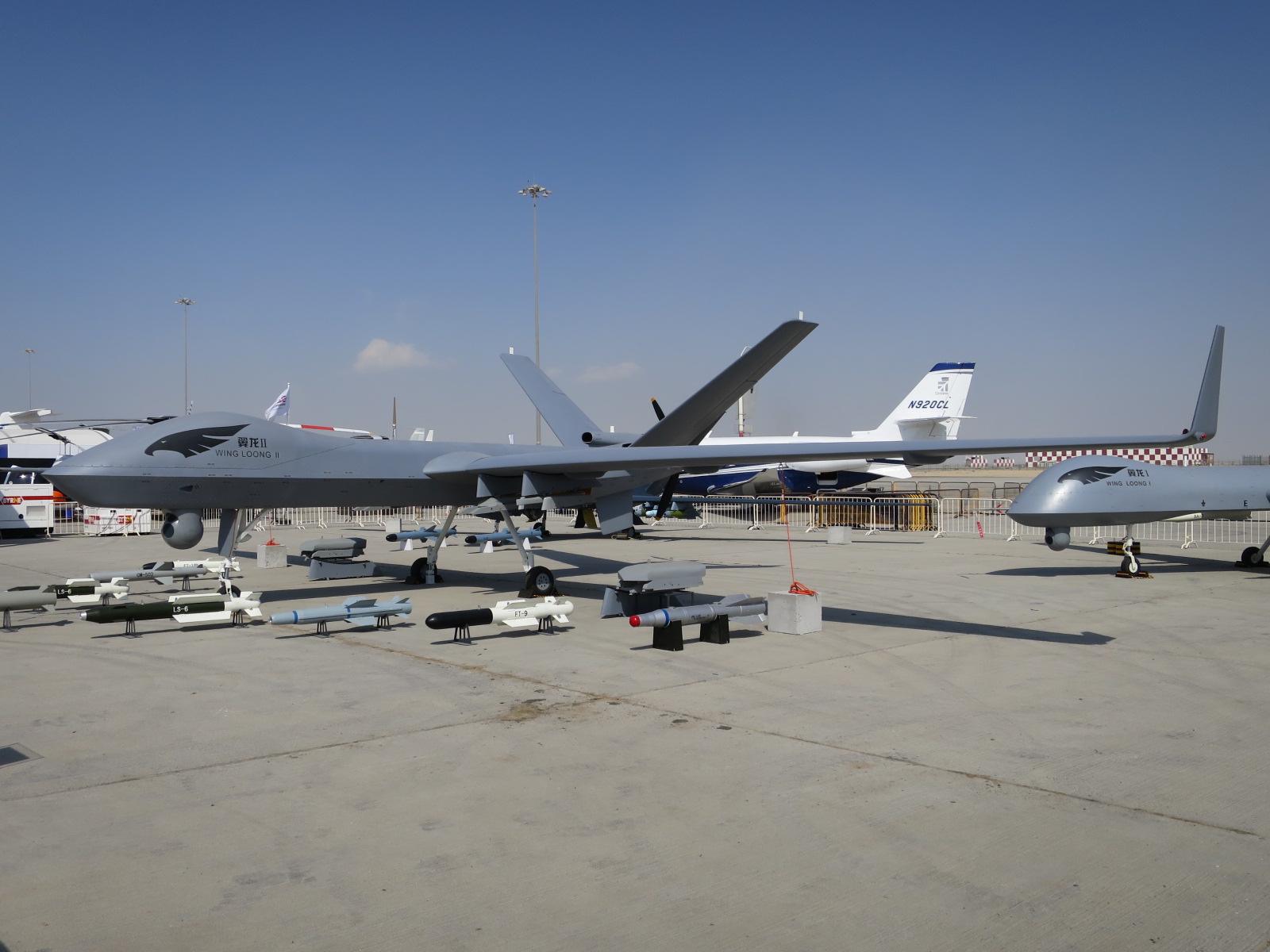
Photo: A Wing Loong II medium-altitude, long-endurance drone on static display, the same type the Nigerian Air Force has operated since November 2020. This aircraft is a Chinese demonstrator photographed at the Dubai Airshow, not a Nigerian-marked airframe — no freely licensed photo of an NAF Wing Loong II in Nigeria was found. Credit: Mztourist, CC BY-SA 4.0, via Wikimedia Commons.
Direct answer
Nigeria received its first two Wing Loong II armed drones from China in November 2020, alongside an order for CH-3 and CH-4 unmanned combat aerial vehicles (UCAVs). The fleet has since grown to roughly a dozen Chinese-built airframes, used mainly for intelligence, surveillance and reconnaissance (ISR) and strike missions against Boko Haram/ISWAP in the northeast and armed bandit groups in the northwest and north-central states. The public record includes officially acknowledged crashes, a December 2023 strike that killed dozens of civilians, and growing use of armed drones by the insurgents themselves.
| System | Chengdu Wing Loong II (CAIG) MALE UCAV; CH-3 and CH-4 UCAVs from the China Academy of Aerospace Aerodynamics (CASC family) |
|---|---|
| Operator | Nigerian Air Force (NAF) |
| First delivered | November 2020 (two Wing Loong II, serials NAF-140/NAF-141); CH-3/CH-4 ordered the same period, CH-4 operational from February 2024 |
| Reported fleet, 2026 | Roughly 5–6 Wing Loong II, around 12 CH-3, 6 CH-4 — open-source estimates; NAF has not published an official count |
| Primary theatres | Northeast Nigeria (Borno/Yobe, Boko Haram/ISWAP); Northwest and North-central (banditry, Zamfara/Katsina/Sokoto/Kebbi/Niger/Kaduna) |
| Officially acknowledged crashes | At least two since 2024 (Kaduna, July 2024; Kontagora, Niger State, January 2026) |
| Evidence cut-off | 1 November 2026 |
Where was it used?
The Chinese fleet flies two distinct Nigerian conflicts. In the northeast, Wing Loong II and CH-4 aircraft operate over the Lake Chad basin — Borno and Yobe states — as part of Operation Hadin Kai against Boko Haram and its Islamic State West Africa Province (ISWAP) offshoot. In the northwest and north-central states, CH-3 and other NAF drones have flown ISR and strike sorties against armed banditry and kidnap-for-ransom networks in Zamfara, Katsina, Sokoto, Kebbi, Niger and Kaduna, under rotating named operations including Fansan Yamma and, more recently, Savannah Shield. A CH-4 unit, the 203 Combat Reconnaissance Group, was stood up in Gombe state specifically to support northeast operations.
What was the mission?
The core mission is persistent overwatch: Nigeria’s manned combat aircraft fleet is small relative to the territory it has to cover, and MALE drones with claimed endurance above 24 hours let the air force watch roads, camps and river crossings for far longer than a jet or helicopter sortie allows. Strike missions follow from that ISR picture — hitting identified Boko Haram/ISWAP camps, convoys and bandit hideouts — rather than drones being used as a stand-alone strike arm. NAF statements describe the aircraft as supporting ground operations rather than replacing them.
What does the public evidence show?
| Claim / event | Date | Evidence level | Source |
|---|---|---|---|
| First two Wing Loong II delivered to NAF (NAF-140/141) | November 2020 | CONFIRMED | Janes, The Defense Post |
| Wing Loong II fleet grows to around five aircraft (NAF-141 to 145) | By 2023 | INDEPENDENTLY REPORTED | Military Africa (open-source tracking, not an official NAF announcement) |
| CH-4 enters NAF service at Makurdi | February 2024 | OFFICIALLY CLAIMED | Military Africa via Migflug |
| Video said to show a Wing Loong II strike on Boko Haram during “Operation Warun,” Borno | June 2023 | UNVERIFIED / VISUALLY DOCUMENTED | Social-media video circulated by defence-watcher accounts; no official NAF confirmation found |
| Army drone strike kills dozens of civilians at a Maulud gathering, Tudun Biri village, Kaduna State | 3 December 2023 | OFFICIALLY CLAIMED (army acknowledged the strike and called it a mistake); toll DISPUTED | Al Jazeera, AP |
| A CH-4 (reported serial NAF-114) crashes near Kontagora, Niger State, during a counter-terrorism sortie | 2 January 2026 | OFFICIALLY CLAIMED (NAF confirmed the crash and no casualties); aircraft type via OSINT | Daily Trust |
| ISWAP fighters attack Forward Operating Base Gajiram using armed drones, mortars and RPGs; repelled | 1 March 2026 | OFFICIALLY CLAIMED (Nigerian Army statement) | AllAfrica, Africa Defense Forum |
| NAF publishes anniversary infographic listing 12 planned TUSAŞ Aksungur UAVs and two more CH-4D drones | 25 October 2026 | OFFICIALLY CLAIMED (NAF infographic); no contract value or schedule disclosed | Janes, Migflug |
What worked?
By NAF’s own account, the Chinese drones filled a real capability gap. A fleet of manned jets and attack helicopters too small to watch the Lake Chad basin and the northwest banditry belt simultaneously gained persistent ISR coverage it did not previously have, at a price and delivery timeline Western suppliers could not match in 2020. The United States did not send its own MQ-9 Reapers to support Nigerian operations until March 2026 — more than five years after Nigeria’s first Chinese UCAVs arrived — illustrating how much faster Beijing moved to supply armed drones with fewer end-user conditions attached. NAF statements credit the drones, alongside manned strike aircraft, with disrupting planned attacks and striking identified camps in Niger, Zamfara and Borno states through 2025 and 2026; these are military claims, not independently audited results, and are reported here as OFFICIALLY CLAIMED rather than confirmed.
What problems appeared?
Three problems recur in the public record. First, reliability: HumAngle’s reporting on US Senate Armed Services Committee testimony states that “the poor quality of these platforms has contributed to their infrequent use,” a characterization that is DISPUTED and has not been independently corroborated with maintenance or sortie-rate data from NAF itself. Second, recurring crash losses — at Kaduna in July 2024 and near Kontagora in January 2026 — with no official cumulative tally published, so the true loss rate remains UNVERIFIED. Third, and most serious, the December 2023 Tudun Biri strike showed the limits of drone-based targeting in populated, low-visibility conditions: the army said the strike was ordered after observing “tactics usually employed by bandits,” then acknowledged the target was a civilian gathering. The aircraft type used was not officially disclosed, so this incident cannot be definitively attributed to any one of the three Chinese systems, but it stands as the clearest evidence of civilian-harm risk in Nigeria’s wider drone campaign. Separately, Boko Haram and ISWAP have increasingly turned the tables: since late 2025 they have used commercial off-the-shelf (COTS) and armed first-person-view drones in multiple attacks on army bases, including Sabon Gari (Damboa, January 2026) and FOB Gajiram (March 2026), eroding the one-sided air advantage Nigeria held when it first bought Chinese UCAVs.
Confirmed losses and limitations
| Incident | Date / location | Evidence level | Detail |
|---|---|---|---|
| Wreckage resembling a CH-3 found near Dumge village | January 2015, Borno State | VISUALLY DOCUMENTED | Photographs of a crash-landed UCAV circulated; a Nigeria–China CH-3 sale was not officially confirmed at the time |
| NAF UAV crashes on takeoff near Rumji village | 1 July 2024, Kaduna State | OFFICIALLY CLAIMED | NAF confirmed the crash and said there were no casualties; aircraft type not disclosed |
| CH-4 (reported NAF-114) loses data link and crashes in Zangata Forest | 2 January 2026, Kontagora, Niger State | OFFICIALLY CLAIMED | NAF said the crash site was secured and a technical evaluation opened; no casualties reported |
| “Poor quality” / infrequent-use characterization | Reported 2021–2026 | DISPUTED | Sourced to US congressional testimony relayed by HumAngle; not independently verified against NAF maintenance data |
No comparative crash-rate data for Nigeria’s Chinese drones versus its Turkish or Western-origin aircraft has been published, so this article makes no system-versus-system reliability claim beyond what is documented above. A destroyed or lost airframe is not, on its own, evidence that a system is unsuited to the mission, and a successful strike claim is not evidence that a system is immune to losses or error — both points apply equally here.
What is still disputed?
Several open questions remain genuinely unresolved in the public record. The exact size of the current Chinese drone fleet is UNVERIFIED — NAF has not published a count, and the widely cited figures (around five Wing Loong II, a dozen CH-3, six CH-4) come from open-source trackers rather than official disclosure. Whether the June 2023 “Operation Warun” footage really shows a Wing Loong II strike is UNVERIFIED, resting on a single circulated video rather than an NAF statement. The Tudun Biri death toll is DISPUTED between Nigeria’s national emergency management agency (around 85) and Amnesty International (around 120), and the drone type used was never officially named. Whether reliability concerns specifically — as opposed to cost, industrial relationships, or simple fleet diversification — are what pushed NAF toward more Turkish systems is an UNVERIFIED causal claim; no NAF or Chinese-manufacturer statement draws that link explicitly.
Did the manufacturer or operator change anything?
Neither Chengdu Aircraft Industry Group nor the CH-3/CH-4 manufacturer has issued a public statement responding to Nigeria’s loss or reliability reports. NAF’s own response has been to diversify rather than replace: the Chinese fleet has not been withdrawn, and the CH-4 line has in fact grown, from an original four airframes to a reported six, with two additional CH-4D aircraft publicly flagged for delivery as of the 25 October 2026 infographic — alongside a stated intent to acquire 12 Turkish TUSAŞ Aksungur UAVs and six more T129 ATAK attack helicopters, a program Nigeria has been expanding since 2019. No contract value or delivery schedule for the Aksungur order has been disclosed, so this is OFFICIALLY CLAIMED intent rather than a confirmed procurement.
Did other countries buy it afterward?
| Operator | Year | Detail | Source |
|---|---|---|---|
| Côte d’Ivoire | Confirmed August 2026 | Became the second West African Wing Loong II operator; contract with China’s CATIC signed June 2024, aircraft shown publicly at Bouaké Air Base, part of a stated push to diversify suppliers beyond France | Janes, Afridex |
| Democratic Republic of Congo | 2023 | Bought nine CH-4 drones separately for operations against M23 — a related but distinct Chinese UCAV program, covered in DefenceMENA’s dedicated article | DefenceMENA |
What does this mean for African procurement?
Nigeria’s six years with Chinese UCAVs is the clearest African case study of a pattern now repeating elsewhere: Chinese suppliers offered fast delivery and few political strings at a time when Western MALE drones were hard to access, and Nigeria took that route years before Washington extended its own Reaper support. Côte d’Ivoire’s 2026 Wing Loong II purchase shows other West African air forces drawing the same conclusion. But Nigeria’s record also carries the costs: unresolved questions about reliability, a mass-casualty strike that the public still cannot attribute to a specific aircraft type, and an adversary that now flies its own armed drones against Nigerian bases. For other African buyers, the lesson is not “avoid Chinese systems” but “budget beyond the purchase price” — for maintenance and spares, for the ISR-to-strike discipline needed to avoid another Tudun Biri, and increasingly for counter-UAS capability now that insurgent and militia groups across the Sahel and Lake Chad basin are acquiring their own drones, a trend DefenceMENA has also tracked in its wider survey of loitering munitions in African armies. Nigeria’s push toward local assembly and maintenance, discussed in DefenceMENA’s reporting on Nigeria’s local defence-production effort, is itself partly a response to the sustainment gap this fleet has exposed. For a fuller picture of which African air forces operate which systems, see DefenceMENA’s overview of military drones in Africa, the evolution of military drones on the continent, how Nigeria’s Chinese drones compare with Turkish alternatives to the Bayraktar TB2, and the continent-wide military equipment database.
Battlefield file
Chinese-built MALE UCAVs operated by the Nigerian Air Force since November 2020.
Lake Chad basin against Boko Haram/ISWAP; Zamfara, Katsina, Sokoto, Kebbi, Niger and Kaduna against armed banditry.
Long-endurance overwatch to extend a small manned-aircraft fleet’s reach, followed by strikes on identified targets.
Fleet growth is documented; individual strike claims mostly come from the military and are rarely independently verified.
Kaduna 2024 and Kontagora 2026 crashes; the December 2023 Tudun Biri strike killed dozens of civilians.
NAF kept and expanded its Chinese fleet while adding more Turkish Aksungur and T129 ATAK aircraft.
Chinese UCAVs gave African air forces faster access than Western suppliers — but reliability, targeting discipline and counter-UAS needs follow.
FAQ
Does Nigeria operate Chinese Wing Loong II drones?
Yes. The Nigerian Air Force received its first two Wing Loong II drones from China in November 2020 and has since expanded the fleet to an estimated five or six aircraft, according to open-source tracking; NAF has not published an official total.
What Chinese drones does the Nigerian Air Force fly?
Three types: the Wing Loong II, and the CH-3 and CH-4, both from China’s CH (Rainbow) family. All three are used for ISR and strike missions in the northeast and northwest.
Has the Nigerian Air Force lost any of its Chinese-made drones?
NAF has officially acknowledged at least two UAV crashes since 2024, at Kaduna in July 2024 and near Kontagora, Niger State, in January 2026. No official cumulative loss figure has been published.
Do Boko Haram and ISWAP use drones against the Nigerian military?
Yes. ISWAP has used drones for surveillance since around 2020, and since late 2025 both groups have increasingly used commercial and armed first-person-view drones in direct attacks on army bases, including at Sabon Gari in January 2026 and FOB Gajiram in March 2026.
What happened in the Tudun Biri drone strike?
On 3 December 2023, a Nigerian Army drone strike hit a gathering marking the Maulud festival in Tudun Biri village, Kaduna State. The army apologized and called it a mistake. Nigeria’s emergency management agency put the toll at about 85 dead; Amnesty International cited a higher figure of around 120. The drone type used was not officially disclosed.
Is Nigeria still buying drones from China in 2026?
Nigeria has not withdrawn its Chinese fleet. An NAF infographic published on 25 October 2026 flagged two more CH-4D drones as expected, alongside a separate plan to acquire 12 Turkish TUSAŞ Aksungur UAVs — suggesting a mixed-supplier fleet rather than a shift away from Chinese systems.
Sources
- Janes — Nigeria receives Wing Loong II UAVs from China
- The Defense Post — Nigeria receives Wing Loong II drones
- Military Africa — Nigerian Air Force Wing Loong II fleet tracking
- Migflug/Afterburner — Nigerian Air Force Lists Aksungur Drones and Six More T129s
- Janes — Nigerian Air Force reveals procurement plans
- Janes — Côte d’Ivoire unveils Wing Loong II UAVs
- Afridex — Côte d’Ivoire builds the next generation of defence capability
- Daily Trust — NAF’s unmanned aerial plane crashes in Niger State
- Al Jazeera — Nigerian military drone attack kills 85 civilians in error
- Associated Press (via KSAT) — At least 85 civilians killed by a Nigerian army drone attack
- Africa Defense Forum — ISWAP turns to armed drones
- Africa Defense Forum — Nigerian terrorists increase COTS armed drone use
- AllAfrica — Troops kill 8 terrorists, recover RPGs, guns, drones in Borno clashes
- AllAfrica — 12 terrorists, soldiers killed as troops repel ISWAP drone attack
- Oryx — A Guide to Nigeria’s Military Drones (visual documentation / OSINT)
- Shephard Media — Nigeria expands UAV fleet for counter-terror operations
- HumAngle (via Pacesetter Frontier) — Armed drones making a strong entrance in Nigeria’s anti-terror campaign
More from Battlefield Proven
- Bayraktar TB2 in Libya: What Did Its Combat Use Actually Show?
- Sudan War Drones: What the Evidence Shows on SAF and RSF Since 2023
- Pantsir-S1 in Libya: What the Battlefield Record Revealed
- Drones in the Ethiopia War: What Is Confirmed and What Remains Unverified
- Wing Loong II in Libya: How Did China’s Armed Drone Perform in Combat?
- Bayraktar TB2 and Akinci in Mali and Burkina Faso: What Combat Use Has Shown
- Nigeria Super Tucano: What Five Years of Combat Use Have Shown
- BMC Kirpi in Africa: What Is Publicly Known About Its Mine and IED Protection Record
- Mi-24 and Mi-35 Attack Helicopters in Africa: What Combat in Nigeria, Mali and Uganda Has Shown
- Casspir and Mamba: What South Africa’s Mine-Protected Vehicles Proved in African Combat
- Rooivalk in the DRC: What Combat Use Actually Showed
- SAMIDRC in the DRC: What Combat Against M23 Showed About South African Equipment
Evidence for this article was drawn from open-source and defence-press reporting; several figures, including total fleet size and some crash details, rely on OSINT tracking rather than official Nigerian Air Force disclosure, and are marked accordingly above. This article will be updated at the same URL if significant new evidence appears.