


Pantsir-S1 in Libya: What the Battlefield Record Revealed


The Pantsir-S1 arrived in Libya as the air-defence shield of Khalifa Haftar’s Libyan National Army (LNA) and within about a year became one of the most photographed air-defence losses of the war. Read carefully, the Pantsir S1 Libya record says less about the Russian system in isolation than about what happens when a complex short-range air-defence system is fielded without a network, a stable crew base or protection against a determined electronic-warfare opponent.
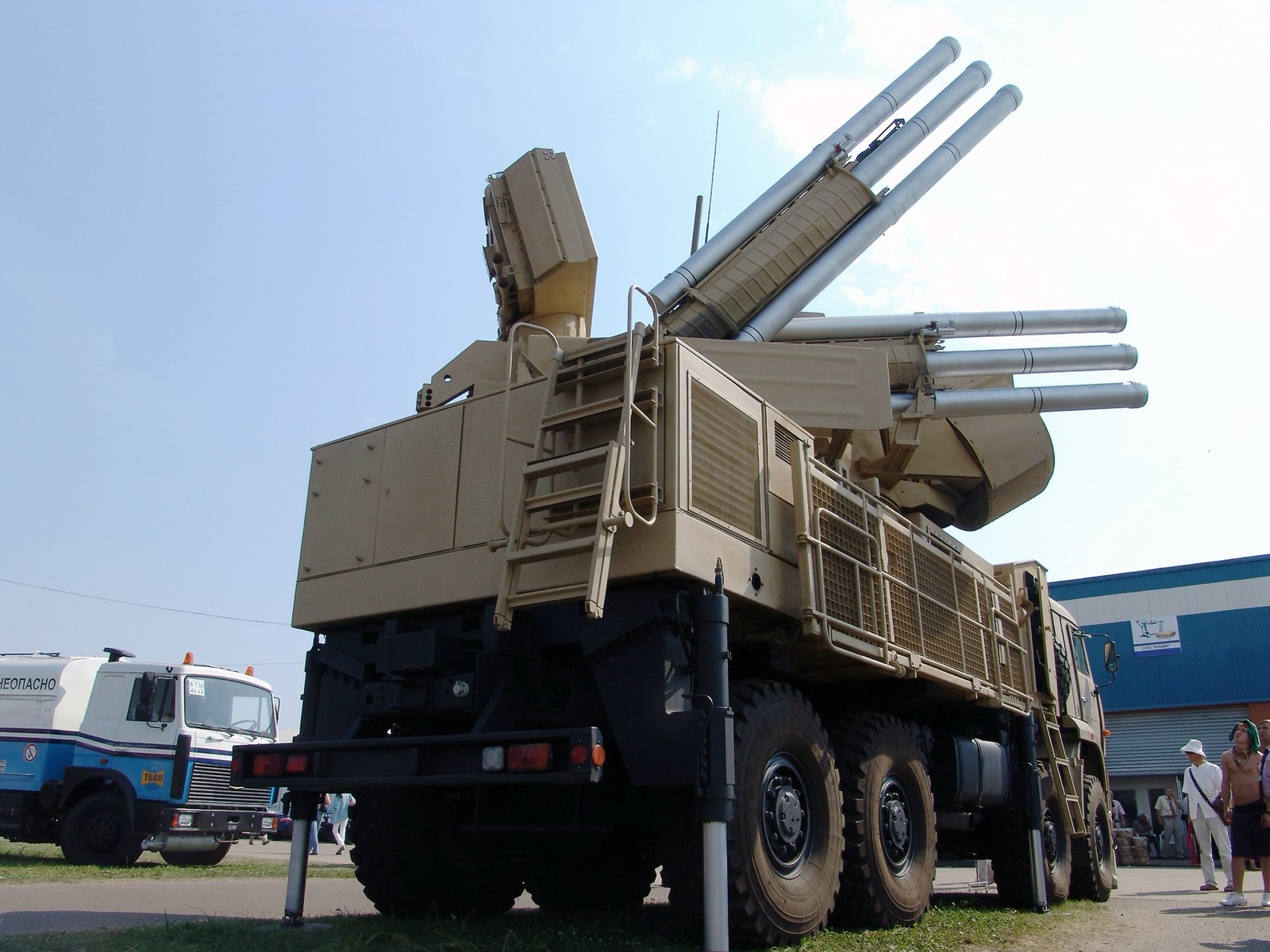
Photo: A Pantsir-S1 on the KAMAZ-6560 chassis, the version the UN Panel of Experts linked to Russian supply in Libya from mid-2020. Photo: Mike1979 Russia, CC BY-SA 3.0, via Wikimedia Commons. Credit: Mike1979 Russia, CC BY-SA 3.0, via Wikimedia Commons.
Direct answer
The UN Panel of Experts found that Pantsir-S1 systems on MAN SX45 trucks, a configuration used only by the United Arab Emirates, defended LNA bases from March 2019, and that Russian-supplied KAMAZ-mounted systems operated by the Wagner Group followed in mid-2020. Several were destroyed or damaged in May 2020, and one relatively intact system captured at al-Watiya was flown out of Libya under a US exploitation programme. Libya documents the fate of a small, isolated Pantsir force in one theatre, not a universal verdict on the system.
| System | Pantsir-S1 (96K6; NATO: SA-22 Greyhound), combined 30mm gun and missile short-range air defence |
| Manufacturer | KBP Instrument Design Bureau, Tula (High Precision Weapons holding, Rostec) |
| Origin | Russia |
| Operator(s) in this conflict | LNA side: UAE-origin systems (MAN SX45) from 2019; Russian-origin systems (KAMAZ) operated by ChVK Wagner from mid-2020, per the UN Panel. One captured system passed to the Government of National Accord (GNA) side in May 2020 |
| Period | March 2019 – late 2020 |
| Evidence level summary | Deployment and origin: confirmed by UN Panel. Losses: at least six visually documented, higher totals claimed. Intercept claims: largely unverified |
Where was it used?
Using open-source and confidential satellite imagery, the UN Panel established that at least two Pantsir-S1 systems covered Jufra air base in central Libya between 5 March and 19 April 2019, and its December 2019 report (S/2019/914) also listed al-Khadim air base in the east. On 18–19 June 2019 a Pantsir was photographed on a low loader south of Gharyan, the LNA’s forward hub for the Tripoli offensive; defenceWeb reported at the time that it appeared to have arrived on a UAE military transport aircraft.
By spring 2020 systems were dispersed along the LNA’s western front, including al-Watiya air base near the Tunisian border, Tarhuna south-east of Tripoli, and the Sirte axis. After the LNA’s withdrawal from the west, the Panel’s March 2021 report (S/2021/229) placed KAMAZ-mounted systems around Jufra and the new front line in September 2020 imagery. Russia had discussed a Pantsir sale with the Gaddafi government in 2010, but no delivery is documented before the 2011 embargo; for Libya’s more recent defence ties, see Italy and Libya’s deepening military cooperation.
What was the mission?
Point defence of air bases and ground forces against low-flying aircraft and, above all, armed drones. From April 2019 the LNA’s Tripoli offensive relied on air superiority from aircraft, helicopters and UAE-supplied Wing Loong II drones, while the GNA answered with a small fleet of Turkish-supplied armed drones. From early 2020, after a November 2019 security agreement, Türkiye added naval air defence, electronic-warfare systems and more drones, and the Pantsir force had to survive against an opponent actively hunting air-defence assets.
What does the public evidence show?
The strongest evidence is in two UN Panel of Experts reports. Loss documentation comes mainly from open-source analysts (Oryx, New America), useful for visual identification but not an official loss register.
| Claim / event | Date | Evidence level | Source |
|---|---|---|---|
| At least two Pantsir-S1 defend Jufra air base | Mar–Apr 2019 | Confirmed (UN Panel, satellite imagery) | UN S/2019/914, annex 40 |
| Systems on MAN SX45 chassis, used only by the UAE; Panel finds the UAE in non-compliance with the embargo | 2019 | Confirmed (UN Panel finding) | UN S/2019/914, para. 96 |
| Pantsir moved south of Gharyan for the LNA | 18–19 Jun 2019 | Visually documented; confirmed by Panel | UN S/2019/914; defenceWeb |
| GNA says it destroyed four Pantsirs | 18 Jun 2019 | Officially claimed; Panel called report unverified | Libya Observer; UN S/2019/914 |
| Pantsir initially inflicted losses on GNA-AF armed drones | 2019 – early 2020 | Independently reported (Panel assessment, no figure) | UN S/2021/229, para. 60 |
| Pantsirs struck at al-Watiya, Tarhuna, al-Wushka, Sirte, Souq al-Ahed | 16–20 May 2020 | Visually documented; totals disputed | New America; Oryx |
| Relatively intact Pantsir captured at al-Watiya | 18 May 2020 | Confirmed (UN Panel), visually documented | UN S/2021/229, para. 78 |
| Captured system flown out of Libya on a US aircraft (reportedly C-17, Zuwarah to Ramstein) | June 2020 | Transfer confirmed by Panel; route independently reported | UN S/2021/229, para. 79; The Times via TWZ |
| Russian-origin Pantsir on KAMAZ, operated by ChVK Wagner | From Jul 2020 | Confirmed (UN Panel) | UN S/2021/229, annex 23 |
On supply, the UN record is unusually clear. The Panel noted that all other Pantsir export variants use Russian or Belarusian chassis and judged it “very unlikely” that the UAE had passed the system to an intermediary. Context on the UAE’s own architecture is in the evolution of UAE integrated air and missile defence.
What worked?
In the first phase the Pantsir appears to have done what it was bought for. The Panel’s 2021 report describes GNA air operations in this phase as limited to local strikes, while the LNA and its backers held local air superiority over most of the country through 2019 (the Panel’s account of drone attrition is set out under losses below). The system also proved deployable: flown in, moved by road between bases and the front, and relocated to Jufra and Sirte after the LNA’s defeat in the west, where the front froze before the October 2020 ceasefire.
What problems appeared?
The Panel’s assessment of 2020 is blunt: drones, loitering munitions and electronic warfare proved “a highly effective combination in defeating” the UAE-delivered Pantsirs, which “suffered significant casualties”, leaving LNA units with no real protection from air attack. It described those units as “neither trained nor motivated” to defend against the new technology.
Isolation. There is no public evidence that the Pantsirs were tied into a layered network with longer-range radars, medium-range missiles or a common air picture. Designed as the inner layer of an air-defence system, in Libya the Pantsir often had to be the whole system.
Electronic warfare. The Panel reported that Türkiye deployed the Koral electronic-warfare system and that the Pantsirs took losses even when operated in modes meant to limit exposure to jamming. New America’s analysts added that the Libyan examples lacked the radar and software improvements Russia later fielded for intensive drone warfare; this is analysis, not a disclosed specification.
Crews and sustainment. Who crewed the MAN-mounted systems at each stage is not publicly established. The Panel confirms Wagner as the operator of the KAMAZ systems from mid-2020, and Oryx noted that one system hit at Tarhuna bore a nickname it attributed to former Emirati operators. Either way, the force was sustained far from its supplier, through an arms embargo.
Confirmed losses and limitations
Pantsir losses. The LNA, the UAE and Russia have published no loss figure. New America’s open-source count recorded about ten strikes on Pantsir crews between September 2019 and July 2020 and at least six systems visually confirmed as destroyed, most within a few days in May 2020. GNA statements and Ukrainian outlet Defence Express gave totals of up to 15, which cannot be checked against imagery. Oryx documented one system badly damaged at Tarhuna on 20 May 2020 and later recovered by GNA forces.
The captured system. According to the Panel, the Pantsir captured at al-Watiya on 18 May 2020 was held by an armed group in Zuwarah, moved to Mitiga airport under Turkish protection, then “acquired as part of the United States of America foreign military exploitation programme” and taken out of Libya. The US reply to the Panel “contained no relevant information”, and the Panel recorded the flight as an embargo violation by the United States. The Times first reported the June 2020 C-17 flight to Ramstein; the system’s later destination has not been officially disclosed.
Intercept claims. Both sides claimed large numbers of drones shot down. The only independent assessment is the Panel’s general statement that, early on, GNA-AF Bayraktar TB2 aircraft “were easily destroyed in the air” by the Pantsir once launched, with no figure given. Imagery of downed drones rarely shows whether a Pantsir, another system, electronic warfare or an accident was responsible, so no reliable public figure credits the Pantsir with a specific number of kills.
Civilian harm. No public reporting attributes civilian casualties to the Pantsir itself in Libya.
What is still disputed?
- Totals: how many Pantsirs reached Libya and how many were lost; the Panel established deployments but published no total.
- Crews: whether the MAN-mounted systems were operated by UAE personnel, LNA crews, Russian contractors or mixed teams.
- Onward transfer: Oryx reported UAE-supplied systems with Wagner at Bani Walid; the Panel treats the KAMAZ systems as a separate Russian supply.
- Cause of loss: public evidence cannot separate design, export configuration, crew proficiency, deployment choices and the opponent’s capabilities.
Libya is one record. Pantsir systems have also been used in Syria and, on a far larger scale, by Russia in Ukraine, with different variants, operators, threats and integration; those records differ and are not covered in detail here.
Did the manufacturer or operator change anything?
The UAE, which bought about 50 systems under a US$734 million contract signed in 2000, had already asked Rosoboronexport for a further modernisation programme in February 2019; its content has not been published. Its wider inventory is set out in what the UAE’s armed forces operate.
Russia has since promoted the Pantsir-SM and the export Pantsir-SMD-E. KBP presented a smaller anti-drone interceptor in February 2024, and Rostec said deliveries to the Russian Ministry of Defence began in July 2025. In September 2026 Rosoboronexport chief Alexander Mikheyev said the Pantsir-SMD-E had shown “outstanding results” in real conditions and expected African interest. Neither KBP nor Rostec has publicly linked these changes to Libya; New America argues the losses prompted upgrades, which remains analysis.
Did other countries buy it afterwards?
We found no confirmed new Pantsir order by an African state placed after the 2020 Libyan losses in the public record up to 30 September 2026. Documented African operators acquired their systems earlier, or at undisclosed dates.
| Country | What is known | Year | Evidence level | Source |
|---|---|---|---|---|
| Algeria | Reported deal for about 40 Pantsir-S1 worth around US$500m; a 2018 claim of Pantsir-SM in exercises is unconfirmed by officials | 2010 | Independently reported | Army Technology; Military Watch (claim) |
| Ethiopia | Pantsir-S1 shown on state television; further imagery in 2023; delivery date and route undisclosed | First seen 2019 | Visually documented | defenceWeb; Army Recognition |
| Equatorial Guinea | Listed as an operator in Russian-sourced reporting | Not disclosed | Unverified | Military Africa |
| Any African state, post-2020 order | None found; Pantsir-SMD-E marketed in Egypt in 2026 | 2021–2026 | No reliable public figure | TASS |
Algeria remains the largest African Pantsir operator; see Inside Algeria’s Russian-built arsenal and its reported move to the Chinese HQ-17. Ethiopia’s air-defence build-up is covered in the evolution of Ethiopia’s air force. The absence of new orders cannot be pinned on Libya alone: sanctions risk, Russia’s own wartime demand after 2022 and Chinese competition plausibly matter as much.
What does this mean for African procurement?
Buy a network, not a vehicle. A short-range gun-missile system is an inner layer. Without early-warning radar, medium-range cover and a shared air picture, it carries the whole mission alone. The same integration questions apply to Chinese and Turkish offers, as Burkina Faso’s Sky Dragon 30 trials and the market for counter-drone systems in African armies show.
Plan for electronic warfare. Libya was an early case of short-range air defence facing armed drones, loitering munitions and deliberate jamming together. Contracts should specify through-life software and radar upgrades and training, not just delivery specifications.
Crews and sustainment are part of the purchase. Emirati officers reportedly took six-month courses in Russia on operation and maintenance. Libya showed how uncertain performance becomes when crewing and support are unclear; simulators, instructors and a domestic maintenance base need budgets of their own.
Sanctions exposure. Section 231 of the US CAATSA law allows sanctions on significant transactions with Russia’s defence sector. In September 2022, 27 members of Congress urged its use over Algeria’s Russian purchases; no such sanctions had been announced by the evidence cut-off, but payment, spare-parts and supplier-capacity risks remain.
Export perception. The al-Watiya capture showed that a system lost in combat can end up with a third country. When a supplier calls a system combat-proven, buyers should ask where, against what, with which variant and which crews. Comparable systems are listed in the DefenceMENA military equipment database.
Battlefield file: 7 cards
KBP Tula’s Pantsir-S1 pairs 30mm cannon with missiles on an 8×8 truck; Libya saw both UAE MAN and Russian KAMAZ versions.
UN-confirmed at Jufra from March 2019, later at Gharyan, al-Watiya, Tarhuna and Sirte.
Protecting LNA bases and forces during the 2019–2020 Tripoli offensive.
The UN Panel credits the Pantsir with an early defensive effect, then records that the systems “suffered significant casualties” in 2020.
At least six visually confirmed destroyed; one captured at al-Watiya and flown out under a US exploitation programme, per the UN Panel.
Russia markets the Pantsir-SM/SMD-E and a smaller anti-drone interceptor; officials have not linked this to Libya.
Short-range air defence needs a network, EW resilience, trained crews, secure sustainment and a sanctions plan.
FAQ
What happened to the Pantsir S1 in Libya?
UAE-origin Pantsir-S1 systems defended LNA bases from 2019, and Wagner-operated Russian systems arrived in mid-2020. Open-source analysts visually confirmed at least six destroyed, mostly in May 2020, and one was captured at al-Watiya. Higher totals claimed by the GNA are unverified.
Who supplied the Pantsir to Haftar’s forces in Libya?
The UN Panel of Experts found the UAE responsible for Pantsir-S1 systems on MAN SX45 trucks, a configuration only the UAE uses. It found that KAMAZ-mounted systems seen from July 2020 came from Russia and were operated by the Wagner Group.
Did the US capture a Pantsir in Libya?
GNA forces captured the system at al-Watiya in May 2020. The UN Panel says it was then acquired under a US foreign military exploitation programme and flown out of Libya. The Times reported a June 2020 C-17 flight to Ramstein, Germany. Its final destination has not been officially disclosed.
How many Pantsir systems were destroyed in Libya?
There is no official figure. New America’s open-source count recorded about ten strikes and at least six systems visually confirmed as destroyed. GNA and Ukrainian media totals of up to 15 have not been independently verified.
Which African countries operate the Pantsir-S1?
Algeria and Ethiopia are documented operators. Equatorial Guinea appears in Russian-sourced lists but is unverified. No new African order placed after 2020 was found in public records up to 30 September 2026.
Sources
- UN Panel of Experts on Libya, final report S/2019/914 (9 December 2019), para. 96 and annex 40
- UN Panel of Experts on Libya, final report S/2021/229 (8 March 2021), paras. 60–65, 78–80, 97 and annex 23
- Security Council Report: S/2021/229 document record
- defenceWeb: Libya operating Pantsir-S1 air defence systems (June 2019)
- Libya Observer: GNA claim of Pantsir destruction (June 2019)
- New America: Analyzing Wagner Group air defense and ground maneuvers
- Oryx: Disaster at Tarhuna (visual documentation)
- The War Zone: The US smuggled a Russian-made Pantsir out of Libya, report (January 2021)
- Army Technology: US flies Russian-built Pantsir S-1 out of Libya
- Military Africa: US military whisks away Russian-made Pantsir from Libya
- Gulf News: Russia, UAE to complete delivery of 50 Pantsir-S1 in 2013
- TASS: UAE plans to modernise Pantsir-S1 (February 2019)
- defenceWeb: Ethiopia operating Pantsir-S1 air defence systems (March 2019)
- Army Recognition: New pictures of Ethiopia’s Pantsir systems (2023)
- Army Technology: Algeria and Libya to purchase Russian air defence systems (June 2010)
- Military Africa: Russia develops new mini-missiles for Pantsir (February 2024)
- TASS: Rosoboronexport on Russian air defence prospects in Africa (September 2026)
- Office of Rep. Lisa McClain: letter to Secretary Blinken on Algeria and CAATSA (September 2022)
Evidence note: Loss figures in this article come from UN Panel findings and open-source visual documentation. Neither is a complete or official loss register, and the LNA, the UAE and Russia have published no figures. Claims by the parties to the conflict are identified as claims. This article will be updated at the same URL if significant new evidence appears.
More from Battlefield Proven
- Bayraktar TB2 in Libya: What Did Its Combat Use Actually Show?
- Sudan War Drones: What the Evidence Shows on SAF and RSF Since 2023


