African armies facing armed commercial and first-person-view drones have no single answer: Nigeria has fielded a Lithuanian handheld jammer and is evaluating an indigenous detection-and-jamming system, Niger and Angola have contracted a Turkish fixed-site system, a Nigerian company is mass-producing a kinetic interceptor drone still in trials, and a South African firm has just finished proof-of-concept trials of a vehicle-mounted, multi-effector system with no confirmed military customer yet. Range, mobility, kill method and evidence of actual delivery differ sharply between them.
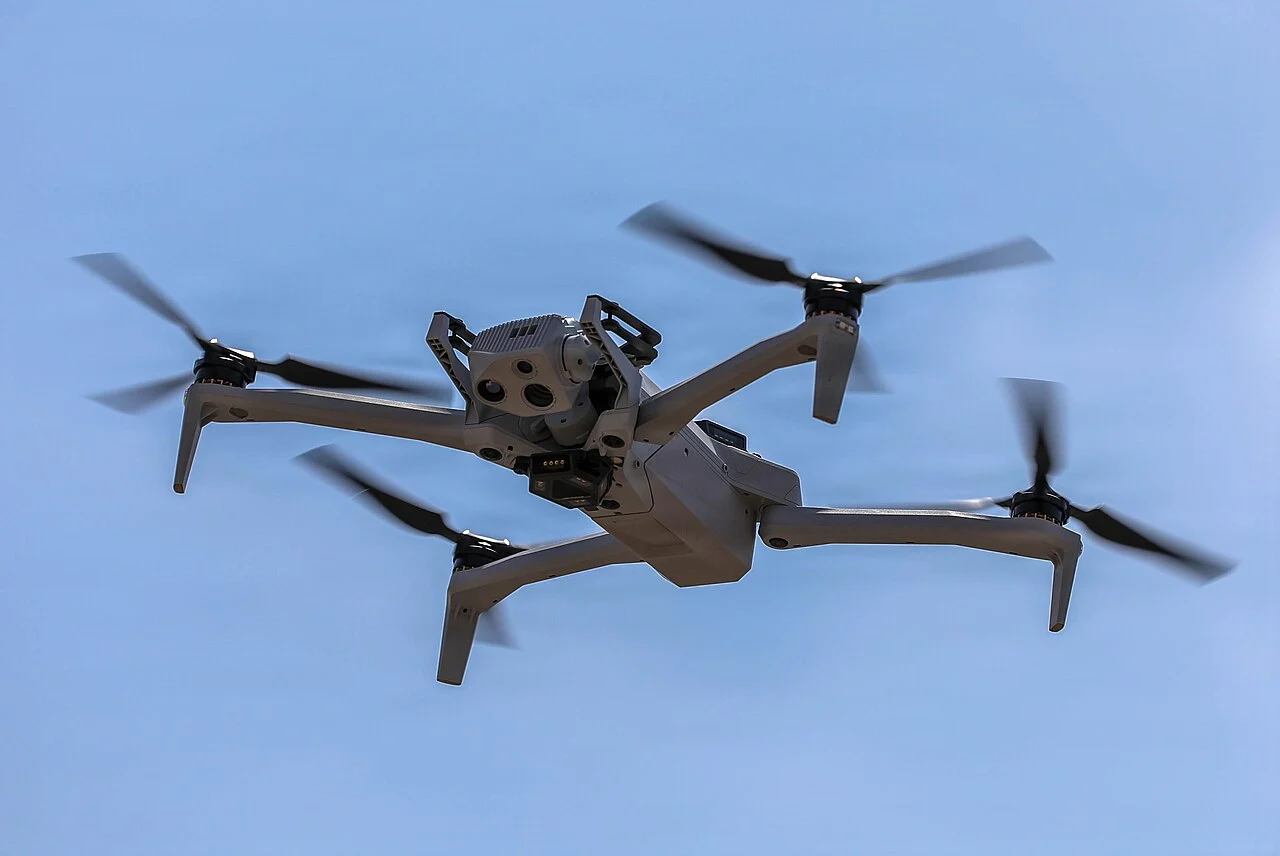
Photo: A drone used during the inaugural multinational drone academics at African Lion 26, Agadir, Morocco. Credit: U.S. Army photo by Sgt. Shane Killeen, Public Domain, via Wikimedia Commons.
Direct answer
For the counter-UAS requirement now facing African armies, mainly protection against small, cheap, armed or ISR-configured drones flown by non-state groups, five systems have documented African evidence: the EDM4S SkyWiper (Lithuania, NT Service), a handheld jammer already fielded by Nigeria; ASELSAN İHTAR (Türkiye), a fixed/semi-mobile detect-and-jam system reported in April 2023 to be under contract to Niger and Angola; the BabaSky/UNICCON counter-UAS system (Nigeria), a mobile detection, pilot-geolocation and jamming system demonstrated to the Nigerian Army and Air Force but not yet ordered; Terra Industries’ Kama (Nigeria), a kinetic interceptor drone in production and trials; and the Centauri TriAD (South Africa), a vehicle-mounted, multi-sensor, multi-effector hard-kill system that has completed proof-of-concept trials with no confirmed military customer. No single system covers the requirement end to end: some are proven but narrow in scope (EDM4S), some are contracted but unconfirmed in delivery (İHTAR), and several are still pre-order (BabaSky, Kama, TriAD).
| Requirement | Detect and defeat small, low-cost, armed or ISR-configured drones over forward bases, convoys and critical infrastructure |
| Systems compared | EDM4S SkyWiper, ASELSAN İHTAR, BabaSky/UNICCON C-UAS, Terra Industries Kama, Centauri TriAD |
| Only system confirmed operationally fielded in Africa | EDM4S SkyWiper (Nigerian Army, against ISWAP drones) |
| Only system with confirmed African contracts | ASELSAN İHTAR (Niger, Angola, both reported April 2023) |
| Largest related programme (not a point system, cited for scale) | MARSS NiDAR national C4I MoU with Nigeria, reported at over $190 million |
The African requirement
The requirement did not exist in this form five years ago. Non-state armed groups in the Lake Chad Basin and the Sahel have moved from using commercial quadcopters for surveillance to dropping improvised munitions and, more recently, flying armed first-person-view (FPV) drones directly at troops. The Islamic State West Africa Province (ISWAP) attack on a Nigerian forward operating base at Wajiroko on 24 December 2024, which wounded at least five soldiers, is the case most often cited by analysts as the turning point (Military Africa). Analysts recorded close to 60 UAS attack incidents across Africa in 2025, roughly triple the prior year, concentrated in Nigeria, Mali, Burkina Faso, Niger and Cameroon (Military Africa; Africa Defense Forum). The requirement is not one system but a layered problem: detect a small, slow, low radar-cross-section target; identify whether it is hostile; and defeat it without wasting an expensive missile on a cheap airframe.
Operating environment
- Forward operating bases with thin infrastructure. Many of the bases under drone attack in the Lake Chad Basin and central Sahel run on generator power and have limited technical staff, which favours systems that are portable, battery-powered or low-maintenance over large fixed radar-and-jammer masts.
- Low, slow, small targets. COTS and FPV drones are hard for conventional air-defence radar to pick up and are not worth engaging with a guided missile; the requirement pushes toward radio-frequency detection, acoustic sensors and low-cost kinetic or electronic kill methods rather than traditional short-range air defence.
- Dispersed, road-bound forces. Convoys and outposts are spread across large, arid or semi-arid terrain (Lake Chad Basin, central Sahel), so a system tied to one fixed site protects a base but not a moving column; portable or vehicle-mounted systems address a different slice of the same requirement.
- Critical infrastructure protection. A second, separate use case, protecting ports, oil and gas sites and command nodes, favours fixed or semi-mobile detect-and-jam installations of the kind ASELSAN and similar vendors market for perimeter defence.
- No source reviewed for this article publishes comparable hot-weather or dust-ingress test data across all five systems; that gap is stated rather than filled.
What capabilities matter?
The same criteria are applied to every system: primary kill-chain function (detect, soft-kill/jam, hard-kill/kinetic), platform and mobility, detection or engagement range as reported, documented African users and their status, evidence of a contract or delivery, and any local production or technology-transfer evidence. Where a source does not state a figure, the table says so.
Comparison table
| System | Origin | Primary function | Platform / mobility | Range (reported) | Documented African users | Contract / price evidence | Local production / ToT evidence |
|---|---|---|---|---|---|---|---|
| EDM4S SkyWiper | Lithuania (NT Service) | Soft-kill: RF/GNSS jamming | Handheld, one operator | Up to 5 km (manufacturer/reporting) | Nigeria (Army, fielded against ISWAP) | No Nigerian contract value published; a unit price near $15,000 appears in vendor/product-database descriptions, not in an official disclosure | None found |
| ASELSAN İHTAR | Türkiye | Detect (radar/EO/acoustic) + soft-kill jamming | Fixed or semi-mobile, site/perimeter defence | Not stated in sources reviewed for the exported configuration | Niger and Angola (contracts reported April 2023) | Contract value not disclosed for either state | None confirmed in Africa |
| BabaSky / UNICCON C-UAS | Nigeria | Detect + pilot geolocation + directional jamming | Mobile, vehicle or trailer-based | ~8 km detection radius (manufacturer, demonstrated) | Nigeria (demonstrated to Army and Air Force, August 2026; no order confirmed) | Not stated; demonstration only | Built under a DICON partnership of about two years; production/assembly location not detailed in sources reviewed |
| Terra Industries Kama | Nigeria | Hard-kill: kinetic interceptor drone | Expendable interceptor airframe, launched per engagement | Up to 300 km/h intercept speed (manufacturer claim); engagement range not stated | Nigeria (developer, DICON joint venture); “trials with several militaries across West Africa” (manufacturer claim, states not named) | Not stated; no confirmed sale price | Abuja factory reported producing 20 prototypes/day; DICON joint venture (Feb 2026) covering manufacturing, ToT and supply chain; second factory under construction in Accra, Ghana, first batch expected Q3 2026 |
| Centauri TriAD | South Africa | Detect (radar/RF/EO with AI fusion) + hard-kill (gun/cannon/grenade launcher variants) | Vehicle-mounted | Not stated in sources reviewed | Not confirmed; company-run proof-of-concept trials only, first shown at IDEX 2025 (Abu Dhabi) | Not stated; no contract identified | Developed in South Africa by Centauri Technologies; no assembly/ToT arrangement with another African state found |
The Kama is an expendable interceptor rather than a reusable jammer or gun, and its manufacturer’s West Africa trials claim could not be independently confirmed. The İHTAR’s exported configuration’s range is also not published, unlike the domestic Steel Dome variants ASELSAN markets in Türkiye.
EDM4S SkyWiper
The SkyWiper is a 5.5 kg rifle-shaped RF jammer, roughly 1,050 mm long, built by Lithuania’s NT Service and first shown publicly in 2019. It disrupts a drone’s control and navigation links rather than physically destroying it, with an effective range reported at 3–5 km. The Nigerian Army fielded the system after ISWAP’s escalation to armed drone attacks in the Lake Chad Basin, including the Wajiroko strike and subsequent incidents at Damaturu and around Lake Chad (Military Africa). Quantities delivered to Nigeria are not stated in the sources reviewed. Status: operational (fielded), Nigerian Army.
Turkish option: ASELSAN İHTAR
İHTAR is relevant to this requirement because it is built specifically for the fixed-site detect-and-jam mission, protecting critical infrastructure against small UAVs using a mix of radar, electro-optical tracking and acoustic detection (the SEDA-100 sensor), paired with jamming effectors on a mast or perimeter installation. Anadolu Agency reported, citing information it obtained, export contracts for İHTAR with four states: the Turkish Republic of Northern Cyprus, Kyrgyzstan, Niger and Angola, in April 2023 (Anadolu Agency). Neither delivery dates nor operational status in Niger or Angola are confirmed in the sources reviewed for this article, and no contract value has been published for either state. Status: contracted (Niger and Angola, reported April 2023); delivery and in-service status: not confirmed.
What is verified for the Turkish option: signed export contracts covering Niger and Angola, and a documented product line (İHTAR, with the KORKUT gun-based and GÖKBERK laser-based systems as related ASELSAN counter-UAS products not reported in African service). What is not verified: delivery status, unit or contract price, in-country training or maintenance arrangements, and any claim that İHTAR is faster to deliver or cheaper than the other systems compared here.
BabaSky / UNICCON counter-UAS system
BabaSky, a subsidiary of the Nigerian UNICCON Group, demonstrated an integrated detection, pilot-geolocation and directional-jamming system to the Nigerian Army and Air Force in August 2026. The system is reported to detect drones out to roughly 8 km, locate the ground operator flying them, and establish a dynamically defined no-fly zone that forces intruding drones down (defenceWeb). BabaSky’s parent, UNICCON Group, has run a roughly two-year partnership with Nigeria’s Defence Industries Corporation (DICON), though the sources reviewed do not confirm the partnership covers this specific counter-UAS product. No order or operational deployment has been reported. Status: evaluated (demonstrated, no confirmed order).
Terra Industries Kama
Kama is a different category of answer to the same requirement: rather than jamming a drone’s link, it is a high-speed kinetic interceptor drone, reported by its manufacturer to reach up to 300 km/h, built for high-volume production rather than as a one-off weapon. Terra Industries says it is producing about 20 Kama prototypes a day at its Abuja factory and, following a February 2026 joint-venture agreement with DICON covering manufacturing, technology transfer and supply-chain integration, is building a second factory in Accra, Ghana, expected to deliver its first locally built batch in the third quarter of 2026 (The Defense Post; Military Africa). Terra states Kama is “in trials with several militaries across West Africa,” a manufacturer claim this article could not independently verify by naming the states involved. No sale, contract value or confirmed operational use has been documented. Status: evaluated / in trials (manufacturer claim, unconfirmed customers).
Centauri TriAD
TriAD is a vehicle-mounted South African system that fuses radar, radio-frequency and electro-optical sensors with AI-assisted target prioritisation, then defeats the drone with one of several hard-kill effectors depending on configuration: a 7.62 mm machine gun (CRx-7), a 30×113 mm cannon (CRx-30) or a six-shot 40 mm grenade launcher (CRx-40) (defenceWeb). Pretoria-based Centauri Technologies first showed the system publicly at IDEX 2025 in Abu Dhabi, then announced in November 2025 that it had completed proof-of-concept, multi-layered capability trials in a vehicle-mounted configuration (defenceWeb). The sources reviewed do not name a military organisation overseeing these trials or confirm any African contract; the trials read as company-run validation rather than an official acceptance test. Status: not confirmed as an operator anywhere in Africa; in trials with the manufacturer.
African operators at a glance
- Nigeria: EDM4S SkyWiper (Army, fielded/operational against ISWAP); BabaSky/UNICCON system (demonstrated to Army and Air Force, not ordered); Terra Industries Kama (developer and DICON joint-venture partner; unnamed West African states reported in trials by the manufacturer).
- Niger: ASELSAN İHTAR (contract reported April 2023; delivery not confirmed).
- Angola: ASELSAN İHTAR (contract reported April 2023; delivery not confirmed).
- South Africa: Centauri TriAD developed domestically; no confirmed South African National Defence Force order identified in sources reviewed. See DefenceMENA’s overview of military drones used across Africa for the offensive/ISR side of the same countries’ fleets.
Procurement and price evidence
No comparable unit price exists across these five systems. The one figure sometimes quoted for EDM4S, around $15,000, comes from vendor and product-database descriptions rather than a disclosed Nigerian contract, and is treated here as unverified. Contract values for the İHTAR sales to Niger and Angola have not been published. For scale, the largest related African programme is not one of the five systems above but a national architecture: MARSS, a Monaco/UK-headquartered company, signed an MoU with Nigeria’s Ministry of Defence in March 2026 for its NiDAR command-and-control system, reported at over $190 million and covering sensors, effectors, UAV integration, training and new command centres (MARSS; defenceWeb). That is an MoU value for an entire programme, not a per-unit price, and should not be divided by any equipment count to produce a unit cost.
Delivery speed
Delivery timelines are not comparable, since most systems have no public contract date. EDM4S: fielded by the Nigerian Army by March 2025; acquisition date and quantity undocumented. İHTAR: contracts reported in April 2023 for Niger and Angola; no delivery date confirmed. BabaSky and TriAD: still at the demonstration/trial stage, with no contract to measure from. Kama: prototypes in daily production since 2026, with a first Ghana-built batch targeted for Q3 2026, but no confirmed sale to an operational customer. No system here can be honestly ranked as “fastest to deliver.”
Training, maintenance and local production
Local production and technology-transfer evidence is uneven and concentrated in Nigeria’s indigenous entrants. Terra Industries has the clearest arrangement: a February 2026 joint venture with DICON covering manufacturing, technology transfer and supply chain, plus a second factory under construction in Ghana. BabaSky’s UNICCON Group has run a roughly two-year DICON partnership, though sources do not confirm it extends to this specific product’s manufacture. No source reviewed documents local assembly, licensed production or a maintenance facility for the EDM4S, İHTAR or TriAD inside an African state. Anyone evaluating these systems for procurement should ask directly about spares stock, consumable resupply for jammers and interceptors, and in-country technical training, since none of this is public for most of the five.
Which requirement fits which option?
| If the priority is | Options with documented evidence | Evidence gap |
|---|---|---|
| A cheap, portable tool already proven in African combat use | EDM4S SkyWiper | Quantities fielded; unit price |
| Fixed-site protection of critical infrastructure, with a signed African contract | ASELSAN İHTAR | Delivery status in Niger and Angola; contract value |
| A mobile system built and supported inside Nigeria | BabaSky/UNICCON C-UAS | No order yet; independent performance data |
| Local manufacturing capacity and a stated technology-transfer plan | Terra Industries Kama | No confirmed operational customer; interceptor engagement range |
| A multi-effector, AI-assisted system for a state building its own defence industry | Centauri TriAD | No confirmed military customer anywhere |
See DefenceMENA’s military equipment database for country-by-country files, our report on MRAPs used in the Sahel, and our overview of military drones operated across Africa.
FAQ
What counter-UAS systems are used by African armies?
Documented systems include Nigeria’s fielded EDM4S SkyWiper jammer, ASELSAN’s İHTAR under contract to Niger and Angola, and three systems still in trials or demonstration: BabaSky/UNICCON’s detection-and-jamming system and Terra Industries’ Kama interceptor (both Nigerian), and South Africa’s Centauri TriAD.
Has any African country ordered a Turkish counter-UAS system?
Yes. Anadolu Agency reported in April 2023 that ASELSAN had signed export contracts for its İHTAR anti-drone system with Niger and Angola. Delivery and in-service status for both states are not confirmed in public sources.
Which African counter-UAS system is actually in combat use?
The Lithuanian EDM4S SkyWiper, fielded by the Nigerian Army against ISWAP drone attacks in the Lake Chad Basin since around March 2025, is the one system in this comparison with a documented operational deployment rather than a contract, demonstration or trial.
How much do these counter-UAS systems cost?
Confirmed unit or contract prices are not public for any of the five systems compared here. A commonly cited figure of about $15,000 for the EDM4S comes from vendor and product-database sources, not a disclosed Nigerian contract, and should be treated as unverified.
For ASELSAN’s full air-defence and counter-drone line-up, including İHTAR, KORKUT and the Steel Dome layers, see ASELSAN air defence and counter-drone systems.
Sources
- Military Africa: Nigerian Army fields Lithuanian C-UAV against insurgents’ drones
- Military Africa: Kill the Drone — Africa’s Counter-UAS Imperative
- Africa Defense Forum: Militaries Lag in Counter-Drone Technology
- Anadolu Agency: Aselsan begins to export anti-drone system İHTAR
- defenceWeb: BabaSky Technologies demonstrates counter-drone system to Nigerian Army and Air Force
- The Defense Post: Nigeria expands domestic defense tech with new drone systems
- Military Africa: Terra Industries commences construction of drone factory in Ghana
- defenceWeb: Centauri’s TriAD — a hard-kill counter-UAV system
- defenceWeb: South African counter-drone system earns capability pass mark
- MARSS: MARSS signs MoU with Nigerian MoD valued at over $190M
- defenceWeb: MARSS signs $190 million security contract with Nigeria
Specifications, contract dates and status labels are as reported by the sources named and vary between sources. Manufacturer claims are labelled as such; procurement decisions should be checked against SIPRI’s Arms Transfers Database and direct vendor documentation.
Related: DefenceMENA compares the towed and self-propelled artillery being bought by African armies fighting the same Sahel and Horn of Africa conflicts in Artillery for African Armies.
Related: DefenceMENA compares the Pantsir-S1, FN-6/FB-6A, Starstreak and Mistral short-range air defence and MANPADS systems African armies field against higher, faster aerial threats than small drones in Short-Range Air Defence and MANPADS for African Armies.