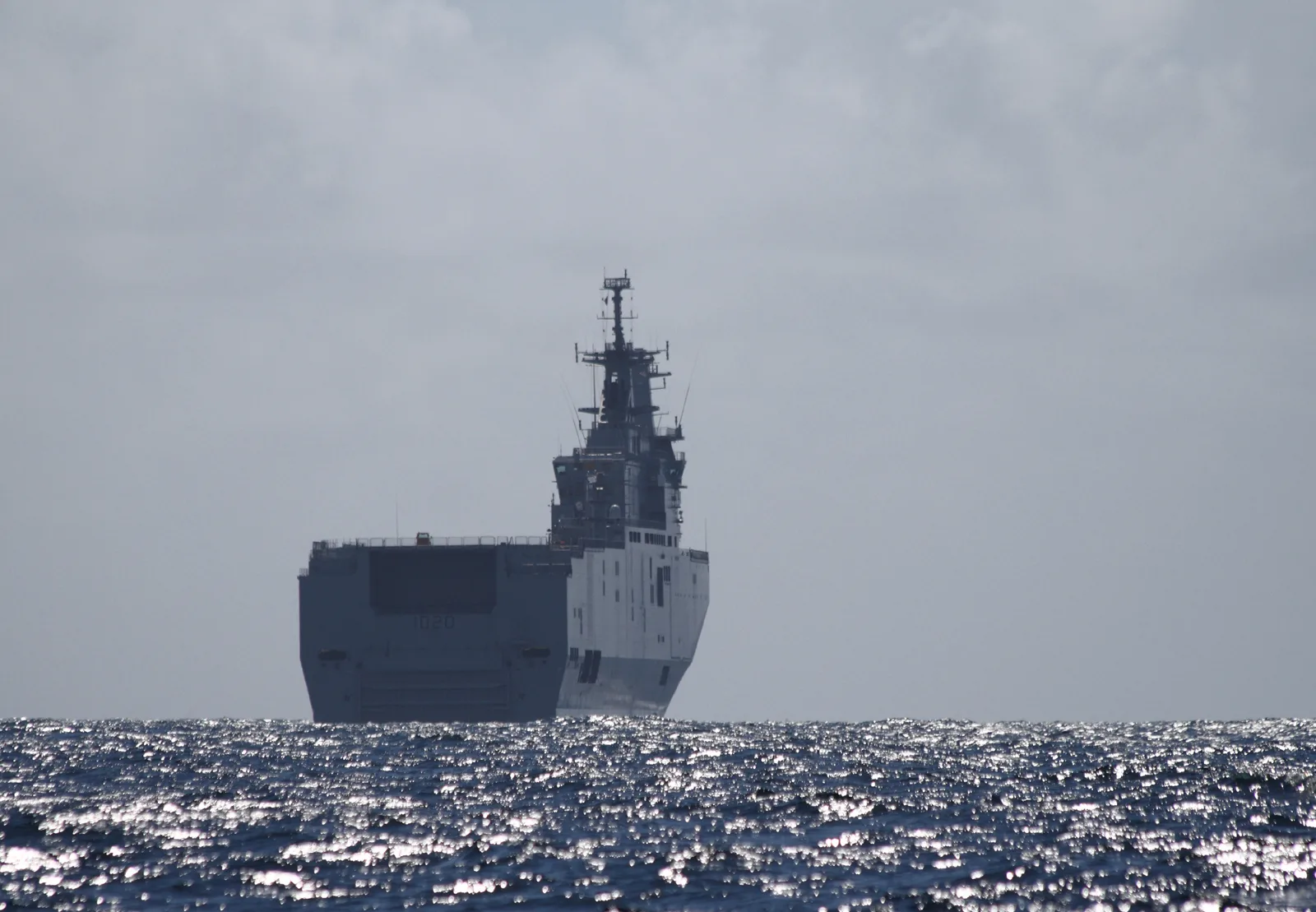
No African country operates an aircraft carrier. The closest equivalent is Egypt’s pair of French-built Mistral-class amphibious assault ships, Gamal Abdel Nasser and Anwar El Sadat, delivered in 2016. These helicopter carriers can embark troops, vehicles, landing craft and up to 16 helicopters, but they cannot launch fixed-wing jets. Algeria operates the Italian-built amphibious ship Kalaat Beni Abbes, and Morocco, Nigeria, Angola, Mauritania, Djibouti, Kenya and Equatorial Guinea have smaller landing ships or landing craft.
Photo: Egyptian Navy Mistral-class amphibious assault ship ENS Anwar El Sadat, August 2016. Credit: Remi Jouan, CC BY 4.0, via Wikimedia Commons.
Aircraft carrier, helicopter carrier, landing ship: what is the difference?
- Aircraft carrier: a warship with a flight deck built to launch and recover fixed-wing combat aircraft, using catapults, ski-jumps or short take-off and vertical landing jets.
- Amphibious assault ship (LHD/LHA), often called a helicopter carrier: has a full-length deck for helicopters plus a floodable well dock for landing craft, and carries troops and vehicles for an amphibious operation, an assault or landing from the sea.
- Landing platform dock (LPD): a smaller amphibious ship with a well dock and a helicopter deck.
- Landing ship / landing craft (LST, LCT, LCU): vessels that beach or unload directly onto the shore, carrying troops (personnel landing) or tanks and trucks (mechanised landing).
Quick answer, verified 3 November 2026
- Aircraft carriers in Africa: none
- Helicopter carriers (LHD): Egypt, 2 Mistral class (delivered 2016)
- Amphibious transport dock / LPD-type: Algeria, Kalaat Beni Abbes
- Landing ships and craft: Morocco, Nigeria, Angola, Mauritania, Djibouti, Kenya, Equatorial Guinea
| Country | Ship / class | Type | Builder | Delivered |
|---|---|---|---|---|
| Egypt | Gamal Abdel Nasser, Anwar El Sadat (Mistral) | Amphibious assault ship (LHD) | France | 2016 |
| Algeria | Kalaat Beni Abbes (BDSL) | Amphibious ship with well dock | Fincantieri, Italy | 2014 |
| Morocco | Sidi Mohammed Ben Abdallah (ex-US Newport) | Tank landing ship | United States (second-hand) | 1994 |
| Nigeria | NNS Kada (LST-100) | Landing ship | Damen (Netherlands), built in the UAE | 2022 |
| Angola | LCT-200-70 (4 de Abril) | Landing ship | France | 2023, 2025 (2 ships) |
| Mauritania | Nimlane | Landing ship | China | 2019 |
| Djibouti | Colonel Major Ali Gaad; Chinese 66 m landing ship | Landing ships | Netherlands/Vietnam; China | 2022; 2021 |
| Kenya | Galana class | Landing ships | Spain | 1994 (2 ships) |
| Equatorial Guinea | Osa | Landing ship | China | 2009 |
Egypt’s Mistrals: Africa’s only helicopter carriers
The two Mistral-class ships were built in France for Russia. Paris cancelled that sale in 2015 after EU sanctions over Ukraine, and Egypt bought the ships the same year. SIPRI records a EUR950 million (about $1 billion) deal and delivery in 2016. The first ship, Gamal Abdel Nasser, was handed over on 2 June 2016. Each Mistral is about 199 m long, displaces about 21,300 tonnes at full load, can carry up to 16 helicopters, and has a well dock for landing craft. SIPRI also records two French EDAR landing craft delivered with them in 2016. Egypt uses them as the core of its Mediterranean and Red Sea naval task groups. Their helicopter decks give the Egyptian Navy a reach and command capability no other African navy has. More on Egypt’s wider fleet: Egypt vs Algeria military comparison.
Algeria’s Kalaat Beni Abbes
Algeria’s largest warship is Kalaat Beni Abbes, built by Fincantieri and delivered in 2014. SIPRI lists her as an amphibious assault ship, and Fincantieri describes her as an amphibious landing platform dock. She was handed over at Muggiano on 4 September 2014, with a well dock and a helicopter flight deck. Algeria also operates two older British-built LSL landing ships, delivered in 1984 and modernised with new radars in 2014–15, according to SIPRI. See Algeria military strength.
Smaller amphibious fleets
Morocco’s main amphibious ship is the former US Navy Newport-class tank landing ship Sidi Mohammed Ben Abdallah, transferred in 1994. A French-built 50 m landing craft followed in 2016 (Morocco Navy ships). Nigeria took delivery of the Damen LST 100 landing ship NNS Kada, built at Albwardy Damen in Sharjah, in 2022 and formally commissioned her in May 2023, for operations in the Niger Delta and Gulf of Guinea (Nigerian Navy ships). Angola’s two French-built LCT-200-70 landing ships arrived in 2023 and 2025. Mauritania, Djibouti, Kenya and Equatorial Guinea operate single landing ships or small classes for coastal transport and island resupply.
Will any African country get an aircraft carrier?
No African government has announced an aircraft carrier programme. A carrier requires embarked fighter aircraft, escorts, a large crew and heavy running costs. No African state has fixed-wing naval aviation of that kind. The realistic growth area is in amphibious ships and offshore patrol vessels, along with uncrewed surface and air systems operating from them.
Frequently asked questions
Does Egypt have an aircraft carrier?
No. Egypt has two Mistral-class amphibious assault ships, often called helicopter carriers, which operate helicopters but not fixed-wing fighters.
Which African country has the biggest warship?
Egypt. Its Mistrals, at about 21,000 tonnes, are the largest warships in any African navy.
Does Algeria have a helicopter carrier?
Algeria’s Kalaat Beni Abbes has a helicopter flight deck and a well dock, but it is a smaller amphibious ship rather than a full-deck helicopter carrier.
Does Nigeria have amphibious ships?
Yes. The landing ship NNS Kada was delivered in 2022 and commissioned in May 2023.
Sources
- SIPRI Arms Transfers Database – amphibious assault ship and landing ship entries for African recipients (accessed 3 November 2026)
- BBC News, June 2016 – First French-made Mistral ship handed over to Egypt
- DCNS (now Naval Group), June 2016 – Delivery of LHD Gamal Abdel Nasser (archived)
- Fincantieri, September 2014 – Kalaat Beni-Abbes delivered
- NIMASA – NNS Kada will strengthen our security architecture
- Albwardy Damen – Vessel review: Kada
Method: ship deliveries come from SIPRI and builders. Ship type labels follow SIPRI and builders’ own descriptions.
Last verified: 3 November 2026