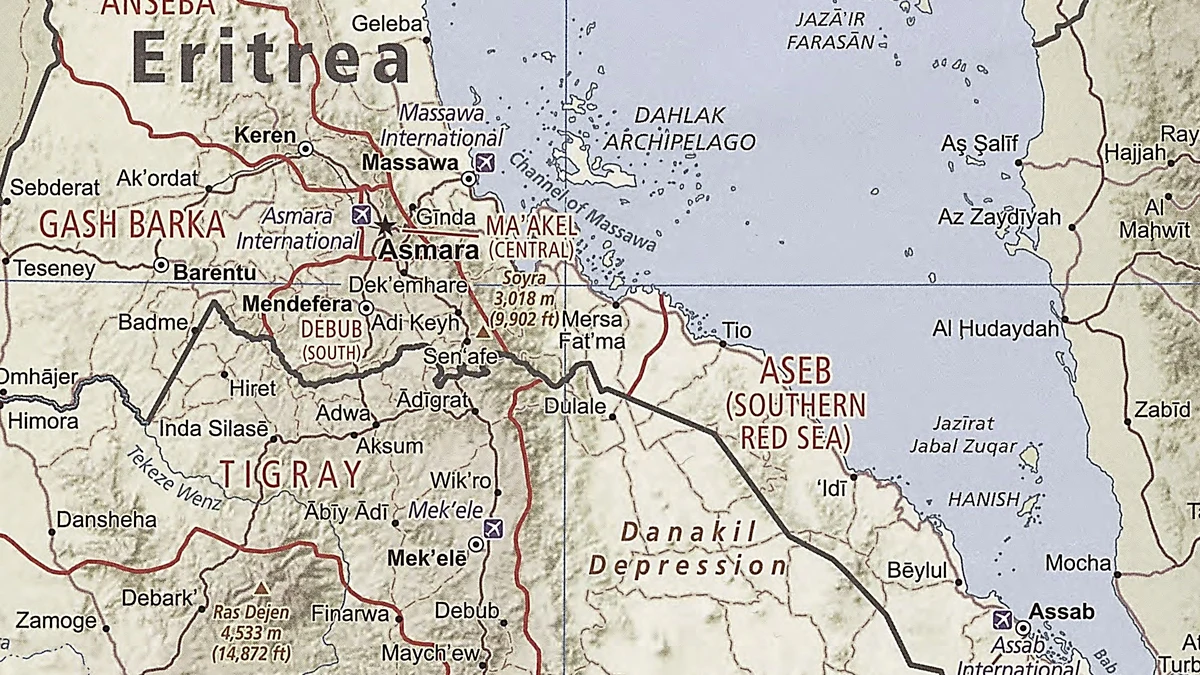
Ethiopia’s military chief, Field Marshal Birhanu Jula, has accused Eritrea of leading a new Tigrayan offensive against federal forces and says Egypt supplied it. “The offensive was led by Eritrea, with logistical support and military supplies provided by Egypt,” he told a press conference in Addis Ababa on Saturday 14 November. “However, our forces managed to repel the offensive.” He did not present evidence. Eritrea has accused Ethiopia of aggression, and Egypt has denied similar accusations before.
What the army chief claimed
Birhanu, who is chief of general staff of the Ethiopian National Defense Force (ENDF), said the Tigray People’s Liberation Front (TPLF) had launched a fourth round of attacks on army positions in the Amhara and Afar regions. His main claims, as reported by Daily News Egypt, Shabelle Media, Al Jazeera and other outlets, were:
- Eritrea led the offensive, and Egypt provided logistics and military supplies.
- Federal forces repelled the attacks.
- Commanders of the attacking forces fled to Eritrea and are sheltering in Adi Keyh, Mendefera and Asmara.
- Eritrea has been building a coalition of the TPLF, the Amhara-based Fano militia, the Oromo Liberation Front, Sudan and Egypt. Its “ultimate objective was to unite these forces to destroy Ethiopia and overthrow its government”.
- Tigrayan authorities are forcibly recruiting young people, and as many as 800,000 have left the region to avoid it.
The day before, on his first visit to Mekelle since fighting resumed, Birhanu called the Eritrean government “a vector of chaos and a subcontractor for all would-be adversaries of Ethiopia”, according to Ethiopian Business View as cited by The Insight International.
None of these claims has been independently verified. That covers the alleged Eritrean command role, the alleged Egyptian supplies, the coalition and the 800,000 figure. Birhanu did not name any weapons, deliveries, routes or dates linked to Egypt.
What Eritrea, Egypt and the TPLF say
Eritrea rejects Ethiopia’s account. Information Minister Yemane Gebremeskel said on 11 November that Ethiopia was pursuing a “regional” war agenda, and a Ministry of Information editorial on 12 November accused Ethiopia of invading Eritrea, according to the Critical Threats Project. On 13 November Yemane wrote on X that senior Ethiopian officials had run “frantic and inflammatory” campaigns for more than three years to justify “an unprovoked war of aggression against Eritrea”.
Egypt had not commented on the latest accusation by the time of writing. Cairo has repeatedly rejected Ethiopian claims that it is involved in the conflict. In September a senior Egyptian source called them unfounded, Daily News Egypt reported.
The TPLF has denied getting military or logistical support from Eritrea or Sudan. A TPLF official said its foreign ties are political contacts, HNGN reported.
Fighting on the ground: Badme and northern Tigray
The accusations come as fighting moves towards the Eritrean border. According to the Critical Threats Project’s 13 November review, ENDF troops reportedly fought TPLF and Eritrean forces around Badme from 9 November. Ethiopian and Eritrean forces then reportedly traded artillery fire there from 11 to 13 November, and Ethiopian drone strikes on Eritrean positions were also reported. Badme was the flashpoint of the 1998–2000 Ethiopia–Eritrea war.
Control of the town is disputed. Two conflict trackers claimed Ethiopian forces captured Badme on 12 November. ACLED reported on 13 November that neither army controlled it, with Ethiopian troops between Sheraro and Badme and Eritrean forces near the town’s edge. Federal forces had entered Sheraro on 3 November, according to conflict monitors. Clashes were also reported around Rama, north of Adwa, and near Semema, south of Axum.
How the war got here
Fighting between federal forces and the TPLF-led alliance resumed in late September. It was the most serious fighting since the 2020–2022 Tigray war, when Ethiopia and Eritrea fought on the same side. Federal forces later retook Mekelle, and in October Prime Minister Abiy Ahmed set up a six-month caretaker administration for Tigray. Ethiopia and Eritrea cut diplomatic ties in early October. Ethiopian Foreign Minister Gedion Timothewos then told the UN Security Council that Eritrean troops had advanced up to 60 km into Tigray, a claim Asmara rejected.
Relations have also broken down over Ethiopia’s push for access to the Red Sea, which Eritrea calls a threat to its sovereignty (see Ethiopian Navy Chief Says Red Sea Access Will Be Regained Through Law, Diplomacy or ‘Other Alternative’). The dispute with Sudan has escalated at the same time. Khartoum accuses Ethiopia of letting the Rapid Support Forces launch drones from its territory, which Addis Ababa denies (see Ethiopia–Sudan tensions over Blue Nile drone strikes and Sudan’s army says it shot down a ‘strategic’ drone from Ethiopia).
The G7 foreign ministers said after their Paris meeting on 9–10 November that they noted “with great concern” the situation between Ethiopia and Eritrea. They called for “maximum restraint” and diplomatic solutions.
Why it matters
Birhanu’s speech went further than earlier Ethiopian accusations, which said Cairo and Asmara supported the rebels. He now says Eritrea is directing the offensive and that Egypt is supplying it. If Addis Ababa treats that as fact, it could be used to justify strikes inside Eritrea. Shelling and drone strikes around Badme show the two armies are already in contact. Ethiopia’s drone fleet has been central to its campaigns since 2021 (see Ethiopia’s drones). Egypt’s growing security ties with Eritrea, Somalia and Sudan are why Addis Ababa keeps naming Cairo (see Egypt–Sudan joint defence agreement).
What to watch
- Any formal response from Cairo or a new statement from Asmara
- Independent confirmation of who holds Badme and whether fighting has crossed the border
- Any evidence, such as captured equipment or supply routes, that backs the claim of Egyptian supplies
- AU, UN or US mediation attempts after the G7 statement
Sources
- Daily News Egypt Africa, 15 November 2026: africa.dailynewsegypt.com
- Shabelle Media Network: shabellemedia.com
- Al Jazeera, 14 November 2026: aljazeera.com
- The Insight International (Mekelle visit, 13 November): theinsightinternational.com
- Critical Threats Project, Ethiopia War Security Review, 13 November 2026: criticalthreats.org
- HNGN, Badme clashes and G7 statement, 15 November 2026: hngn.com
- Eritrean Information Minister Yemane Gebremeskel on X, 13 November 2026 (via Frontlines.et)
- ACLED Ethiopia alerts: acleddata.com