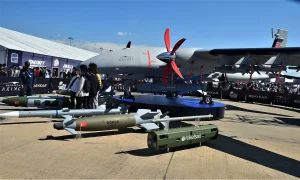
Ethiopia’s Military Drones (2026): Bayraktar TB2, Akinci and the Full UAV Fleet




Ethiopia now flies drones from four foreign suppliers – Turkish Bayraktar TB2 and Akinci, Chinese Wing Loong, Iranian Mohajer-6 and, since January 2026, Russia’s Kronshtadt Orion-E – and builds its own at two new factories that officials say can turn out thousands of cheap first-person-view strike drones a year. Here is what is confirmed, what is still a reported figure, and who built each part of the fleet.
The short answer to “does Ethiopia have military drones?” is yes, and it has for longer than most African air forces: the Ethiopian National Defence Force first flew armed Chinese and Iranian UAVs over Tigray in 2021, added Turkey’s Bayraktar TB2 the same year, and by late 2023 had become only the third foreign operator of the larger Bayraktar Akinci. The newest addition is Russian – a Kronshtadt Orion-E unveiled at Bishoftu Air Base in January 2026, making Ethiopia the system’s first export customer. Running alongside the imports is a fast-growing domestic programme: two state-linked factories, SkyWin Aeronautics Industries and Aeroabay, that opened in 2025 and are now central to the “how many drones does Ethiopia have” question, since open-source trackers can name the imported types but nobody outside the programme has confirmed how many locally built airframes exist.
| Confirmed foreign-built UAV types | 5: Bayraktar TB2, Bayraktar Akinci (Turkey); Wing Loong I/II (China); Mohajer-6 (Iran); Orion-E (Russia) |
| Largest confirmed armed type by combat use | Bayraktar TB2 (Turkey, Baykar) – operational since ~2021, used throughout the Tigray war |
| Newest confirmed delivery | Kronshtadt Orion-E (Russia) – shown at Bishoftu Air Base, January 2026; Ethiopia is the type’s first export customer |
| Domestic production | SkyWin Aeronautics Industries (inaugurated March 2025) and Aeroabay (opened late 2025); production figures reported but not officially confirmed |
| Main operator | Ethiopian Air Force / Ethiopian National Defence Force |
| Main roles | Counter-insurgency strikes (Tigray, Amhara, Oromia conflicts); reported cross-border operations linked to the Sudan war |
| Era | 2021 (Tigray war imports) → 2023 (Akinci) → 2025 (domestic factories) → 2026 (Russian Orion-E) |
Turkish systems in Ethiopia: Bayraktar TB2 and Akinci
Turkey supplies the two most capable drones Ethiopia is confirmed to operate. The Bayraktar TB2 entered service around 2021 and became the most visible weapon of the Tigray war: an Ethiopian Broadcasting Corporation documentary from May 2023 showed TB2s armed with Roketsan’s MAM-L smart micro-munition, and satellite-imagery analysts at PAX had already confirmed the type’s presence by late 2021. The fleet has not been loss-free. On 23 May 2024 an Ethiopian Air Force TB2 came down in the Horo Guduru Welega Zone of Oromia; the Oromo Liberation Army and some analysts said it was shot down, while Ukrainian outlet Militarnyi and others judged a technical fault or pilot error more likely. Neither Addis Ababa nor Baykar has issued an official account, so the cause stays unresolved.
Ethiopia’s Bayraktar Akinci – a larger, longer-ranged design than the TB2 – surfaced in November 2023, when Baykar’s own chairman posted footage of an Akinci carrying an Ethiopian flag. That made Ethiopia the third foreign Akinci operator, after Pakistan (April 2023) and Libya (May 2023); no fleet size has been disclosed. The type returned to the headlines in March 2026, when reports said an Akinci flying from Bahir Dar Airport on a mission over Sudan, and described by Defense Express as belonging to the Ethiopian Air Force, was shot down by a Sudanese Air Force Akinci. Baykar reportedly told Militarnyi the downed airframe’s serial, S88, instead belongs to the United Arab Emirates – leaving the Ethiopian attribution disputed. Turkey arms and sells to multiple parties in the region, including both sides of the Sudan war, which is part of why ownership claims around any single airframe are hard to settle from open sources.
| System | Origin | Quantity | Status | Source |
|---|---|---|---|---|
| Bayraktar TB2 | Turkey (Baykar) | Undisclosed; armed with Roketsan MAM-L, ASELSAN CATS | Operational since ~2021; one lost/downed, Oromia, 23 May 2024 | Janes, PAX, Overt Defense, Aviation Safety Network |
| Bayraktar Akinci | Turkey (Baykar) | Undisclosed; 3rd foreign operator (after Pakistan, Libya) | Operational; one airframe reported shot down over Sudan, March 2026 (ownership disputed) | Overt Defense, Defense Express, Militarnyi, Eurasian Times |
Ethiopia’s own drones: SkyWin, Aeroabay and the shift to kit assembly
This is the part of the fleet that most directly answers “does Ethiopia produce military drones?” – and the answer is increasingly yes, though the scale is contested. Prime Minister Abiy Ahmed inaugurated the state-run SkyWin Aeronautics Industries plant in Addis Ababa in March 2025, describing its output as dual-use unmanned aircraft for civilian and military roles. A single, weakly sourced report puts its capacity at 1,000 drones a year; an AllAfrica investigation published in September 2026 found the government has not disclosed capacity figures or the origin of key components, and foreign media have not been given access to the site. A second facility, Aeroabay, opened in late 2025; a PAX researcher told AFP it is turning out thousands of small, weaponised first-person-view drones costing roughly $5,000 to $10,000 each. Taken together, French broadcaster France24 and other outlets have suggested Ethiopia’s federal government may now hold a fleet “in the thousands” – a figure this page treats as Reported rather than confirmed, since no unit-by-unit count exists anywhere in open sources.
Analysts who have looked at the supply chain describe a familiar path for a new drone producer: start by assembling imported components, typically Chinese kits, then push for technology transfer and local parts manufacturing. A 2024 Ethiopia-China agreement is reported to cover exactly that, including cooperation around China’s CH-7 stealth drone concept, though no CH-7-related hardware has been confirmed in Ethiopia. In May 2026, Ethiopia and Nigeria announced they would collaborate on African-made drones, a sign Addis Ababa is positioning itself as a regional supplier rather than only a buyer. The expansion has a documented cost: Addis Standard and other outlets have reported allegations of civilian casualties from drone strikes in Tigray, Amhara and Oromia, coinciding with the period these domestic programmes scaled up.
| System | Origin | Quantity | Status | Source |
|---|---|---|---|---|
| SkyWin-built UAVs (type/types undisclosed) | Ethiopia (SkyWin Aeronautics Industries, Addis Ababa) | Reported ~1,000/year capacity (single weak source, unverified) | Operational (plant inaugurated March 2025) | Capmad, AllAfrica, NTU CAS |
| Small FPV strike drones | Ethiopia (Aeroabay) | Reported “thousands”; unit cost ~$5,000–10,000 | Reported (unconfirmed official total) | AFP via PAX researcher, Worldview/RANE, ADF Magazine |
China’s Wing Loong: the Tigray war’s first drone
China’s Wing Loong family was the first foreign armed drone confirmed over Ethiopia. Airbus satellite imagery analysed in November 2021 showed Wing Loong-type aircraft in the country, and video from late October 2021 placed a Wing Loong I over Mekelle, Tigray’s capital. Analysts traced a likely supply route through cargo flights from Chengdu, where the type is built, to Harar Meda air base, with one Ukrainian-operated An-124 identified as a probable carrier. Ethiopia reportedly bought around 50 Chinese TL-2 missiles for the type – a modest number that analysts said would limit each drone to a handful of strike sorties – and used the Wing Loong mainly to locate targets for manned Su-27 strikes rather than to strike independently. Open-source analysts at Oryx also flagged a higher-than-average crash/defect rate for the type in Ethiopian service. Participation of the larger, more capable Wing Loong II has long been suspected, with one 2021 report citing the UAE as a possible conduit, but no outlet has firmly confirmed it operating in Ethiopian colours.
| System | Origin | Quantity | Status | Source |
|---|---|---|---|---|
| Wing Loong I | China (CAIG/AVIC) | Undisclosed; confirmed via satellite imagery and video, Oct–Nov 2021 | Operational (ISR/targeting; limited strike use) | PAX, Oryx Spioenkop, Netzpolitik |
| Wing Loong II | China (CAIG/AVIC) | Suspected, not confirmed | Reported (unconfirmed) | China Global South, Oryx Spioenkop |
Iran’s Mohajer-6: the war’s other imported drone
Iran’s Qods Mohajer-6 arrived in Ethiopia around the same time as the Wing Loong. A US State Department spokesperson said Iran delivered Mohajer-6 UAVs to Ethiopia in the summer of 2021 and that Washington informed the United Nations of the transfer. Satellite imagery from August 2021 showed two Mohajer-6 airframes and a ground control station at Semara airport in the northeast; Bellingcat and Oryx Spioenkop both judged the control station’s design consistent with Iranian equipment. The Mohajer-6 can carry Iran’s Qaem air-to-surface missile, which analysts linked to at least one strike in Tigray, though no official Ethiopian source has confirmed specific missions flown. Oryx’s assessment at the time was that the Mohajer-6 was the least proven of Ethiopia’s new drones, with weaker sensors and munitions than the Chinese and Turkish types.
| System | Origin | Quantity | Status | Source |
|---|---|---|---|---|
| Mohajer-6 | Iran (Qods Aviation Industries) | At least 2 confirmed via satellite imagery, August 2021; total undisclosed | Delivered 2021; operational status since then unconfirmed in open sources | US State Department (via The East African), Bellingcat, Oryx Spioenkop |
Russia’s Orion-E: the newest, least-tested arrival
Russia is Ethiopia’s most recent drone supplier. At Aviation Expo 2026, held at Bishoftu Air Base from 23 to 27 January 2026 to mark the Ethiopian Air Force’s 90th anniversary, Addis Ababa displayed a Kronshtadt Orion-E medium-altitude, long-endurance drone carrying the identification OV-1921, alongside newly delivered Yak-130 trainer jets. Russian and Ukrainian defence-industry reporting described it as the first confirmed export of the Orion anywhere, making Ethiopia the type’s launch foreign customer ahead of Algeria, which separately confirmed an Orion deployment in April 2026. Russian marketing material cites a range of up to 1,440 km using autonomous or satellite-linked navigation and a strike payload of up to 250 kg – figures that come from the manufacturer or Russian state media and have not been independently verified. Neither government has disclosed the contract’s value, quantity or delivery schedule, and the Orion-E’s arrival sits alongside a far larger October 2026 Russian delivery of Su-35 fighters to Ethiopia, suggesting Moscow is building a broader, not just a drone, relationship with Addis Ababa.
| System | Origin | Quantity | Status | Source |
|---|---|---|---|---|
| Kronshtadt Orion-E (OV-1921) | Russia (Kronshtadt Group) | At least 1 shown publicly; total undisclosed | Delivered; shown at Aviation Expo, Jan 2026 | Defense Express, united24media, davidshinn.blogspot.com, military.africa |
How the arsenal was built
Ethiopia’s drone fleet was assembled in a rush, not a plan. The 2020-22 Tigray war forced the air force to find armed UAVs fast, and it took whatever suppliers would sell: Iran’s Mohajer-6 and China’s Wing Loong both appeared within weeks of each other in 2021, followed quickly by Turkey’s TB2, which went on to become the most combat-tested type because it could be flown and rearmed locally with Turkish support. That wartime improvisation hardened into a deliberate strategy once the Akinci arrived in late 2023 – a larger, more expensive platform bought in peacetime rather than crisis, signalling Addis Ababa wanted a standing strike-drone capability, not just a stopgap. From March 2025, the strategy shifted again: instead of only buying more foreign MALE drones, Ethiopia began building its own, starting with Chinese-kit assembly at SkyWin and scaling into thousands of cheap FPV munitions at Aeroabay, a far cheaper way to generate volume than importing TB2-class aircraft. January 2026 added a fourth and new foreign supplier, Russia, whose Orion-E delivery came packaged with trainer jets and, within months, a much larger fighter and air-defence relationship – evidence that Ethiopia is diversifying its suppliers across its whole air arm, drones included, rather than settling on any one partner.
| Date | Event | Value | Status |
|---|---|---|---|
| 23–27 Jan 2026 | Kronshtadt Orion-E drone shown at Aviation Expo, Bishoftu Air Base; Ethiopia named as the type’s first export customer | Undisclosed | Delivered |
| 1 Mar 2026 (reported) | Bayraktar Akinci described as Ethiopian-operated reportedly flies from Bahir Dar Airport on a mission over Sudan and is shot down by a Sudanese Akinci; manufacturer reportedly attributes the airframe’s serial (S88) to the UAE instead | n/a | Reported (unconfirmed, ownership disputed) |
| May 2026 | Ethiopia and Nigeria announce collaboration on African-made military drones | n/a | Reported |
| Sep 2026 | AllAfrica/France24-sourced reporting says SkyWin and Aeroabay together may give Ethiopia a domestic fleet “in the thousands”; government declines to confirm capacity or component origin | n/a | Reported (unconfirmed) |
How many drones does Ethiopia have? FAQ
How many military drones does Ethiopia have?
No official or independently verified total exists. Open sources confirm at least five imported UAV types – Bayraktar TB2 and Akinci (Turkey), Wing Loong I (China), Mohajer-6 (Iran) and Orion-E (Russia) – plus an unknown but reportedly large number of domestically built small drones from the SkyWin and Aeroabay factories. Claims of a fleet “in the thousands” rest on a single researcher’s estimate relayed by France24 and AFP, not on an official count.
Does Ethiopia have military drones?
Yes. Ethiopia has operated armed and ISR drones since 2021, when Chinese, Iranian and Turkish types first appeared during the Tigray war, and has added Turkish, Russian and domestically built systems since.
Does Ethiopia produce its own military drones?
Yes, at two state-linked or state-supported factories: SkyWin Aeronautics Industries in Addis Ababa, inaugurated by Prime Minister Abiy Ahmed in March 2025, and Aeroabay, which opened in late 2025 and is reported to mass-produce low-cost FPV strike drones. Officially confirmed production figures have not been released.
Does Ethiopia operate Bayraktar Akinci drones?
Yes. Ethiopia became the third foreign operator of the Akinci in November 2023, after Pakistan and Libya. Fleet size is undisclosed, and a March 2026 report that an Ethiopian-flagged Akinci was shot down over Sudan has been disputed by the manufacturer, which reportedly attributed the specific airframe to the UAE instead.
What happened to the Ethiopian drone reportedly downed over Sudan in 2026?
Reports said a Sudanese Air Force Akinci shot down another Akinci on a mission from Ethiopian territory on 1 March 2026. Baykar reportedly told one outlet the downed aircraft’s serial number belongs to the United Arab Emirates, not Ethiopia, so the incident’s attribution remains contested and is treated here as Reported, not confirmed.
How Ethiopia’s drone fleet compares
Drones are one layer of a rapidly modernising force: the Ethiopia military strength profile covers the whole picture, while Ethiopian Army weapons and equipment and Ethiopian Air Force aircraft inventory cover the manned side – including the Su-27 and Su-30K fighters the Wing Loong has historically helped target, and the Su-35s Ethiopia began receiving from Russia on 28 October 2026, the same relationship now supplying the Orion-E. For regional context, see how Ethiopia’s forces stack up in Egypt vs Ethiopia and Kenya vs Ethiopia, and how its drone build-up fits the continental pattern in the evolution of military drones in Africa. Envanter Medya’s own inventory profile of Ethiopia’s armed forces covers the Turkish share of this fleet from a Turkish-industry perspective.
A note on the numbers
Almost every figure in this piece is Reported rather than Official. Fleet sizes for the Bayraktar TB2, Akinci, Wing Loong and Mohajer-6 have never been disclosed by Ethiopia, and independent counts rely on satellite imagery, leaked footage or single-incident sightings rather than a published order of battle. The domestic programme is the least verified section: the 1,000-drones-a-year SkyWin figure traces to one blog-style outlet with no official confirmation, AllAfrica reported in September 2026 that the government will not disclose capacity or component sourcing, and the “thousands” fleet estimate comes from one PAX researcher’s comment to AFP. The March 2026 Sudan shoot-down is Reported and disputed at the level of which country’s airframe was actually destroyed. Wing Loong II participation remains unconfirmed despite years of suspicion. Only the Orion-E’s public unveiling at Aviation Expo 2026 and the TB2’s 2023 documentary appearance count as directly observed rather than inferred.
Sources
- Janes – Ethiopia UAV documentary reporting, May 2023
- PAX – satellite imagery analysis of drones in Ethiopia, 2021
- Oryx Spioenkop – Wing Loong and Mohajer-6 fleet analysis
- Bellingcat – Mohajer-6 imagery investigation, August 2021
- Overt Defense – TB2 Oromia loss, Akinci operator reveal
- Defense Express – Orion-E and Akinci-over-Sudan reporting
- Militarnyi – Akinci shoot-down and serial-attribution dispute
- AllAfrica – Yak-130/Orion-E delivery reporting; SkyWin capacity investigation
- Capmad – SkyWin plant inauguration reporting
- Africa Defense Forum – Ethiopia-Nigeria domestic drone collaboration
- Military Africa – Aviation Expo 2026 and ongoing Ethiopian drone coverage
- The East African – US State Department statement on Iranian drone transfer