


Comparing the Armed Forces of Egypt and Ethiopia in 2026

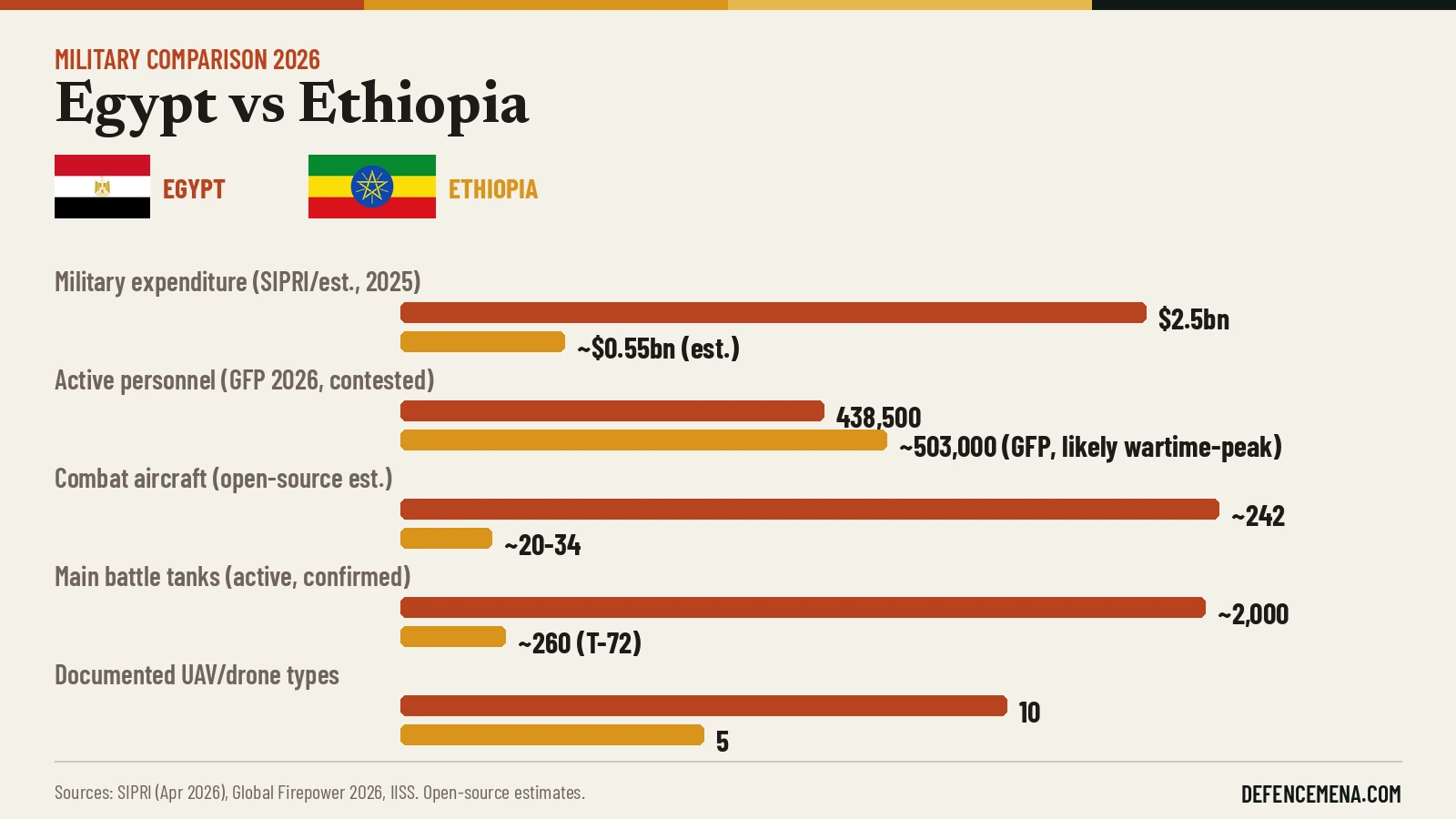


Egypt fields Africa’s largest conventional air and naval force, while Ethiopia, landlocked and still demobilising from the 2020-22 Tigray war, builds around a large army and a growing drone fleet. This comparison sets out what open-source reporting actually supports for both militaries in 2026, where trackers disagree, and why the two forces are shaped by very different geography.
Egypt and Ethiopia sit on opposite ends of the Nile and increasingly in each other’s strategic calculations. DefenceMENA’s Egypt desk and Ethiopia desk carry full breakdowns in How Strong Is Egypt’s Military in 2026? and How Strong Is Ethiopia’s Military in 2026?, drawn on here alongside our North Africa and East Africa coverage and earlier comparisons: Egypt vs Algeria, Egypt vs Nigeria and Kenya vs Ethiopia.
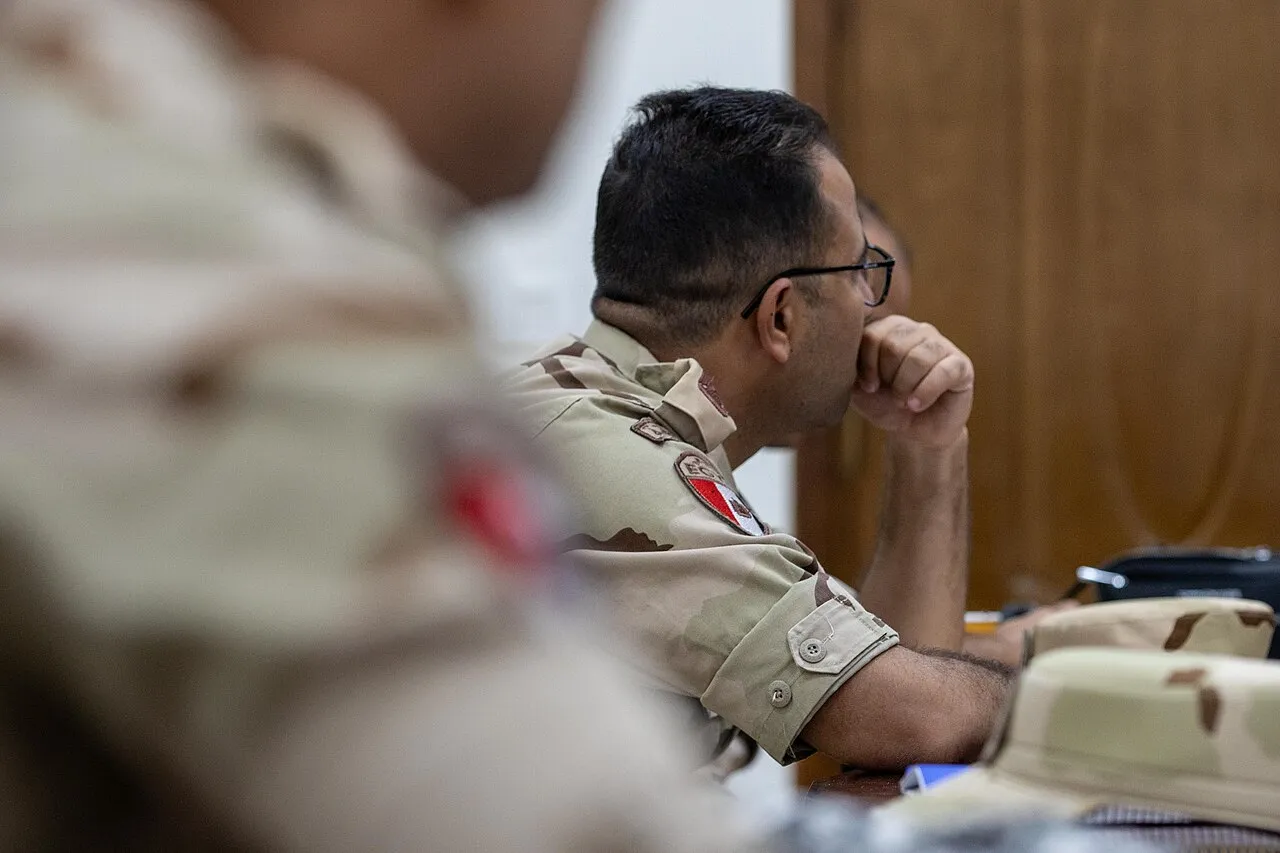
Egypt vs Ethiopia at a glance
| Metric | Egypt | Ethiopia | Source / year |
|---|---|---|---|
| Military expenditure (SIPRI) | $2.5bn (2025) | Not broken out by SIPRI; open-source estimates ~$0.5-0.6bn | SIPRI Milex fact sheet, Apr 2026 |
| Official defence budget line | No single consolidated line published | 81bn birr (~$496m, 2025-26) or ~24bn birr (~$600m, FY2024/25) depending on tracker | Egyptian state budget / Wikipedia-ENDF / militaryspend.org |
| Active personnel | 438,500 | ~503,000 (widely reproduced, likely a wartime-peak figure) | Global Firepower 2026 |
| Reserve / paramilitary | 479,000 reserve + 300,000 paramilitary | Not separately published | GFP 2026 |
| Main battle tanks (active) | ~2,000 active (IISS); 3,620 incl. stored (GFP) | ~260 confirmed T-72; larger aggregator figures uncorroborated | IISS 2025 / GFP 2026 / Oryx |
| Combat aircraft | ~242 fighters; estimates range to 332 incl. attack types | ~24-34 fighters (open-source estimates differ) | GFP 2026 / WAF 2026 / Military Africa |
| Attack helicopters | ~100 (AH-64D/E, Ka-52) | 12-18 (Mi-24/Mi-35) | GFP 2026 / CAST.ru |
| UAV/UCAV capability | ~10 documented types, incl. armed Bayraktar Akinci | ≥5 confirmed types, incl. armed Bayraktar TB2 | DefenceMENA tracking, 2026 |
| Major naval vessels | 2 LHDs, ~13 frigates, 7 corvettes, 8 submarines | Landlocked; no navy of blue-water type | GFP 2026 |
| Air defence | Layered: S-300VM/HQ-9B (long), IRIS-T SLM (medium), Tor-M2/Pantsir (short) | Single confirmed layer: Pantsir-S1 (short-range, Army-held) | DefenceMENA tracking, 2026 |
| Defence industry | Large and diversified (MoMP, AOI, Alexandria Shipyard) | Small arms and ammunition only (Gafat, Homicho) | DefenceMENA tracking, 2026 |
| GFP 2026 rank (auxiliary) | 19th of 145 | 47th of 145 (5th in Africa) | Global Firepower 2026 |
Defence budgets
The two are measured by different yardsticks and should not be read as directly comparable. SIPRI’s April 2026 fact sheet puts Egypt’s 2025 spending at $2.5bn, up 4.3 per cent in real terms — almost certainly conservative, since SIPRI’s own 2020 background paper flagged likely gaps in official reporting, including an estimated $1.3bn a year in US Foreign Military Financing. Egypt’s FY2026/27 state budget runs to EGP 8.176 trillion overall, but no single consolidated defence line is published; GFP’s auxiliary estimate puts defence spending at $5.19bn.
Ethiopia’s picture is murkier. SIPRI’s public fact sheet gives no country-level figure for Ethiopia, only regional Africa totals. Outlets report a roughly 25 per cent real-terms decline since the 2022 Pretoria deal ending the Tigray war, but the absolute number is disputed: Wikipedia’s ENDF page cites 81 billion birr for 2025-26 (about $496m), while militaryspend.org gives a smaller official FY2024/25 figure of roughly 24 billion birr (about $600m) and argues true spending is higher than either number. Neither is verified against an audited line.
Personnel
GFP lists Egypt’s active force at 438,500, plus 479,000 reserves, 300,000 paramilitary and a separate Air Defence Forces branch of roughly 80,000 — figures that have stayed broadly stable.
Ethiopia’s headline number is less settled. The widely reproduced 503,000 active-troops figure almost certainly reflects the ENDF’s size at the height of the Tigray war rather than today’s strength. Addis Ababa has run a demobilisation, disarmament and reintegration (DDR) programme since the 2022 peace deal: over 56,000 ex-combatants were demobilised across four regions by June 2025, against a national target as high as 372,000, with a second phase proposing a further 150,000 in 2026. Egypt’s figure is stable; Ethiopia’s is falling.
Air power
Egypt operates the far larger, more diverse fleet: French Rafales (46-50 in service against 54 contracted, plus 24 more requested in an unconfirmed September 2026 report), roughly 200 US F-16s delivered 1982-2013, 45 Russian MiG-29M/M2s and 18 Mirage 2000s. GFP’s combat total is 242 fighters, though estimates differ — FlightGlobal’s 2024 count put Egypt’s total inventory, trainers and transports included, at 757. Egypt also runs 7 E-2C Hawkeyes, C-130H/C-295 transports and AH-64D/Ka-52 attack helicopters, with 10 AH-64E and 11 CH-47F on order, and no tankers.
Ethiopia’s air force is smaller and harder to pin down. Confirmed fighters are 18 Su-27P/SK and 6 Su-27UB from the 1990s, plus 2 Su-30K delivered January 2024 as refurbished ex-Indian aircraft. A reported 6 Su-35s, per a leaked October 2025 Rostec document, remained undelivered at the January 2026 Black Lion air show and is unconfirmed. Roughly 10 MiG-23BN/UB are mostly inoperable, with stored MiG-21s and a small Su-25/Su-25UB number. Trainers (Yak-130, L-39, Grob G120TP, SF.260) are tracked separately. Aggregators disagree sharply: GFP gives 104 aircraft of all types for 2026, GlobalMilitary.net’s AIRS index gives 99, including 34 combat aircraft. Ethiopia’s helicopter force (Mi-24/Mi-35, Mi-17/Mi-171Sh/Mi-8, a handful of AW139/AW119Ke) is modest by comparison. DefenceMENA’s Egypt Rafale fleet tracker and F-16 equipment file cover Egypt’s largest fast-jet types.
Land forces
Egypt’s army centres on a large, ageing armoured force: roughly 2,000 active main battle tanks by IISS’s count (3,620 incl. stored per GFP), led by 1,300 locally assembled M1A1 Abrams (555 slated for upgrade to M1A1SA), alongside M60A3, T-62 and T-54/55 types. Mechanised infantry runs on YPR-765 and BMP-1 IFVs plus a large APC fleet (M113 variants, Fahd, Walid, BMR-600, BTR-60/50). Self-propelled artillery includes 325 M109A5 and 50 M110A2 howitzers, with a $1.6bn 2022 Hanwha K9A1EGY/K10/K11 contract under way — the first locally assembled battery was shown December 2025 — plus 358 MLRS (M270, K136, BM-21 variants).
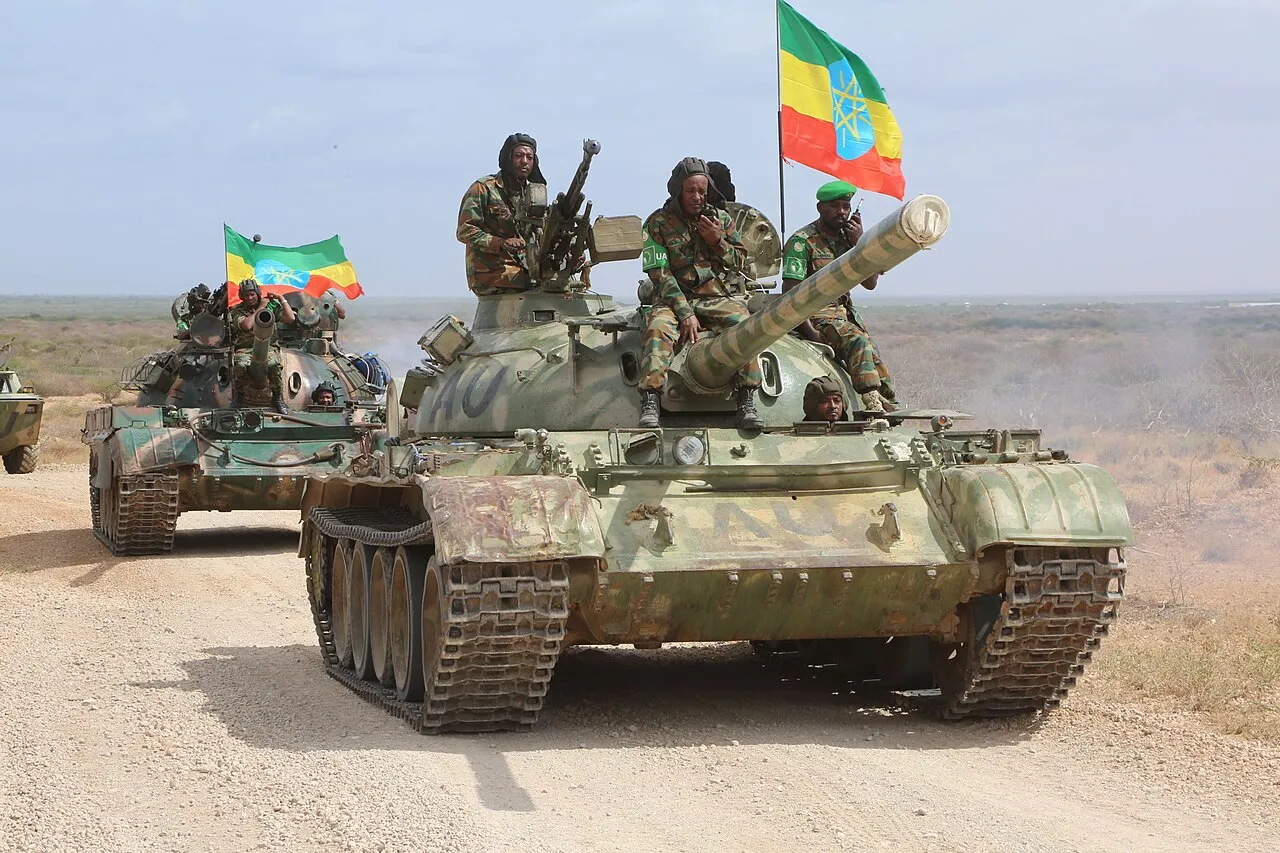
Ethiopia’s land forces are smaller in confirmed equipment than aggregator totals suggest. Its best-documented tank fleet is roughly 260 T-72s: about 60 ex-Yemen surplus from 2003 and 200-plus Ukrainian-delivered T-72/T-72UA1s from a 2011 order, delivered from November 2013. Older T-54/55 numbers are unconfirmed; DefenceMENA excludes aggregator figures above 1,500 tanks as unverified. Armoured transport increasingly runs on the UAE’s Calidus MCAV-20 4×4, hundreds delivered across three-plus shipments from July 2024 to March 2026, alongside Chinese WZ-551/Type-92A APCs and legacy Soviet types. Artillery modernisation centres on at least 32 Chinese SH-15/PCL-181 155mm self-propelled howitzers from January 2023; reported PHL-03 MLRS and A-200 rocket artillery remain single-sourced. Army air defence rests on a 2018 Russian Pantsir-S1 order (about four launchers, 100 missiles), delivered by late 2019.
Naval power
Egypt’s navy is one of the largest and most modern in Africa: two Mistral-class LHDs (2016), a mixed FREMM force (French-built Tahya Misr plus Italian-built Al-Galala and Bernees), four German MEKO A-200EN frigates (three delivered, a fourth built at Alexandria Shipyard for late-2025 delivery), two ex-US Perry frigates, four Gowind 2500 corvettes (three built locally) and four Type 209/1400mod submarines, plus four older Romeo-class boats of doubtful status. Bases run from Alexandria and Safaga to the newer Red Sea facility at Berenice, opened 2020.
Ethiopia has had no coastline since Eritrea’s 1993 independence; its navy was dissolved after the late-1990s border war and re-established under a 2019 proclamation, headquartered inland at Bahir Dar, focused on protecting the Grand Ethiopian Renaissance Dam and Ethiopian-flagged shipping rather than any blue-water role. PM Abiy Ahmed has renewed a push for Red Sea access, citing roughly $1.5bn a year in Djibouti port fees; a reported January 2026 Somaliland MOU over a coastal base is single-outlet and disputed by Somalia.
Air defence
Egypt runs a genuinely layered architecture under a separate Air Defence Forces branch of roughly 80,000. Long-range: four S-300VM Antey-2500 battalions by 2017, an HQ-9B confirmed on state television in July 2025, and 10 IRIS-T SLX batteries reportedly under contract. Medium: seven IRIS-T SLM batteries with 400 missiles, paraded at Ismailia in October 2024, four to five Buk-M2 batteries and 62 I-Hawk launchers. Short-range: Tor-M1/M2, Pantsir-S1, Crotale, Skyguard/Amoun, Avenger and Chaparral launchers, roughly 350 ZSU-23-4 guns and six reported IRIS-T SLS batteries. A reported US NASAMS/F-16-upgrade package remains unordered. DefenceMENA’s survey of African air-defence systems places Egypt among the continent’s most layered forces.
Ethiopia’s confirmed layer is far thinner: a single Pantsir-S1 battery-equivalent from a 2018 Russian order, held at army rather than air-defence-command level. No long- or medium-range system is confirmed in Ethiopian service.
Drones and loitering munitions
Both militaries have invested heavily here, though fleets differ by supplier and role. Egypt’s documented inventory spans roughly ten types: Chinese Wing Loong I/II and CH-4B, Turkish Bayraktar Akinci (at least two at East Oweinat since August 2025) and TB2 (agreed 2024, deliveries unconfirmed), the domestic EJune-30/Nut MALE platform, Thebes/Taba tactical drones, the Hamza-1 loitering system built with Turkey’s Havelsan, the Hamza-3 loitering munition unveiled February 2026, a Haris-2 jammer and interceptor drones shown at EIAS 2026.
Ethiopia’s confirmed drone fleet is smaller but combat-tested. The TB2 has been operational since roughly 2021 and was central to Tigray-war strikes, armed with Roketsan’s MAM-L munition and Aselsan’s CATS pod; at least four were confirmed via a 2023 state documentary. The larger Akinci was confirmed flying at the January 2026 air show. Ethiopia also operates Chinese Wing Loong I/II (unarmed ISR confirmed, armed use disputed), Iranian Mohajer-6s used in the Tigray war, and at least one Russian Kronshtadt Orion, reportedly the type’s first export sale, January 2026. Fleet sizes for most non-TB2 types are unpublished.
Turkish systems in the two inventories
Both countries operate Turkish-made drones, useful for direct comparison rather than for declaring either side’s choice superior.
| System | Manufacturer | Quantity | Status | Role |
|---|---|---|---|---|
| Bayraktar Akinci | Baykar | Egypt: ≥2 observed; Ethiopia: undisclosed, confirmed flying | Operational (both) | Long-endurance armed ISR/strike |
| Bayraktar TB2 | Baykar | Egypt: undisclosed, agreed 2024; Ethiopia: ≥4 confirmed | Unconfirmed deliveries (Egypt); operational since ~2021 (Ethiopia) | Medium-altitude armed ISR/strike |
| Hamza-1 | Havelsan (with Egypt’s AOI) | Egypt only; local production agreed Sep 2026 | Sales agreement, not yet in service | Loitering munition |
The practical case for these platforms rests on cost, delivery speed and the munitions ecosystem around them, not country of origin. TB2 and Akinci are cheaper to acquire and run than Western MALE-class alternatives, and Baykar has repeatedly delivered faster than competitors facing export-licensing delays, with both buyers gaining a maturing family of Roketsan munitions built for these airframes. Egypt’s Hamza-1 deal goes further, pairing the drone with local production through AOI — a technology-transfer benefit a straight import lacks. Ethiopia’s TB2s were acquired as straightforward imports, sitting alongside Chinese and Iranian types in a more diversified, lower-cost mix. Neither approach is simply “better”; they reflect different budgets and industrial ambitions.
Defence industry
Egypt’s industrial base is large by African standards. The Ministry of Military Production (MoMP) runs roughly twenty factories, including the Factory 200 tank plant, while AOI builds the Fahd, Temsah and ST-100 armoured family alongside Sakr rockets and aircraft/engine components. Alexandria Shipyard has delivered three Gowind 2500 corvettes and built the MEKO A-200EN frigate Al-Jabbar locally; K9A1EGY is being localised toward 60-plus per cent domestic content, and AOI holds a Dassault manufacturing agreement for Rafale. AOI has begun exporting components, including a reported Nigeria deal for the Vinicius vehicle. Egypt hosts the EDEX and EIAS exhibitions.
Ethiopia’s base is far narrower, focused almost entirely on ammunition and small arms: the Gafat Armament Engineering Complex (Bishoftu) since the 1980s, and the Homicho Ammunition Engineering Complex (Ambo); officials claim near self-sufficiency in small-arms and ammunition output as of 2025-26. There is no confirmed domestic production of armoured vehicles, ships or aircraft — Calidus MCAV-20 and SH-15 are imports, not licensed local builds. Ethiopia’s base does not approach Egypt’s, regardless of army size.
Main suppliers
SIPRI’s Arms Transfers fact sheet for 2021-25 ranks Egypt 12th among global arms importers, a 2.6 per cent share of world imports — down 51 per cent from 2016-20, largely reflecting cut Russian deliveries and a German policy tightening after 2021. Top three suppliers: France (39%), Germany (30%), Italy (18%).
| Rank (importers) | Share of imports, 2021-25 | Change vs 2016-20 | Top 3 suppliers |
|---|---|---|---|
| Egypt: 12th globally | 2.6% | -51% | France 39% / Germany 30% / Italy 18% |
| Ethiopia: not separately ranked | Not published | Not published | Historical (2001-20): Russia ~50% / Ukraine ~33% |
SIPRI’s public fact sheets give no Ethiopia country-level import figure, only regional Africa totals. SIPRI’s 2017-21 Yearbook described Ethiopia, with Angola, Nigeria and Mali, as having a diversified supplier base, a pattern that continues: open-source deal tracking since 2019 shows Russia (Pantsir-S1, the Su-30K transfer, Orion, an unconfirmed Su-35 contract), China (SH-15), Turkey (TB2, Akinci), the UAE (Calidus) and Iran (Mohajer-6) all supplying current equipment — deal-level tracking, not a SIPRI trend-indicator-value pull, so not equivalent in precision to Egypt’s ranking.
Modernisation and orders not yet in service
Egypt has several programmes outside its active inventory: a reported September 2026 RFP (not a signed contract) for 24 more Rafales, 10 AH-64E, 11 CH-47F and 2 C-130J, continued K9A1EGY/K10/K11 localisation, further IRIS-T SLX/SLS batteries, the 2024 TB2 agreement, local Hamza-1 production, a reported but unordered US F-16-upgrade-and-NASAMS package, and a submarine-replacement study opened in 2024. None count toward the active-inventory figures above.
Ethiopia’s largest pending item is six Su-35s reportedly under contract per an October 2025 leaked document; none delivered by the January 2026 air show, unconfirmed by a second source. Yak-130 deliveries continue against a contract for up to ten, and Calidus MCAV-20 deliveries continue through at least March 2026. The most consequential near-term change, though, is not a purchase: ongoing DDR demobilisation is expected to keep reducing force size through 2026-28.
Geography and doctrine
Egypt’s geography is defined by chokepoints under pressure: a 2,450km Mediterranean/Red Sea coastline, a 2,612km land border, the Suez Canal, a 1,115km Libya frontier, a drone base at East Oweinat near Sudan, the Sinai counter-insurgency effort, and the Bab el-Mandeb corridor covered from Berenice. Running through it all is the Nile: Egypt depends on roughly 55.5 billion cubic metres a year and considers the Grand Ethiopian Renaissance Dam, inaugurated September 2025, a threat to that supply, while Ethiopia treats the dam as central to its own development. The two traded accusations over Nile flooding as recently as October 2025; the dispute remains a diplomatic flashpoint, not a military one.
Ethiopia’s doctrine is shaped by being landlocked and multi-front: counter-insurgency after the Tigray war, a push for Red Sea access, a role in AMISOM/ATMIS peacekeeping in Somalia, and the dam as a point of national pride defended diplomatically. Neither country’s doctrine, on the open-source record, points toward direct confrontation with the other.
What the numbers show
Egypt operates the larger, more current force across every domain except raw troop numbers, where Ethiopia’s contested 503,000 figure still exceeds Egypt’s steadier 438,500 — though the Ethiopian number is trending down as demobilisation continues. Egypt’s navy has no Ethiopian counterpart, a function of geography, not policy. Egypt’s air defence is genuinely layered, from S-300VM and HQ-9B down to Pantsir-S1, while Ethiopia’s confirmed layer begins and ends with a single Pantsir-S1 delivery. The two converge on drones: both have adopted Turkish Bayraktar types as their most combat-relevant uncrewed systems, though Egypt pairs its order with local production and Ethiopia has used TB2s in combat for longer. Egypt’s industrial base, built with French, German, Italian, Korean and now Turkish partners, has no equivalent in Ethiopia’s small-arms-focused industry. The clearest long-term variable on either side is not a weapons system: whether Ethiopia’s demobilisation succeeds, and whether Egypt’s Rafale request becomes a signed contract.
Methodology and data notes
- Figures are not from the same year in every category; where a different year was unavoidable, it is given in the table or text.
- Every contested or single-sourced figure is labelled “estimated,” “reported” or “unconfirmed” above.
- Active, reserve and paramilitary personnel are kept separate, never summed into one headline number.
- Training aircraft are listed separately from combat-aircraft totals for both air forces.
- Ordered or reportedly contracted systems (Egypt’s 24 additional Rafale, Ethiopia’s 6 Su-35) are excluded from active-inventory figures and discussed only under modernisation.
- Where trackers disagree — Ethiopian tank, aircraft and budget totals — a range or explicit disagreement is given rather than one imposed number.
- Global Firepower figures are used only as an auxiliary, clearly attributed data point, never as the sole measure of strength.
- SIPRI expenditure and official defence budgets are different measures, not treated as interchangeable; Egypt’s SIPRI figure is flagged as a likely understatement per SIPRI’s 2020 background paper.
- “Major naval vessels” excludes small patrol craft; Ethiopia’s lack of a coastline is a geographic fact, not a capability gap to be scored.
Sources
- SIPRI, Trends in World Military Expenditure 2025 (April 2026)
- SIPRI, Arms Transfers fact sheet (March 2026)
- DefenceMENA, How Strong Is Egypt’s Military in 2026?
- DefenceMENA, How Strong Is Ethiopia’s Military in 2026?
- Wikipedia, Ethiopian National Defense Force
- Military Spend Watch, Ethiopia country profile
- AllAfrica, “Ethiopia: Over 56,000 Ex-Combatants Demobilized” (June 2025)
- Sudan Tribune, Egypt-Ethiopia Nile flooding dispute (October 2025)
- Ecofin Agency, Global Firepower Index 2026 coverage
- Envanter Media, Africa’s Strongest Militaries 2026


