A Closer Look at Kenya and Ethiopia’s Military Capabilities

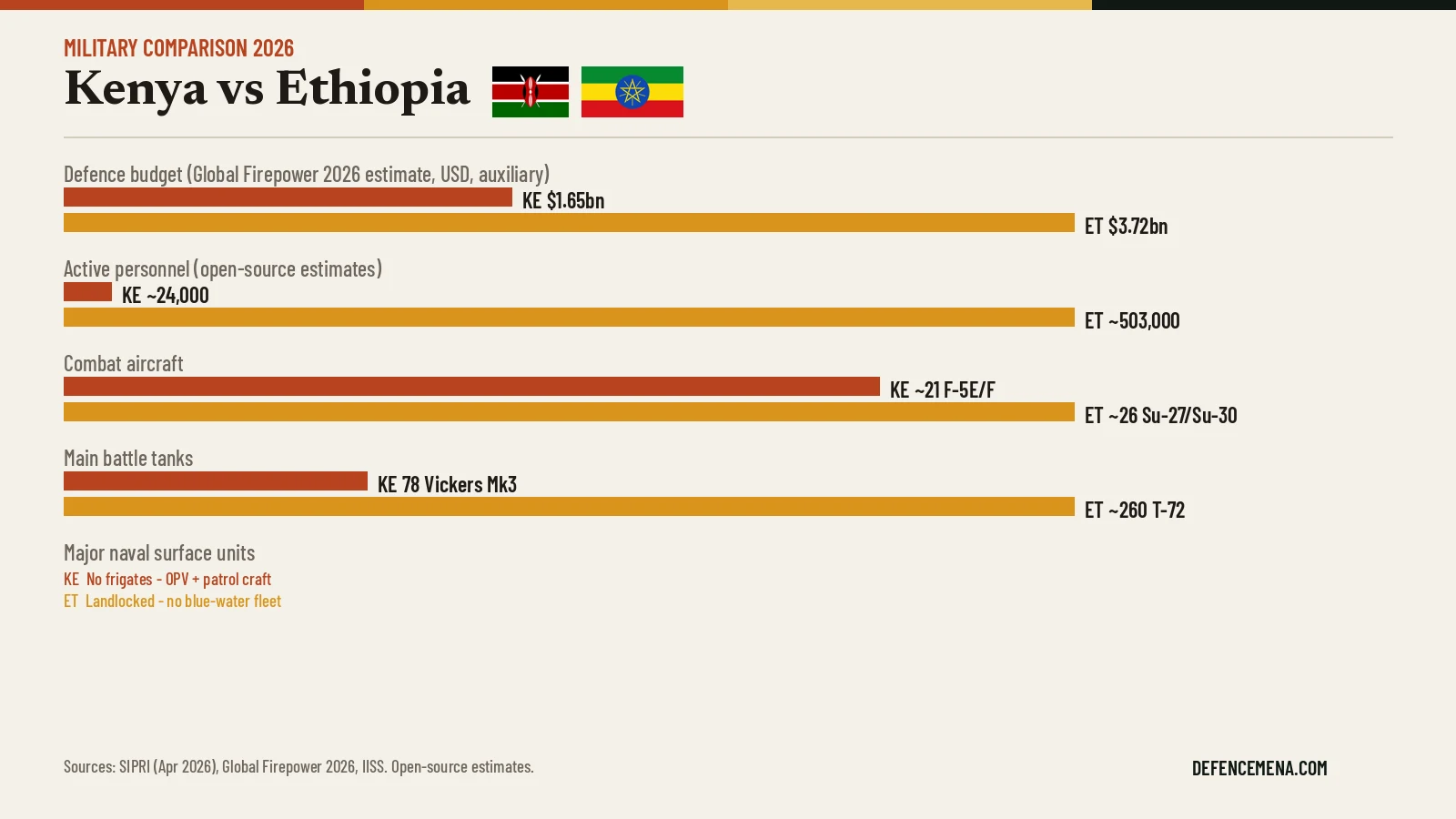


Kenya and Ethiopia are East Africa’s two most closely watched militaries, but they have taken very different paths: Nairobi is buying selectively from Israel, Turkiye and the United States to patch an ageing force, while Addis Ababa is rebuilding a much larger army after the 2020-22 Tigray war. This comparison sets out what each side operates, using official budget data, SIPRI’s regional reporting and open-source tracking rather than a single composite “power” score.
Both countries are covered on DefenceMENA’s Kenya desk and Ethiopia desk, filed under our East Africa coverage. Dedicated Kenya and Ethiopia strength profiles are in production; this piece sits alongside our earlier comparison of Egypt and Nigeria and other African pairings.
Kenya vs Ethiopia at a glance
| Metric | Kenya | Ethiopia | Source / year |
|---|---|---|---|
| Military expenditure (SIPRI) | Not broken out in SIPRI’s public Apr 2026 fact sheet | Not broken out in SIPRI’s public Apr 2026 fact sheet | SIPRI, Apr 2026 |
| Official/estimated defence budget | Ksh252.15bn (~$1.95bn at 129.3 KES/USD, 31 Jul 2026) | No single confirmed current-year figure; ~25% real-terms decline since the 2022 Pretoria peace deal, per multiple outlets | Kenya MoD FY2026/27 estimates; various, 2025-26 |
| Defence budget (Global Firepower, auxiliary) | $1.65bn | $3.72bn | Global Firepower 2026 |
| Active personnel | ~24,000 (IISS/CIA-style tracking); GFP lists 50,000 | GFP lists 503,000; likely a wartime-peak figure amid active demobilisation | Trackers disagree, see Personnel section |
| Reserve / paramilitary | ~5,000 reserve reported; General Service Unit (paramilitary police) separate from KDF | GFP lists 138,000 reserve; DDR programme has demobilised 56,000+ ex-combatants since late 2024 | Various, 2025-26 |
| Main battle tanks | 78 Vickers Mk3 (operational) + ~110 T-72/T-72AV (status unclear) | ~260 T-72/T-72UA1 (sourced); higher aggregator figures not corroborated | DefenceMENA research, 2026 |
| Combat aircraft | ~21 F-5E/F Tiger II (ageing, no confirmed replacement in service) | ~24-26 Su-27/Su-30 (6 Su-35 on order, undelivered) | DefenceMENA research, 2026 |
| Attack helicopters | None dedicated; MD-530F used in light attack/recon role | Mi-24/Mi-35, 12-18 reported | DefenceMENA research, 2026 |
| UAV/UCAV capability | 6 Bayraktar TB2 (armed); ScanEagle, Raven (ISR only) | TB2, Akinci, Wing Loong I/II, Mohajer-6, Kronshtadt Orion — most diversified fleet of the pair | DefenceMENA research, 2024-26 |
| Major naval vessels | No frigates; OPV Jasiri + 2 Shupavu-class patrol craft | Landlocked; no blue-water fleet | DefenceMENA research, 2026 |
| Submarines | None | None | — |
| Air defence | 1 SPYDER battery (Israel, delivered Dec 2025) plus legacy guns | Pantsir-S1 (Russia, delivered 2019); legacy Soviet-era systems | DefenceMENA research, 2026 |
| Defence industry | Ammunition (KOFC) and small arms (Ruiru) only | Small arms and ammunition (Gafat, Homicho); claims near self-sufficiency | DefenceMENA research, 2026 |
| GFP rank (auxiliary) | 84th of 145 (PwrIndx 1.8588) | 47th of 145 (PwrIndx 0.8525), 5th in Africa | Global Firepower 2026 |
Defence budgets
Kenya’s Ministry of Defence set out FY2026/27 estimates of Ksh252.15 billion — a Ksh235.5 billion defence programme plus Ksh13.14 billion for defence industrialisation — about $1.95 billion at the 31 July 2026 rate of roughly 129.3 KES to the dollar. That is an official figure, not a SIPRI one: SIPRI’s April 2026 fact sheet publishes only regional totals, not a Kenya line. Global Firepower’s auxiliary estimate of $1.65 billion sits in the same range but is a different methodology.
Ethiopia is murkier still. SIPRI does not break out an Ethiopian figure either, and no current-year USD total has been confirmed to one methodology. Multiple outlets report real spending down roughly a quarter since the November 2022 Pretoria deal ended the Tigray war, as resources shifted to reconstruction. GFP’s auxiliary estimate of $3.72 billion is nearly double Kenya’s, consistent with Ethiopia’s larger standing force. Both GFP figures are directional, not authoritative — SIPRI’s own 2020 background work notes that official regional figures can understate real outlays.
Personnel
Kenya’s personnel count varies sharply by tracker: Index Mundi’s IISS-sourced series runs close to 29,000; the CIA World Factbook gives about 24,000 (20,000 Army, 1,500 Navy, 2,500 Air Force); Global Firepower lists 50,000 active with zero reserves, which looks inflated and may fold in paramilitary units like the General Service Unit, which sits under the police, not the KDF, and is excluded here. A range of 24,000-29,000 active, with about 5,000 reserve, is more defensible.
Ethiopia is harder to pin down. GFP’s 503,000 active and 138,000 reserve figures likely reflect the force’s wartime peak. Since the Pretoria deal, Ethiopia’s National Rehabilitation Commission has run a formal demobilisation programme, reporting over 56,000 ex-combatants demobilised by June 2025 against a national target of up to roughly 372,000 beneficiaries — the wider DDR caseload rather than the standing force itself, but a sign of active drawdown. No independently verified current total exists; GFP’s figure is a pre-drawdown ceiling, not today’s strength.
Air power
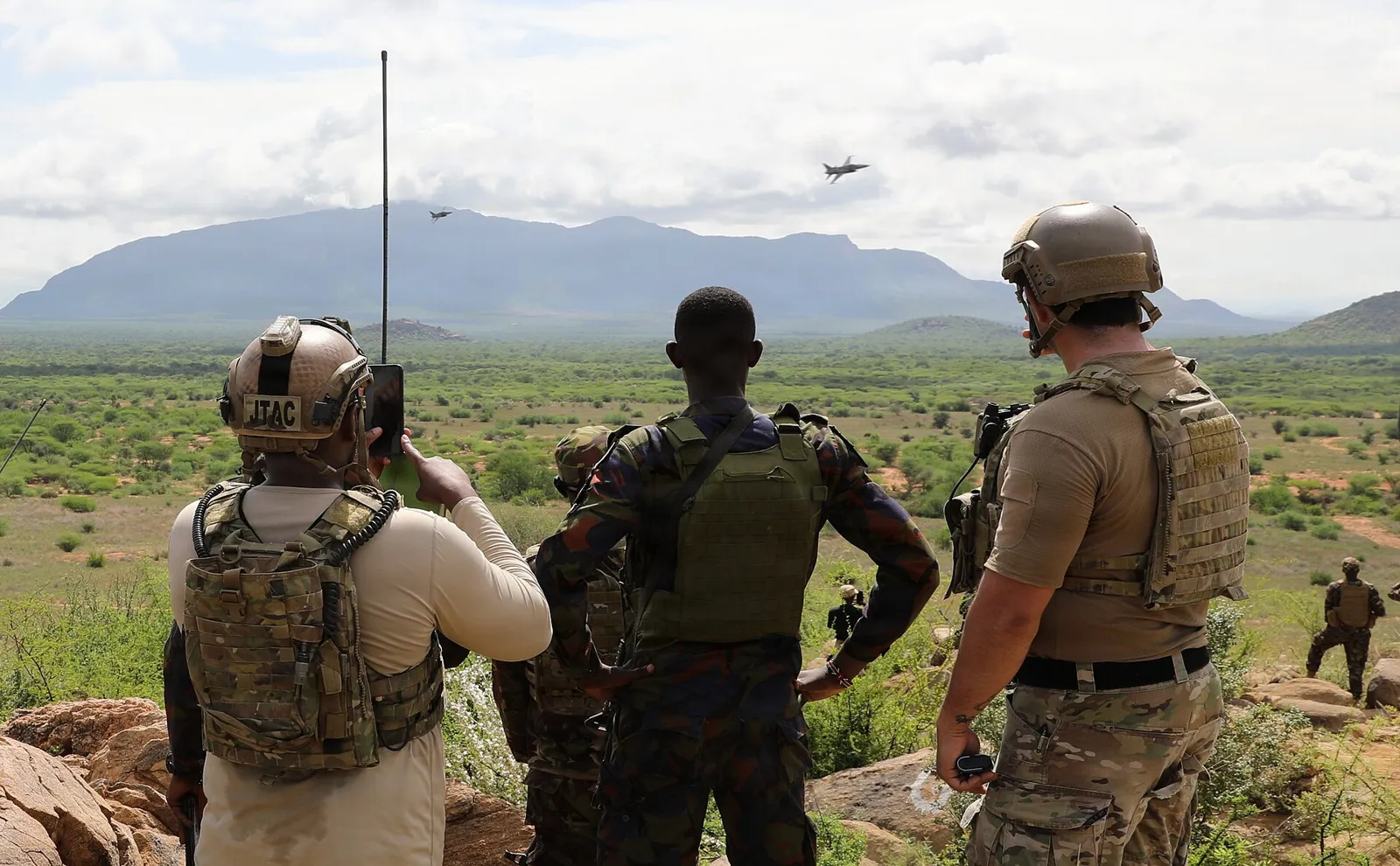
Kenya’s combat capability rests entirely on a fleet reported at 17-23 F-5E/F Tiger IIs, US-supplied fighters nearing the end of their airframe life by multiple 2026 accounts, with rising maintenance costs and scarce parts. No replacement is confirmed in service: India offered its Tejas Mk1A in January 2026, and a reported US approval for unspecified attack aircraft has not been confirmed delivered, while 2015 reports of Kenyan-bound F-15s never materialised. The rotary fleet adds roughly 46 MD-500/MD-530F light helicopters plus a small number of Chinese CATIC Z-9s from October 2024.
Ethiopia’s air force centres on Soviet- and Russian-supplied fighters: 18 Su-27P/SK plus 6 Su-27UB from the mid-1990s, and 2 Su-30K delivered January 2024 (refurbished ex-Indian airframes). A leaked Rostec document (October 2025) pointed to a 6-aircraft Su-35 contract, undelivered as of the January 2026 air show and excluded here under our ordered-but-not-delivered rule. Roughly 10 MiG-23BN/UB are mostly inoperable; stored MiG-21s are not counted active. Trainers (at least 6 Yak-130s) are kept separate from the combat count. Helicopters include Mi-24/Mi-35 attack types (12-18 reported). Aggregators disagree on the all-types total (GFP: 104; GlobalMilitary.net: 99), wider than the 24-26 confirmed combat aircraft used here.
Land forces
Kenya’s armour is a patchwork: 78 British-built Vickers Mk3 tanks confirmed, plus an estimated 110 or so T-72/T-72AV acquired via Ukraine (status unconfirmed). Wheeled armour spans legacy French and British types alongside newer South African Pumas, Turkish Hizir MRAPs (118 vehicles, a 2021 Katmerciler contract worth about $69 million), and roughly 144 US M1117s commissioned in May 2026. Artillery includes up to 18 Serbian Nora B-52 155mm self-propelled howitzers and 11 BM-21 Grad MLRS; anti-tank capability rests on roughly 40 Milan launchers. Below SPYDER, army air defence is limited to towed 40mm and 20mm guns.
Ethiopia’s armour is more concentrated: roughly 260 T-72s — about 60 ex-Yemeni surplus from 2003 and 200-plus upgraded T-72/T-72UA1s from Ukraine, delivered from late 2013 — with older T-54/T-55s unconfirmed. Aggregator totals above 1,500 tanks circulate online but lack sourced deliveries, so are excluded here. APCs include hundreds of UAE-built Calidus MCAV-20 4x4s delivered in tranches since July 2024, plus Chinese WZ-551/Type-92A vehicles. Artillery includes at least 32 Chinese SH-15/PCL-181 155mm self-propelled howitzers (January 2023) and legacy Soviet D-30s and BM-21 Grads. Army-level air defence is the Russian Pantsir-S1 — four launch vehicles and 100 missiles from a 2018 order completed late 2019 — with no confirmed Turkish ground systems in Army service.
Naval power
Kenya has an Indian Ocean coastline centred on Mombasa but no frigates. Its main surface combatant is the offshore patrol vessel KNS Jasiri (85 metres, 1,400 tonnes), delayed for years by a contractual dispute and only recently armed per Spanish defence reporting. Two Shupavu-class patrol boats, in service since 1997, round out the fleet, with limited range and sea-handling. Trackers put total naval assets around 25 vessels including coastal craft and auxiliaries. Most of the defence budget goes to personnel and maintenance, leaving little for new naval acquisitions, though Kenya has been selected for Japan’s Official Security Assistance programme, which may supply patrol boats on an unconfirmed timeline.
Ethiopia has no coastline and no navy in the conventional sense, having lost its Red Sea coast when Eritrea became independent in 1993 and all port access after the late-1990s border war. A navy was re-established under a 2019 proclamation, headquartered inland at Bahir Dar and oriented around protecting the Grand Ethiopian Renaissance Dam and Ethiopian-flagged shipping rather than blue-water operations. Abiy Ahmed renewed his push for sea access in October 2026; a reported January 2026 Somaliland agreement has been described as offering a coastal naval-base site, though Somalia disputes it and the claim rests on limited reporting.
Air defence
Kenya’s layer changed in December 2025 with the delivery of an Israeli SPYDER system — reportedly one reinforced medium-range battery, financed through a roughly Ksh3.4 billion ($26 million) loan. It fires Python-5 infrared-homing and Derby radar-homing missiles, paired with Elta radars (EL/M-2106 ATAR short-range, EL/M-2084 medium-range) for 360-degree, all-weather coverage; the exact configuration has not been officially detailed. Below SPYDER, Kenya’s layer is ageing towed guns — Swedish L-70 40mm and Swiss Oerlikon 20mm.
Ethiopia’s most capable system is the Russian Pantsir-S1, a short-to-medium-range gun/missile system delivered in 2019 and tied to point defence of key sites rather than a layered network. Beyond Pantsir, Ethiopia is assumed to retain Soviet-era legacy equipment, but open-source reporting on its current radar and command-and-control setup is thin. Neither country fields a long-range SAM or documented integrated air-defence network.
Drones and loitering munitions
Kenya’s armed-drone capability is recent and modest: six Bayraktar TB2s reportedly delivered in late 2024 made it the newest African TB2 operator at the time. Kenya also operates US-supplied ScanEagle (about 20) and Raven (about 8), both unarmed ISR. No loitering munitions or domestic UAV production are confirmed.
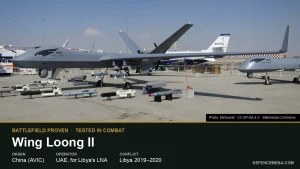
Ethiopia operates a far more diversified drone fleet, reflecting heavy reliance on armed UAVs through the Tigray war: Bayraktar TB2 (at least four confirmed via a 2023 state documentary, armed with Roketsan’s MAM-L munition, operational since ~2021), the larger Bayraktar Akinci (undisclosed quantity, flying at the January 2026 air show), Chinese Wing Loong I/II (unarmed ISR confirmed, armed status disputed), Iranian Mohajer-6, and Russia’s Kronshtadt Orion, with Ethiopia reported as its first export customer. Fleet sizes are mostly unpublished, but the mix spans four supplier countries — markedly wider than Kenya’s single-supplier fleet.
Turkish systems in the two inventories
Both countries operate Turkish-made equipment, in different domains. Kenya’s inventory centres on 118 Katmerciler Hizir mine-resistant vehicles (2021, roughly $69 million) plus six Bayraktar TB2s from late 2024. Ethiopia’s Turkish holdings sit entirely in the air: Baykar’s TB2 and Akinci back its armed-drone fleet, with no confirmed Turkish share of manned aircraft or ground vehicles.
| System | Manufacturer | Quantity | Status | Role |
|---|---|---|---|---|
| Hizir MRAP | Katmerciler (Turkiye) | 118 (Kenya) | Delivered, 2021 order | Mine-resistant troop transport |
| Bayraktar TB2 | Baykar (Turkiye) | 6 (Kenya) | Delivered late 2024 | Armed ISR/strike UAV |
| Bayraktar TB2 | Baykar (Turkiye) | 4+ confirmed (Ethiopia) | Operational since ~2021 | Armed ISR/strike UAV, with Roketsan MAM-L |
| Bayraktar Akinci | Baykar (Turkiye) | Undisclosed (Ethiopia) | Flying as of Jan 2026 | Larger armed ISR/strike UAV |
This fits a pattern across African air forces: Turkish systems compete less on being intrinsically superior to Chinese or Western alternatives than on cost, delivery speed, an established munitions ecosystem (Roketsan’s MAM-L, used on both countries’ TB2s) and straightforward integration. Ethiopia’s wider mix of Chinese and Iranian types alongside its Bayraktars shows Turkish platforms used alongside, not instead of, other suppliers — a procurement pattern, not a verdict on which system performs better. DefenceMENA has separately tracked the list of TB2 export customers compiled by Envanter Medya.
Defence industry
Neither country has a substantial manufacturing base; both are concentrated on small arms and ammunition. Kenya’s capacity runs through the Kenya Ordnance Factories Corporation in Eldoret — its only ammunition maker — and a small-arms plant in Ruiru (opened April 2021, roughly Ksh4 billion, about 12,000 rifles a year single-shift, 60 percent local content). FY2026/27 allocates Ksh13.14 billion to defence industrialisation, including a three-phase KOFC upgrade targeting roughly 35 percent more capacity by FY2027/28. A reported armoured-vehicle venture, Osprea Logistics, has been described by Military Africa sources as having failed to begin production — a caution against assuming announced projects translate into output.
Ethiopia’s base is older: the Gafat Armament Engineering Complex at Bishoftu has produced small arms since the 1980s with Soviet and North Korean assistance, alongside the Homicho Ammunition Engineering Complex at Ambo. Officials claim near self-sufficiency in small-arms and ammunition production as of 2025-26. There is no confirmed domestic production of armoured vehicles, ships or aircraft — the Calidus MCAV-20 and SH-15 howitzers in service are imports from the UAE and China, not licensed local builds.
Main suppliers
Neither country appears with a breakdown in SIPRI’s public fact sheets, which report continental and sub-regional aggregates only; a direct pull from the SIPRI Arms Transfers Database was not accessible for this update. The qualitative picture from national and trade reporting is reasonably clear for each.
| Country | Leading suppliers (recent deals, not a SIPRI percentage) | Notes |
|---|---|---|
| Kenya | Israel, Italy, United States (reported ~90% of 2020-25 imports combined, exact split not published); Turkiye, China emerging | Kenya reported as Africa’s second-largest major arms importer by value in 2025, driven largely by the SPYDER deal |
| Ethiopia | Russia (Pantsir-S1, Su-30K, Orion drone), China (SH-15), Turkiye (TB2, Akinci), UAE (Calidus MCAV-20), Iran (Mohajer-6) | SIPRI’s 2017-21 Yearbook described Ethiopia, alongside Angola, Nigeria and Mali, as having a diversified supplier base; 2001-20 SIPRI data had Russia and Ukraine at roughly 50% and 33% of imports |
Modernisation and orders not yet in service
Kenya’s near-term modernisation is anchored by the newly delivered SPYDER system. India’s Tejas Mk1A offer and a reported US attack-aircraft approval remain unconfirmed as actual orders, not a settled F-5 replacement pipeline. The KOFC Eldoret upgrade is under way but not due for completion until FY2027/28.
Ethiopia’s most significant pending item is the reported 6-aircraft Su-35 contract, undelivered as of January 2026 and excluded from the active fleet until confirmed. Yak-130 and Calidus MCAV-20 deliveries continue in tranches. Arguably more consequential is the ongoing DDR process, expected to keep reducing force size through 2026-28.
Geography and doctrine
Kenya and Ethiopia share a border in the arid Omo-Turkana region, both within the Horn of Africa security complex shaped by instability in Somalia and South Sudan. Kenya’s coastline and counter-terrorism posture — a long-running AU troop contributor against al-Shabab, and the first Sub-Saharan country designated a US “major non-NATO ally” in 2024 — point its doctrine toward counter-insurgency and border security, with naval effort on coastal and EEZ protection rather than power projection.
Ethiopia is landlocked, shaping a doctrine built around a large land army, internal counter-insurgency capacity (recent operations against Fano militia in Amhara and unrest in Oromia) and a renewed push for sea access — through Djibouti, Eritrea’s Assab port, or the disputed Somaliland arrangement. Relations with Eritrea have shown renewed friction through 2026, and heavy use of armed drones in the Tigray war has left a lasting mark on how Ethiopia weighs airpower against its still-Soviet-rooted fighter fleet.
What the numbers show
Ethiopia fields the larger force on almost every raw metric — more tanks, more aircraft, a more diversified drone fleet, a higher budget estimate — consistent with its larger population and recent history of large-scale war in Tigray. Kenya’s force is smaller and older in its core equipment, most visibly an F-5 fleet past its planned service life with no confirmed replacement, but Kenya moved faster on one specific gap: its December 2025 SPYDER delivery is more modern than anything confirmed in Ethiopian air defence, where Pantsir-S1 remains the newest asset, from 2019. Kenya’s modest navy rests on an actual coastline; Ethiopia’s is a doctrinal project aimed at a coastline it does not have. On drones, Ethiopia’s wartime experience produced a genuinely multi-supplier fleet, while Kenya’s single TB2 order is a smaller, more recent step in the same direction. Both countries’ personnel figures are unreliable in different ways: Kenya’s are debated across a narrow band, Ethiopia’s reflect a force still working through demobilisation.
Methodology and data notes
- Neither country appears with an individual figure in SIPRI’s public fact sheets, so official budget data and open-source deal tracking are used instead and labelled accordingly.
- Active, reserve and paramilitary personnel are kept separate throughout; where a tracker blended categories, that is flagged, not presented as authoritative.
- Ordered or contracted systems not yet confirmed delivered — Ethiopia’s reported Su-35 contract chief among them — are excluded from active totals and discussed only under modernisation.
- Training aircraft are listed separately from combat totals; “total ships” is not used as a naval-strength metric.
- Where trackers disagree — aircraft, personnel, tanks — a range is given rather than one imposed number, and Global Firepower figures are used only as auxiliary, attributed data points.
Sources
- SIPRI, Trends in World Military Expenditure 2025 (fact sheet, April 2026)
- SIPRI, Trends in International Arms Transfers 2025 (fact sheet, March 2026)
- Kenya Ministry of Defence, FY2026/27 budget estimates and defence-industrialisation update
- Global Firepower, Kenya 2026 country profile
- Global Firepower, Ethiopia 2026 country profile
- Business Daily Africa, “Kenya now Africa’s second-largest major arms importer”
- Military Africa, Kenya SPYDER air-defence delivery
- Army Recognition, Kenya SPYDER system details
- GlobalSecurity.org, Kenya Navy modernisation
- Defensa.com, KNS Jasiri armament report
- Addis Ababa University thesis, Ethiopia’s naval re-establishment and Red Sea access policy
- Semafor, Abiy Ahmed renews push for Red Sea access (October 2026)
- AllAfrica, Ethiopia DDR demobilisation progress (June 2025)
- Envanter Medya, Bayraktar TB2 export customer list