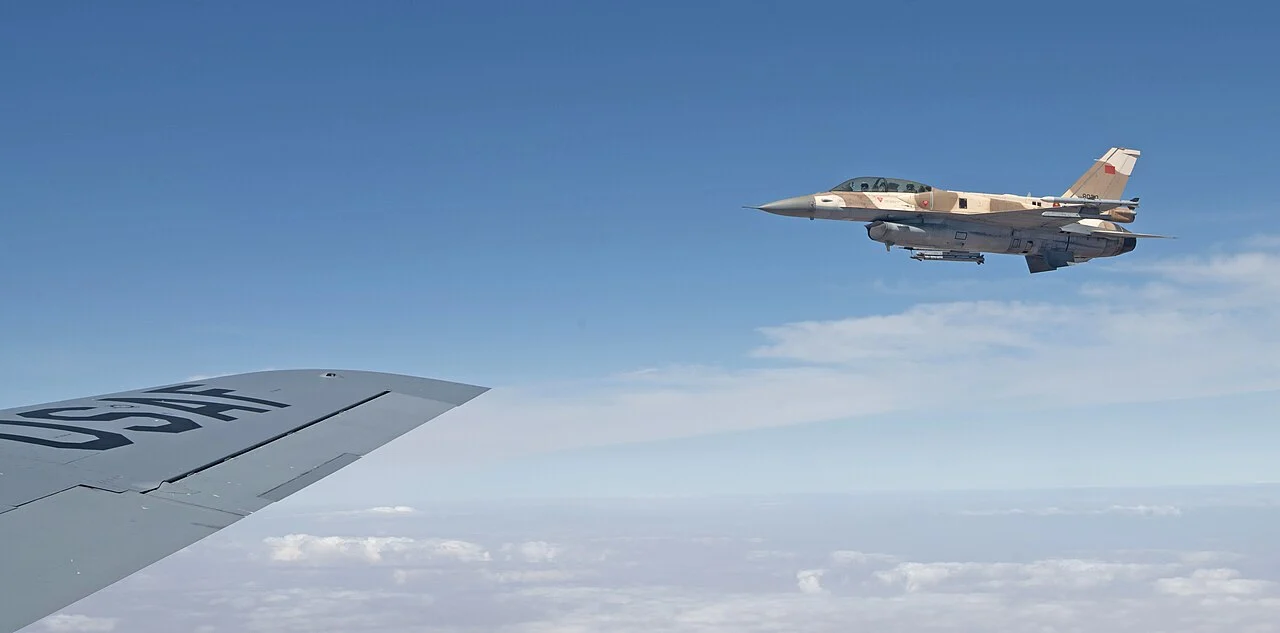
Morocco is flying two F-16 fleets at once: a decade-old Block 52+ force that has already lost one jet in combat, and 25 new Block 72 Vipers that were due years ago and still have not arrived. Here is what Rabat actually operates today, what it is still waiting for, and why.
Photo: A Royal Moroccan Air Force F-16 Fighting Falcon flies alongside a US Air Force KC-135R tanker during Exercise African Lion 2025, 13 May 2025. Credit: U.S. Air Force photo by Tech. Sgt. Alexandra Longfellow, Public domain, via Wikimedia Commons.
Morocco is a confirmed F-16 operator, in service and operational for its first-generation fleet and under contract, not yet delivered for a second, larger batch. The Royal Moroccan Air Force (Force Aérienne Royale Marocaine) ordered 24 F-16C/D Block 52+ aircraft in 2008 and has flown them since 2011–2012, with 23 airframes still on strength after one was lost during Saudi-led coalition operations over Yemen in 2015. In March 2019 the US State Department approved a further sale of 25 new-build F-16C/D Block 72 aircraft and an upgrade of the surviving 23 Block 52s to F-16V standard, together notified at up to roughly $4.8 billion. Morocco signed on, and Lockheed Martin has been building the jets since — but as of September 2026, seven years after approval, not one Block 72 has yet reached Morocco. First flights of Moroccan airframes and Lockheed Martin statements point to deliveries “within weeks,” while the underlying contract schedule runs to 2027. This file separates what Morocco actually flies today from what it has paid for and is still waiting on.
| Country | Morocco |
| System | General Dynamics / Lockheed Martin F-16 Fighting Falcon |
| Manufacturer | Lockheed Martin (United States) |
| Origin | United States |
| Variant | F-16C/D Block 52+ (in service); F-16C/D Block 72 “Viper” on order, plus upgrade of the Block 52+ fleet to F-16V standard |
| Quantity | 23 Block 52+ in active service (of 24 delivered); 25 new Block 72 plus 23 upgrades under contract |
| Order year | 2008 (Block 52+); 2019 (Block 72 and upgrade) |
| Delivery | Block 52+ complete by 2012; Block 72 not yet delivered as of September 2026 |
| Service status | In service (Block 52+); under contract, awaiting delivery (Block 72 / F-16V) |
| Reported contract value | ~$2.4bn (2008 package); DSCA-notified ceilings of $3.787bn (new aircraft, 2019) and $985.2m (upgrade, 2019) — notification ceilings, not confirmed final prices |
What is the F-16, and which version does Morocco fly?
The F-16 Fighting Falcon is a single-engine, multirole fourth-generation fighter originally designed by General Dynamics and now built by Lockheed Martin, in continuous production and service with dozens of air forces since 1978. Morocco’s original fleet is the Block 52+ standard: an AN/APG-68 mechanically scanned radar, conformal fuel tanks omitted, and a weapons fit centred on the AIM-120 AMRAAM and precision-guided bombs. The aircraft Rabat is still waiting for is the newer F-16C/D Block 72, marketed by Lockheed Martin as the “F-16V Viper,” which replaces the older radar with the Northrop Grumman AN/APG-83 Scalable Agile Beam Radar (SABR), an active electronically scanned array (AESA) set, adds a large-format cockpit display, a modernised mission computer and updated electronic warfare systems. Under the same 2019 program, Morocco’s original 23 surviving Block 52+ jets are also being brought up to the F-16V configuration, so the two fleets are meant to converge on a common avionics standard once deliveries and upgrades are complete.
Why did Morocco acquire the F-16?
Morocco’s move to the F-16 in the mid-2000s followed a regional trigger: Algeria’s decision to buy additional Mikoyan MiG-29SMT and Sukhoi Su-30MKA fighters from Russia reopened a capability gap that Rabat’s ageing Mirage F1 and F-5E fleet could not close. Morocco evaluated the Dassault Mirage 2000-5 and Saab Gripen alongside the F-16 before settling on the American aircraft, a choice that also reinforced a defence relationship formalised by Morocco’s 2004 designation as a Major Non-NATO Ally of the United States and by decades of joint training, including the annual Exercise African Lion. Unlike Egypt’s later move toward France for the Rafale, Morocco’s F-16 purchases moved in the opposite direction, deepening rather than diversifying away from its principal Western supplier; DefenceMENA’s supplier profile on US arms sales to Morocco and how Morocco balances its American, Israeli and Turkish suppliers set the F-16 programme in that wider context. The 2019 Block 72 order was driven by the same logic a decade on, replacing an ageing radar and mission system rather than responding to a single new threat.
When did Morocco order it, and what happened next?
| Date | Event | Value | Status | Source |
|---|---|---|---|---|
| 2007 | Morocco selects the F-16 over the Mirage 2000-5 and Gripen to modernise its fighter fleet, in response to Algerian MiG-29/Su-30 orders | — | Selected | Defense Industry Daily, F-16.net |
| May 2008 | Morocco signs an FMS contract for 24 F-16C/D Block 52+ (16 single-seat, 8 twin-seat) | ~$2.4bn (package, incl. support) | Contracted | F-16.net, contemporary press reporting |
| Aug 2011–Aug 2012 | All 24 Block 52+ aircraft delivered to Ben Guerir Air Base | — | Delivered | MILAVIA, Air & Space Forces Magazine |
| 10 May 2015 | One Moroccan F-16 lost over Sa’ada, Yemen during Saudi-led coalition operations against Houthi forces | — | Combat loss | F-16.net, Al Jazeera, Middle East Eye |
| 26 Mar 2019 | US State Department approves possible FMS of 25 new F-16C/D Block 72 aircraft plus upgrade of 23 existing Block 52+ to F-16V standard | $3.787bn (new aircraft) + $985.2m (upgrade), notification ceilings | Approved for possible sale | DSCA |
| 14 Aug 2020 | US Air Force awards Lockheed Martin a combined production contract for 90 new-build F-16s covering Morocco (24) and Taiwan (66) | $4.94bn combined award (not broken out by country) | Under contract | DefenceWeb |
| 2022 | Lockheed Martin and Moroccan partners form Maintenance Aero Maroc (MAM), a joint venture for F-16 and C-130H maintenance, repair and overhaul in Morocco | Not disclosed | Established | Morocco World News |
| Aug 2025 | Production of engines for Morocco’s Block 72 aircraft completed | — | Manufacturing milestone | Defense-Arabic.com |
| 2 Sep 2026 | US Army awards CAE Inc. $42.1m (of which $37.98m FMS-funded at award) for two F-16 Block 72 full-mission trainers for Morocco, work through April 2029 | $42.1m | Under contract | Army Recognition, U.S. DoD contract announcement |
| Mid-to-late 2026 | First Moroccan Block 72 airframe completes ground tests; flight tests reported underway; Lockheed Martin statements point to first deliveries “within weeks” | — | Not yet delivered | Médias24, Hespress, La Relève |
| 2027 | Contractual delivery milestone for the Block 72 batch, per reporting on the original programme terms | — | Scheduled | Médias24, Morocco World News |
How many F-16s does Morocco operate?
Morocco’s confirmed in-service fleet is 23 F-16C/D Block 52+ aircraft, the survivors of the 24 delivered in 2011–2012 after one was lost over Yemen in 2015. A second, larger batch of 25 new-build F-16C/D Block 72 aircraft is under contract but had not been delivered as of September 2026; DefenceMENA treats these as separate figures rather than a combined “Morocco has 48 F-16s” total, because ordered and delivered are not the same thing. Once the programme completes, Morocco’s fleet is intended to reach 48 F-16s in total (23 upgraded Block 52+/F-16V plus 25 new Block 72), assuming no further attrition and no changes to the contracted quantities.
How much has Morocco paid for its F-16s?
The 2008 contract for the original 24 Block 52+ aircraft was reported at approximately $2.4 billion, a package figure that bundled the airframes with support, spares and training rather than a bare unit price. The 2019 approval for the Block 72 programme was notified by the US Defense Security Cooperation Agency at up to $3.787 billion for the 25 new aircraft and associated equipment, plus a separate ceiling of $985.2 million for upgrading the 23 surviving Block 52+ jets to F-16V standard — together potentially around $4.8 billion. These DSCA figures are congressional notification ceilings, not final contract prices, and typically fall as negotiations proceed; the August 2020 production award to Lockheed Martin, worth $4.94 billion, covered 90 aircraft for both Morocco and Taiwan combined and does not break out Morocco’s individual share. No source reviewed for this file publishes a confirmed per-aircraft price for either the new-build or upgrade components, and dividing the notified ceilings by aircraft count would invent a figure the public record does not support. The September 2026 CAE trainer contract, a comparatively small $42.1 million, is one of the few individually disclosed line items in the wider programme.
Which variant does Morocco fly, and which is it waiting for?
Morocco’s fielded aircraft are F-16C (single-seat) and F-16D (twin-seat) Block 52+, delivered with the AN/APG-68 radar and conventional cockpit displays typical of late-1990s/early-2000s production standards. The aircraft on order are F-16C/D Block 72, the newest F-16 production standard, which Lockheed Martin markets under the “F-16V” designation once delivered; Morocco’s own Block 52+ fleet is being upgraded under the same programme to reach the same F-16V configuration, so the end state is a single common standard across both batches rather than two permanently different fleets.
Technical characteristics
| Parameter | Value | Source |
|---|---|---|
| Crew | 1 (F-16C) or 2 (F-16D) | Lockheed Martin |
| Engine | 1x Pratt & Whitney F100-PW-229, block-52 standard fit; Morocco’s 2019 order includes 29 F100-229 engines | DSCA, Lockheed Martin |
| Max speed | Mach 2 class (manufacturer figure, altitude-dependent) | Lockheed Martin |
| Radar (Block 52+, in service) | AN/APG-68(V) mechanically scanned array | Lockheed Martin |
| Radar (Block 72 / F-16V, on order) | Northrop Grumman AN/APG-83 Scalable Agile Beam Radar (SABR), AESA | Northrop Grumman, DSCA |
| Principal air-to-air missile | AIM-120 AMRAAM (40 AIM-120C-7 included in the 2019 notification) | DSCA |
| Precision munitions (2019 package) | GBU-39/B Small Diameter Bomb (60), GBU-38/54 JDAM kits, inert MK82 bombs | DSCA |
| Structural life (Block 72) | Reported at more than 50% greater than earlier F-16 production blocks | Lockheed Martin (manufacturer figure) |
How long has it been in service, and how has it performed?
Official record: Morocco’s Block 52+ F-16s have been in service since 2011–2012, based at Ben Guerir Air Base, and are described by the Royal Moroccan Air Force and US partners as the backbone of its fast-jet fleet alongside the older Mirage F1 and F-5E. Verified operational record: Morocco contributed F-16s to the Saudi-led coalition intervention in Yemen from 2015, and on 10 May 2015 a Moroccan F-16 went down over Sa’ada while flying a mission in that campaign; Houthi media claimed to have shot it down, Moroccan authorities did not confirm a cause, and the sources reviewed for this file do not establish the pilot’s fate with certainty. Media reports and exercises: Moroccan F-16s fly regularly in Exercise African Lion with US forces, including air-to-air refuelling and multinational strike-package training, most recently in 2025. Beyond the 2015 Yemen loss, DefenceMENA has not identified verified reporting of Moroccan F-16s in combat operations, and this file does not infer a broader combat record from exercise participation.
Is the F-16 suited to Morocco’s operating environment?
Morocco operates across a range of conditions from the Mediterranean coast to the pre-Saharan south, and its F-16s are based at Ben Guerir in the country’s semi-arid interior. The clearest environmental evidence available is indirect: Lockheed Martin and the US Air Force have qualified the F-16 across desert basing in the Gulf and North Africa for decades, and Morocco’s own F-16 detachment to Yemen in 2015 demonstrated sustained hot-climate operations, including the loss event described above. No Moroccan Air Force data on Block 52+ sortie generation rates, sand or dust-related maintenance burden, or F-16V-specific environmental qualification for Morocco has been identified in the sources reviewed, and this file does not claim the aircraft is uniquely suited to Moroccan conditions beyond that indirect record.
Strengths
- Deep regional and NATO interoperability: the F-16 is the most widely flown Western fighter in the Middle East and North Africa, and Morocco’s Major Non-NATO Ally status and long-running African Lion exercises give it a mature training and logistics relationship with the US Air Force.
- Local sustainment infrastructure: Eaton-Souriau has manufactured aerospace components in Tangiers for nearly two decades, and the 2022 Maintenance Aero Maroc joint venture gives Morocco domestic maintenance, repair and overhaul capacity for its F-16 and C-130H fleets, a level of documented local industrial content this file did not find for several of Morocco’s other fast-jet-adjacent programmes.
- Convergent fleet standard: upgrading the existing Block 52+ jets to F-16V alongside the new Block 72 delivery means Morocco is not left running two permanently different avionics standards once the programme completes.
- Mature munitions ecosystem: the AIM-120 AMRAAM, GBU-39 and JDAM families in Morocco’s package are combat-proven and widely supported across allied air forces in the region.
Limitations
- Multi-year delivery slippage: the Block 72 batch was approved in March 2019 and, as of September 2026, has not been delivered; Moroccan reporting describes the kingdom examining compensation claims against Lockheed Martin over the delay.
- Shared production queue: Morocco’s new aircraft are built on the same combined production line and contract as Taiwan’s larger order, and Moroccan media reporting has described contractual terms that can give priority in the delivery queue to other customers.
- Attrition risk already realised: the 2015 loss over Yemen cut the original 24-aircraft Block 52+ fleet to 23, a reminder that combat deployment carries real attrition risk for a fleet this size.
- ITAR-linked export controls: as a US-origin platform, Morocco’s F-16 fleet is subject to American end-use and re-export restrictions that do not apply to some of its other suppliers’ equipment.
What do neighbouring and regional countries operate?
| Country | System | Variant | Status | Approx. quantity | Supplier | Order year | Delivery status |
|---|---|---|---|---|---|---|---|
| Morocco | F-16 | Block 52+ (in service); Block 72/F-16V (on order) | In service / under contract | 23 in service; 25 on order | United States | 2008, 2019 | Delivered (Block 52+); not yet delivered (Block 72) |
| Egypt | F-16 | Block 15/32/40/52 | In service | Approx. 200–220 across all blocks (Estimated) | United States | 1980 onward | Delivered |
| Jordan | F-16 | Block 20 (AM/BM), plus retired Peace Falcon airframes | In service | Approx. 40–60 (Estimated) | United States | Multiple, from 1997 | Delivered |
| Iraq | F-16 | Block 52 | In service | Approx. 30–34 (Estimated) | United States | 2011 | Delivered |
| Oman | F-16 | Block 50 | In service | Approx. 18–20 (Estimated) | United States | 2002 | Delivered |
| Bahrain | F-16 | Block 40, plus Block 70 on order | In service / on order | Approx. 20 in service; Block 70 batch on order (Not disclosed) | United States | 1987 onward; 2018 | Delivered / not yet delivered |
| Algeria | Su-30MKA / MiG-29M/M2 | MKA; M/M2 | In service | Approx. 60 Su-30MKA; Approx. 46 MiG-29M/M2 (Estimated) | Russia | 2006 onward; 2016 onward | Delivered |
What are the closest alternatives?
Within the same class of single-engine, US/Western-aligned 4th-to-4.5-generation multirole fighters, the closest alternatives to the F-16 are the Saab Gripen C/D and E/F (South Africa flies the earlier Gripen C/D), the Dassault Mirage 2000-9 (United Arab Emirates), and, at a lower capability and cost tier, the Chinese-Pakistani JF-17 Thunder, which Nigeria has ordered in the region. Moroccan media reporting from mid-2026 has floated the JF-17 as a cheaper stopgap given the Block 72 delays, but this is speculative regional press commentary rather than a confirmed Moroccan government position, and no procurement process for the JF-17 in Morocco has been reported. Separately, Morocco has also expressed interest in the F-35, according to regional reporting, though no F-35 sale to Morocco has been approved or contracted as of this writing.
Is there a Turkish alternative?
Turkey does not currently export a fighter in the F-16’s class. TUSAş’s KAAN (TF-X) fifth-generation fighter, which flew its first prototype sortie in 2024, remains a future national programme rather than an available export product, with no signed export contracts anywhere in Africa or the Middle East as of this writing. Turkish industry does have a long-standing F-16 connection of its own — TUSAş has built and supported F-16s under license for the Turkish Air Force for decades — but that is a domestic industrial programme, not an export offer to Morocco, and this file does not present it as a Moroccan alternative.
What could replace or complement Morocco’s F-16 fleet?
Morocco has not announced an F-16 replacement; the immediate priority is completing delivery of the Block 72 batch and the parallel F-16V upgrade of the Block 52+ fleet, both still pending as of September 2026. Regional reporting has separately noted Moroccan interest in the F-35, which would sit above the F-16 rather than replace it in the near term, but no contract or DSCA notification for an F-35 sale to Morocco has been identified. Until the Block 72 programme is complete, the practical near-term development to watch is whether continued delivery delays lead Morocco to any interim acquisition, a step no source reviewed here confirms is underway.
Frequently asked questions
Does Morocco operate the F-16?
Yes. Morocco has flown F-16C/D Block 52+ aircraft operationally since 2011–2012, with 23 currently in service. A further 25 new Block 72 aircraft are under contract but had not been delivered as of September 2026.
How many F-16s does Morocco have?
Morocco has 23 F-16C/D Block 52+ aircraft in active service (of 24 originally delivered) and 25 new F-16C/D Block 72 aircraft under contract, not yet delivered. Once both the new delivery and the Block 52+ upgrade are complete, the fleet is intended to total 48 aircraft.
Why has Morocco’s F-16 Block 72 order been delayed?
Moroccan and regional press reporting attributes the delay, now running roughly seven years from the 2019 approval, to production capacity constraints on a combined line shared with Taiwan’s larger order and to integration work on the aircraft’s electronic warfare systems; Lockheed Martin has not published an official explanation, and Morocco has reportedly examined compensation claims over the delay.
How much did Morocco pay for its F-16s?
The original 2008 contract for 24 Block 52+ aircraft was reported at about $2.4 billion. The 2019 Block 72 programme was notified at up to $3.787 billion for new aircraft and $985.2 million for upgrading the existing fleet; these are DSCA notification ceilings, not confirmed final contract prices, and no source publishes a bare per-aircraft figure.
Has Morocco used its F-16s in combat?
Yes. Moroccan F-16s flew in the Saudi-led coalition’s operations against Houthi forces in Yemen from 2015, and one aircraft was lost over Sa’ada on 10 May 2015. DefenceMENA has not identified verified reporting of other Moroccan F-16 combat missions.
What radar will Morocco’s new F-16s carry?
The Block 72/F-16V aircraft, both new-build and upgraded from the existing Block 52+ fleet, are fitted with the Northrop Grumman AN/APG-83 SABR active electronically scanned array radar, replacing the older AN/APG-68 mechanically scanned set.
A note on the numbers: public figures for Morocco’s F-16 fleet vary because in-service, delivered, ordered and upgraded aircraft are frequently run together in open reporting. This file keeps those categories separate and treats the Block 72 batch as under contract, not in service, until deliveries are independently confirmed. For more on Morocco’s wider procurement, see the DefenceMENA Morocco tag desk.
Sources
- Defense Security Cooperation Agency, “Morocco – F-16 Block 72 New Purchase,” 26 Mar 2019
- The War Zone / TWZ, “Here’s What’s In Morocco’s Deal To Buy 25 Advanced F-16s And Upgrade Its Existing Fleet”
- F-16.net, “Morocco approved to buy 25 F-16Vs and upgrade 23 others”
- DefenceWeb, “Lockheed Martin awarded contract for Moroccan F-16s,” 14 Aug 2020
- MILAVIA, “Morocco Receives First Four F-16 Advanced Block 52s,” 2011
- Air & Space Forces Magazine, “Final Delivery Of F-16s For Morocco”
- F-16.net, “Moroccan F-16 crashes over Yemen,” May 2015
- Middle East Eye, “Moroccan F-16 jet goes missing ahead of Yemen ceasefire,” May 2015
- Morocco World News, “Lockheed Martin Expands Defense Manufacturing Footprint in Morocco,” 10 Dec 2024
- Army Recognition, “U.S. Boosts Morocco F-16 Block 72 Fighter Jets Combat Readiness With New Full-Mission Trainers,” 2 Sep 2026
- Médias24, “F-16 marocains : derrière les rumeurs de retard, la réalité des clauses contractuelles,” 4 Jul 2026
- Barlamane, “Les F-16 américains promis au Maroc s’enlisent dans les délais…,” 2 Jul 2026
- Hespress Français, “F-16 Block 72 : Lockheed Martin confirme une nouvelle configuration destinée au Maroc”
- Defense-Arabic.com, “Completion of production of all engines for Moroccan F-16 Block 72+ fighters,” 4 Aug 2025
- Defense Industry Daily, “Morocco’s Air Force Reloads: And Now, The Training…”