How Many Patriot Missile Batteries Does Saudi Arabia Actually Have?



Saudi Arabia has fielded the Patriot air defence system since the first Gulf War, and it has been the kingdom’s main shield against Yemen-launched ballistic missiles and drones for a decade. The exact size of the Saudi Patriot force has never been officially disclosed, and in January 2026 Washington approved a further $9 billion sale of 730 interceptors to rebuild stocks that years of Houthi attacks have strained.
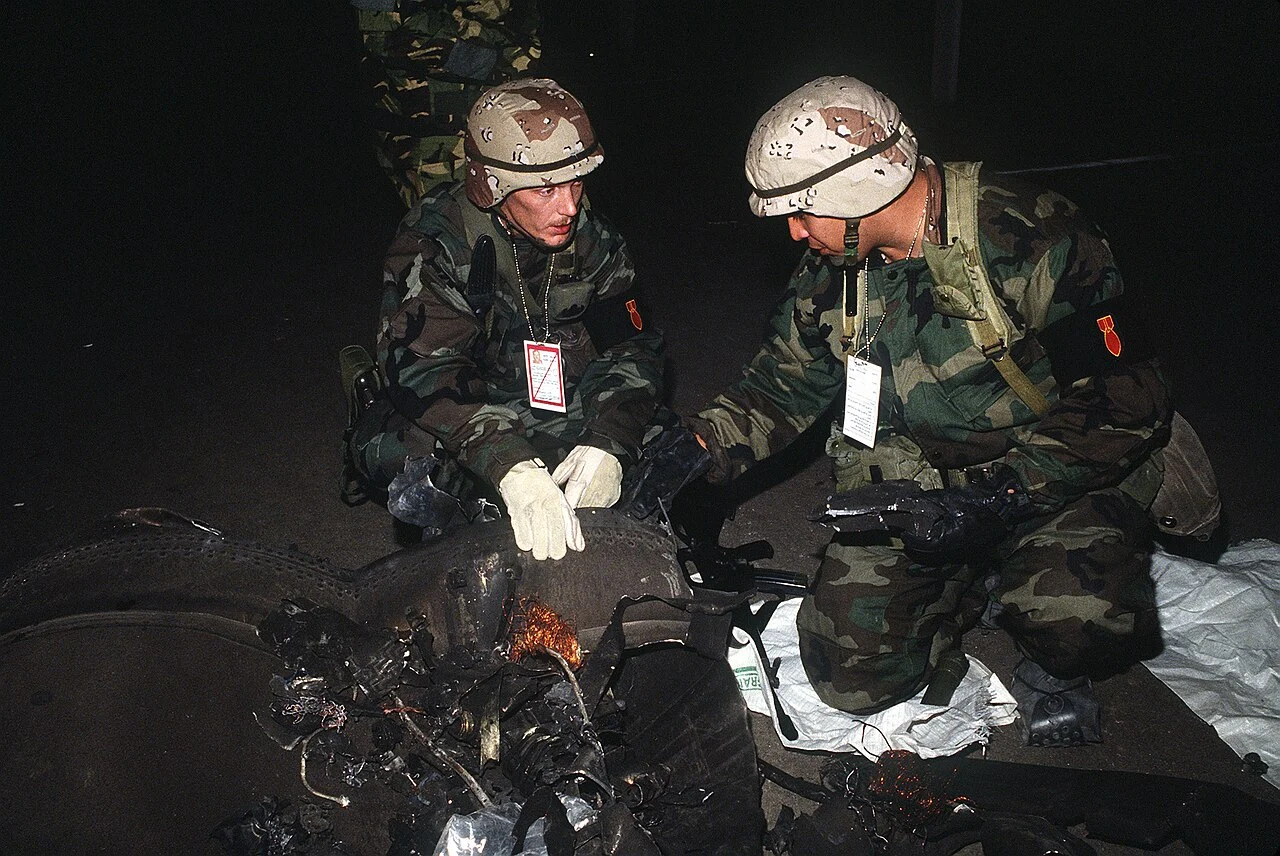
Photo: U.S. explosive ordnance disposal technicians inspect the remains of an Iraqi Scud missile shot down over Saudi Arabia by a Patriot interceptor during Operation Desert Storm, February 1991. Credit: U.S. Department of Defense, public domain, via Wikimedia Commons / Digital Public Library of America.
Saudi Arabia is a confirmed, long-standing Patriot operator, in service and operational since the system’s first combat intercepts over the kingdom in January 1991. Riyadh has since bought and received several generations of the interceptor — PAC-2, PAC-2 GEM and the hit-to-kill PAC-3 and PAC-3 MSE — through a long series of US government-to-government sales, the latest a January 2026 notification for 730 PAC-3 MSE missiles worth an estimated $9.0 billion. That request is still at the approved-for-possible-sale stage, not a signed contract, as of this writing. The system has intercepted Houthi ballistic missiles and drones fired from Yemen on a near-routine basis since 2015, including fresh claimed intercepts over the Mecca and Medina regions on 24 October 2026, though Saudi authorities did not name which air defence system made that specific interception.
| Country | Saudi Arabia |
| System | MIM-104 Patriot |
| Manufacturer | Raytheon (RTX) — system integration and legacy interceptors; Lockheed Martin — PAC-3 / PAC-3 MSE interceptors |
| Origin | United States |
| Variant | Mixed fleet: PAC-2, PAC-2 GEM and PAC-3/PAC-3 MSE hit-to-kill interceptors |
| Quantity | Not officially disclosed by Riyadh; DefenceMENA’s own Saudi Arabia profile lists 108 M902 launchers across six battalions (Estimated), superseding an older, widely cited trade-press estimate of around 4 battalions / 24 batteries |
| Order year | Deployed from 1990; major interceptor purchases notified in 2014, 2015 and 2026 (see timeline) |
| Delivery | Ongoing in batches since the 1990s; most recent $9.0bn, 730-missile request notified January 2026, undelivered |
| Service status | In service / operational since 1991; continuously replenished |
| Reported contract value | Not disclosed as a single figure. Three separate US notifications alone total over $16bn in authorised ceilings ($1.75bn in 2014, $5.4bn in 2015, $9.0bn in 2026); these are maximum FMS values, not confirmed final contract prices |
What is the Patriot system?
The MIM-104 Patriot is a mobile, ground-based air and missile defence system built around a phased-array radar, an engagement control station and truck-mounted launchers, each typically holding four older PAC-2-family interceptors or up to sixteen of the smaller PAC-3/PAC-3 MSE missiles. Raytheon (now part of RTX) has built and integrated the system since the 1980s; Lockheed Martin builds the PAC-3 family of hit-to-kill interceptors, which are designed to destroy an incoming ballistic missile’s warhead by direct impact rather than relying on a proximity-fused blast fragmentation warhead as the older PAC-2 does. A single Patriot battery combines a radar, launchers and crew and can engage aircraft, cruise missiles and short- to medium-range ballistic missiles, depending on which interceptor type it carries. Saudi Arabia’s force is a mixed fleet spanning several interceptor generations bought across more than three decades.
Why did Saudi Arabia acquire it?
Saudi Arabia’s first Patriot batteries arrived in August 1990 as part of the US-led build-up ahead of the Gulf War, deployed specifically against the threat of Iraqi Scud missiles. That immediate wartime need became a standing requirement once the war ended: Riyadh kept and expanded its Patriot holdings through the 1990s and 2000s as a hedge against Iran’s growing ballistic missile arsenal, then found a second, sustained justification after 2015, when the Saudi-led coalition’s intervention in Yemen made Saudi territory a near-constant target for Houthi ballistic missiles and, increasingly, drones and cruise missiles. Successive PAC-3 purchase requests in 2014 and 2015 were explicitly framed by the US State Department as modernising and replenishing a Patriot stockpile that was both ageing and, from 2015 onward, being expended in real engagements rather than held purely as a deterrent.
When did Saudi Arabia order it, and how has the fleet grown?
| Date | Event | Value | Status | Source |
|---|---|---|---|---|
| August 1990 | First Patriot batteries deployed to Saudi Arabia ahead of the Gulf War, against the Iraqi Scud threat | — | Delivered | GlobalSecurity.org |
| January 1991 | First combat intercepts over Saudi Arabia against Iraqi Scuds; initial claims of a 95% success rate were later revised to roughly 70% for the Saudi theatre | — | Combat use | GlobalSecurity.org |
| 1990s–2000s | Holdings expanded; trade press later cites a total of 4 battalions (about 24 batteries), a figure never officially confirmed | Not disclosed | Reported / unconfirmed | StrategyPage |
| 30 Sep 2014 (Transmittal 14-43) | US State Dept/DSCA notify Congress of a possible sale of 202 PAC-3 missiles with containers, 1 GEM flight-test target, telemetry kits, fire-solution computers and launcher modification kits, to upgrade PAC-2 systems with PAC-3 capability | $1.75bn | Approved for possible sale | DSCA / media.defense.gov |
| 2015 | Saudi-based Patriot batteries begin intercepting Houthi ballistic missiles and drones fired from Yemen on a recurring basis | — | Combat use begins | CSIS Missile Threat; Defense News |
| 28 Jul 2015 (Transmittal 15-43) | DSCA notifies a possible sale of 600 PAC-3 CRI missiles and 8 test missiles with support, stated purpose to modernise and replenish an ageing stockpile; a later Reuters report describes a signed follow-on deal covering 320 missiles, scope unclear | $5.4bn | Approved for possible sale / partially contracted | DSCA; Defense News; Reuters (via Military.com) |
| 4 Nov 2017 | Patriot batteries attempt to intercept a missile aimed at Riyadh; independent analysts (Jeffrey Lewis and colleagues) conclude several interceptors failed and the warhead landed close to Riyadh’s airport terminal; the coalition disputed the characterisation | — | Disputed intercept | Middlebury analysis via Defense One |
| Nov 2017 (Dubai Airshow) | Raytheon states Saudi-based Patriots have intercepted more than 100 tactical ballistic missiles since 2015 | — | Manufacturer claim | Defense News |
| 25–26 Mar 2018 | Houthi missile barrage on Riyadh; Saudi coalition claims all seven missiles intercepted; independent video analysis finds at least one interceptor failed after launch and crashed in Riyadh’s al-Malqa district, with debris killing one Egyptian resident | — | Disputed intercept | Defense News |
| 2020 | United States withdraws four of its own Patriot batteries from Saudi Arabia as part of a wider regional force drawdown | — | US asset withdrawn | The Defense Post |
| April 2021 | Greece agrees to lend Saudi Arabia a Patriot battery to help protect energy infrastructure | — | Ally loan | The Defense Post |
| December 2021 | Saudi Arabia reportedly requests “hundreds more” Patriot interceptor rounds from the US and allied stocks; a Wall Street Journal report cites a roughly 90% claimed success rate but heavy expenditure of missiles against cheap drone and missile threats | — | Replenishment request | Wall Street Journal via The War Zone |
| 30 Jan 2026 (Transmittal 26-13) | State Dept/DSCA approve a possible sale of 730 PAC-3 MSE missiles with launcher conversion kits, automated logistics system kits, telemetry kits and training rounds; major defence equipment valued at $7.0bn of the total | $9.0bn | Approved for possible sale (pending as of Oct 2026) | DSCA; Federal Register |
| Oct 2026 | Renewed wave of Houthi ballistic missile and drone attacks on Saudi airports, Aramco facilities and, per Saudi Civil Defence, projectiles intercepted in the Mecca and Medina regions on 24 Oct; the responsible air defence system was not officially named | — | Ongoing | DefenceMENA; Saudi Press Agency via Arab News |
Three separate Patriot interceptor packages notified to the US Congress since 2014 alone total $16.15 billion in authorised ceilings. None of that is a confirmed final contract price — DSCA notifications set a maximum value for congressional review, and actual negotiated contracts, where later reported, have sometimes covered smaller quantities (Reuters reported a follow-on 320-missile deal after the 2015 notification, for instance). The January 2026 request remained unfinalised as of this file’s publication.
How many Patriot batteries does Saudi Arabia operate?
Saudi Arabia has never officially published a battery or interceptor count, and this is the single most-searched fact about the programme. The most frequently cited older public estimate, from the trade publication StrategyPage, put total Saudi holdings at four battalions, equivalent to roughly 24 batteries, with each battery typically assigned a radar and four launchers; that estimate dates mostly from the mid-2010s. DefenceMENA’s own Saudi Arabia military-strength profile, drawing on open-source order-of-battle trackers, now lists a larger and more current figure: 108 M902 launchers organised into six battalions, explicitly flagged there as an estimate rather than an officially confirmed count. Independent defence reporting has repeatedly noted that Riyadh does not disclose the size of its Patriot force, a gap made more visible in 2020–21 when outside observers could track discrete, confirmed changes — the US withdrawal of four of its own batteries, and Greece’s loan of one Saudi-leased battery — without ever learning the total Saudi-owned inventory those changes were set against. Even the six-battalion, 108-launcher figure should be read as the best current open-source estimate, not a disclosed Saudi government number.
How much did it cost?
No single disclosed figure covers “the Saudi Patriot programme.” What is public are the ceiling values of individual US Foreign Military Sales notifications, each covering a different scope: $1.75 billion in 2014 for 202 PAC-3 missiles plus support equipment to upgrade PAC-2 batteries; $5.4 billion in 2015 for 600 PAC-3 CRI missiles and test rounds, explicitly to replenish an ageing stockpile; and $9.0 billion in January 2026 for 730 PAC-3 MSE missiles, of which $7.0 billion is major defence equipment and $2.0 billion covers launcher conversion kits, logistics systems, telemetry kits, training rounds and support services. These are DSCA-notified maximum values for congressional review, not confirmed contract prices, and none of them should be divided by missile count to produce a “unit price” — each package bundles interceptors with kits, training and support whose individual costs are not broken out. Separate reporting has cited a roughly $1 million unit cost for older Patriot interceptor rounds and a markedly higher cost for the PAC-3 MSE, but no DefenceMENA-verifiable, itemised unit price for the current Saudi order was found in open sources; where this file cannot confirm a figure, it says so rather than estimating one.
Which variant does Saudi Arabia operate?
Saudi Arabia’s Patriot force is a mixed-generation fleet rather than a single standardised variant. It retains PAC-2 and PAC-2 GEM (Guidance Enhanced Missile) interceptors from earlier purchases alongside Lockheed Martin’s hit-to-kill PAC-3 family, including the PAC-3 Cost Reduction Initiative (CRI) missiles ordered in 2015 and the more capable PAC-3 MSE (Missile Segment Enhancement) ordered most recently in 2026. The 2014 notification specifically funded launcher modification kits to let existing PAC-2 launchers fire PAC-3 interceptors, meaning individual Saudi batteries can field a mix of older and newer rounds on the same launch infrastructure rather than requiring a wholesale fleet replacement.
Technical characteristics
| Parameter | Value | Source |
|---|---|---|
| Interceptor types in Saudi service | PAC-2, PAC-2 GEM, PAC-3 CRI, PAC-3 MSE | DSCA notifications; trade press |
| Kill mechanism | PAC-2: proximity-fused blast-fragmentation warhead. PAC-3/MSE: hit-to-kill, direct body impact on the target | Manufacturer/industry reporting |
| Missiles per launcher | 4 for PAC-2-family rounds; up to 16 for the smaller PAC-3/MSE rounds (same launcher footprint) | Industry reporting |
| Battery composition | Radar, engagement control station, launchers (reported as 4 per battery in Saudi-focused trade coverage), generators and crew of roughly 100 | StrategyPage |
| Radar | Phased-array engagement radar (AN/MPQ-53/65 family, depending on upgrade state) | Standard Patriot system architecture |
| Target set | Aircraft, cruise missiles, and short- to medium-range ballistic missiles in the terminal phase | Manufacturer/industry reporting |
| Role in layered defence | Lower/mid-tier terminal interceptor, beneath the exo/endo-atmospheric THAAD system Saudi Arabia has separately contracted | DefenceMENA THAAD explainer |
How long in service, and how has it performed?
Saudi Arabia has operated Patriot for roughly 35 years, longer than almost any other export customer, and it is also one of the few Patriot operators with a sustained record of real combat engagements rather than deterrence alone. The evidence on performance is mixed and comes from several distinct categories that should not be collapsed into one another. Manufacturer claims: Raytheon told the 2017 Dubai Airshow that Saudi-based Patriot batteries had intercepted more than 100 tactical ballistic missiles since 2015. Official coalition statements: Saudi and coalition authorities have repeatedly announced successful interceptions of specific Houthi salvos, for example claiming all seven missiles destroyed in a 25–26 March 2018 barrage on Riyadh; these official claims are generally not independently verifiable. Independent tracking: the CSIS Missile Defense Project recorded 177 publicly reported intercepts of Yemen-launched missiles through September 2020, while cautioning that the true number of intercepts or unintercepted strikes may be higher given the limited reliability of wartime reporting. Independent failure analysis: researchers led by Jeffrey Lewis at the Middlebury Institute concluded that interceptors fired at a November 2017 missile over Riyadh failed, with the warhead detonating close to the city’s airport terminal; Defense News later reported that video of the March 2018 engagement showed at least one interceptor malfunctioning after launch and crashing into a Riyadh neighbourhood, with falling debris killing one Egyptian resident. Unverified claims: Houthi statements about missile and drone strikes reaching specific Saudi targets are frequently disputed by Riyadh and should be treated as one side’s claim rather than confirmed fact, as in the most recent 24 October 2026 case, where Saudi Civil Defence reported two intercepted missiles toward Mecca and Medina while the Houthis denied targeting the holy cities. No systematic, source-agreed intercept success rate exists for the programme as a whole; what is documented is a long run of both claimed successes and specific, independently examined failures.
Is it suited to Saudi Arabia’s operating environment?
Saudi Arabia’s climate is demanding for any ground-based electronic system: summer temperatures on the peninsula can approach 50°C, and declassified US military assessments from the Gulf War era record that heat caused significant overheating problems for signal and radio equipment, while windborne dust with uniformly fine grain sizes was identified as a core reliability challenge for Gulf-deployed hardware generally. No manufacturer-published environmental test data specific to Patriot’s performance in Saudi desert conditions was found in open sources for this file, and no independent study quantifying heat- or dust-related reliability effects on Saudi Patriot batteries was identified either. What is documented is sustained in-country sustainment: Raytheon has maintained an ongoing presence of Patriot maintenance personnel inside the kingdom, consistent with the kind of continuous field support that high-maintenance phased-array radar systems typically require in harsh environments, though this says nothing by itself about how well the system copes with heat and sand. In the absence of a published qualification record, the honest position is that Patriot has operated in Saudi Arabia for three decades without a disclosed environment-driven failure pattern, while the sustained Raytheon and Lockheed Martin field-support presence suggests the environment adds a real, ongoing maintenance burden rather than posing no challenge at all.
Strengths
- Longest combat record of any export Patriot operator: three decades of near-continuous deployment, including sustained use against real ballistic missile and drone threats since 2015, distinguishes the Saudi force from most other Patriot customers, who have never used the system in anger.
- Hit-to-kill capability: the PAC-3 and PAC-3 MSE interceptors in Saudi service are designed to destroy an incoming warhead by direct impact, a more precise kill mechanism than the older PAC-2’s blast-fragmentation approach.
- Mixed-fleet flexibility: launcher modification kits bought in 2014 let Saudi batteries fire both older and newer interceptor types from the same launch infrastructure, avoiding a wholesale fleet replacement.
- Established in-country sustainment: continuous Raytheon and Lockheed Martin field support inside the kingdom reduces, though does not eliminate, the logistics burden of operating a complex US-sourced system far from its manufacturing base.
Limitations
- Cost-asymmetry against cheap threats: Patriot interceptors reportedly costing roughly $1 million or more apiece have repeatedly been fired at Houthi drones and missiles that can cost only a fraction of that to build, a mismatch cited by US analysts as structurally unsustainable over a long war.
- Repeated stockpile depletion: Saudi Arabia has needed successive US replenishment sales (2014, 2015, 2026) and at least one allied loan (Greece, 2021) to sustain its interceptor inventory through the Yemen war, evidence of a system whose magazine depth has struggled to keep pace with the threat volume.
- Documented intercept failures: independent analysis has identified specific, named incidents (November 2017, March 2018) where Patriot interceptors did not destroy their targets as claimed, meaning official Saudi and coalition success claims cannot be taken at face value without independent verification.
- Undisclosed order of battle: because Riyadh does not publish battery or interceptor numbers, independent assessment of the force’s actual coverage and depth is limited to estimates from secondary trade sources, several of them now a decade old.
- Dependent on US approval for replenishment: every major interceptor purchase requires a Foreign Military Sales notification and US congressional review, a process that adds political and time friction to restocking during an active air defence campaign.
What do neighbouring and regional countries operate?
| Country | System | Variant | Status | Approx. quantity | Supplier | Order year | Delivery status |
|---|---|---|---|---|---|---|---|
| Saudi Arabia | Patriot | PAC-2 / PAC-2 GEM / PAC-3 / PAC-3 MSE (mixed) | In service | Not disclosed (~24 batteries, dated estimate) | United States | 1990 onward; latest 2026 | Continuously replenished; 2026 order undelivered |
| Saudi Arabia | THAAD | — | Under contract (1 of 7 batteries operational) | 7 batteries contracted, 1 active | United States | 2017 | First activated July 2025; rest scheduled through 2028 |
| United Arab Emirates | Patriot | PAC-3 | In service | 10 fire units; 172 missiles (2009 package) | United States | 2009 | Delivered |
| United Arab Emirates | THAAD | — | In service | 2 batteries | United States | 2011 | Delivered 2015–16; used in combat against Houthi missiles |
| Qatar | Patriot | PAC-3 | In service | Not fully disclosed | United States | 2014 | Delivered ($2.4bn FMS package) |
| Kuwait | Patriot | PAC-3 | In service | Not disclosed | United States | Multiple batches | Delivered |
| Bahrain | Patriot | PAC-3 MSE | In service | 60 PAC-3 MSE, 36 GEM-T missiles; 9 M903 launchers; 2 AN/MPQ-65 radars | United States | 2019 | Delivered |
Every Gulf Cooperation Council state with a long-range air defence requirement has converged on the same US supplier and the same basic system, making Patriot the GCC’s common lower/mid-tier interceptor. Saudi Arabia and the UAE are the only two regional states to have added the higher-altitude THAAD system on top of Patriot, a layered approach DefenceMENA covers in its separate THAAD explainer, which also sets out the UAE’s own confirmed combat use of THAAD against Houthi missiles. The near-universal Gulf reliance on a single supplier for this capability also means any US political or supply-chain constraint affects the whole region’s layered air defence posture at once.
What are the closest global alternatives?
In the same broad class — mobile, medium-to-long-range, radar-guided interceptors capable of engaging ballistic missiles as well as aircraft — the main alternatives to Patriot are Russia’s S-300/S-400 family and the French-Italian SAMP/T. Algeria is the region’s main S-300/S-400 operator; no GCC state has adopted a Russian long-range air defence system, and US sanctions exposure under CAATSA has been cited by analysts as a practical barrier to any Gulf state doing so while remaining a close US security partner. SAMP/T has not been purchased by a Gulf state either, though France has offered it regionally in other contexts. Within the US product line itself, THAAD is not a direct substitute for Patriot but a complementary, higher-altitude layer that Saudi Arabia and the UAE have both added rather than used as a replacement.
Is there a Turkish alternative?
Partially. Türkiye’s SİPER is a genuinely comparable system in concept — a mobile, radar-guided, long-range air defence interceptor intended to sit at the top of Türkiye’s own layered “Steel Dome” architecture. SİPER entered Turkish service in 2025 and was formally integrated into that architecture in January 2026, with an initial Block-1 range reported at roughly 100 km and later blocks intended to reach further. However, no confirmed export sale of SİPER to any Gulf or wider Middle Eastern state has been identified in open sources, and Türkiye itself has separately been reported exploring Patriot or SAMP/T purchases to round out its own air defence needs — a sign that SİPER, while real and fielded domestically, has not yet accumulated the decades of combat use, export contracts or integration track record that would make it a proven substitute for Saudi Arabia’s Patriot force today. It is a system to watch rather than a currently available alternative.
What could replace or complement it?
Saudi Arabia’s own answer to the “what comes next” question has been to add capability rather than replace Patriot: the kingdom contracted for seven THAAD batteries in 2017 specifically to provide a higher-altitude layer above Patriot’s terminal-defence role, activating its first THAAD battery in July 2025 with the rest scheduled through 2028. The January 2026 PAC-3 MSE request, if finalised, extends Patriot’s own service life further rather than signalling a move away from it. On present evidence, Patriot is likely to remain the kingdom’s primary lower-tier interceptor for years to come, operating alongside an expanding THAAD layer rather than being displaced by it.
Frequently asked questions
Does Saudi Arabia operate the Patriot missile system?
Yes. Saudi Arabia has operated Patriot since 1991 and has used it repeatedly in combat against Houthi ballistic missiles and drones since 2015.
How many Patriot batteries does Saudi Arabia have?
Riyadh has never officially disclosed the figure. Older trade-press estimates cite around four battalions (roughly 24 batteries); DefenceMENA’s own Saudi Arabia profile now estimates 108 M902 launchers across six battalions, though this too is an open-source estimate, not an official count.
How much has Saudi Arabia spent on Patriot missiles?
No single total is public. Three US sales notifications since 2014 alone carry a combined ceiling of $16.15 billion ($1.75bn in 2014, $5.4bn in 2015, $9.0bn in 2026), though these are maximum authorised values, not confirmed contract prices.
Did Saudi Arabia’s Patriot system intercept the missiles fired at Mecca and Medina in October 2026?
Saudi authorities confirmed intercepting two missiles toward those regions on 24 October 2026 but did not name the air defence system responsible; Patriot is the system most frequently credited with Saudi intercepts historically, but this specific event is not officially attributed to it.
Has Saudi Arabia’s Patriot system ever failed to intercept a missile?
Yes, according to independent analysis. Researchers found evidence of failed intercepts in November 2017 and March 2018, including one case where interceptor debris killed a civilian in Riyadh.
Is Saudi Arabia replacing Patriot with THAAD?
No. Saudi Arabia is adding THAAD as a higher-altitude layer above Patriot, not replacing it; the kingdom activated its first THAAD battery in 2025 while also seeking more Patriot interceptors in 2026.
A note on the numbers
Saudi Arabia does not publish official data on its Patriot force size, contract values or verified intercept outcomes. Every figure in this file comes from US government sales notifications (which set maximum authorised ceilings, not confirmed prices), manufacturer statements, independent research institutions and defence trade press, several of which are a decade or more old and have not been publicly updated. Where sources disagree or no verifiable figure exists, this file says so rather than estimating one, including on the still-unanswered question of exactly how many Patriot batteries the kingdom fields today.
Sources
- DSCA — Kingdom of Saudi Arabia: PAC-3 MSE Missiles, Transmittal 26-13 (30 January 2026)
- DSCA — Kingdom of Saudi Arabia: Patriot PAC-3 Enhancement, Transmittal 14-43 (2014)
- Defense News — U.S. State Dept. OKs PAC-3 Sale to Saudi (29 July 2015)
- GlobalSecurity.org — Patriot PAC-2, Gulf War combat record
- Defense News — Raytheon: Saudi-Based Patriots Intercepted Over 100 TBMs Since 2015
- Defense One — Did the Saudis Shoot Down a Houthi Missile on Nov. 4?
- Defense News — Videos Raise Questions Over Saudi Missile Intercept Claims (March 2018)
- CSIS Missile Defense Project — The Missile War in Yemen
- The War Zone (via Wall Street Journal reporting) — Saudi Arabia Running Low on Patriot Missiles (2021)
- The Defense Post — Greece Lends Saudi Arabia a Patriot Battery (2021)
- StrategyPage — Air Defense: Arabs and Patriots
- DefenceMENA — Saudi Arabia Says It Intercepted Two Houthi Missiles Fired Towards Mecca and Medina (24 October 2026)
- DefenceMENA — THAAD: Who Operates It in the Middle East, and How Does It Work?
- DefenceMENA — How Strong Is Saudi Arabia’s Military?